CDP
Connect fragmented customer data for analysis, segmentation, and action
Integrate data from the web, apps, LINE, CRM, and transactions, allowing marketing and operations teams to perform analysis, segmentation, and marketing workflows using natural language—no more toggling between multiple systems to reconcile data.



ISO/IEC 27001:2022
Private cloud deployment
In the era of data governance, first-party data is the core of competitiveness.
Businesses often have plenty of data, but it remains scattered and slow to analyze, ultimately requiring manual effort to move results into the next system.

Fragmented customer data
With data siloed across websites, apps, LINE, CRM, and transaction records, it is difficult to gain a complete view of the customer journey.

Analysis requires waiting
Every time dimensions or criteria change, data must be re-extracted, preventing marketing and operations teams from getting real-time answers to business questions.

Insights are not connected to action
After analysis, manual list preparation, message setup, and result tracking are still required, often causing workflow disruptions during handoffs.
Use the same set of customer data from initial integration through to customer communication

Integrate cross-device and cross-channel behavior into a single customer asset
Use a global user identification mechanism to unify online behavior, internal systems, and external data into a single customer view.

Ask questions in natural language and see analysis results instantly in your workspace
Marketing and operations teams can ask questions about funnels, paths, segments, and performance, and the system will organize the criteria, charts, and results.


Connect customer segments and insights to marketing automation workflows
Launch customer journeys based on real-time behavior or schedules. Communicate via SMS, email, app push, LINE, on-site pop-ups, banners, and product recommendations, or use Webhooks to connect to custom channels.
See how a CDP solves real-world problems
Tasks that previously required writing SQL or waiting for data requests can now be handled using natural language. AI organizes the criteria, charts, and results, allowing segments to be integrated directly into marketing workflows.
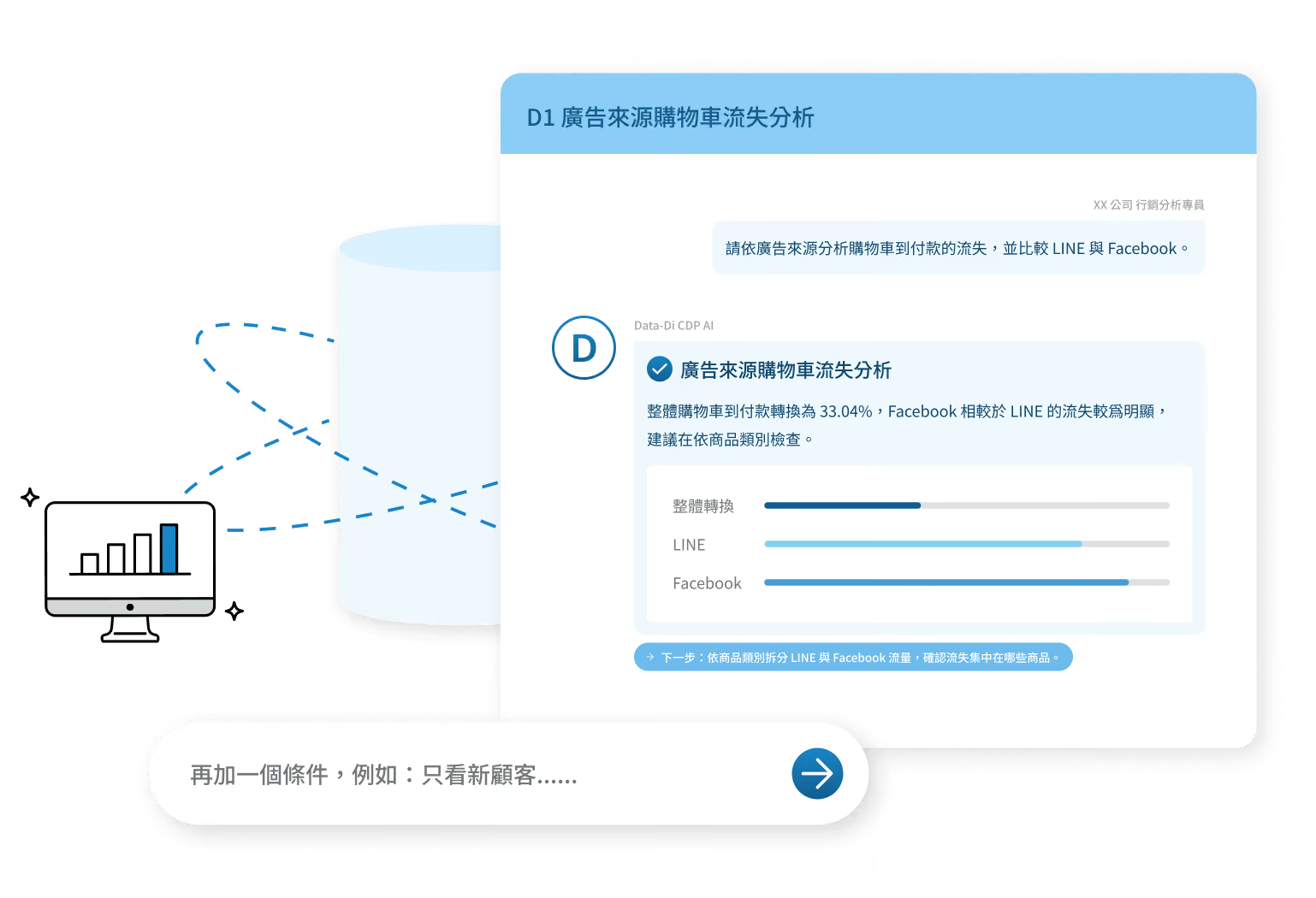
Ad-to-Cart Drop-off Analysis
Identify Ad-Driven Churn
Compare sources like LINE and Facebook to identify differences between cart abandonment and payment completion.
Analyze Sources with AI
AI organizes ad sources, shopping cart activity, and payment events to highlight overall discrepancies and suggest follow-up actions.
Registration Conversion Optimization
Identify Registration Drop-offs
Clarify where users are most likely to drop off between starting and completing registration.
Analyze funnels and paths together
AI organizes registration steps, median completion time, and verification stages that require priority checks.
Inactive Customer Segmentation
Identify Inactive Shoppers
Customers who have purchased before but haven't returned recently; need to build a re-engagement audience.
One-Prompt Segmentation
AI confirms event definitions and converts conditions into ready-to-use audience segments.
Failed Purchase Recovery
CRM operations team wants to recover failed purchases
Distinguish between abandoned carts and unpaid orders to set up different reminder workflows.
Segment and workflow creation in one go
AI separates the two failure states and establishes corresponding SMS reminder workflows.
Campaign SMS Performance Analysis
Marketing team wants to compare SMS performance
First, verify whether delivery, click, and conversion data are sufficient to support content comparison.
Prevent misinterpretation when data is insufficient
AI identifies missing return and attribution fields and avoids forcing a winning version.
From new customer acquisition to customer management: Real-world application scenarios for Data-DI CDP
The following are scenarios where Data-DI assisted enterprises in implementing CDP and MA; client names have been replaced with industry aliases.


Gain clear visibility into the customer value driven by each advertising channel


Track the journey from LINE push notifications to order payment


Identify where users drop off during the test drive booking process


Create customer tags from purchase and behavioral data

Send reminders at the optimal time for customer repurchase

Re-engage dormant customers through segmentation and testing

Connect data requirements to operating workflows
Businesses usually aren't lacking data; it's that their data is siloed, analysis takes too long, and they end up manually moving results into the next system.
Shared customer data between CDP and MA
No more moving lists between multiple systems for analysis, segmentation, and customer communication.
Natural language and visual operations combined
Ask questions in natural language for daily tasks, while using rules or SQL for complex conditions.
Data consultants help clarify requirements and metrics
From data auditing and metric definition to usage, we help businesses clarify the purpose behind every report.

Before and after adopting a CDP
With Data-DI CDP
Without CDP
Use case: identify registration and booking drop-off points
A mobility service used CDP and marketing automation to identify users who did not complete verification and to add follow-up messages to the registration journey. The team also tested engagement workflows for users who left the booking process after selecting a vehicle.

Implementation from requirements review to operational handover
The implementation process covers requirements and metrics, data review and integration, platform configuration and validation, training, and ongoing support.
Requirements and Metrics Interview
Identify business problems, user roles, data scope, and the results to be tracked.

Data audit and integration
Organizing data sources, identification rules, field quality, and system integration methods.

Platform configuration and validation
Setting up tags, segments, reports, and journeys to ensure alignment between data and business definitions.

Training and ongoing support
Providing training and documentation based on product features, marketing scenarios, and system operations.

Pricing
Growth Plan
CDP + MA
Enterprise Plan
FAQ
Questions regarding CDP products, implementation, security, and partnerships.
Faced with fragmented data, how does the CDP collect and integrate it into unified customer profiles?

It uses a global user identification mechanism for end-to-end attribution. The system aggregates online behavior (Web, App, LINE interactions), internal data (CRM, data warehouses, eCIF, transaction details), and external data (surveys, ads), consolidating fragmented behavior across devices and channels into a single customer asset.
What analysis features are built into the CDP? Is it easy for non-technical marketers to use?
Yes, it is easy. The system provides a No-Code analysis interface where you can perform multi-dimensional analysis by clicking and dragging. It includes 12 built-in analysis models covering events, funnels, retention, distribution, LTV, paths, and attribution. It also supports custom SQL queries and provides smart alerts for abnormal metrics, automatically notifying you to identify anomalous dimensions and user segments.
How can we provide precise early warnings and re-engagement for "high-value customer churn"?
We use a 3x3 matrix based on FM (Frequency and Monetary value) to segment customers. First, we clarify the current churn status and transaction share of each group, then filter out potential dormant high-value clients who have exceeded their average transaction cycle to generate an outreach list. Finally, we communicate by segment: high-frequency core clients are handled by dedicated account managers or customer service, while low-to-medium frequency clients are re-engaged via digital ads and automated marketing.
Does the CDP support on-premises deployment?
Yes. The system can be deployed on-premises to ensure data residency and security for financial institutions. Deployment includes a reverse proxy and load-balancing forwarding server, as well as an internal network firewall. We recommend a cluster architecture for both production and testing environments of the MA system to ensure stability, with hardware specifications adjustable based on actual needs.
Compared to other CDP brands, what sets Data-DI apart in terms of after-sales service and consulting?
The core difference is our end-to-end partnership in data strategy, rather than just delivering a tool. Companies often find that after implementing competitor products, interviews become a formality and system usage remains low. Data-DI conducts in-depth interviews of over 2 hours with each department and holds 3 to 5 discussions to refine metrics, ensuring that reports deliver real business value. After launch, we provide targeted training on product features, marketing scenarios, and system maintenance, delivered personally by our engineers and data consultants, accompanied by comprehensive documentation.