


From pilot to production: a complete guide to multi-agent adoption in the enterprise (2026 update)
Multi-Agent AI (multi-agent systems, MAS) is an architecture in which several AI agents with different specialties divide the work and cooperate to complete a complex workflow. It moves AI from "one general-purpose model doing everything" to "a digital team with clear roles," and suits companies with long, cross-department processes that need to run at scale. In 2026 it is the architectural shift drawing the most attention as companies move automation from experiments to production lines.
In one sentence: from "one super employee" to "a team of specialists."
"Monolithic AI," which relies on a single general-purpose model to carry every task, has hit a wall in long, multi-step scenarios: the more steps there are, the more errors accumulate and grow along the way. That is why both Forrester and Gartner treat 2026 as the breakthrough year for Multi-Agent in practice [1]. The evidence from practice is concrete too. Databricks' 2026 State of AI Agents report (covering more than 20,000 organizations worldwide, over 60% of them Fortune 500 companies) shows that usage of multi-agent workflows on its platform grew 327% in less than 4 months [4].
But the same report also points to a harsher reality: only 19% of organizations have actually deployed agents at scale in production [4]. This production gap, where experiments get built but cannot be pushed live, is the core issue this article takes apart.
This article first lays out the definition, architecture, and collaboration patterns of Multi-Agent in one place. It then uses three practical scenarios in manufacturing, finance, and marketing to show how this "AI digital team" actually works inside a company, and what to think through before adoption.
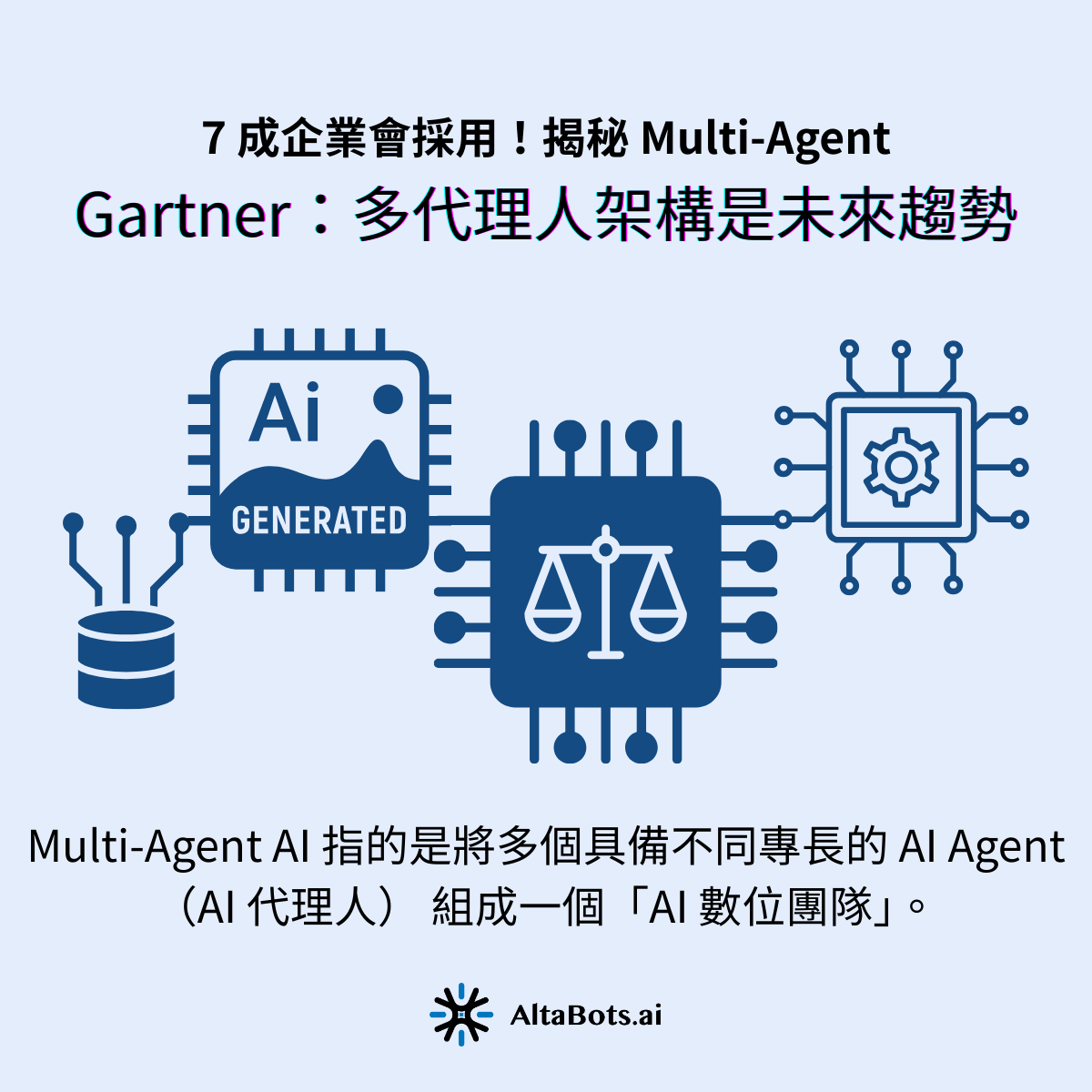
What is multi-agent AI? How does it differ from monolithic AI?
Multi-Agent AI is an architecture that breaks a complex workflow into modular steps and hands them to AI agents with different specialties (writing, review, data analysis, and so on) to complete together. Like human colleagues, they divide the work and check each other, making real cross-department process automation possible.
The key point first: for long processes that a single model struggles with, hand them to a team of agents with divided roles.
Gartner points out that traditional monolithic AI relies on a single general-purpose model and struggles with complex workflows, while MAS breaks the process into manageable steps with the most suitable agent responsible for each one, which speeds up automation and reduces the error accumulation common in monolithic AI [1]. More importantly, a validated agent can be reused across different workflows [1]. This means the return on MAS investment grows as deployment scales, rather than every new project starting from zero.
How fast is this trend moving? Gartner predicts that by the end of 2026, 40% of enterprise applications will integrate task-specific AI agents, up from less than 5% in 2025 [2]. By 2027, one third of those implementations will combine agents with different specialties to handle complex tasks [2]. Single-function agent models are quickly being replaced by "collaborative digital teams."
One new observation in 2026 deserves companies' attention, though: the market has started to distinguish "real agents" from "agent-washing" (repackaging a chatbot or RPA as an agent). This is not baseless. Gartner also predicts that by the end of 2027, more than 40% of agentic AI projects will be canceled, mainly because of runaway costs, unclear business value, or inadequate risk controls [3]. In other words, the first question when choosing a MAS platform should not be "what can it do" but "is this a real agent or a repackaged old system, and can it be managed?"
What does a multi-agent architecture look like? Supervisor and specialized roles
At the core of a typical Multi-Agent architecture is a "Supervisor Agent" that breaks a high-level goal into subtasks, assigns them to sub-agents that each specialize in something (for example data lookup or compliance checks), and finally compiles the results. It is almost a copy of a human management hierarchy, built as a digital team.
The key point first: one supervisor agent assigns tasks, and a group of specialist agents each do their own job.
This is not theory. Databricks' measured data shows that among the types of agents companies use, the Supervisor Agent is the most common pattern, accounting for about 37% of usage [4]: a central supervisor breaks down the goal, delegates to dedicated sub-agents (for example one that runs SQL queries or one that handles regulatory compliance), and then integrates the results. This also matches Gartner's prediction that by 2027, 70% of MAS will use highly specialized agents with finer divisions of labor [1]. Specialization improves accuracy, at the cost of higher coordination complexity, which is why governance and observability become important (discussed later).
Key differences: multi-agent vs. agent-to-agent
Many people mix these three concepts together when evaluating. All three involve "how AI handles tasks," but their operating logic is completely different:
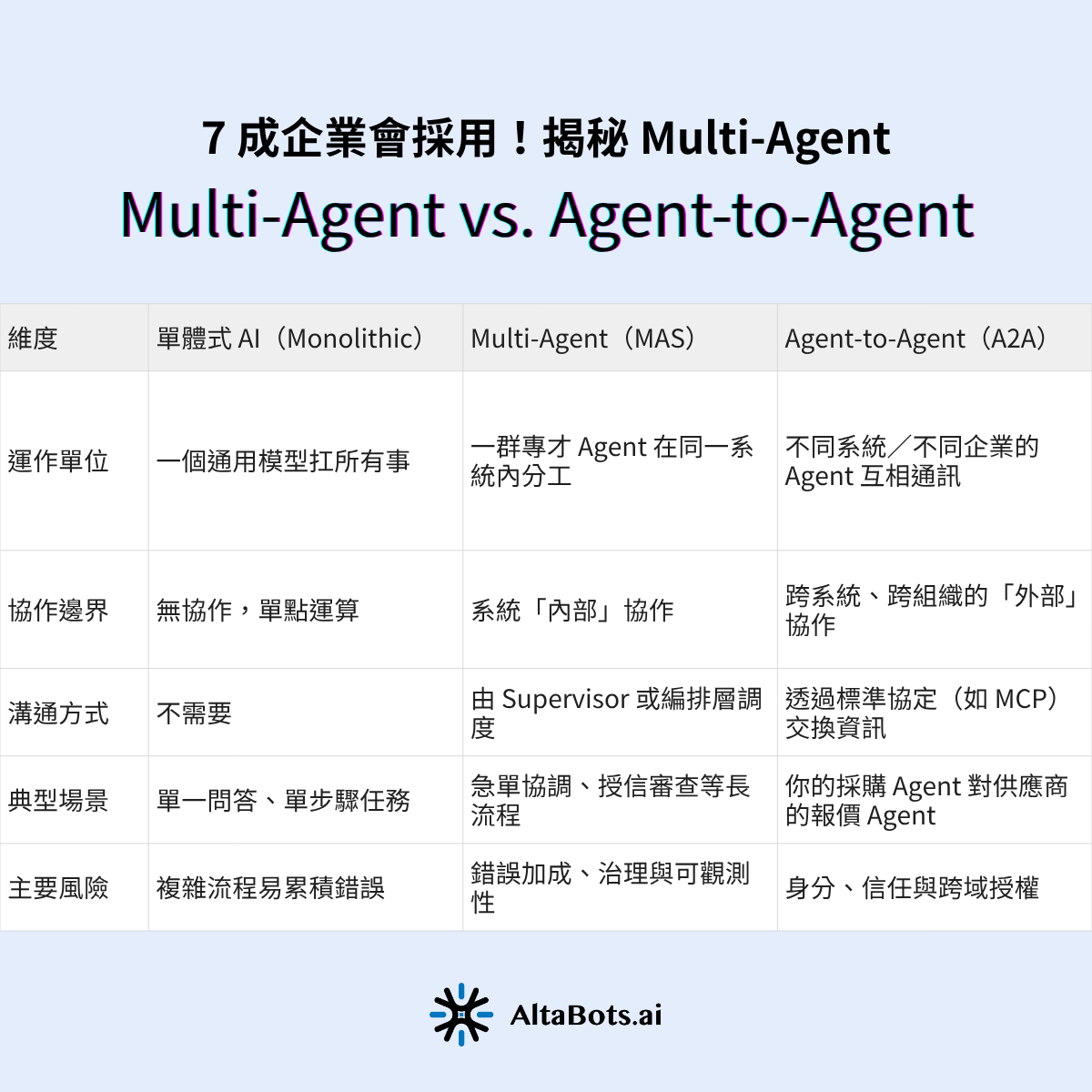
A one-line way to remember it: Multi-Agent is "division of labor within one company's team," and Agent-to-Agent is "business dealings between two companies." Together they make up the full ecosystem of enterprise AI applications in 2026, but the problems they address sit at different layers.
What problems can multi-agent solve in the enterprise? Three practical scenarios
After understanding the Multi-Agent architecture, you may be at a decision point: build it yourself by connecting each model and tool and writing your own orchestration logic, or use an enterprise platform that is already integrated and has consultants to help design the process? For an engineering team, building it yourself is a good way to learn. For an IT lead or digital transformation owner, the time cost is real. If you are evaluating whether enterprise adoption is feasible, our 30-Day POC Guide can help you validate a scenario at minimal cost first, and then decide whether to scale up. The three scenarios below are the ones in highest demand in our actual work with the Taiwan market.
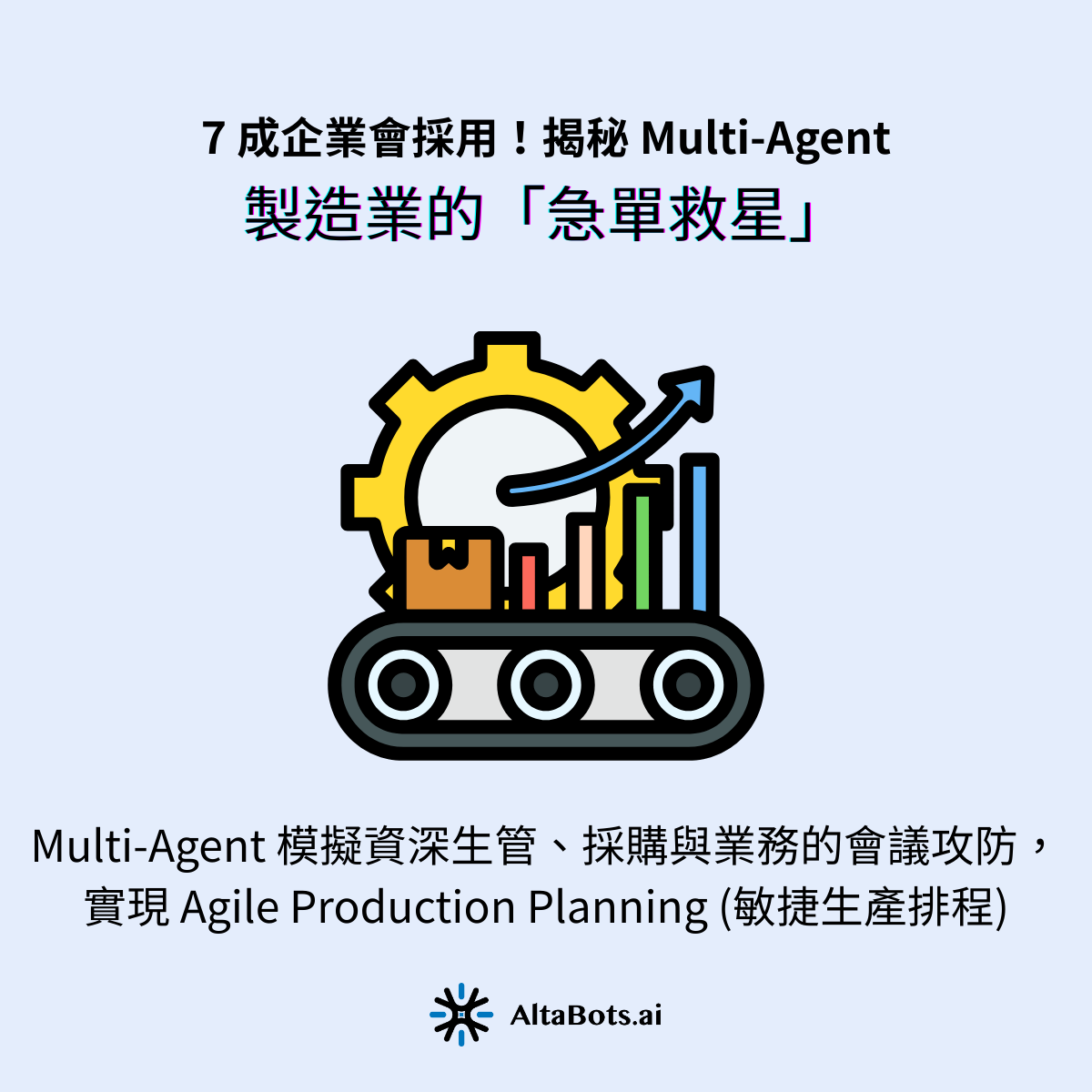
Case 1: the "rush order lifesaver" in manufacturing: a sales-and-production coordination brain
Scenario: The most painful crises in Taiwan's make-to-order manufacturing industry are "rush orders" and "material shortages." Planners spend a lot of time every day adjusting schedules in Excel, and because they often cannot work out overtime and line-changeover costs, they end up "accepting a rush order and losing money."
AltaBots.ai's solution is to use Multi-Agent to simulate the meeting between experienced production planners, purchasing, and sales, achieving Agile Production Planning:
- Sales Agent: Receives the customer's urgent request: "We need 5,000 units in 3 days. Can we take it?"
- Production Planning Agent (Planner): Calculates production line load in real time, finds low-priority orders that can be moved, and suggests schedule changes
- Materials Agent: Checks the BOM and ERP inventory at the same time, and warns immediately if there is a material shortage risk
- Cost Estimation Agent: Calculates the hidden costs of the inserted order (overtime pay, changeover losses, price differences on emergency material purchases) and reports back to sales: "Costs will rise by about 12%, so we suggest raising the quote to $X"
- Decision Support Agent: Combines the information above and produces an "order-acceptance profitability analysis" for decision makers to decide
What trouble it saves: It cuts scheduling time for production planning from hours to minutes. More importantly, it makes every rush order one that has been "checked for whether it loses money" before it is accepted. According to the records from one manufacturing client project of ours, after adoption there were clear improvements in rush-order decision quality and profit protection. The key is not how strong the algorithm is, but turning the old problem of "sales impulsively accepts orders, production planning cleans up afterward" into a collaboration where the numbers are worked out before anyone commits.
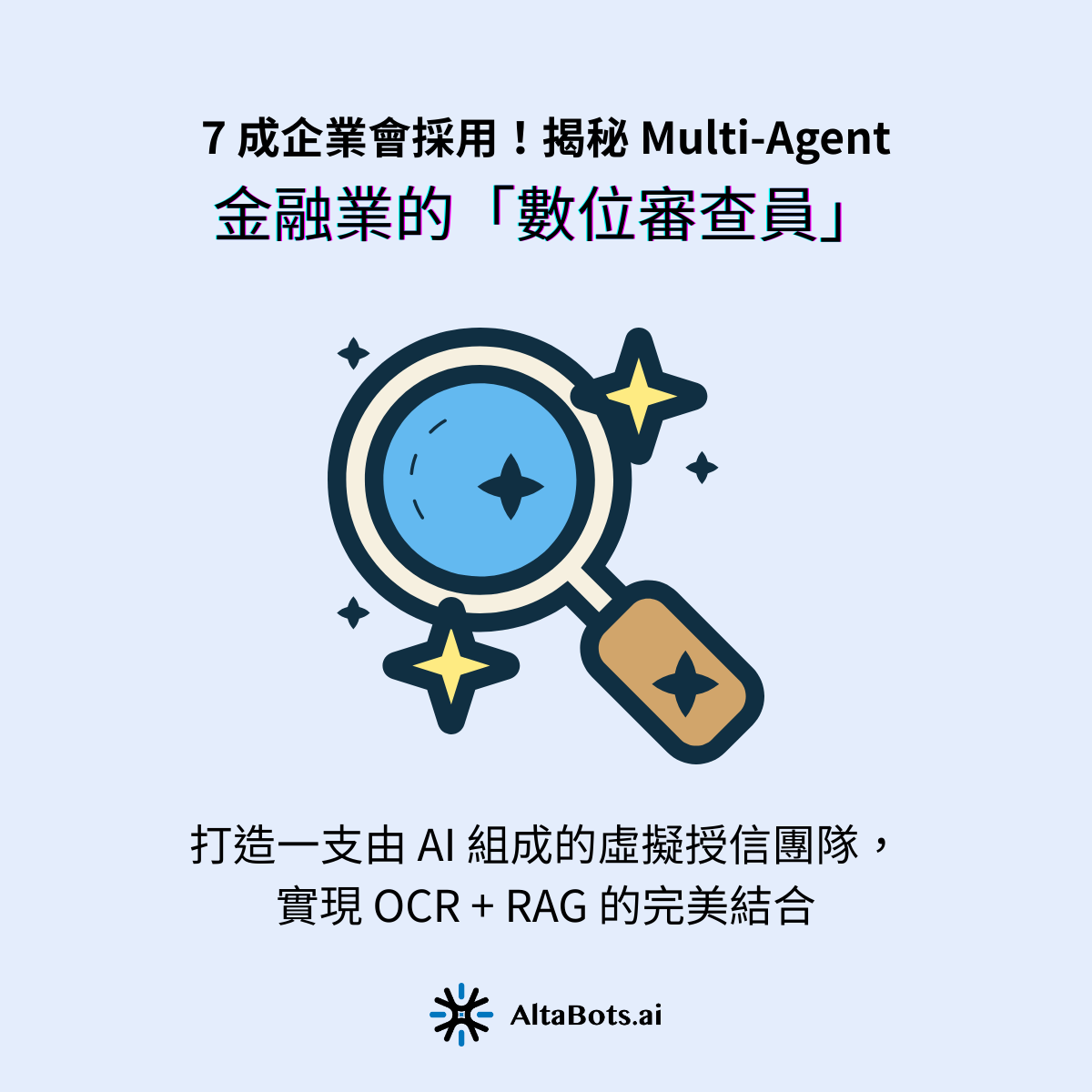
Case 2: the "digital reviewer" in finance: intelligent corporate credit review
Scenario: When banks review corporate loans, they must read large volumes of documents (financial statements, Form 401 reports) and negative news, and strictly follow Financial Supervisory Commission regulations and ESG policies. Manual review is time-consuming, applies inconsistent standards, and runs into a shortage of experienced reviewers.
AltaBots.ai's solution is to build a virtual credit team made of AI, combining OCR and RAG:
- Credit Investigation Agent: Connects automatically through APIs to look up business registration and litigation records, and uses OCR (optical character recognition) to read figures from scanned financial statements accurately
- Risk Model Agent: Feeds the extracted data into the internal risk model to calculate probability of default (PD) and credit scores
- Compliance Review Agent (Compliance Officer): Uses RAG (retrieval-augmented generation) to retrieve the latest Financial Supervisory Commission regulations and internal credit rules, and does a Peer Review to make sure the case meets regulatory and ESG standards
- Report Generation Agent: Compiles all the information and automatically produces a draft "approve/decline recommendation" for a human manager to sign off
- Security mechanism: PII de-identification runs automatically throughout, meeting high financial information security standards
What trouble it saves: In one financial-sector client project we advised, the case review cycle was cut by about half, and experienced staff were freed from repetitive document checking. This architecture also matches Gartner's MAS governance principle of embedding compliance checks into every layer of agents rather than patching them in afterward [1]. This is exactly what buyers of "enterprise certification and review automation" care about most: not just fast, but fast and under control.
Case 3: the automated marketing content factory
Scenario: Big e-commerce campaigns (such as Double 11) need large volumes of creative assets, manual design and review take a long time, and newcomers often break the rules (for example by using prohibited advertising terms), and one slip becomes brand risk.
AltaBots.ai's solution is to build an automated pipeline using the "Role Definition & Peer Review" pattern:
- Marketing Planning Agent (Planner): Receives the campaign theme and plans the post strategy
- Copywriting Agent (Writer): Writes social copy in several styles (humorous, urgent)
- Visual Design Agent (Designer): Calls an image-generation plugin to produce matching images in the right sizes
- Compliance Review Agent (Reviewer): Automatically checks for prohibited terms such as exaggerated treatment claims, and sends anything that fails straight back to the Writer or Designer for revision
What trouble it saves: It runs the two steps most prone to bottlenecks, "production" and "review," in parallel, doubling creative output during big campaigns, and uses AI pre-review to stop compliance risks before anything goes live. This is also the core value of MAS that Gartner describes: one validated compliance review agent can be reused across different campaigns and product lines, with no need to reconfigure it for every new campaign [1].
4 things companies should think through before adopting multi-agent
Whether Multi-Agent adoption succeeds depends not on technology selection but on four management areas: process inventory, modular design, governance and observability, and human-AI collaboration. This also explains why Gartner predicts that more than 40% of agentic AI projects will be canceled before 2027 ends [3]. Most failures come not from the model but from management.
The key point first: being manageable matters more than running fast.
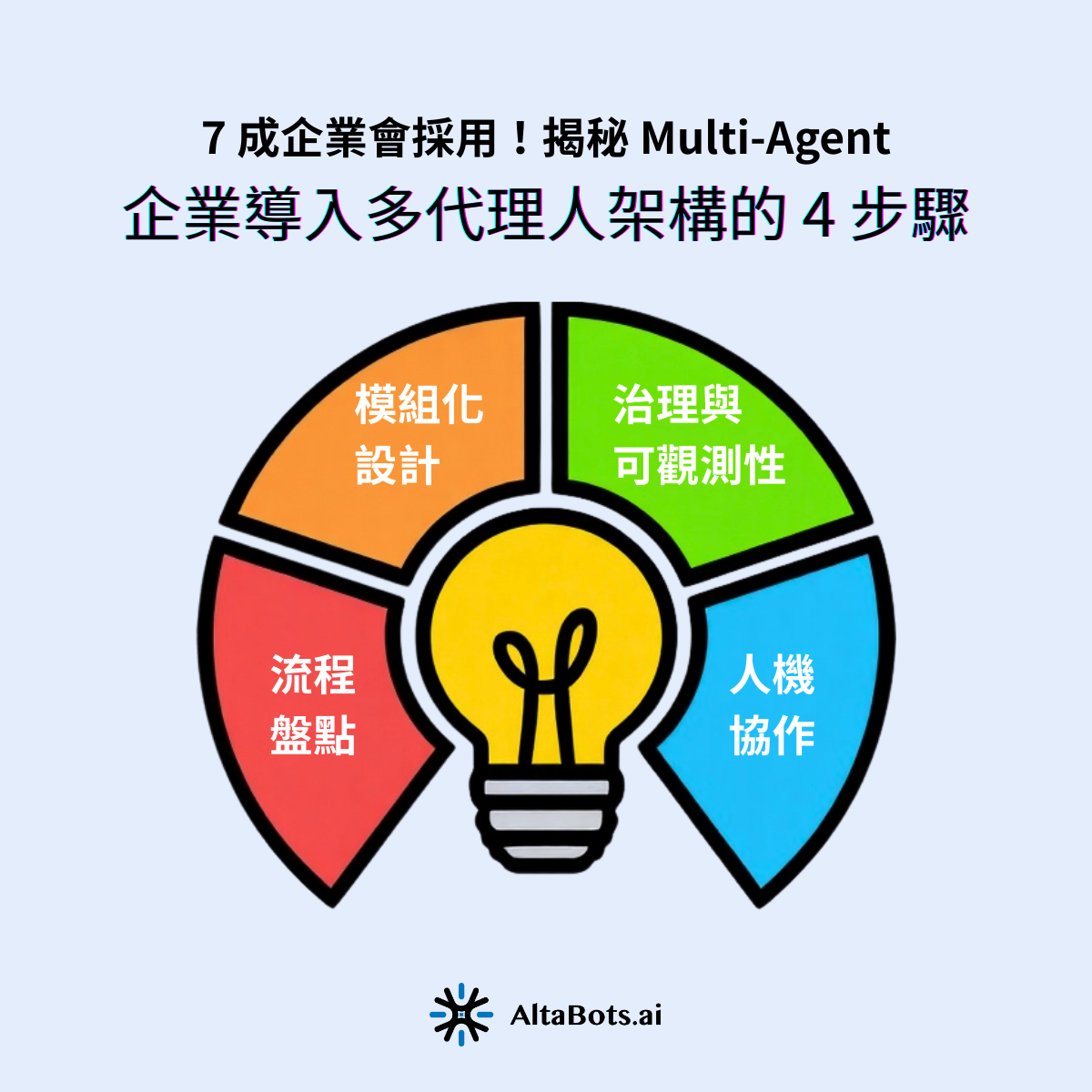
Point 3 is the easiest to overlook. As the number of agents grows, the risk from interactions between agents does not increase "linearly" but can grow "exponentially": adding one more agent can double the failure scenarios that need to be prevented. This is also why Gartner repeatedly stresses that governance and observability decide whether MAS succeeds [1]. To learn how to build a systematic error analysis and evaluation process for agents, see our Guide to Agent Error Analysis and Evals.
And governance is not only defense but also a moat. Databricks' data is direct: organizations that use dedicated AI governance tools push 12 times as many projects into production as their peers, and those that use evaluation tools get nearly 6 times as many [4]. At the same time, 78% of companies now use two or more large language models [4]. Giving routine tasks to small, low-cost models and keeping high-risk reasoning for flagship models is becoming the norm as a "hybrid" strategy. Whether it can be managed directly decides whether your Multi-Agent is an asset or a liability.
Get started: build your multi-agent digital team
Enterprise digital transformation has entered a new era of AI collaboration. Whether you want to solve a scheduling problem in manufacturing, review efficiency in finance, or build an automated marketing factory, Multi-Agent is a strong aid, but only if you pick the right scenario, can manage it, and have someone working alongside you to take it from POC to production.
This is also where AltaBots.ai differs most from platforms that simply "sell a tool." We don't hand you a No Code interface to figure out on your own. Instead, consultants work with you to inventory processes and design how this digital team should divide its work, and stay with you until there are results. For more extended uses of Multi-Agent in customer interaction and customer data integration, see the Alta.DI AI customer interaction platform, which shows how the same collaboration architecture upgrades customer service and marketing automation.
If you are evaluating whether Multi-Agent suits your industry, you are welcome to book an AltaBots.ai demo, where we use your actual scenarios to show how these "digital employees" work and which process to start with. For more industry trends and adoption practice, you can also browse our AI trend articles section.
References

[1] Coshow, T., & Zamanian, K. (2025). Multiagent Systems: A New Era in AI-Driven Enterprise Automation. Gartner.
https://www.gartner.com/en/articles/multiagent-systems
[2] Gartner. (2025). Gartner Predicts 40% of Enterprise Apps Will Feature Task-Specific AI Agents by 2026, Up from Less Than 5% in 2025. Gartner Newsroom.
https://www.gartner.com/en/newsroom/press-releases/2025-08-26-gartner-predicts-40-percent-of-enterprise-apps-will-feature-task-specific-ai-agents-by-2026-up-from-less-than-5-percent-in-2025
[3] Gartner. (2025). Gartner Predicts Over 40% of Agentic AI Projects Will Be Canceled by End of 2027. Gartner Newsroom.
https://www.gartner.com/en/newsroom/press-releases/2025-06-25-gartner-predicts-over-40-percent-of-agentic-ai-projects-will-be-canceled-by-end-of-2027
[4] Databricks. (2026). 2026 State of AI Agents. Databricks.
https://www.databricks.com/resources/ebook/state-of-ai-agents
FAQ
FAQs about this article
What is Multi-Agent AI (a multi-agent system), and how does it differ from traditional monolithic AI?

Multi-Agent AI is an architecture that breaks complex work into modular steps and hands them to agents with different specialties to complete together, like a digital team. Traditional monolithic AI uses a single model for every task and tends to accumulate errors in long processes. Multi-Agent relies on division of labor and mutual checking, so it can handle longer and more precise business processes.
What does a Multi-Agent architecture look like? Is a Supervisor Agent always required?
The most common architecture is a Supervisor Agent that breaks a goal into subtasks, assigns them to dedicated sub-agents, and then compiles the results. According to Databricks' measurements, the Supervisor pattern accounts for about one third of enterprise agent usage and is the mainstream approach. Simple processes do not necessarily need a supervisor layer, but long cross-department processes usually use one to reduce coordination costs.
How does Multi-Agent differ from Agent-to-Agent (A2A)?
Multi-Agent is internal collaboration, with several agents dividing work inside one system. Agent-to-Agent is external communication, with agents from different companies or systems exchanging information through standard protocols (such as MCP). The former is like a team inside a company and the latter is like business dealings between two companies. Together they make up the enterprise AI ecosystem of 2026.
How is the cost of adopting Multi-Agent calculated? Do I need a POC first?
Adoption cost varies with process complexity, the number of systems connected, and the number of agents, and usually includes ongoing inference and compute fees. We suggest first running a POC of about 30 days to validate one high-value scenario, and scaling up after business benefit and feasibility are confirmed, which greatly lowers the risk of failure and overspending. For an actual quote, book a consultation and a consultant will help assess it.
What is the most easily overlooked risk when adopting a Multi-Agent system?
The most critical one is compounding errors. As the number of agents grows, failure scenarios can grow exponentially. So adoption needs strong observability to monitor the decision logic between agents in real time, and strict control of each agent's permissions.
More articles


訂閱我們的電子報
每月 8 日定期發送最新趨勢與實用資訊!



