

From prompt to context engineering: 2026 prompt frameworks
From prompt engineering to context engineering: master four frameworks, CO-STAR, Chain of Density, Multi-Persona Debate and Structured Verification, with 2026 prompt examples and a four-layer evolution path you can apply to your AI workflows directly.


You just upgraded to GPT-5 or Claude Opus 5 and find that the prompt that worked well last month now produces something different. The model did not get dumber. The rules of the game for writing instructions are changing.
Prompt engineering is the method of writing a single instruction clearly, while context engineering is the strategy of deciding "which information to put into the model's window at this moment". In 2026 the two are layered, not substitutes for each other.
In the previous two articles, we introduced basic interaction patterns and advanced techniques for dealing with hallucination.
Improve Conversation Quality! Must-Know Prompt Techniques: Beginner Edition
Improve Conversation Quality! Must-Know Prompt Techniques: Advanced Edition
However, as models with deep reasoning ability (such as OpenAI's GPT-5 series and the latest GPT-6 Astra, and Google's Gemini 3 series) became widely available from late 2025 through 2026 [1][2][12], the paradigm of prompt engineering has also shifted significantly.
In 2026, the most skilled AI users no longer just "instruct", they are "structuring" a thinking framework.
This article is the final chapter (the trends piece) of our AI prompt engineering series. Next we introduce 4 prompt structures designed for the new generation of reasoning models and agentic AI. These techniques are backed by solid academic research and can help you handle denser information and more complex decisions, and even make an AI work like a team.
What exactly is "prompt engineering", and how does it differ from the "context engineering" that is popular in 2026?
Prompt engineering is the method of designing and organizing the instructions given to an AI model, with the aim of getting a language model to produce output that steadily meets quality and format requirements. It applies to anyone who works with AI frequently.
From mid-2025, this field began to be described another way. AI researcher Andrej Karpathy and Shopify CEO Tobi Lütke each publicly put forward the concept of "context engineering". They argued that once tasks evolve from single question-and-answer exchanges into multi-turn, multi-tool Agent workflows, the focus moves from "how to word this sentence" to "what to put into the model's context window at this moment". The industry quickly adopted the term, and Anthropic's official engineering blog formally defined it in September 2025: context engineering is a whole set of strategies for "continuously curating and maintaining the optimal set of tokens during LLM inference", of which prompt engineering is only one part [3].
But this does not mean prompt engineering is outdated. Quite the opposite: how well you do context engineering depends on whether you can turn each judgment of "what information does this task actually need" into a clear, reusable structure. That is the value of the four frameworks introduced next: they are concrete tools for upgrading "offhand instructions" into "structured context". If you want to first understand the full concept of context engineering systematically, see our other article Context Engineering Explained in Full。
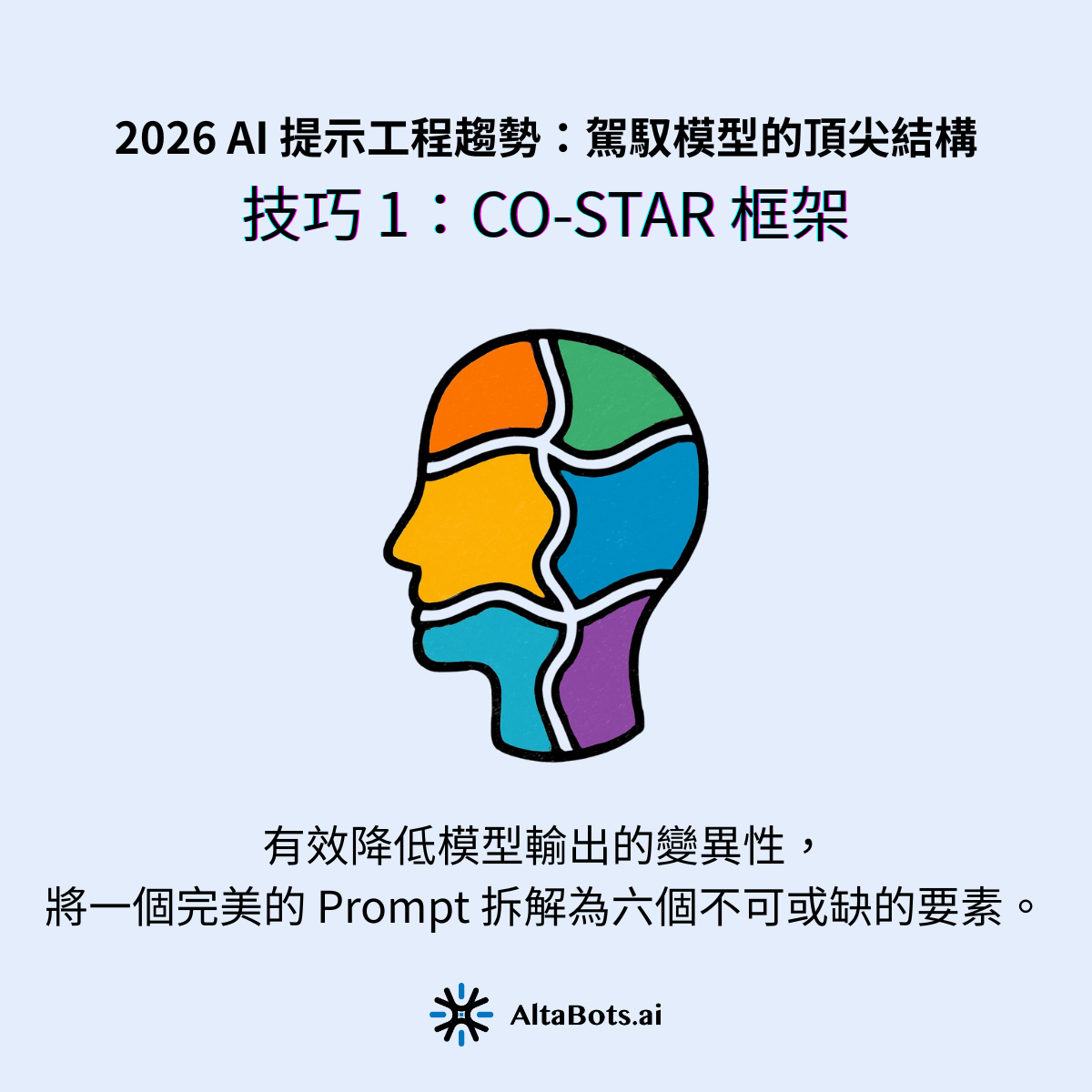
Technique 1: the CO-STAR framework: a structure for clear instructions
The pain point: A colleague uses AI to produce a 90-point presentation outline in ten minutes, while you spend half an hour going back and forth and still get 70. The problem is usually not that the AI cannot do it, but that you piece the prompt together differently each time and leave out key information.
This structured prompting method was proposed by the data science team at GovTech Singapore, and received very high praise in the first GPT-4 Prompt Engineering competition [4]. According to GovTech data scientist Sheila Teo, the CO-STAR framework effectively reduces the variability of model output and has become one of the structured prompting methods widely recognized by companies adopting AI around the world [4].
The CO-STAR structure in detail: it breaks a complete prompt into six indispensable elements:
- C (Context): give background information for the task
- O (Objective): define clearly what you want the AI to do
- S (Style): specify the writing style (for example, Lu Xun's style or a McKinsey consultant's style)
- T (Tone): set the emotion and attitude (for example, humorous, serious, motivating)
- A (Audience): who the content is written for
- R (Response): specify the output format (JSON, Markdown, table)
A practical prompt example:
"(C) Context: I am a product manager at a SaaS software company, and we have just released our new AI automation features for Q1 2026.
(O) Objective: Please write an email inviting former customers who have churned to come back for a free trial.
(S) Style: Concise and punchy, similar to Apple's marketing copy, emphasizing innovation and minimalism.
(T) Tone: Full of enthusiasm but professional, without overselling.
(A) Audience: Inactive users who have not logged in for the past 6 months, usually mid-to-senior managers at companies.
(R) Response: Please give me plain text, including 3 subject line options with different angles."

Technique 2: chain of density (CoD): building high-value summaries
The pain point: Your manager hands you a 30-page industry report and asks you to "cover it in one page for tomorrow's presentation". You ask the AI for a summary, and the result is either too short and misses key figures, or too long and reads like a retelling of the original.
This technique was proposed in the 2023 paper "From Sparse to Dense" by a research team from Salesforce Research, MIT (Massachusetts Institute of Technology) and Columbia University [5]. The study showed that through "recursive refinement", CoD generates summaries with significantly higher information density than traditional methods. Its core logic is to ask the AI to keep packing in more "entities" while holding the word count constant.
A practical prompt example:
"Please read this report on the 2025 global semiconductor supply chain. I need you to generate 5 versions of a summary.
[Iteration rules] Version 1: a first summary (about 100 words). Versions 2 to 5: find the "specific figures", "company names" and "technical terms" missing from the previous version and fold them into the new summary. Constraint: each version must stay at about 100 words (free up space by cutting unnecessary modifiers). List the 5 versions in order so I can compare how the information density changes."
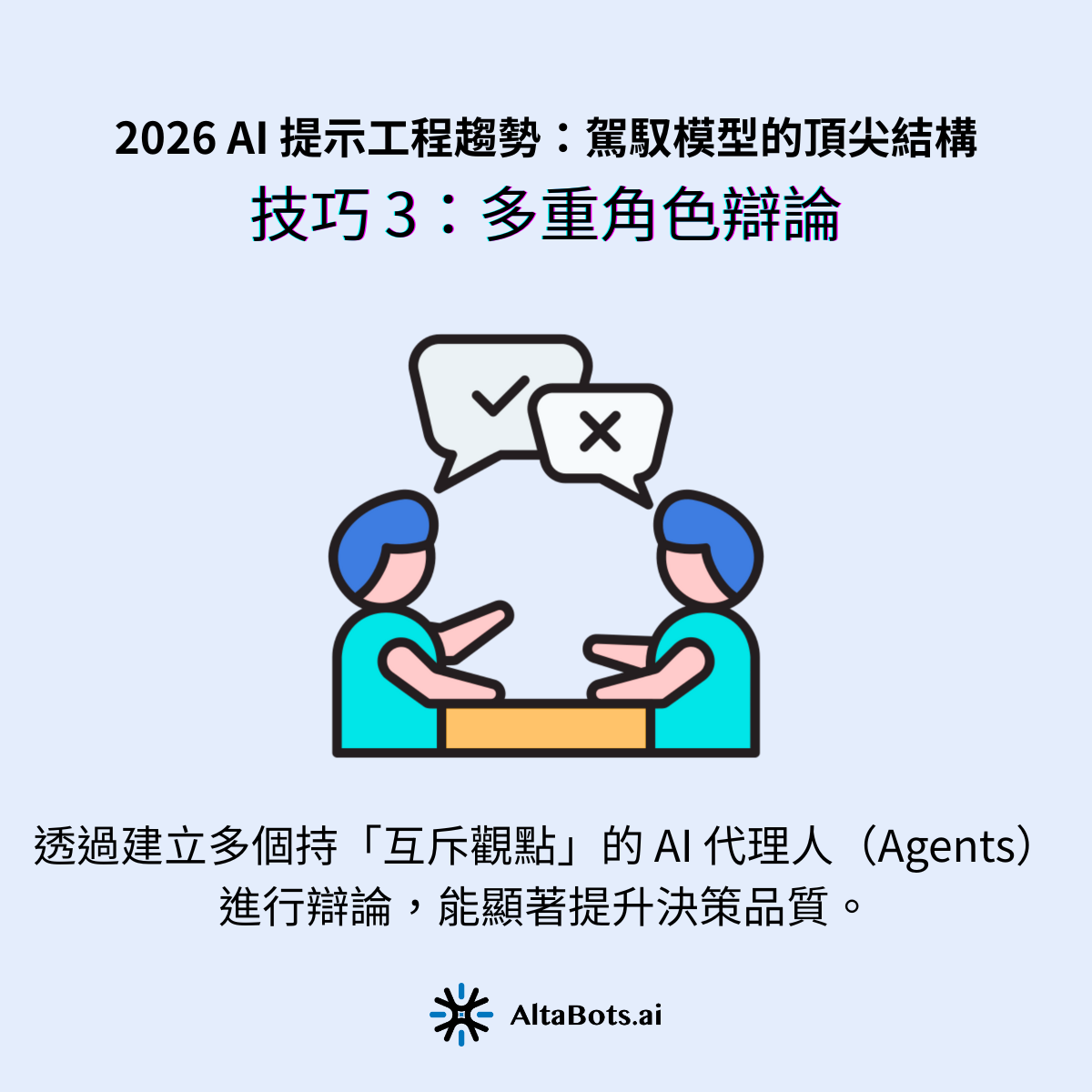
Technique 3: multi-persona debate: Simulating an expert meeting
The pain point: You ask an AI to evaluate a new plan, and it replies with a pile of safe lines like "you may consider..." that say nothing. What you need is someone to play devil's advocate, not an AI that simply agrees.
This technique comes from collaborative research between MIT and Google DeepMind [6]. The research notes that a single model's thinking easily falls into "sycophancy bias", where the AI tends to say what the user wants to hear. Having several AI agents hold "mutually exclusive viewpoints" and debate can significantly improve decision quality. Since today's models have very large context windows, you might as well have the AI play several people at once and hold a virtual meeting for you.
A practical prompt example:
"I am considering whether to invest in opening an unmanned coffee shop in 2026. Please start a 'multi-persona debate mode':
Persona A (an optimistic entrepreneur): focuses on automation trends, labor cost savings and the novel experience. Persona B (a conservative financial advisor): focuses on up-front equipment depreciation, system maintenance risk and cash flow pressure. Persona C (a sharp-tongued market commentator): focuses on criticizing competitors and consumer fatigue with unstaffed service.
Have these three personas debate my business plan over 3 rounds. In each round, they must rebut each other's arguments. At the end, you summarize with one objective recommendation."
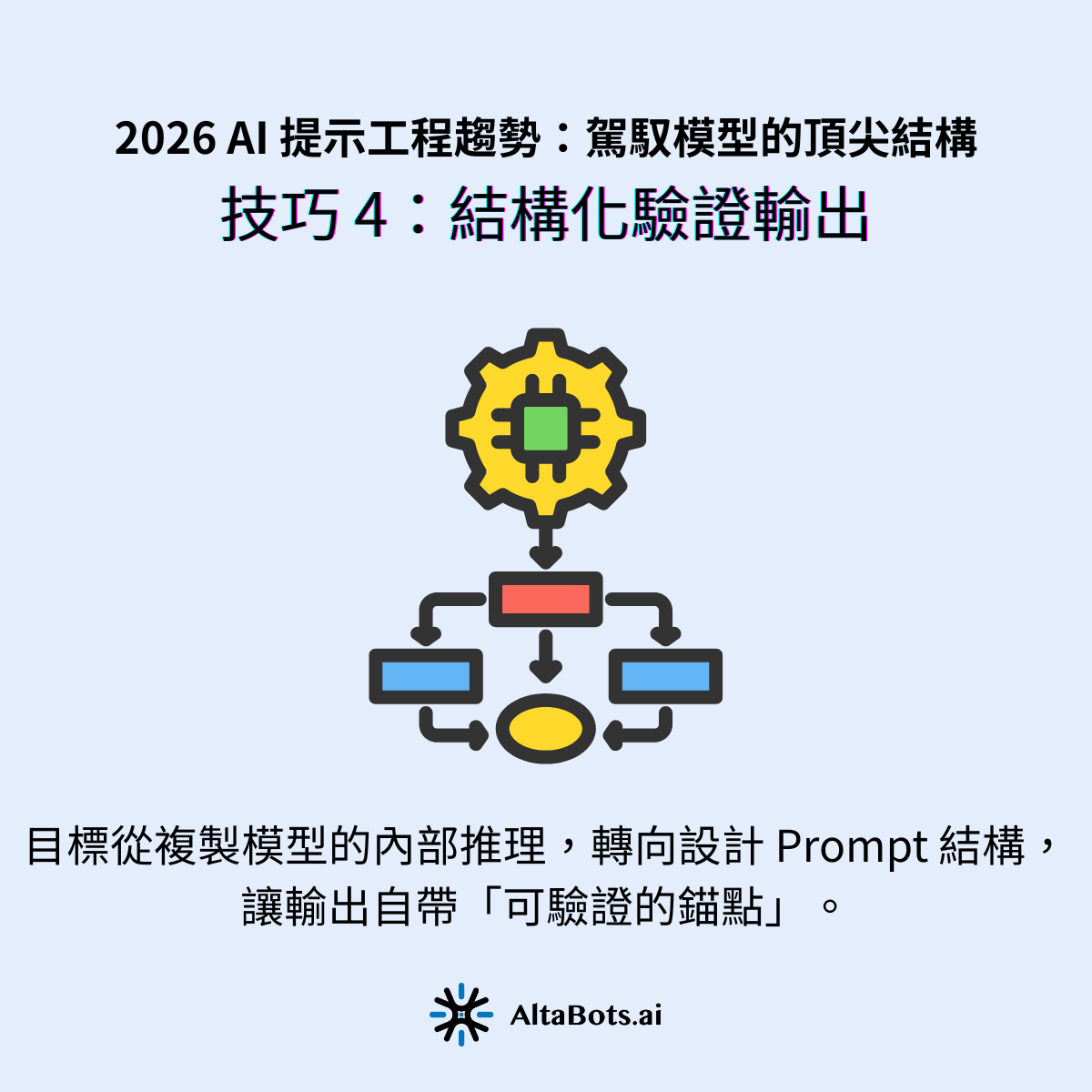
Technique 4: structured verification: making a reasoning model's answers checkable
The pain point: You ask an AI to review a contract or a piece of code, and it hands back a conclusion directly, but you are not sure which conditions it actually checked. Your instinct is to tell it to "write out the reasoning process", and the answer actually gets worse.
This is not a bug but the design logic of the new generation of reasoning models. OpenAI's GPT-5 series, GPT-6 Astra released in September 2026 [1][12], and Google's Gemini 3 series [2] all run a "hidden chain of thought" internally, meaning the model completes multi-step reasoning in the background before outputting the final answer. OpenAI states explicitly in its official developer documentation: do not use prompts such as "explain step by step" or "show your thinking process" with reasoning models, because the model already does this internally, and the extra request may lower output quality instead [11].
So the question arises: if we cannot tell it to "write out the reasoning", how do we confirm the answer is right?
According to the foundational Chain-of-Thought theory proposed by Wei et al. (2022) [7], the reasoning process is critical to the output quality of language models. The difference is that reasoning models in 2026 have built this in. The goal shifts from copying the model's internal reasoning to designing the prompt structure so the output carries its own "verifiable anchors": state the assumptions plainly, mark the basis, and show the boundary conditions tested. The focus moves from "watching how it thinks" to "making it hand over something that can be checked".
GPT-5.6 Sol (officially released in July 2026 [8]), GPT-6 Astra [12] and Anthropic's Claude Opus 5 [9] all provide an "Effort" setting that lets users directly adjust reasoning depth (from low to max). This replaces, with a product dial, the "please think harder" that used to be requested manually in the prompt, so you can focus on what really matters: how to verify the output.
A practical prompt example:
"Please review this Python code for potential logic flaws.
[Output requirements] Do not give me only the fixed code. Deliver the result in the structure below, with each block something I can check independently:
[Assumptions] Your understanding of this code's intent, and the input data types and ranges you assume. [Test plan] Which edge cases you would test with, and why you chose them. [Test results] Simulate running each of the above conditions, marking each as passed or failed. [Fix verification] The fixed code, rerun against the same test conditions to confirm. [Conclusion and residual risk] What this fix resolved, and which situations are still not covered."
From prompt to graph: four layers of AI engineering evolution
The four frameworks in this article solve the problem of "how one person writes a single instruction well". But if you have started using AI Agents for cross-department, multi-step tasks, you may find structured prompts alone are no longer enough. What you need to manage is the entire conversation context, tool state, and even coordination among multiple Agents.
From mid-2025 through 2026, the industry has been rapidly stacking up a clear evolution path [10]:
The key point: these four layers are stacked, not substitutes. Graph is built on Loop, Loop on Context, and Context on Prompt. Learning Graph does not mean you no longer need to write good Prompts, just as being able to design system architecture does not mean you no longer need to write code. The four frameworks in this article are exactly the "first-layer foundation" of this whole evolution path.
If you are interested in Layer 2 (context engineering), the full explainer linked above goes into more detail.
Conclusion: from prompt to graph, structured thinking is the constant foundation
If before 2024 we were learning "how to talk to a chatbot", then in 2025 to 2026 we went through a rapid evolution from system instructions to context engineering, then to Loop and Graph. But however the terms change, only one thing underneath stays the same: whether you can turn a vague intent into a structured, reusable thinking framework.
That said, if you are driving AI adoption inside a company, you may meet a practical problem: getting one or two colleagues to master these 4 frameworks is not hard, but keeping context quality consistent across the Agent workflows of an entire team, or even the whole company, will quickly get out of hand if it relies on copy-and-paste. This is the scaling problem that context engineering is meant to solve. If you are weighing whether to build this context management mechanism yourself, or adopt a No Code AI Agent platform that already builds these practices into its workflows, the consultant-led support offered by AltaBots.ai can first help you see the current situation clearly, and then decide which way saves the most time. Once you have internalized these frameworks, AI output turns from "luck of the draw each time" into a "predictable, repeatable" working tool.
For more trend analysis, see our more 2026 AI trend articles. If you found this article helpful, you are also welcome to follow our Threads for the latest AI application techniques and practical experience.
References

[1] OpenAI.(2026.07)。Model Release Notes. OpenAI HelpCenter.
https://help.openai.com/en/articles/9624314-model-release-notes
[2] Google DeepMind.(2026.03)。A New Era of Intelligencewith Gemini 3. Google Blog.
https://blog.google/products-and-platforms/products/gemini/gemini-3/
[3] Anthropic.(2025.09)。Effective Context Engineering forAI Agents. Anthropic Engineering Blog.
https://www.anthropic.com/engineering/effective-context-engineering-for-ai-agents
[4] Teo, S.(2023.11)。How I Won Singapore’s GPT-4 PromptEngineering Competition. Towards Data Science.
https://towardsdatascience.com/how-i-won-singapores-gpt-4-prompt-engineering-competition-34c195a93d41
[5] Adams, G., Fabbri, A., Ladhak, F., Lehman, E., & Elhadad, N.(2023.09)。From Sparse to Dense: GPT-4 Summarizationwith Chain of Density Prompting. arXiv.
https://arxiv.org/abs/2309.04269
[6] Du, Y., Li, S., Torralba, A., Tenenbaum, J. B., & Mordatch, I.(2023.05)。Improving Factuality and Reasoning in LanguageModels through Multiagent Debate. arXiv.
https://arxiv.org/abs/2305.14325
[7] Wei, J., Wang, X., Schuurmans, D., et al.(2022.01)。Chain-of-Thought Prompting Elicits Reasoning in LargeLanguage Models. arXiv.
https://arxiv.org/abs/2201.11903
[8] OpenAI.(2026.07)。GPT-5.6: Frontier Intelligence ThatScales with Your Ambition. OpenAI Blog.
https://openai.com/index/gpt-5-6/
[9] Anthropic.(2026.05)。Introducing Claude Opus 5.Anthropic News.
https://www.anthropic.com/news/claude-opus-5
[10] MarkTechPost.(2026.07)。Prompt Engineering vs LoopEngineering vs Graph Engineering: What Changes at EachLayer.
https://www.marktechpost.com/2026/07/29/prompt-engineering-vs-loop-engineering-vs-graph-engineering-what-changes-at-each-layer/
[11] OpenAI.(2026.09)。Reasoning Best Practices. OpenAIDeveloper Documentation.
https://developers.openai.com/api/docs/guides/reasoning-best-practices
[12] CNBC.(2026.09)。OpenAI Announces Rollout of GPT-6Astra Model.
https://www.cnbc.com/2026/09/03/open-ai-astra-gpt-6-cyber.html
FAQ
FAQs about this article
What is prompt engineering?

Prompt engineering is the method of designing and organizing the instructions given to an AI model, so that output steadily meets quality and format requirements. It is a foundational skill for anyone who uses AI frequently.
How is prompt engineering different from asking an AI offhand?
Asking offhand relies on the model guessing your intent, which easily produces unstable answers. Prompt engineering defines the task clearly with a structured framework, making output more predictable and easier to reuse.
What is the most important AI prompt engineering trend in 2026?
A shift from "giving instructions" to "building a thinking framework", alongside an industry consensus that has moved from prompt engineering to context engineering, which stresses managing the whole conversation and tool state, not just a single instruction.
How is the CO-STAR framework applied in actual work?
Write out the six elements in order, context, objective, style, tone, audience and response format, to form the instruction. It effectively reduces output variability and suits marketing or customer service workflows that need a fixed output format.
What should you watch for in prompts when using new reasoning models such as GPT-5 and Gemini 3?
These models already run multi-step reasoning internally, so you no longer need "explain step by step" to guide them. The focus shifts to designing a structured output format so that every conclusion comes with its assumptions and test basis, making it easy for people to check item by item.
More articles


訂閱我們的電子報
每月 8 日定期發送最新趨勢與實用資訊!



