

AI adoption consultant: 5 delivery checkpoints and timeline
How do you compare AI adoption consultants? Across five stages, from requirements interviews to post-launch maintenance, we give checkpoints you can verify and files to request, plus the signing-to-launch timeline and five stress-test questions.


Introduction | why "can present a deck" does not mean "can deliver an AI agent"
An AI adoption consultant's delivery capability is the ability to take an AI Agent from pilot to stable operation for six months or more, covering requirements interviews, acceptance criteria and Prompt development through post-launch maintenance. The part of that definition most often skipped is the last one: maintenance after launch.
Let us be clear about where we stand. Data-DI is itself an AI Agent vendor, with the AltaBots.ai platform. So this is not a neutral review. It is our own delivery process laid out in full, for you to use as a baseline, to put to other vendors, and to bring back to us.
Many business owners hit the same snag the first time they evaluate AI consultants: proposal decks from four or five vendors sit on the table, each with a polished system architecture diagram, each claiming to "customize", each attaching "success stories". Then, six months after signing, the boss walks into the office and asks, "So, is our AI Agent live? How is it performing?" Only then do they find that the charts that impressed them are still a long way from "actually live and running steadily".
Your situation may also be a different one: the Agent is already running, but no one is really looking after it. The previous vendor delivered and faded out, your point of contact reports whatever looks odd each day, and after each fix no one knows whether things actually improved. Replacing the vendor in this situation uses somewhat different criteria from a first adoption. The section "Who Looks After It After Launch" in this article is written for exactly that situation, and you can skip straight to it.
The problem is not that companies skip due diligence, but that the evaluation criteria are wrong. Most companies comparing consultants look at "can they do it" (What), when they should look at "how do they do it, how do they accept it, how do they maintain it" (How). Every vendor can answer the former; only consultants who have taken projects into daily use can answer the latter.
The five-stage framework comes from our own project records of delivering conversational AI Agents, mainly "practice-type" Agents such as customer service training, sales simulation and interview rehearsal. That is where our evidence is most solid, so every pitfall scene in this article comes from there. If you are adopting an external-facing customer service or knowledge-base Q&A Agent, the five-stage skeleton still applies, but the specific pitfalls differ. We say this up front.
Each stage comes with a contrast between how a consultant who delivers and a consultant who only talks would answer. Before we begin, here are two things: a yardstick you can use without technical knowledge, and the number everyone most wants to know and few answer directly: how long from signing to launch.
A yardstick that needs no technical knowledge: three signs of evasion
You do not need to understand a consultant's technical answer. You only need to hear the shape of the answer. These three signs are useful at every stage that follows. After the other side finishes speaking, check back against them.
Sign 1: adjectives instead of nouns. A consultant who delivers gives a structured answer, such as "We have an error classification dashboard that monitors four categories." A consultant who only talks brushes past with "Our service is comprehensive" or "Our technology is mature". The more adjectives, the fewer details. You need no technical background to judge this one.
Sign 2: smooth answers, then stuck on the next question. Many consultants have memorized the standard answers to one or two questions (usually the interview process and pricing). Once asked about Prompt pitfalls, they turn to "We'll go back and confirm" or "That depends on the detailed discussion", and that is often where the capability gap sits.
Sign 3: taking over the conversation and defining the problem for you. You ask "How do you write TCs?" and they reply "We'll first understand your needs, then make recommendations." On the surface that sounds client-oriented; in practice they have no template to show. A consultant who delivers will say directly, "Our TC template usually has three sections. Would you like to see an anonymized example?"
How to use this yardstick: apply it to every question in the five stages that follow. It does not matter if you cannot follow the technical content. You can still judge whether they gave you something countable, whether they have a ready-made file, and where they retreat when pressed.
How long from signing to launch?
A simple data-lookup Agent can go live in about 4-5 weeks. A conversational Agent involving multiple roles and scenarios usually takes 2-4 months from interviews to launch, followed by a 3-6 month maintenance period with consultants working alongside you. This is the range from our own projects, not an industry-wide figure, but it gives you a yardstick to check whether the timelines other vendors quote are reasonable.
A consultant who delivers is willing to give a range at the quotation stage and will tell you why the range moves. These three things decide where you land within it:
Variable 1: how ready your knowledge base is. This is the most underestimated factor. If the company's FAQs, product documents and SOPs are scattered across departmental cloud drives with conflicting versions, merely organizing them into a state fit for a knowledge base can consume several weeks. If the consultant quoted a timeline without asking about this, that timeline is a guess.
Variable 2: how many people you can commit, and for how long. The pre-launch tuning stage requires your own people to operate and stress-test the Agent (more on why later). If your point of contact is doing this on the side and can spare only two hours a week, the rhythm of test feedback will set the rhythm of the project. This should be settled at the interview stage, not discovered just before launch that no one is free.
Variable 3: how many roles the Agent plays and how many scenarios it handles. A single-scenario Q&A Agent and a practice-type Agent that simulates many customer personalities differ in workload by a multiple.
If you want a closer look at how to compress the pilot stage, see our guide PoC Guide: How to Run a 30-Day Proof of Concept。
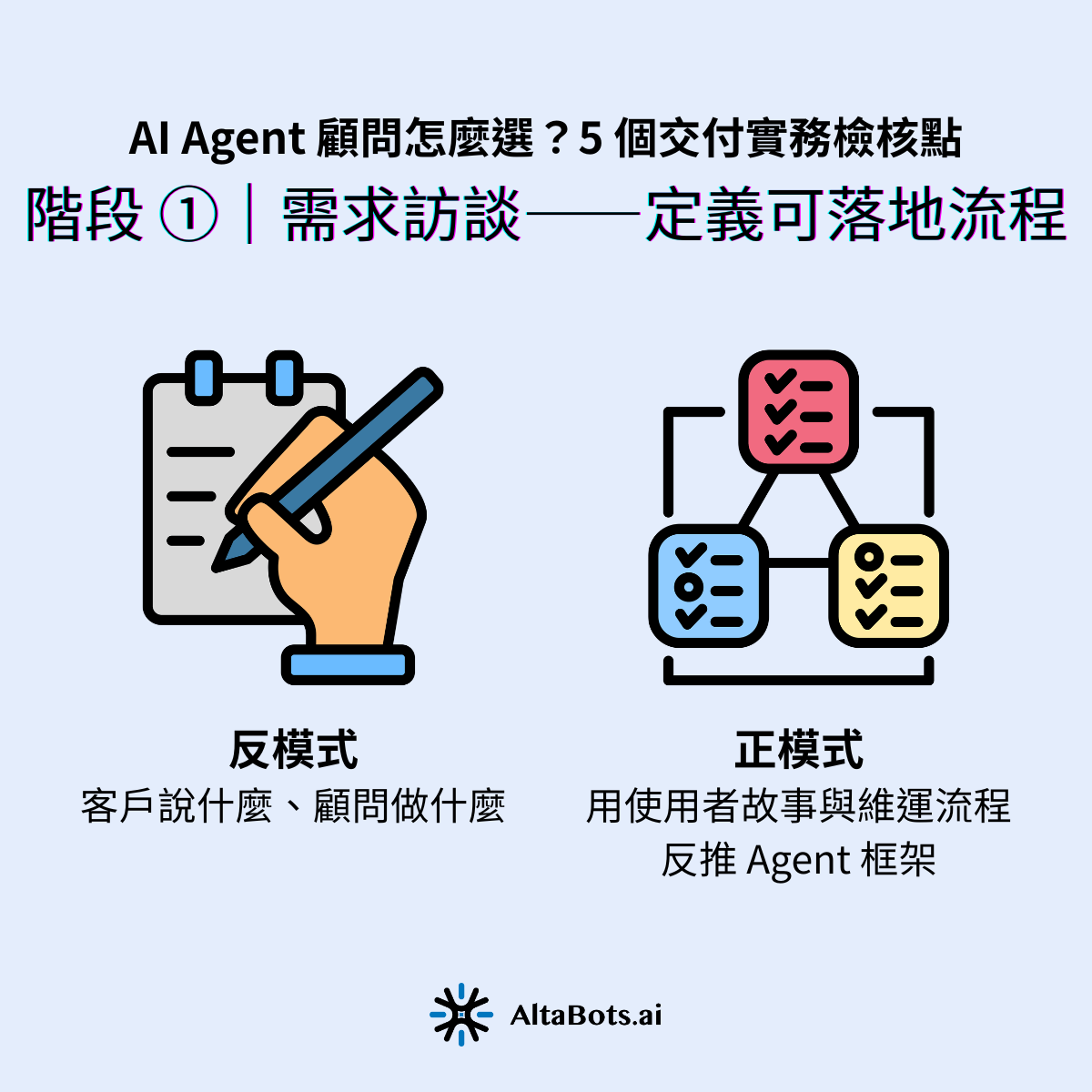
Stage 1 | requirements interview: does the consultant "collect requirements" or "define a workable process"?
A consultant who truly delivers will not ask you "What features do you want?" but "After this Agent goes live, who has to do what every month?" This is the most important dividing line in the interview stage: the former copies the client as a requirements list, while the latter treats the client as a partner and proactively defines a framework that will keep working for the long term.
A consultant who delivers will not ask you "What features do you want?" They will ask, "After this Agent goes live, who has to do what every month?" This is the most important dividing line in the interview stage: the former copies the client as a requirements list, while the latter proactively defines a framework that will keep working for the long term.
When most companies first meet an AI consultant, they mistakenly assume that "a consultant is there to collect requirements": the client lists features, and the consultant takes the list as is and goes away to quote. The meeting looks efficient, but this is exactly where later adoption failures begin。
The anti-pattern: the client says it, the consultant builds it
Failed AI Agent projects share one trait: in the interview stage, the consultant never challenged the client's requirements, treated the feature descriptions as the final specification, and went straight to writing Prompts.
Three months after launch, problems surface. Changing one small condition in the specification means rewriting the entire Agent logic. The "flexibility" the client thought they had is actually the consultant editing Prompts every month. No one has worked out "when new content comes in, who updates the knowledge base". And when errors occur, no one can tell whether "the user asked the wrong thing" or "the Prompt needs fixing".
At this point companies assume the AI technology is immature, but the deeper cause is: the interview stage did not think through maintenance. An AI Agent is a living system that needs someone each month to feed it new data, revise Prompts and adjust the knowledge base. If the interview stage did not define "who does what each month", the day it goes live is the day the trouble starts.
The right pattern: work backward from the interaction flow and maintenance responsibilities to the Agent framework
A consultant who delivers pins down two things in the interview stage:
First, define the ideal interaction flow. The first question is "At the moment a user opens the Agent, what should the ideal experience be? Done in three steps, or five?" rather than "What features should the Agent have?" This answer determines the whole architecture, and it also avoids building a pile of features that all end up idle.
Second, define maintenance rules up front. Everything that updates dynamically (new data, new cases, new FAQs) is planned into the knowledge base, with these written out: how documents are split, how naming rules are set, how data is chunked and fed into the retrieval system (this step is usually called "vectorization"; you do not need the technical details, only to confirm that the consultant can explain what they plan to do and who maintains it afterward), and how the tagging strategy is set, along with which department, which point of contact and which monthly actions are responsible. The Prompt is designed as a long-term structure that is "touched as little as possible".
Once these two things are done, what the company gets is a PRD (product requirements document) that can run long term, rather than a specification that is "impressive now but must go back to the consultant for changes next month".
3 questions to ask a consultant in the interview
If you are in a requirements interview with a consultant, these three questions will show you the depth of the other side right away:
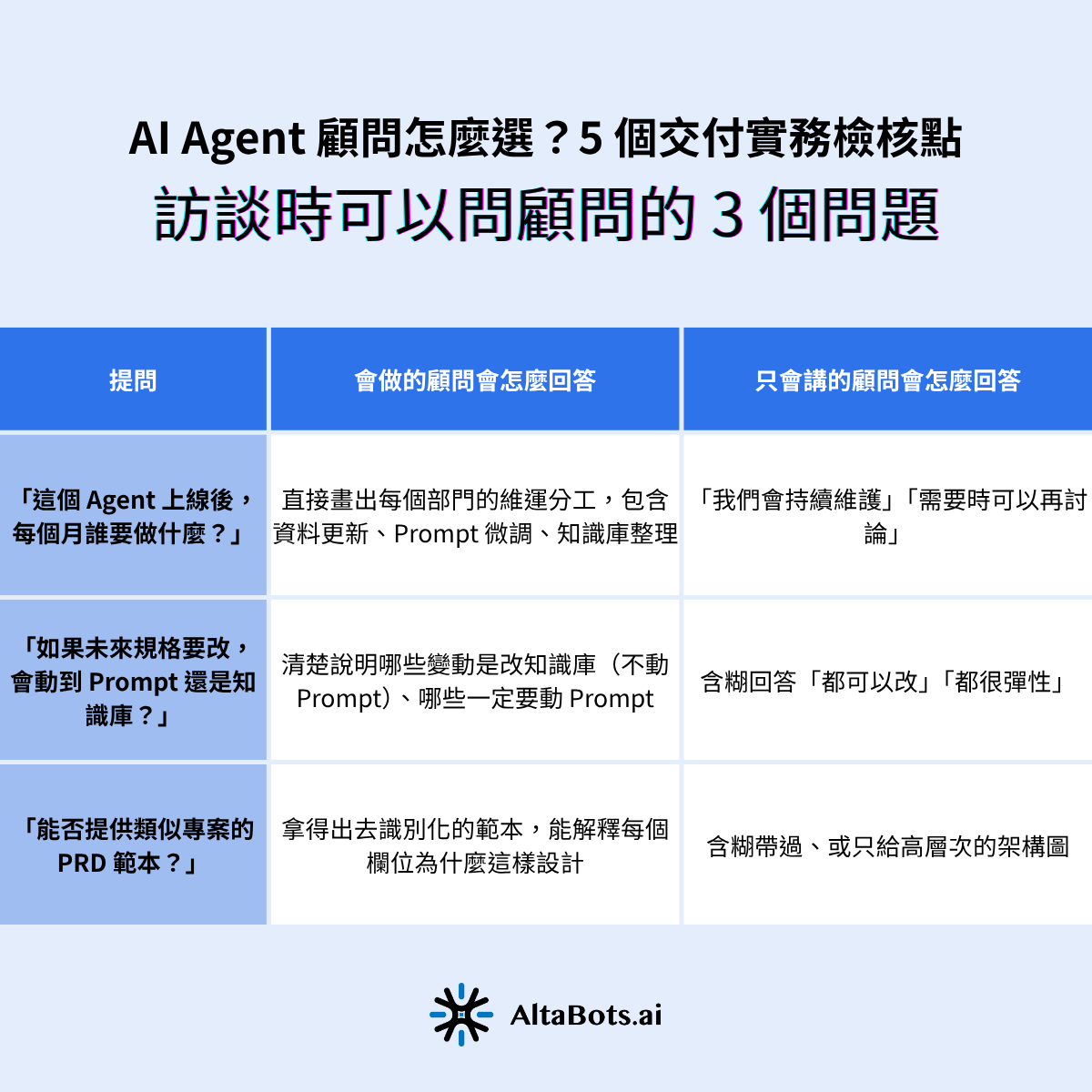
- "After launch, how is the monthly maintenance work divided?" A consultant who delivers will draw out each department's actions and timeline directly. A consultant who only talks will say, "We'll discuss that later."
- "When we change the specification in the future, do we change the Prompt or the knowledge base?" A consultant who delivers will clearly classify which kind of change goes which way, and the cost of each. A consultant who only talks will reply, "Either can be changed."
- "Can you give me an anonymized PRD template?" A consultant who delivers can produce one. A consultant who only talks will be vague.
The third question matters especially. A mature PRD spells out "how users use it, when it triggers, how the knowledge base connects, how errors are handled", and the document itself is evidence of depth of experience. Once you have it, apply the yardstick from earlier: is it a structured, concrete document, or a table of contents full of adjectives?
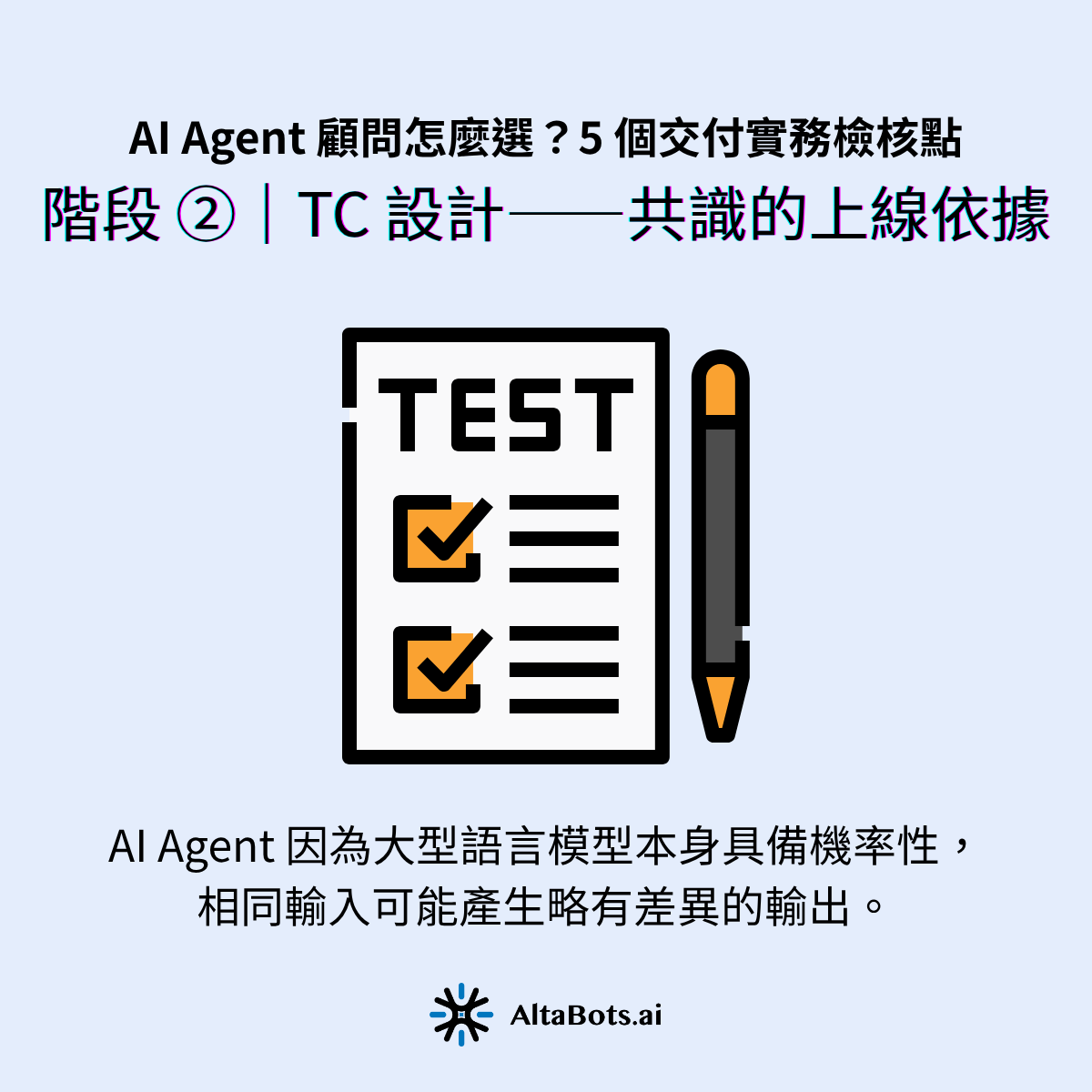
Stage 2 | TC design: what do you use as the basis for "ready for launch"?
A TC (Test Case) is the written agreement between both parties on what "ready for launch" means. Without TCs, whenever the AI Agent makes any error, no one can tell whether the Prompt needs fixing, the knowledge base has gaps or the user is using it incorrectly, and all later maintenance turns into both sides talking past each other.
Most companies do not ask "How do you write TCs?" before signing, because the term sounds technical. But this is the biggest difference between traditional software and AI Agent delivery. Traditional software can be accepted on a binary Pass/Fail basis. An AI Agent, because large language models are probabilistic, may produce slightly different outputs for the same input, so deterministic testing is hard to apply [1].
In other words, a contract without TCs has no acceptance criteria.
Why are TCs the minimum standard for "ready for launch"?
Projects without TCs fall into three typical difficulties:
- Errors cannot be attributed. A user reports that "the Agent can't answer". Is there really a problem with the Agent, did the user ask something unexpected, or does the Prompt need refining? Each side presents its own evidence, and it ends in a tug-of-war of "the client thinks it is not good enough, the consultant thinks it has met the bar".
- You cannot measure whether it is getting better. In summarizing Anthropic's Agent evaluation methodology, Build School Learn notes that teams without an evaluation mechanism can only run a passive cycle: wait for users to report problems → reproduce by hand → fix the bug in front of you → hope no new regression is introduced [2]. The result is that they cannot tell a "real regression" from "random noise".
- Switching models breaks things. When the underlying model is upgraded or the vendor changes, without TCs you cannot quickly verify whether performance stays consistent. In our own experience, projects with TCs complete verification and switchover within days, while those without must retest case by case by hand, stretching the time to weeks.
Different agent types need different ways of writing TCs
There is no universal standard for TCs; they must be adjusted to the Agent's nature. A consultant who has taken projects into daily use can clearly tell three approaches apart:
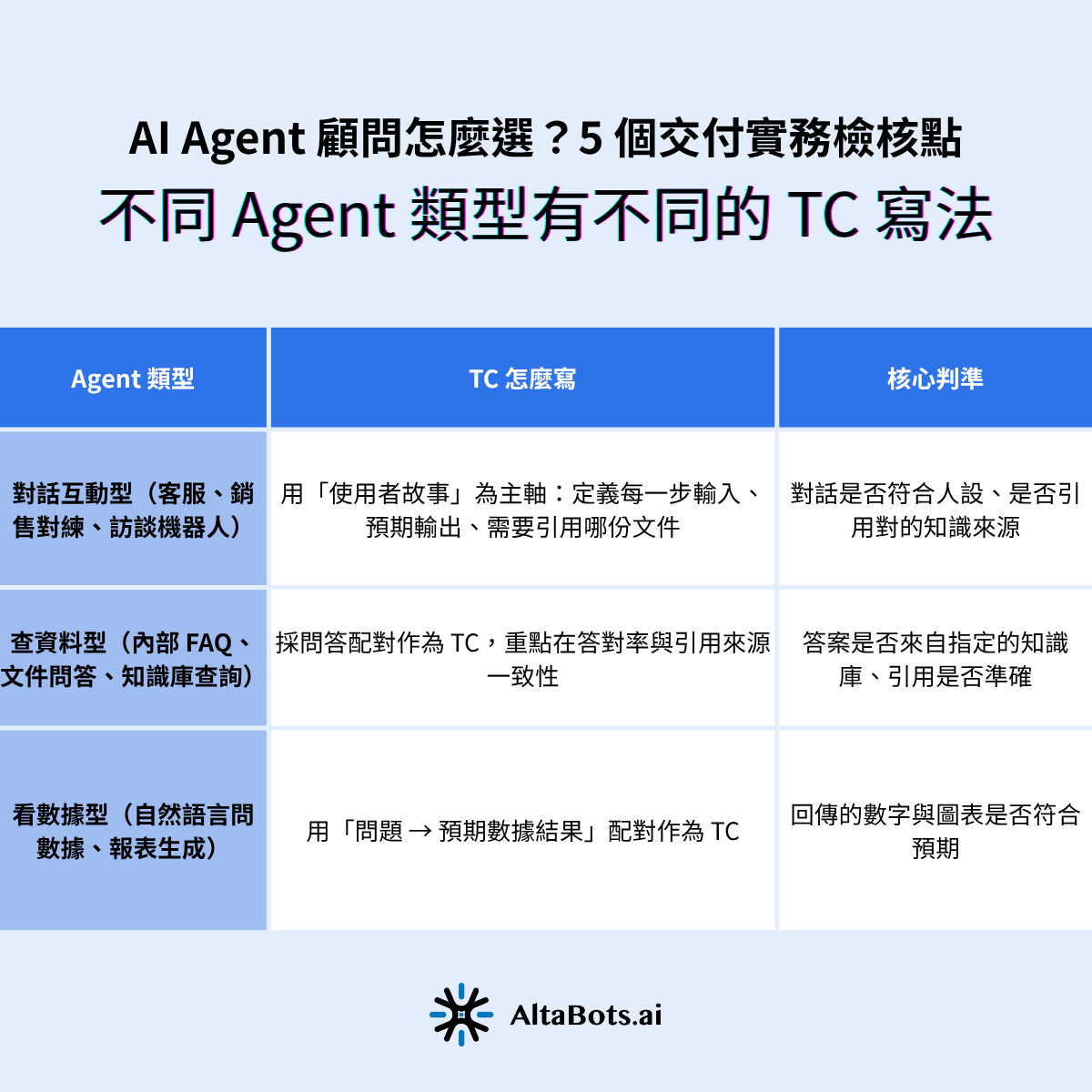
Each type of TC should also be divided into main flows and edge cases. In our project experience, most post-launch complaints cluster in edge cases. Whether a consultant is willing to write them into the TCs is a very practical dividing line.
There is one more question worth asking that few people ask: How is the TC pass threshold set? Outputs are probabilistic, so acceptance will not be "all one hundred questions correct to pass". A consultant who delivers will negotiate a specific accuracy rate with you, and which kinds of errors are red lines that "must never happen even once". If this number cannot be agreed, the acceptance criteria are still empty.
TCs get fine-tuned in real testing, and that is a good thing
A TC is not written once and fixed for life. Here is a situation we have encountered. The original TC said: "When the user enters content unrelated to the topic (for example, 'How is the weather today?'), the Agent should indicate that this content is outside the service scope." After testing, we found that users often make small talk before the formal conversation, and refusing every time made the interaction stiff. The TC was finally revised to "allow reasonable small-talk responses, and naturally steer back to the topic when necessary".
This kind of fine-tuning is a necessary part of "fitting the TC to real situations", and a consultant who delivers will say so up front and build it into the delivery rhythm. One related reminder: whether fine-tuning is charged separately, and how many rounds are free, should be spelled out in the contract.
3 files to request from the consultant before signing
If you are discussing a contract with a consultant, these three files are hard evidence of "real delivery capability":
- TC template from past projects (anonymized, with main flows and edge cases separated)
- Acceptance criteria corresponding to the TCs (clear Pass and Fail conditions, including the pass threshold)
- TC fine-tuning record (which TCs were changed after the last client test)
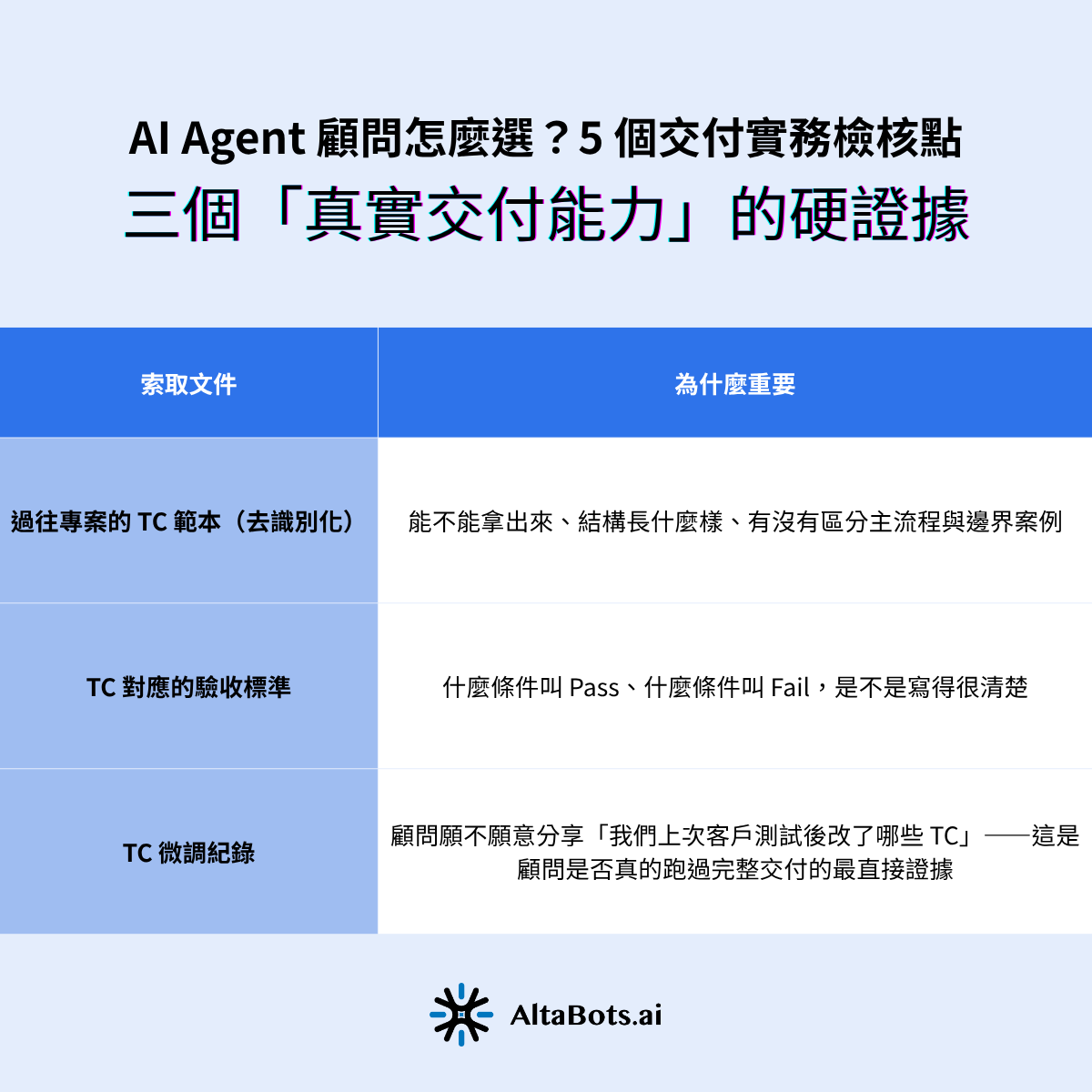
The third is the hardest to fake. It shows that the other side has run a full delivery cycle and is willing to let you see that they have revised their own specifications. If they cannot produce any of the three, it often means they are still at the "build it first, sort it out later" stage.
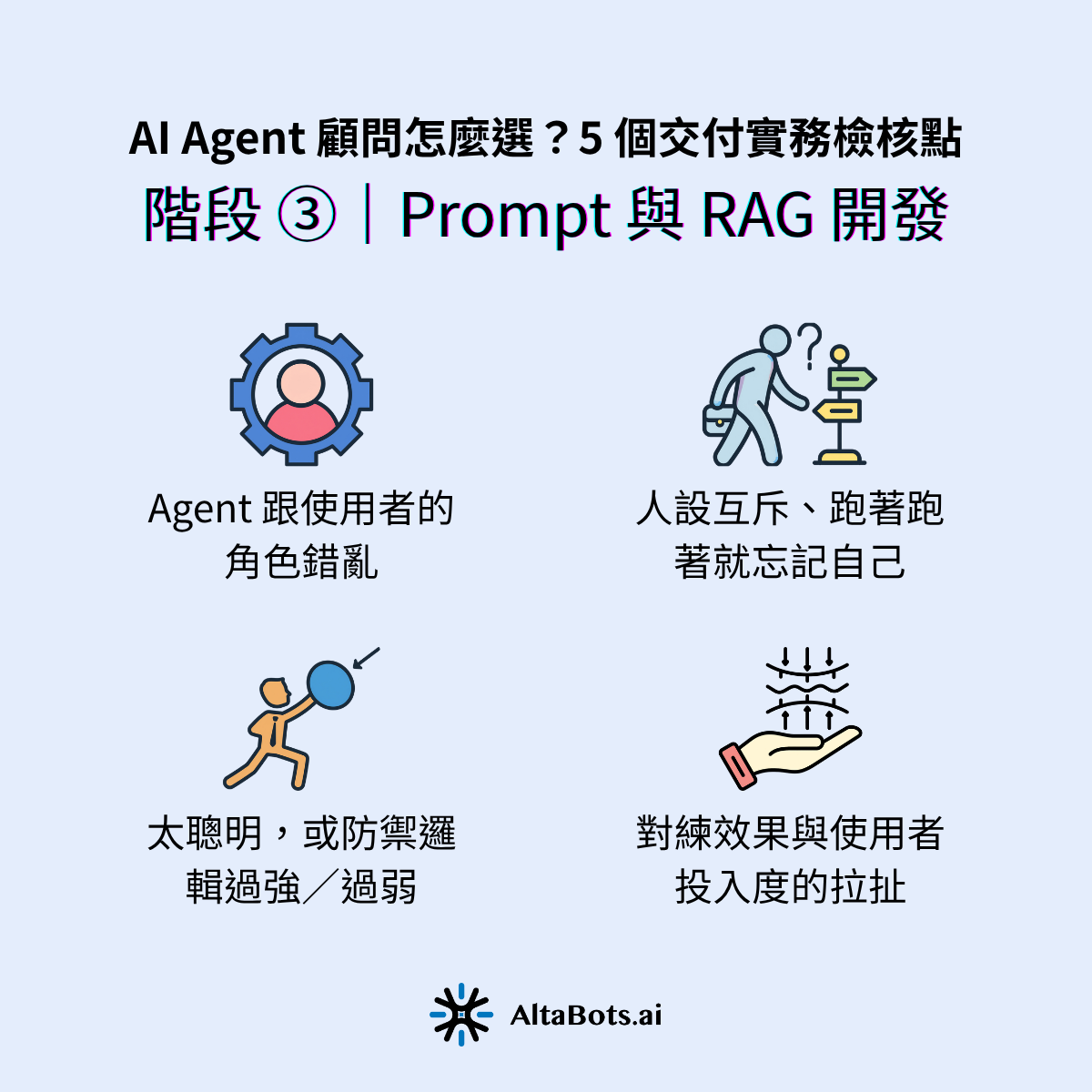
Stage 3 | prompt and RAG development: 4 pitfalls you will certainly Hit. does the consultant know how to solve them?
Whether a consultant can talk about failure is more informative than how beautifully they can talk about success.
The behavior of large language models is not fully predictable, and almost every conversational Agent runs into similar pitfalls. The difference is that an experienced consultant can solve them before the client notices, while an inexperienced one delivers the pitfalls to you as features. So the most effective approach is to ask them to describe one or two pitfalls they have hit, on the spot. You do not need to understand the technical fix. Just use the yardstick from earlier to listen for shape: can they describe a concrete scene (which project, which round of conversation, how it was discovered), or do they only give you "we've handled all that"?
Below are three pitfall scenes most common in practice-type Agents.
Pitfall 1: Roles and personas drift
The Prompt clearly defines "the user is a customer service agent, and the Agent plays a calling customer", but after a few rounds the Agent forgets who it is, flips to playing the customer service agent and starts answering for the user. The same happens with interview simulation Agents (which should ask questions but end up helping the candidate prepare answers) and sales training Agents (which should play the buyer being pitched but end up helping the salesperson think of scripts). The cause is that large language models are trained by default to be "the helpful side", so asking one to play the party being served goes against its default behavior.
The second symptom in the same family is that the persona fades as the conversation grows longer. You set "a senior procurement manager, conservative on risk, very particular about quality". The first three rounds go well, but by round eight or fifteen it suddenly becomes easygoing and agrees to everything.
Both are structural phenomena, not a badly written setup. The fix belongs to the implementation layer and you do not need to be able to do it yourself, but ask the other side how they solve it, because the answer to this question cannot be copied from documentation. If they can say "where in the Prompt we anchor it, what we did in which round, how long it took to stabilize", and can produce an anonymized example, they have done it. If they answer "that depends" or "that's a model capability problem", they have not.
Pitfall 2: Boundaries not defined, so the Agent is too clever or too nervous
One root cause produces three symptoms:
- Too clever: the user asks, "How does the plan you just mentioned compare with competitors?" The Agent really does go into details, but that is content it should not know under this conversation setup
- Over-defensive: the user merely makes small talk, "Nice weather today", and the Agent immediately replies "That is outside my service scope", souring the mood
- Under-defensive: the user asks about a completely off-topic political subject, and the Agent naively answers it
The underlying problem is that the model does not know what it should know. A consultant who delivers will hand over a list of "conversation scenario boundary rules (Guardrails)", spelling out which behaviors are allowed (reasonable small talk, naturally steering back to the topic) and which are forbidden (discussing topics unrelated to the scenario, revealing internal system settings). This list is a physical document you can request, and it is your checkpoint. You do not need to know how it was written.
Pitfall 3: The trade-off between flexibility and consistency (you can judge this one yourself)
Conversational Agents have a structural trade-off: the more up-front setup the user puts in, the more flexible the conversation but the less consistent the experience; the less they put in, the steadier the script, but over time it feels like reciting lines. A consultant who delivers decides which way to go based on "whether the usage scenario needs a clear goal", and helps the client understand this trade-off first, so that no one discovers afterward "why did it test well last week and not this week".
This question is especially useful to you because the criterion is not technical: you only need to observe whether the other side states the trade-off up front. A consultant willing to state trade-offs is usually also willing to talk about risks and failures. One who opens with "we can handle any scenario" will set off your yardstick on its own.
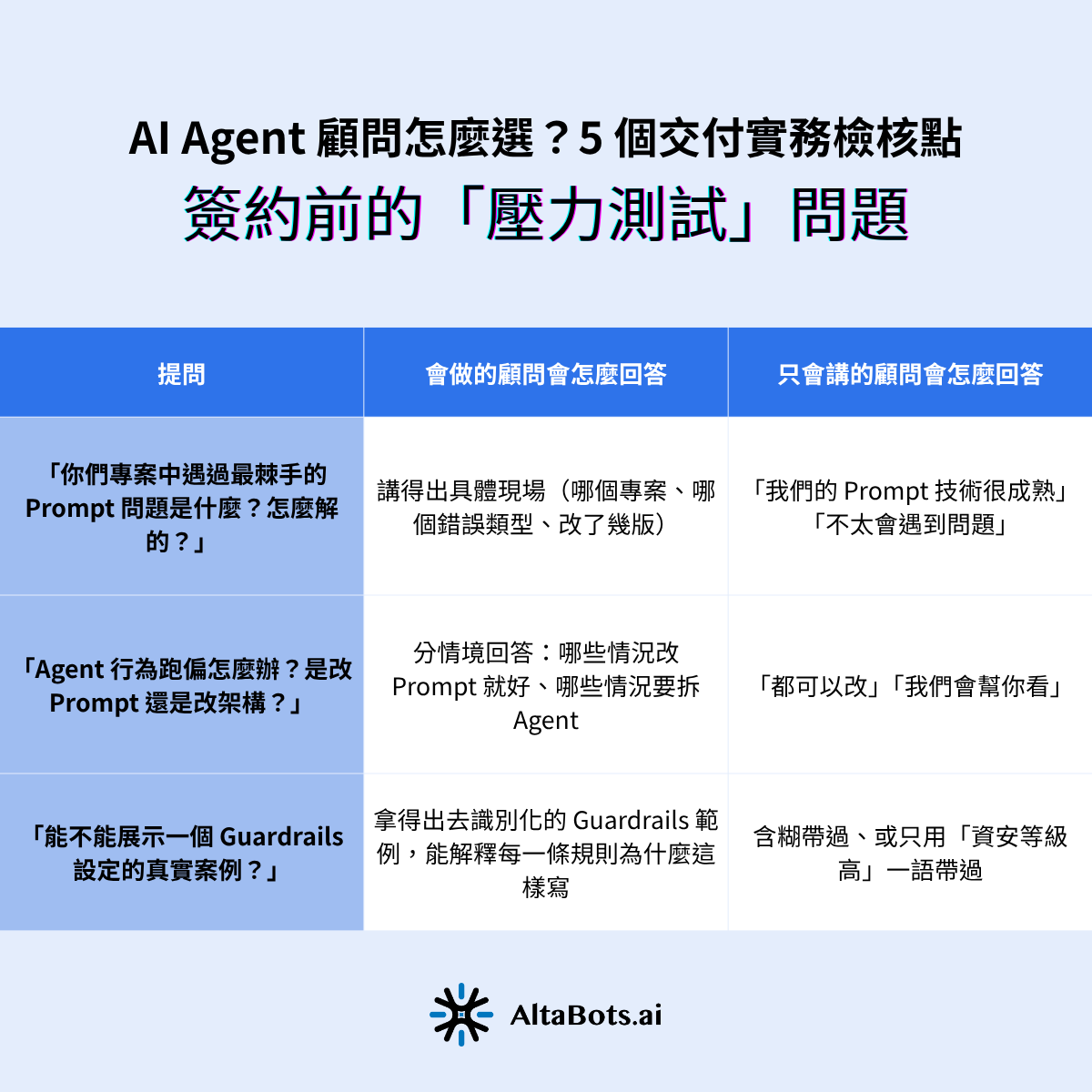
3 stress-test questions before signing
- "What is the toughest Prompt problem you have encountered? How did you solve it?" A consultant who delivers can describe a specific scene.
- "When the Agent's behavior goes off track, do you change the Prompt or the architecture?" A consultant who delivers will answer by scenario and explain the cost of each.
- "Can you show me a real Guardrails setup?" A consultant who delivers can produce an anonymized example and explain the purpose of each rule.
"Stress-test" questions before signing
Next time you meet a consultant, you can put these three questions to them:
- "What is the toughest Prompt problem you have encountered? How did you solve it?" A consultant who delivers can describe a specific scene.
- "When the Agent's behavior goes off track, do you change the Prompt or the architecture?" A consultant who delivers will answer by scenario and explain the cost of each.
- "Can you show me a real Guardrails setup?" A consultant who delivers can produce an anonymized example and explain the purpose of each rule.
Stages 4 and 5 | pre-launch tuning and post-launch evals support: where is the "last mile" of consultant delivery?
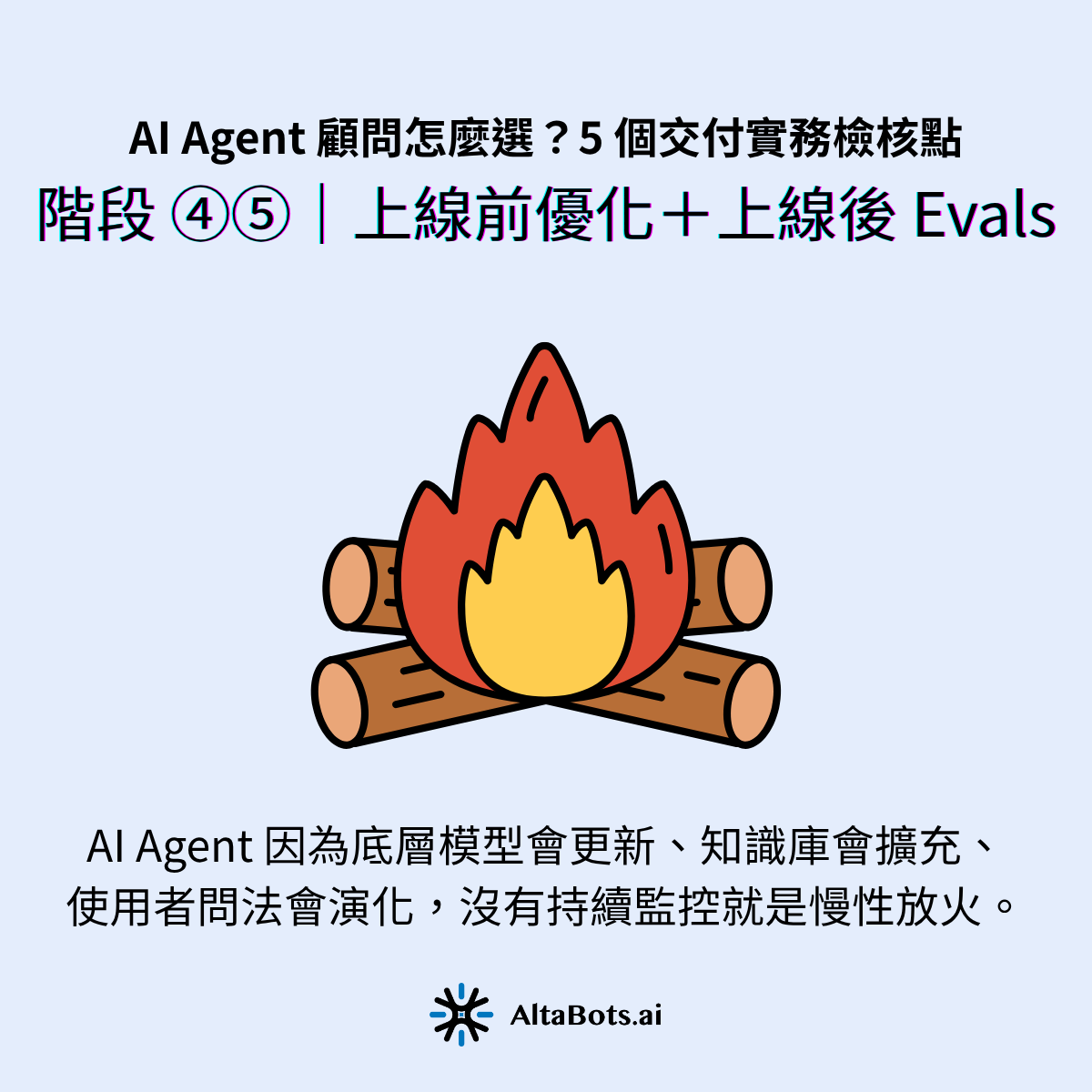
Launching an AI Agent is not the end of the project. It is the real beginning. Maintenance without an evaluation mechanism is like flying a plane with no instrument panel.
Traditional software does not change its behavior by itself after launch, as long as the specification stays the same. An AI Agent is different: the underlying model gets updated, the knowledge base grows and the way users ask questions evolves. Without continuous monitoring, it drifts out of control slowly. This is the last filter for choosing a consultant, and also the stage where vendors' prices differ most.
If you already have an Agent running and want to change who takes over maintenance, this section is your source of criteria. Take the three checkpoints below straight to the party taking over.
Pre-launch tuning: the client tests, not the consultant
Many consultants run a round of tests themselves before launch and deliver once they think it passes. This is the typical "only talks" approach.
A consultant who delivers does this: before launch, they always have people from the client side operate and stress-test the Agent in person, and record anomalies as issue cases. Then they do two things: adjust the architecture or Prompt according to the real anomalies, and classify the issue cases, define their frequency and degree of impact, and organize them into a post-launch monitoring metric library and success criteria. Before they have tested it by hand, the client's expectations of the Agent are vague. Only after operating it can they say, "The response I expect should look like this." A consultant who skips this step is pushing the whole maintenance responsibility onto the client.
One more point to pin down, because it easily leads to arguments: which is the basis for acceptance, the TCs in the contract or the issue cases found in pre-launch testing? The usual practice is that TCs serve as the acceptance baseline, and issue cases serve as the source of post-launch monitoring metrics. If this is not written clearly, here is the entry point for later disputes.
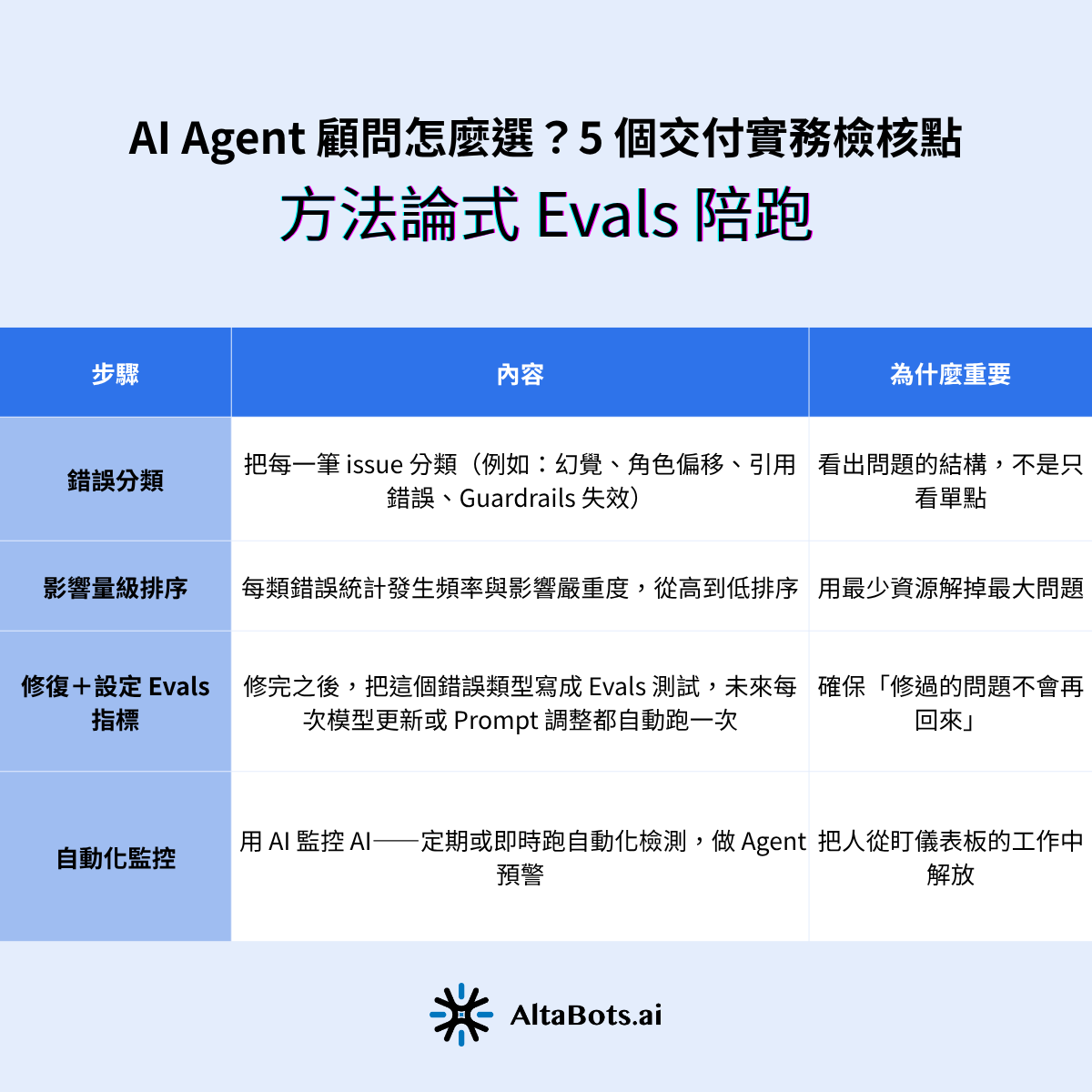
Two maintenance models, worlds apart after six months
The anti-pattern: "fix whatever the contact sees". The client-side contact (marketing manager, customer service manager, IT manager) reads conversation logs every day, reports any entry that looks odd, and the consultant fixes it. It sounds highly customized, but it has three fatal problems. There are no error type statistics, so you cannot tell whether an error is occasional or structural, and you may fix the entry in front of you while missing a whole batch of the same type. There is no priority order, so every issue looks equally important and it turns into whack-a-mole. And there is no measurable improvement, so after fixing, no one knows whether things really got better or just went wrong in a different way.
The right pattern: methodical evaluation support. This approach already has a mature methodology in public Agent engineering material [1][2], and its core is four steps:
- Error classification: classify each issue. The four common types are: Hallucination (saying things that are not in the knowledge base and were made up), Role drift (the persona or role slips, the phenomenon in Pitfall 1 above), Citation error (a source is cited, but the wrong document or the wrong passage), Guardrails failure (crossing a boundary defined in advance)
- Impact ranking: rank by frequency and severity, and fix the highest-impact ones first
- Fix and set evaluation metrics: so that fixed problems do not come back
- Automated monitoring: use a model to run checks on a schedule, rather than relying on people reading logs every day
You do not need to remember the names of the four types, but you can ask the other side for their error classification table. If they can sort by type and say each type's share, they are doing it. If they only say "we will keep improving", your yardstick rings again.
The peak of consultant value: is there a monitoring dashboard?
There is an intuitive yes-or-no question for judging maintenance capability: Does this consultant provide a "monitoring dashboard", and can they demo it live?
Agent error analysis and Evals support looks highly technical, but in essence it is a "continuous quality assurance" service. It includes dashboard design, a monitoring mechanism in which a model reviews the outputs of another model, recommendations for adjusting the Agent architecture (for example, "this Agent should be split into two"), and reorganizing the knowledge base and tuning the retrieval strategy.
You do not need to judge whether the other side has these capabilities; just ask for a live demo of a real dashboard. In a demo, you can tell what they built themselves from what was outsourced, and what exists from what does not. This is also why this question works better than any technical Q&A.
3 things the contract must state in black and white
- Length and frequency of maintenance support: a consultant who delivers gives a clear support period (in our own practice, 3-6 months) and a weekly or monthly review rhythm
- Delivery of error classification and the monitoring dashboard: state what form of dashboard is delivered and what you receive each month
- Pricing of Agent architecture adjustments: state in advance which adjustments fall within the support scope and which are extended services charged separately
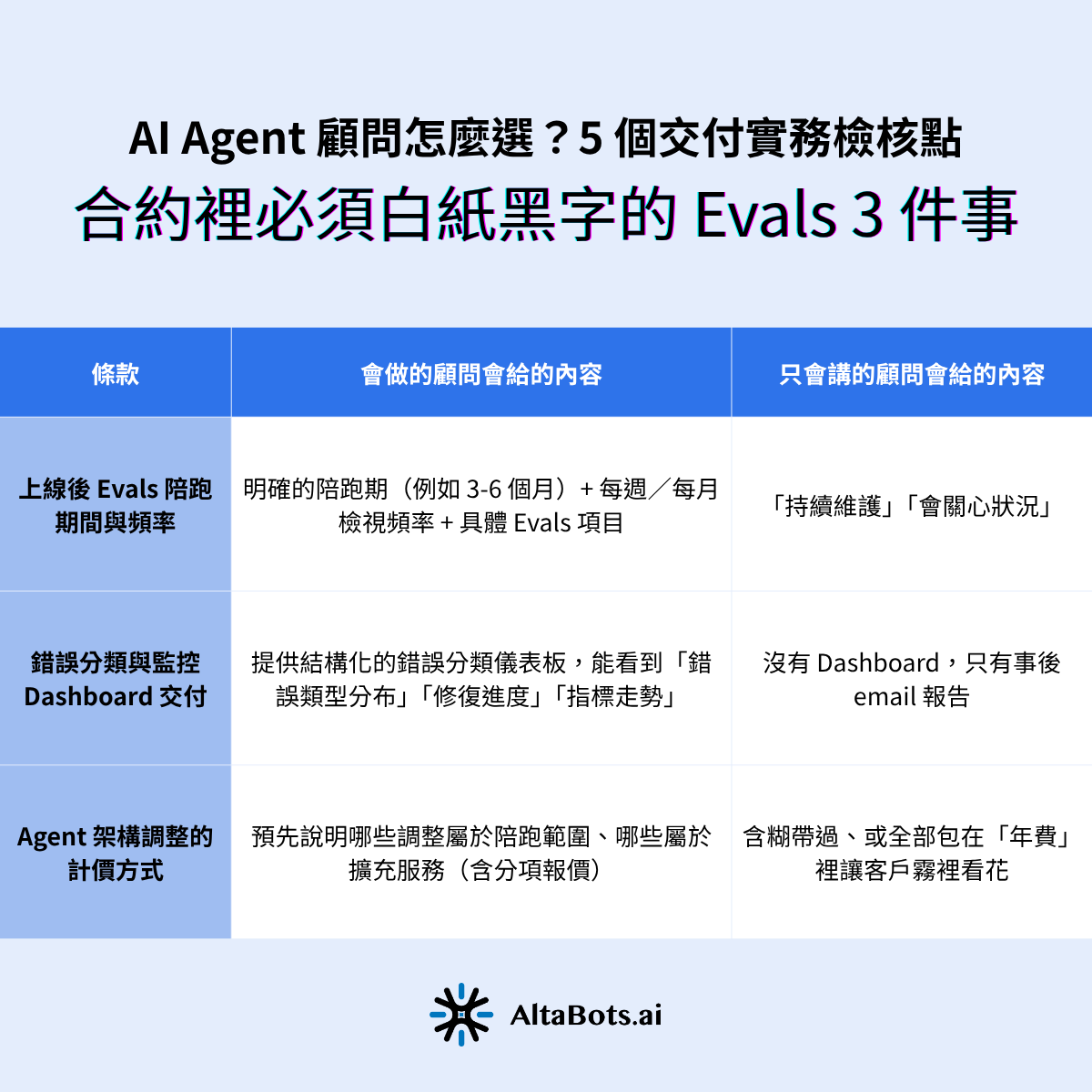
The third is the one most easily skipped and the one most likely to become a dispute in the fourth month. Asking clearly at signing takes far less effort than negotiating after launch.
5 questions to bring into the meeting
If meeting time is limited, ask these 5 questions first. The other side will reveal the rest on their own.
Schedule a 30-45 minute meeting and ask them in order. A consultant who delivers will naturally expand into details, cases and trade-offs. One who only talks usually starts dodging from question 3 and steers the conversation back to "our strengths".
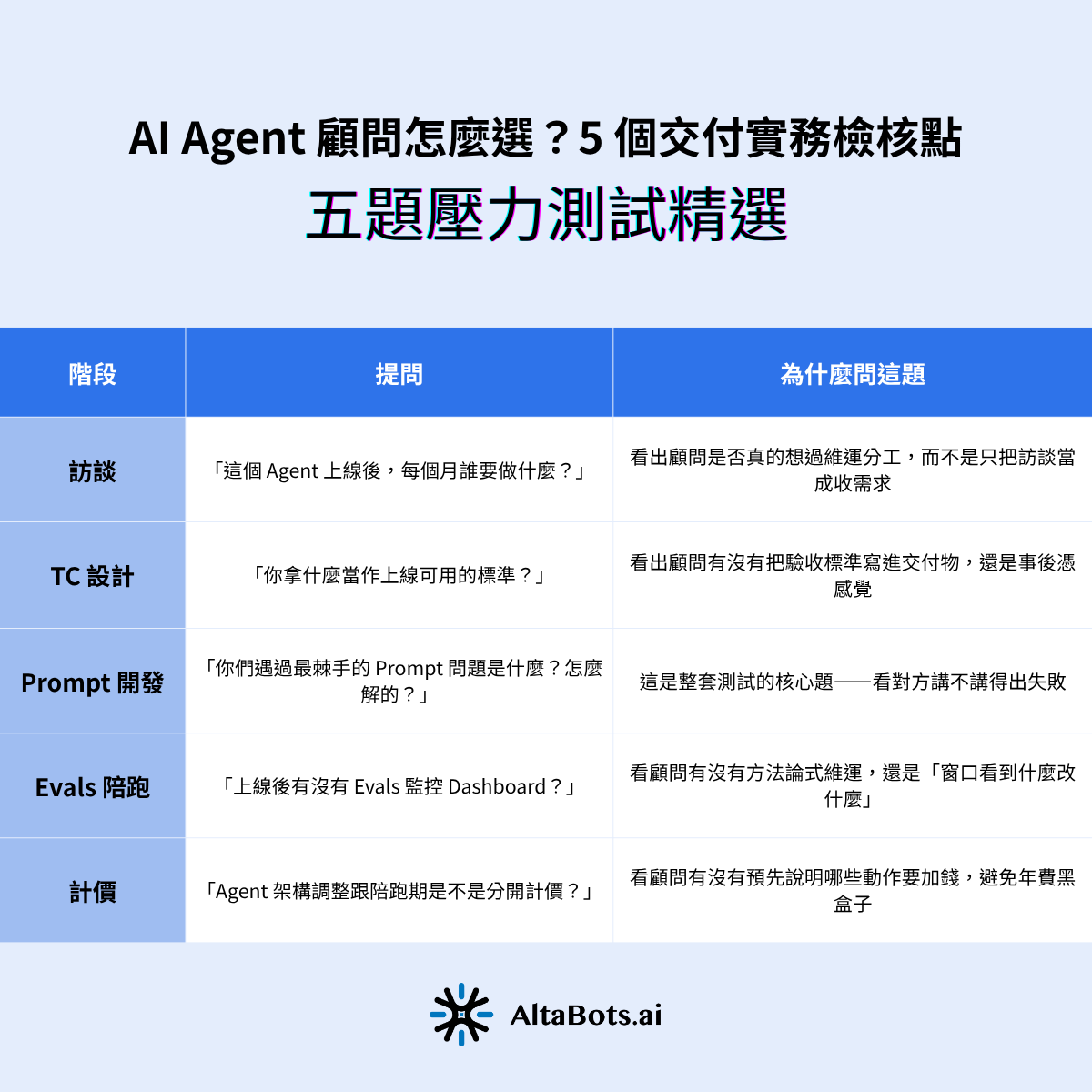
If you can ask only one question, ask question 3. What matters is not whether the answer is right but whether the other side can talk about failure. A consultant who delivers talks about failure naturally, while someone who has not really been through it will instinctively dodge.
Worried that the other side is a good talker who will make up a pitfall on the spot? Layer the three signs of evasion on top: ask them for countable things (which round, how many error types, how long it took), and ask them to produce an anonymized file. A story can be invented, but a file cannot.
For a fuller picture of how adoption works in practice, see 5 Major Risks to Know Before Adopting an AI Agent, or browse Data-DI's other practical guides to AI Agent adoption。
How does AltaBots.ai design consultant-led support?
What you buy is not a No Code platform but "a result that goes live".
We stated our position earlier, and here we finish the thought. AltaBots.ai is Data-DI's enterprise AI Agent platform, differentiated by a dual-track delivery model, "from boardroom decision to production, with consulting throughout", rather than by the No Code tool itself. Most platforms on the market take one of two routes: a pure SaaS tool (buy it, use it yourself, read the documentation when something breaks) or pure consulting (the consultant plans, the tooling is outsourced, integration is weak). We take a third route: the platform and consultants are deeply integrated, and every checkpoint in the five stages above is executed in a standard way inside the delivery process.
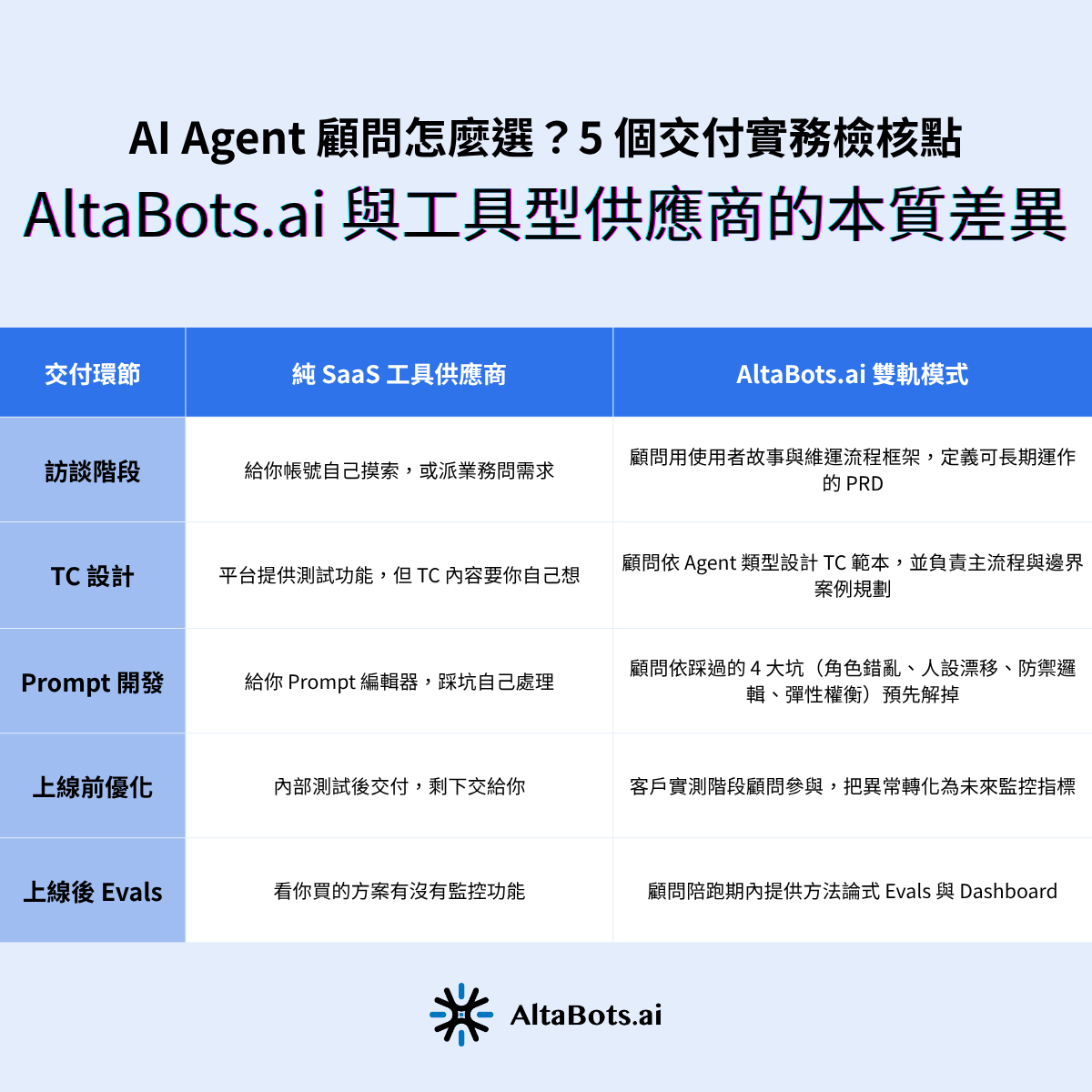
The purpose of this comparison is to help you judge whether you need a tool, or support through to results. If your team already has full adoption experience and only lacks a No Code tool, pure SaaS is enough and there is no need to pay for consulting. If this is your first adoption, or you are redoing a previous failed one, dual-track support is far more practical. If you are only trying it out on a very small budget, a free tool suits you better.
A note on why we do not make No Code our main selling point: it solves "who writes it" but not "what should be written". Whether an Agent gets into daily use and is still usable six months later has nothing to do with No Code and a great deal to do with the delivery capability across the five stages above.
How Can You Verify Us?
This article asks you to request anonymized files from vendors, and the same applies to us. At an evaluation meeting you can ask for these three directly, exactly as you would from any other vendor:
- An anonymized TC template, including the pass threshold and Pass/Fail conditions
- A Guardrails boundary rule list (a real example)
- A live demo of the error classification table and the monitoring dashboard
Our client names and performance figures are covered by contractual confidentiality and will not appear in public articles, so please do not evaluate us on "they say they have done many projects". Evaluate us on the three files above, because those can be verified. Apply the same standard to every vendor on your desk.
If your situation matches the first three points above, book a free AI Agent adoption assessment consultation: 30 minutes, attended by the consultant who would actually work on your project rather than a salesperson, to judge whether dual-track support can solve your current problem based on your company's stage, budget and team setup.
Conclusion | the core question in evaluating a consultant: can they talk about failure?
Back to the opening scene: proposal decks from four or five vendors on the table, each looking impressive. Now you have tools to judge with: see who can talk about failure, detail and trade-offs, rather than whose deck is the most polished.
The five delivery stages (interview, TC design, Prompt development, pre-launch tuning, post-launch maintenance support) are each a filter. A consultant who has taken projects into daily use can answer with concrete execution details at every stage, because those details were earned by hitting the pitfalls, being criticized by clients and revising many versions. One who has not will talk methodology, vision and "we are very professional", and start dodging once details are pressed.
And if you cannot follow the technical answers, that is fine. The three signs of evasion are enough: the density of adjectives, where they retreat when pressed, and whether they have ready-made files. None of these three requires any technical background.
What you are buying is essentially the ability of the consultant to work alongside you for the next six months or a year, not the one presentation in front of you today.
If you are evaluating an AI adoption consultant, or want to first confirm which kind of collaboration suits your company's current stage, you are welcome to use the five questions above on us.
References

[1] Simon Liu(2025). DevOps in AI Agent | Introduction to testing features for judging whether an AI Agent can go live: Google ADK AI Agent Evaluation concepts (in Chinese). Medium.
https://medium.com/@simon3458/adk-ai-agent-evaluation-intro-1-2025-2182627bb775
[2] Build School Learn(2026). A Complete Guide to AI Agent Evaluation: Key Methodology from Demo to Production-Ready System (Anthropic practical guide) (in Chinese).
https://learn.build-school.com/from-demo-to-production-ai-agent-evaluation/
[3] Data-DI (2026). AltaBots.ai internal project records. The four Major Issues in this article (role confusion, persona drift, defensive logic, and the flexibility-stability trade-off) and the five-stage delivery methodology come from Data-DI's hands-on experience across multiple conversational AI Agent adoption projects, anonymized.
FAQ
FAQs about this article
How is an AI Agent consultant different from an SI (system integrator)?

An SI centers on "connecting existing systems" and seldom deals with the design of AI behavior itself. An AI adoption consultant centers on "whether the AI's behavior can be put into daily use", and takes part throughout, from interviews, TC design and Prompt development to post-launch maintenance. What an SI does well is connect tools to internal systems such as ERP and CRM. A simple test: ask the other side, "When the Agent answers wrongly, how do you tell whether the Prompt needs fixing or the knowledge base needs filling?" Only the latter can answer. The two are not substitutes. Large projects often need both, but you should be clear about which one you lack right now.
Are AI operations consultants and AI adoption consultants the same people?
Not necessarily, and this is the gap buyers fall into most often. An adoption consultant gets the Agent to the point where it can launch. An operations consultant (in Taiwan usually called "maintenance") keeps it usable after launch. Maintenance covers error classification, metric monitoring and re-validation when the model is upgraded. Some vendors do only the first part and fade out after delivery. Others do both, but price them in completely different ways. Before signing, ask directly: "Does your service end on launch day, or include the period after? Up to which month?" Writing the answer into the contract takes less effort than amending it afterward.
When switching to a new consultant to take over maintenance of an existing AI Agent, what should you request from the previous vendor?
At least four items: the full Prompt versions with their revision history, the original knowledge base documents and chunking rules, the TCs and acceptance criteria, and the post-launch error records. Without the last two, the party taking over has to rediscover your system from scratch. Ideally, the first contract states that all four are deliverables. Asking for them only when you want to switch leaves you in a much weaker bargaining position. If a new consultant does not ask you for these on their own, that is also a signal.
How should you budget for AI Agent adoption?
The budget is usually split into three parts: interviews and planning, development and testing, and post-launch maintenance with consultants working alongside you. A consultant who delivers gives an itemized quote so you can see what each part costs. If you only get a total, you cannot tell which part was squeezed. Ask especially about change costs: who pays for a Prompt revision, whether an architecture adjustment falls within support or is charged separately, and whether knowledge base updates are done by your side or the consultant's. The answers to these three questions will decide your actual spending in the second year, and they are usually not on the first quote.
Is AI Agent adoption suitable for small and medium-sized businesses without dedicated IT staff?
Yes, provided you state "who maintains it" up front. An AI Agent needs someone to feed it new data and adjust the knowledge base every month. That person need not be an engineer, but there must be a named person with clear monthly actions. A company without dedicated IT should put the length and deliverables of maintenance support into the contract all the more, because you have no internal team to take over. Ask in the interview stage: "After the support period ends, what capabilities do we need on our side to carry on?" A consultant who cannot answer has usually not thought about your situation.
More articles


訂閱我們的電子報
每月 8 日定期發送最新趨勢與實用資訊!



