

5 AI agent adoption risks: 88% already hit them | Alta.DI
88% of companies have already had an AI Agent security incident. Is yours ready? This article examines five adoption risks, including data privacy, black-box decisions and prompt injection attacks, and offers concrete solutions to help companies build an auditable AI governance system.


The risks of adopting AI Agents are five systemic problems: data privacy leaks, black-box decisions, security and identity gaps, organizational resistance, and model bias. They grow together as autonomy increases, and cannot be solved by technical debugging alone.
According to a survey of 919 executives and technical practitioners worldwide by Gravitee in early 2026, 88% of companies had experienced or suspected an AI Agent-related security or privacy incident in the past year, and yet among the same respondents, as many as 82% of executives believed their policies were "sufficient to prevent unauthorized Agent actions" [1]. These figures say one thing: there is a dangerous gap between companies' awareness of AI Agent risk and their actual protective capability.
In 2026, AI Agents have moved from experimental projects to core infrastructure of daily business operations. According to McKinsey's late-2025 State of AI survey, 88% of companies regularly use AI in at least one business function, but about two thirds are still at the experiment or PoC stage. At the same time, 51% of organizations using AI have experienced at least one negative consequence, and "inaccurate AI output" is among the most common problems [2]. Together these data points deliver one core warning: rushing ahead with AI Agents before risk management is in place is not transformation, it is planting mines.
As consultants who have long helped companies with AI transformation, we group the risks companies most often meet when adopting AI Agents into five: data quality and privacy, insufficient decision transparency, security and identity safety, organizational culture shock, and model bias and ethics. When we work alongside companies from PoC to full launch, the most common point of failure is often not that the model lacks capability, but that risk control cannot keep up with the pace of adoption. This article examines the five risks one by one and offers concrete, workable solutions, to help you steadily manage this capable digital employee who cannot be blindly trusted.

Risk 1: Will an AI Agent Leak Company Data?Data quality and privacy risk
Key point of this section: the AI outputs what the knowledge base feeds it. Clean the data first, then talk about technology.
The first major risk of adopting AI Agents is data quality and privacy. When the knowledge base an AI Agent relies on is full of outdated information, wrong data or personal data that has not been anonymized, it not only produces erroneous hallucinated output but may also leak sensitive content such as employee salaries and customer personal data without anyone intending it, violating personal data regulations and triggering a crisis of trust.
The quality of an AI Agent's judgment depends entirely on what data it "reads." If the knowledge base a company feeds in is messy, the AI's output is not only useless but can become a double landmine for legal exposure and reputation.
Pain points
Hallucination is the most common problem when data is insufficient: the AI may give a completely wrong answer in a highly confident tone, and will not say on its own that it is guessing. A more serious compliance landmine arises if the AI is allowed to access salary data or customer personal data without permission controls and leaks it inadvertently when answering other employees' questions; the company then faces legal action under the Personal Data Protection Act. Social Lab's 2026 industry insight report also notes that when a company knowledge base suffers from "data misplacement," where the system pulls an outdated draft instead of the final version, the AI's "professionally wrong answers" are often harder to notice than obvious errors, so the risk is actually higher [3].
Solution
Adopting a platform with RAG (retrieval-augmented generation) technology is key. Taking AltaBots.ai as an example, it supports learning from diverse data (documents, databases, APIs), keeps the AI answering within a controlled scope of knowledge, and through a real-time update mechanism greatly reduces the risk of hallucination caused by outdated information.
Recommended action: do a full "data cleaning" before adoption, and apply the "principle of least privilege" to each AI Agent: it can see only the minimum data needed for the current task, and temporary access is revoked automatically once the task is done.
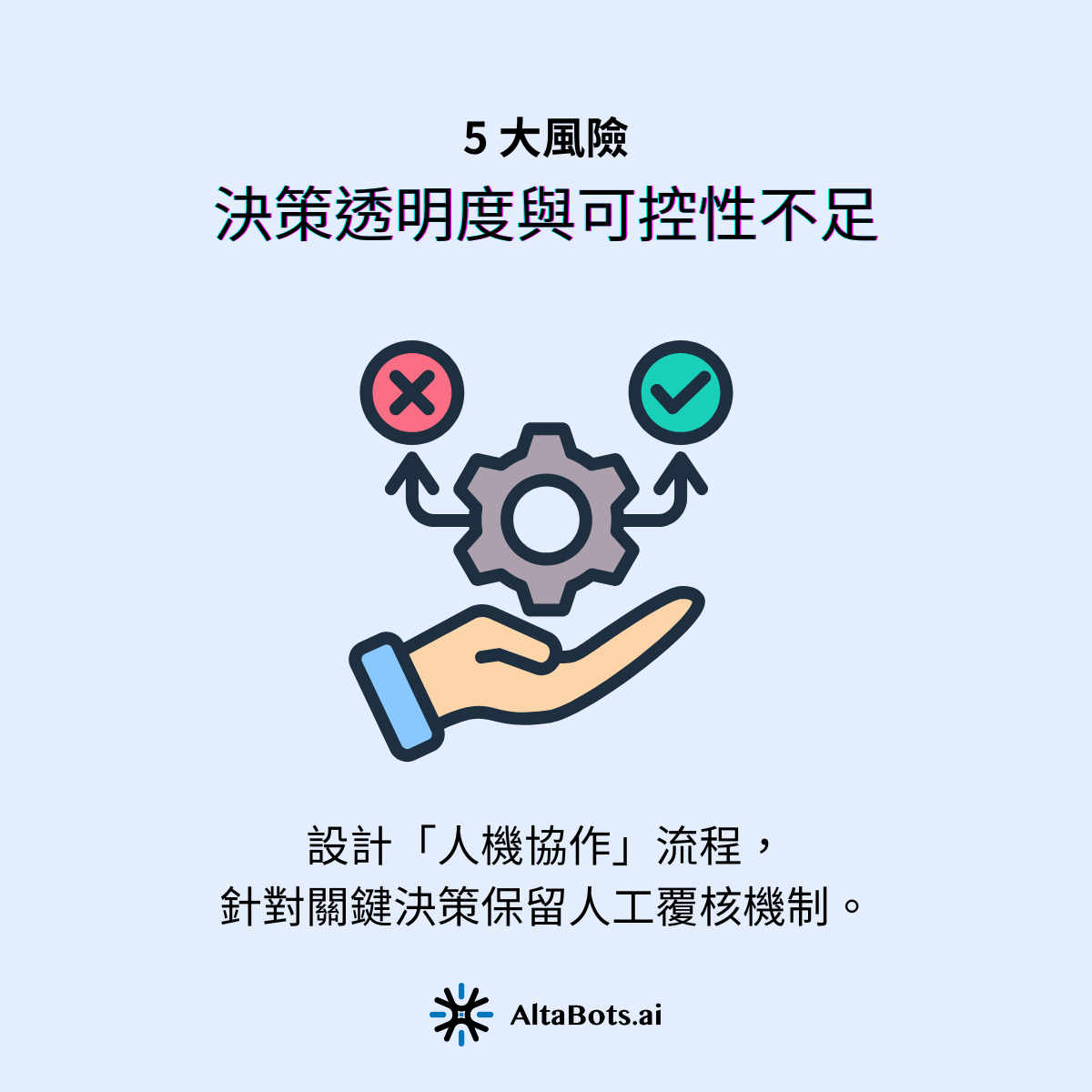
Risk 2: can the decisions an AI agent makes be traced?Decision transparency and control
Key point of this section: if you cannot explain how the AI decided, no one can bear responsibility when something goes wrong.
The second major risk of adopting AI Agents is insufficient decision transparency. AI Agents can reason autonomously, and their decision process is often like a black box. When an AI customer service agent promises a wrong discount or an AI analyst gives an aggressive recommendation, the company cannot trace the cause or clarify responsibility, and automation without human review can set off a chain of errors, so that losses are irreversible by the time they are found.
Traditional automation runs on hard-coded rules, so when it errs you know where. An AI Agent's reasoning path is generated dynamically, and every decision may follow a different logical path. This unexplainability is a minor nuisance in low-risk scenarios, but once it involves financial write-offs, legal contracts or customer commitments, it can cause business losses that cannot be recovered. That is why building a repeatableerror analysis and evaluation mechanismreduces risk more than assigning blame afterward.
Pain points
Unexplainability is the risk item where companies most often "know there is a problem but have no countermeasure." McKinsey's 2025 State of AI survey notes that among the risk categories where companies most often suffer negative consequences, "explainability" ranks second, yet it is also the risk companies address least actively. In other words, most companies know the AI works as a black box but have built no mechanism to deal with it. The risk of losing control also deserves attention: in an automated process with no human review checkpoint, once the AI's judgment drifts, errors amplify down the automation chain, and the resulting loss often far exceeds a single human mistake.
Solution
Companies should adopt a "human-in-the-loop" model and set mandatory human review checkpoints for high-risk decisions (such as financial write-offs, legal contracts and customer refund authorization). AltaBots.ai supports full decision logging and review, so every AI judgment path can be tracked and explained, ensuring the company keeps full control over its digital employees.
Recommended action: before deploying an AI Agent, classify each automated scenario by "decision risk level," and for any decision involving money, contracts or customer commitments, always keep a human final-confirmation checkpoint.
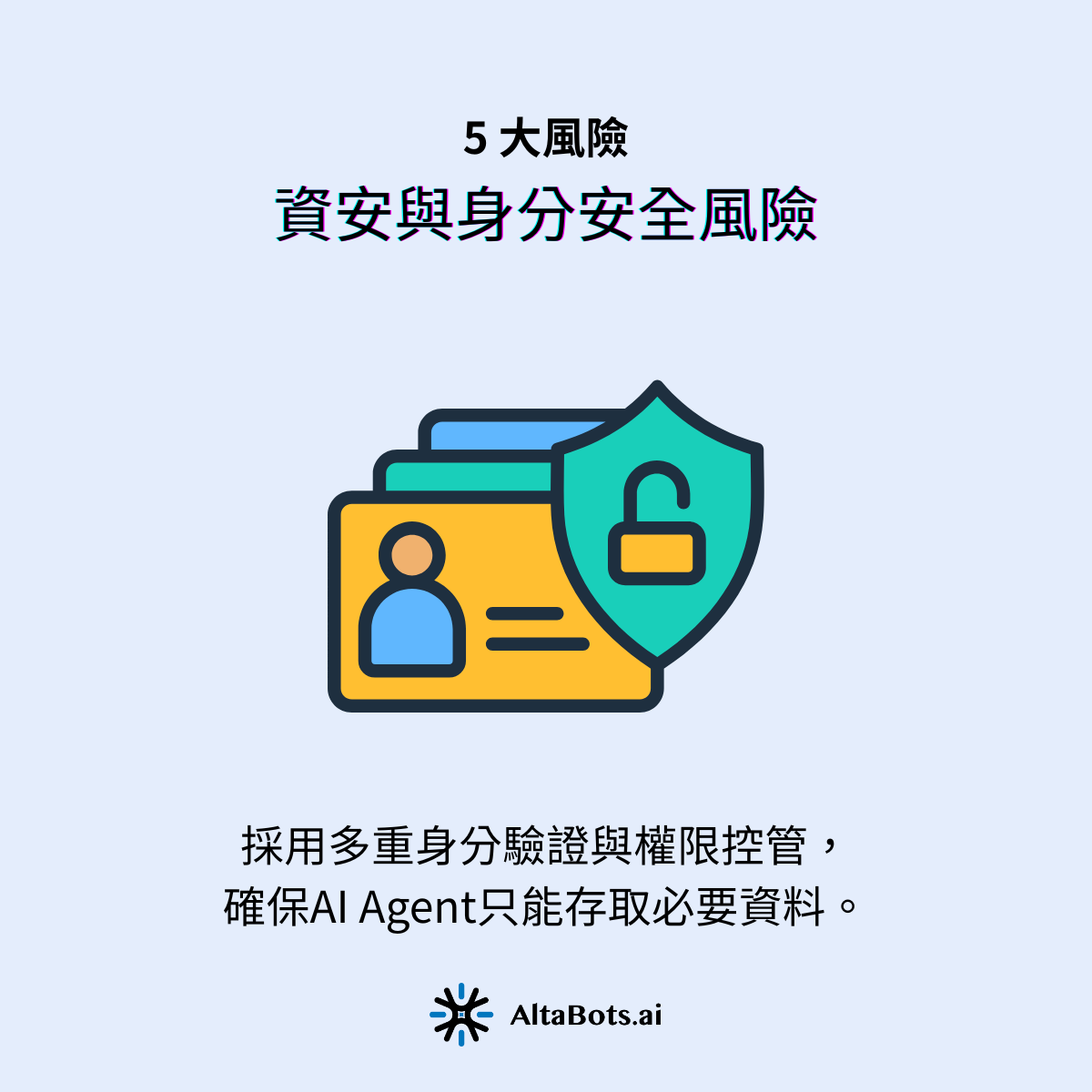
Risk 3: will an AI agent become a new entry point for hackers?Security and identity safety
Key point of this section: the number of Agents is doubling, but security oversight cannot keep pace.
The third major risk of adopting AI Agents is security and identity safety. An AI Agent holds OAuth tokens and API keys under a machine identity and accesses internal systems autonomously around the clock. If it suffers a prompt injection attack or its permissions are set improperly, it may not only leak trade secrets but also become a new entry point for hackers to bypass traditional firewalls and penetrate the whole corporate network. The first step in solving the shadow AI problem is often to see clearlywhere unauthorized Agents are actually hiding.
In 2026 this risk has escalated from a "theoretical threat" to a "common reality."
Pain points
According to Gravitee's State of AI Agent Security 2026 report, 88% of companies had experienced or suspected an AI Agent-related security or privacy incident in the past year, but the same report also notes that only 14.4% of AI Agents passed a full security review process before going live [1]. Gravitee's follow-up survey in April 2026 further showed that the number of Agents deployed inside companies doubled in just four months, yet only about 24% of companies have full visibility into "how Agents communicate with each other." The risk exposure is growing much faster than governance can catch up [1].
Taiwan's Administration for Cyber Security under the Ministry of Digital Affairs also issued a warning in March 2026, noting that because AI Agents hold very high system privileges and run autonomously around the clock, they can easily become a breach point for hackers into personal machines and corporate networks if protections are not set properly. The agency specifically named three categories of high-risk threat scenarios: prompt injection attacks, privilege escalation and supply chain vulnerabilities [4].
In December 2025, OWASP formally published the OWASP Top 10 for Agentic Applications 2026, listing "agent goal hijacking," "tool misuse" and "identity and privilege abuse" as the top three threats. These risks barely exist in traditional LLM applications but are systemic weaknesses of the AI Agent architecture [5].
Solution
Security protection has to start from "identity." Every AI Agent should have its own machine identity rather than sharing an employee account or API key. AltaBots.ai provides role permission settings and AI credit controls that precisely limit how each employee and AI interact, and uses multi-layer protection to prevent leaks of sensitive data. Data-DI itself is also ISO/IEC 27001 certified.
Recommended action: before deployment, create an independent identity credential for each AI Agent and set time-limited temporary authorization. For high-risk operations (accessing credentials, sending email, executing system commands), enforce human review and confirmation, so that every key action of an Agent leaves a traceable audit record.
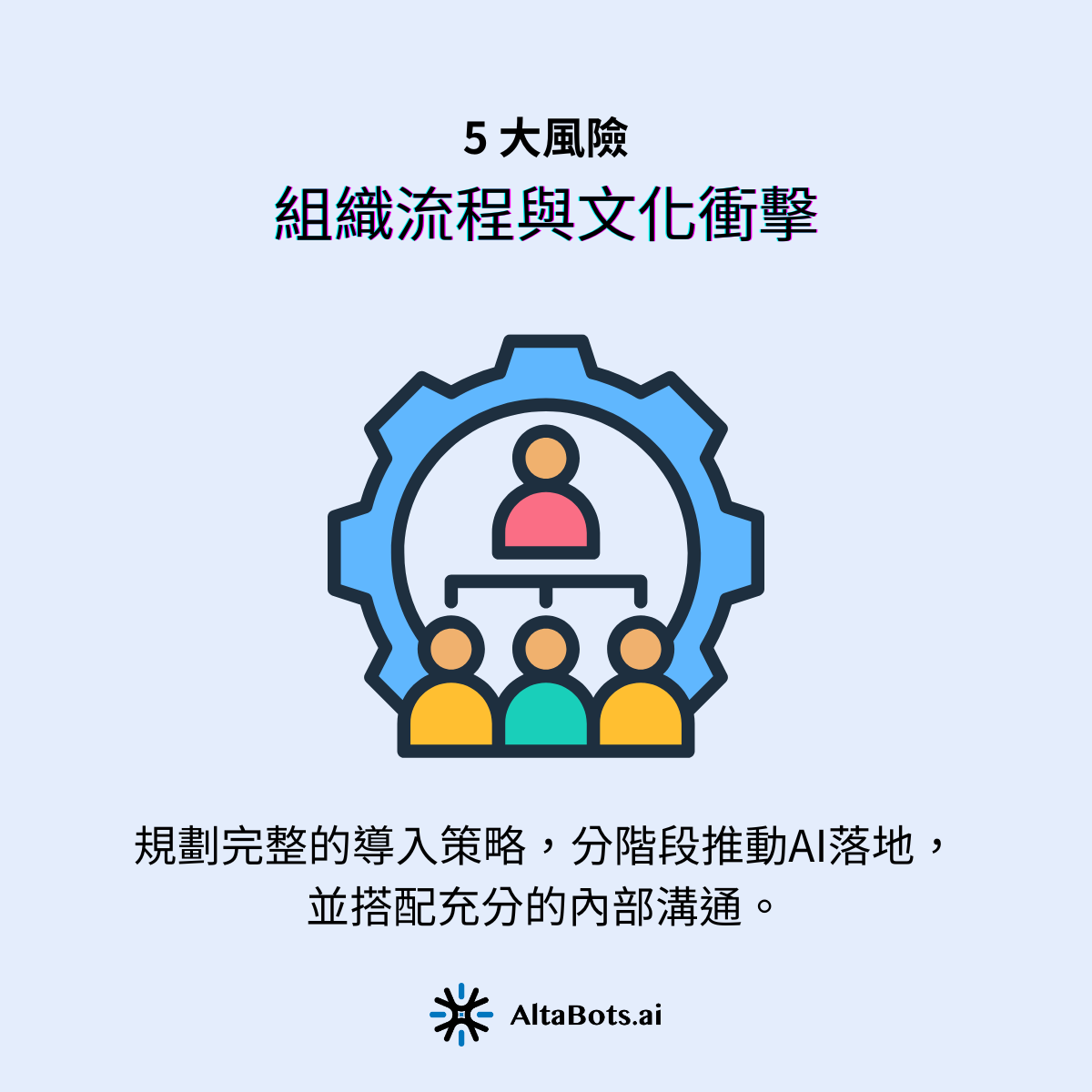
Risk 4: What If Employees Resist Adoption?Organizational process and culture shock
Key point of this section: technical hurdles are easy to clear; the hurdle in people's minds is hardest.
The fourth major risk of adopting AI Agents is organizational culture shock. When employees worry about being replaced, find the operating threshold too high or are unclear about accountability, they often cooperate passively or even resist during adoption, leaving an expensive AI system as a white elephant. The company not only fails to gain efficiency but bears extra change management costs and lost morale.
Adopting AI is not only a technical problem but a "people" problem. Many companies make smooth progress in the PoC stage and then meet strong resistance when rolling out company-wide, and that resistance often comes not from the technology itself but from the people in the office who have not yet been persuaded.
Pain points
A steep learning curve is the most common barrier to adoption: AI tools that require writing prompts or a technical background to operate have a very low success rate when rolled out to non-technical departments. Sales, marketing and customer service are often where AI Agents are most valuable, yet they are also the groups most sensitive to technical barriers. Job anxiety also cannot be ignored: when employees have no clear guidance on transition and do not know "what my job will become once AI arrives," hostility toward AI quietly builds in private and ultimately affects overall adoption through passive cooperation.
McKinsey's 2025 survey confirms this observation: among companies with the weakest AI results, failing to redesign workflows as AI was adopted was one of the main failure factors, and the core obstacle to redesigning workflows was resistance to change inside the organization.
Solution
Lowering the barrier to use is the fundamental way to raise acceptance. A no-code platform lets non-technical staff such as sales and marketing quickly build their own AI workflows without any programming background. AltaBots.ai provides a drag-and-drop design interface and an "enterprise AI App Store" concept, where each department can pick the AI tools it needs the way it downloads phone apps, moving employees from "afraid of being replaced by AI" to "managers who actively steer AI."
Recommended action: before adoption, identify 2-3 "seed users" in each department, let them try it first and become internal advocates; at the same time, communicate the division of work clearly as "AI handles repetitive work, people handle judgment and relationships," to reduce the root of job anxiety.
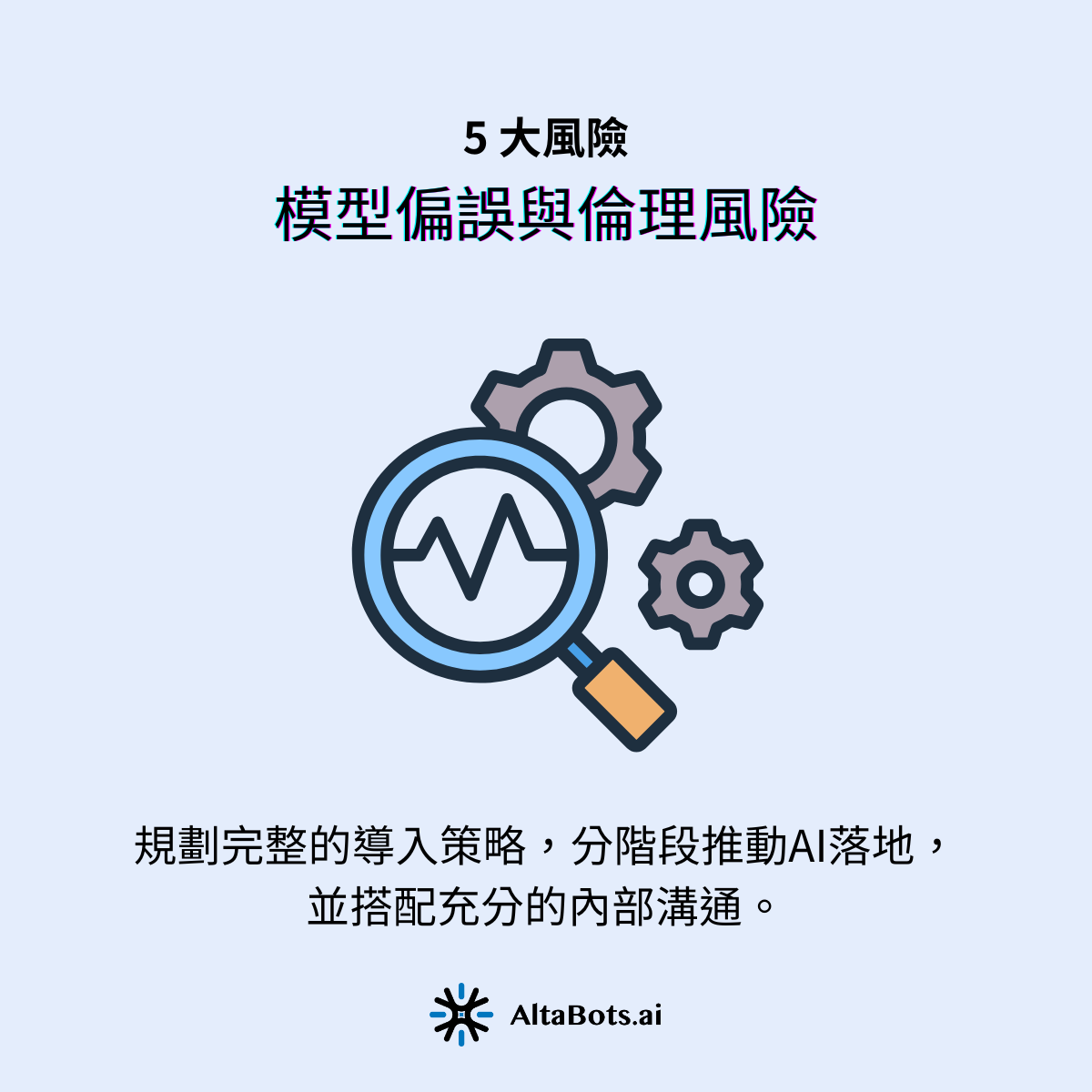
Risk 5: could an AI agent show bias and hurt the brand?Model bias and ethical risk
Key point of this section: Taiwan now has a law to follow, and "not yet legislated" is no longer an excuse.
The fifth major risk of adopting AI Agents is model bias and ethics. When an AI Agent's training data or system settings carry historical bias, it may show systematic discrimination in highly sensitive scenarios such as recruitment screening, customer service and credit review. Once screenshots circulate or regulators inspect, it not only directly damages the brand's reputation but may also trigger lawsuits and a falling ESG score in a chain effect.
What makes this risk especially dangerous is its concealment: model bias does not show up immediately like a system crash, but keeps appearing as "reasonable-looking decisions," causing cumulative, irreversible damage before it is found.
Pain points
Damage to brand reputation is the most direct impact. If an AI customer service agent gives widely different response quality to questions from particular groups, or a recruiting AI systematically filters out applicants with a certain background, once amplified on social media it often sparks a public opinion crisis before the company can respond. Unfair decisions are especially serious in finance and HR: systematic bias produced by AI in lending or hiring already meets the legal definition of discrimination in many countries, which is a fatal blow for modern companies that care about ESG compliance.
The latest change in the regulatory timeline: Taiwan's Artificial Intelligence Basic Act passed its third reading in the Legislative Yuan on December 23, 2025 and was promulgated by the President on January 14, 2026. The law has 20 articles, the central competent authority is the National Science and Technology Council, and it sets seven governance principles including fairness and non-discrimination, transparency and explainability, and accountability, using a risk "classification" framework rather than an EU-style mandatory tiering [6]. This means the vague period in which companies "did not know where the red lines are" has ended. Over the next 12 to 18 months, the relevant competent authorities will successively set out corresponding risk classifications and implementing rules, and a company that only now starts taking stock of the explainability of its AI decisions does not have much time. The EU AI Act timeline is just as tight: compliance obligations for high-risk AI systems formally enter the enforcement stage from August 2026. AI decision mechanisms that are not explainable and accountable will find it hard to hold their ground in international supply chains and compliance reviews.
Solution
Establishing an "AI ethics review mechanism" and choosing a platform that allows customization of the AI persona and response boundaries is the fundamental way to reduce bias risk. AltaBots.ai lets companies freely choose the underlying LLM, and through a customized System Prompt sets the AI's response style and off-limits areas, so that every line of AI output fits the company's brand image and core values, while keeping full decision records for auditing.
Recommended action: before high-risk scenarios (recruitment screening, credit evaluation, complaint handling) go live, run a cross-department "bias test": feed in virtual scenarios with different backgrounds and see whether the AI gives consistent and fair outputs. Also set a regular AI output quality review cycle, rather than letting it run after a one-time acceptance.
Where is the wind blowing for enterprise AI agent adoption in 2026?
Key point of this section: even Gartner says four in ten projects will be cut, for reasons tied to runaway spending, unclear value and weak risk control, not a model that is not smart enough.
In June 2025, Gartner predicted that by the end of 2027, more than 40% of agentic AI projects will be canceled, because of escalating costs, unclear business value and inadequate risk controls. In July 2026 the prediction was cited and discussed again by Forbes, meaning its time window falls right now [7]. The same research also points to the "agent washing" phenomenon: although there are thousands of vendors claiming to offer agentic AI, only about 130 are estimated to have real autonomous agent capability. Risk management and partner screening have replaced model performance as the lifeline that decides whether an AI project survives.
In addition, McKinsey's 2025 The state of AI in 2025 survey shows that although 88% of companies already use AI regularly in at least one business function, nearly two thirds are still at the experiment or PoC stage, and only about one third have truly entered large-scale adoption [2]. Meanwhile, 51% of organizations using AI have experienced at least one negative consequence from AI, of which "inaccurate AI output" is among the most common risks, and together with privacy and compliance it is among the risk categories companies are most actively mitigating [2].
Expert takeaway: the data above shows a marked shift in market direction. Companies have moved from the early fervor of "blindly chasing AI performance" to a calmer "pursuit of Trustworthy AI." Only an AI Agent built on security and transparency, and chosen through careful partner screening, can truly bring a company long-term business value.
Conclusion: choose the right tool, and let risk become a competitive barrier
Adopting AI Agents is a long-distance run that takes patience and strategy, not a hundred-meter sprint. From data governance, decision transparency, security protection and organizational change to ethics and compliance, the five risks are interlinked, and neglect at any link can turn a digital employee meant to raise efficiency into a hidden burden for the company.
Companies that manage risk well can often turn this barrier into a competitive advantage. While most peers are still deploying AI Agents with a "let's try it" attitude, your company has already built an auditable, explainable, bounded AI governance system, which is in itself an organizational capability that is hard to copy.
The "agent washing" phenomenon mentioned earlier points to the same thing: many tools on the market claim to do agentic AI, but few partners can truly work with you to resolve the five risks one by one. Rather than feeling your way alone, find a partner from the start who understandshow to design the process, not just sell you a system.
AltaBots.ai is a no-code AI Agent platform built for enterprises, but the real difference lies not in the tool itself but in how consultants work alongside your team, going through each item and putting each into daily use. Specifically, AltaBots.ai addresses the five risks above through these core capabilities:
- Enterprise-grade security and permission control: built-in role permission control and credit monitoring, with an independent identity credential and least-privilege boundary for each AI Agent, to keep data from leaking.
- Precise RAG retrieval: integrates internal company documents and data, and uses retrieval-augmented generation to greatly reduce AI hallucination risk, so the AI answers only within a controlled scope of knowledge.
- Full decision records and review: supports a human-in-the-loop model, where every AI judgment path can be tracked and explained, so high-risk decisions always keep a human final-confirmation checkpoint.
- Highly flexible no-code design: a drag-and-drop interface lets business experts quickly build their own AI digital employees without a technical background, greatly reducing organizational resistance to adoption.
- Rigorous PoC process and consultants working alongside you: from adoption planning to benefit verification, professional consultants support you throughout, so that adoption results can be quantified and risks controlled. This is also the most fundamental difference between us and vendors who simply sell tools.
Every company gets stuck at a different point. If you want to clarify where your company is stuck now, Data-DI offers a free 30-minute AI Agent risk health check, in which a consultant helps take stock of your current adoption status and potential risk gaps, and proposes priorities for your actual situation. You do not need to prepare data in advance; just tell us where your adoption stands.
If you found this helpful, you are welcome to follow our Threads to keep up with the latest AI application tips. If there is an AI topic you would like to see, tell us in a Threads comment. For further reading, see other articles in the AI Lab series, for practical views on enterprise AI Agent adoption.
References

[1] Gravitee. (2026, February 3). State of AI Agent Security 2026. Gravitee.io.
https://www.gravitee.io/state-of-ai-agent-security
[2] McKinsey & Company. (2025, November). The State of AI in 2025: Agents, Innovation, and Transformation. McKinsey QuantumBlack.
https://www.mckinsey.com/capabilities/quantumblack/our-insights/the-state-of-ai
[3] Social Lab. (2026, April). Industry Insight Report: AI Agents Are Fully Launched! Decoding Practical Enterprise Applications of AI (in Chinese).
https://www.social-lab.cc/2026/04/industry-report/
[4] Administration for Cyber Security, Ministry of Digital Affairs. (2026, March 25). Beware of AI Agents Becoming Security Breach Points: ACS Reminds Organizations Adopting OpenClaw to Apply Five Security Protections (in Chinese).
https://moda.gov.tw/ACS/press/news/press/19294
[5] OWASP GenAI Security Project. (2025, December). OWASP Top 10 for Agentic Applications 2026.
https://genai.owasp.org/resource/owasp-top-10-for-agentic-applications-for-2026/
[6] Central News Agency. (2025, December 23). Legislative Yuan Passes AI Basic Act on Third Reading; National Science and Technology Council to Be Competent Authority (in Chinese).
https://www.cna.com.tw/news/aipl/202512230036.aspx
[7] Gartner, Inc. (2025, June 25). Gartner Predicts Over 40% of Agentic AI Projects Will Be Canceled by End of 2027. Gartner Newsroom.
https://www.gartner.com/en/newsroom/press-releases/2025-06-25-gartner-predicts-over-40-percent-of-agentic-ai-projects-will-be-canceled-by-end-of-2027
FAQ
FAQs about this article
What are the most common risks of adopting an AI Agent?

The five most common risks are data quality and privacy leaks, black-box decisions, security and identity gaps, organizational resistance, and model bias and ethics. Gravitee's 2026 survey shows 88% of companies have experienced or suspected related security incidents.
What is a prompt injection attack on an AI Agent? How should companies guard against it?
A prompt injection attack is when attackers use carefully crafted conversation content to induce an AI Agent to bypass security mechanisms or execute unauthorized instructions; OWASP lists it as a top 2026 risk. Companies should set up independent identity credentials and enable human review as safeguards.
What is the main cause of AI Agent hallucination?
The main cause is poor knowledge base data quality: when the AI cannot find reliable information, it "fills in" an answer in a confident tone, producing output that looks plausible but is wrong. Adopting RAG and cleaning data regularly is the most effective way to reduce it.
How can companies keep AI Agent decisions from becoming a "black box"?
The key is a human-in-the-loop model that keeps human review checkpoints for high-risk decisions such as finance, legal and customer commitments, together with a platform whose decision paths can be tracked and explained.
Does adopting an AI Agent always require IT or a technical team?
Not necessarily. With a no-code AI Agent platform, non-technical departments such as sales, marketing and customer service can build AI workflows themselves. The key is choosing an enterprise-grade platform with role permission control while keeping central IT control.
More articles


訂閱我們的電子報
每月 8 日定期發送最新趨勢與實用資訊!



