

AI data analysis in 2026: choosing between LLMs and AI Agents | Alta.DI
How to start AI data analysis in 2026? A decision framework for three tool categories explains how LLMs, AI Agents and composite AI differ, and how to move from BI that shows data to Agents that act. Book a free assessment.


AI data analysis is a set of practices in which AI handles data cleaning, calculation, interpretation and action recommendations. In 2026 the starting point is no longer pasting a report into ChatGPT, but building a No Code workflow that runs 24 hours a day. Value from data does not come from conversational AI alone. It comes from a "composite AI" system that combines generative AI (interpretation) with machine learning (calculation) and hands the result to an AI Agent to carry out.
This guide to AI data analysis moves from "BI that talks" to "Agents that act", and answers the question many companies get stuck on: if BI already works well, why do we need AI? We break down the technology, compare the options, and then give you a decision framework for choosing data analysis tools.
Gartner predicts [1] that by the end of 2026, 40% of enterprise applications will embed task-specific AI agents (Task-Specific AI Agent), up from less than 5% in 2025.
Why 2026 is a turning point for AI data analysis
In this section: AI shifts from waiting for your question to acting on its own, and that decides who moves faster
The turning point in 2026 is AI moving from a passive Copilot to an active Agent. The former waits for your instructions; the latter monitors data around the clock, spots anomalies and proposes actions directly.
For the past two years we have treated AI as a copilot that responds when someone speaks. Gartner's Hype Cycle for Agentic AI [2] shows that about 17% of enterprises have already deployed AI Agents and more than 60% plan to adopt them within two years, the most active adoption intent among all emerging technologies.
For data-driven decisions, the meaning is concrete. You no longer need to log in to Google Analytics or your CRM every day to check dashboards. An AI Agent runs in the background and sends an alert when it detects that return on ad spend (ROAS) has fallen below 2.0 or that stock for a product looks abnormal. Gartner's 2026 predictions for data and analytics [3] point the same way: analytics is moving from descriptive to prescriptive, telling you not only what happened but also what to do.
McKinsey's survey [4] adds a key point. 88% of companies have adopted AI in at least one business function, but the high performers that see financial returns differ not by how advanced their models are or how large their data is, but by whether they have redesigned their workflows. High performers redesign workflows at nearly 3 times the rate of other companies. Taiwan's own survey confirms this: according to the AI Foundation's (AIF) 2026 Taiwan Industry AI Adoption Survey [6], 85.8% of companies plan to adopt or expand AI in 2026, but only 6.6% have fully integrated it into daily workflows. What the gap between 85.8% and 6.6% lacks is a method for turning AI into a workflow. To understand the difference between an "AI tool" and an "AI result", see our article "Copilot vs Autopilot: Do you want an AI tool, or AI that gets you results".
What technologies power AI data analysis? How generative AI and machine learning divide the work
In this section: one speaks plainly, the other calculates accurately, and you need both
Two families of technology sit behind AI data analysis. Generative AI (LLMs) is good at language understanding and interpretation, turning complex data into words people can follow. Traditional machine learning and predictive AI are good at calculation and pattern recognition, and handle prediction, segmentation and anomaly detection. Knowing the difference tells you which one to use for which need.
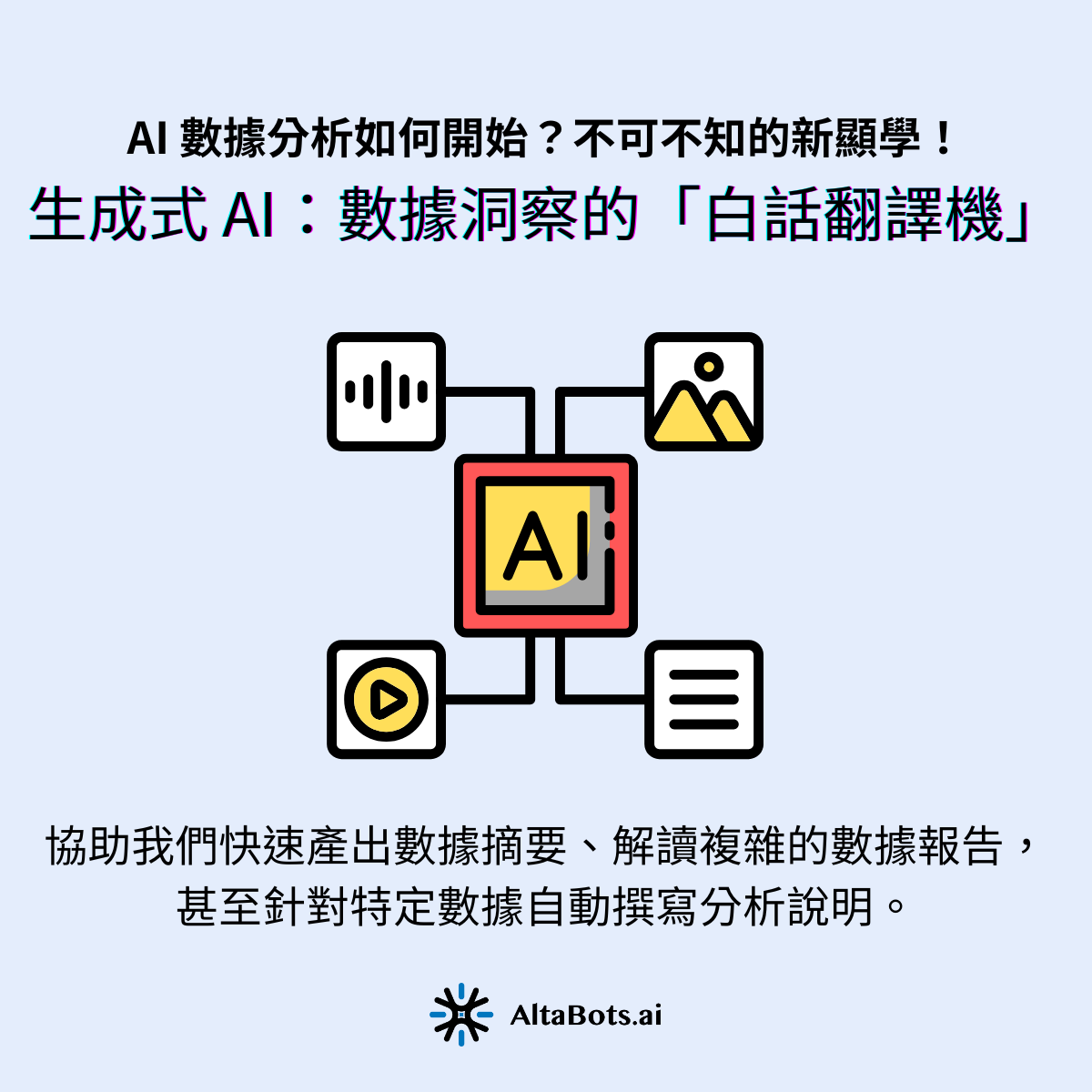
Generative AI: the translator that turns data into plain language
The core of generative AI (LLMs such as ChatGPT, Gemini and Claude) is language ability. It can turn a report full of numbers into plain statements such as which product sells best or which month had the highest revenue.
In data analysis it can do three things: generate summaries for monthly and quarterly reports, translate statistical results into business language for managers, and help draft data-driven proposals. Note, however, that an LLM is like a good translator who is not strong at arithmetic and may confidently get a sum wrong. This is why companies increasingly favor composite AI.
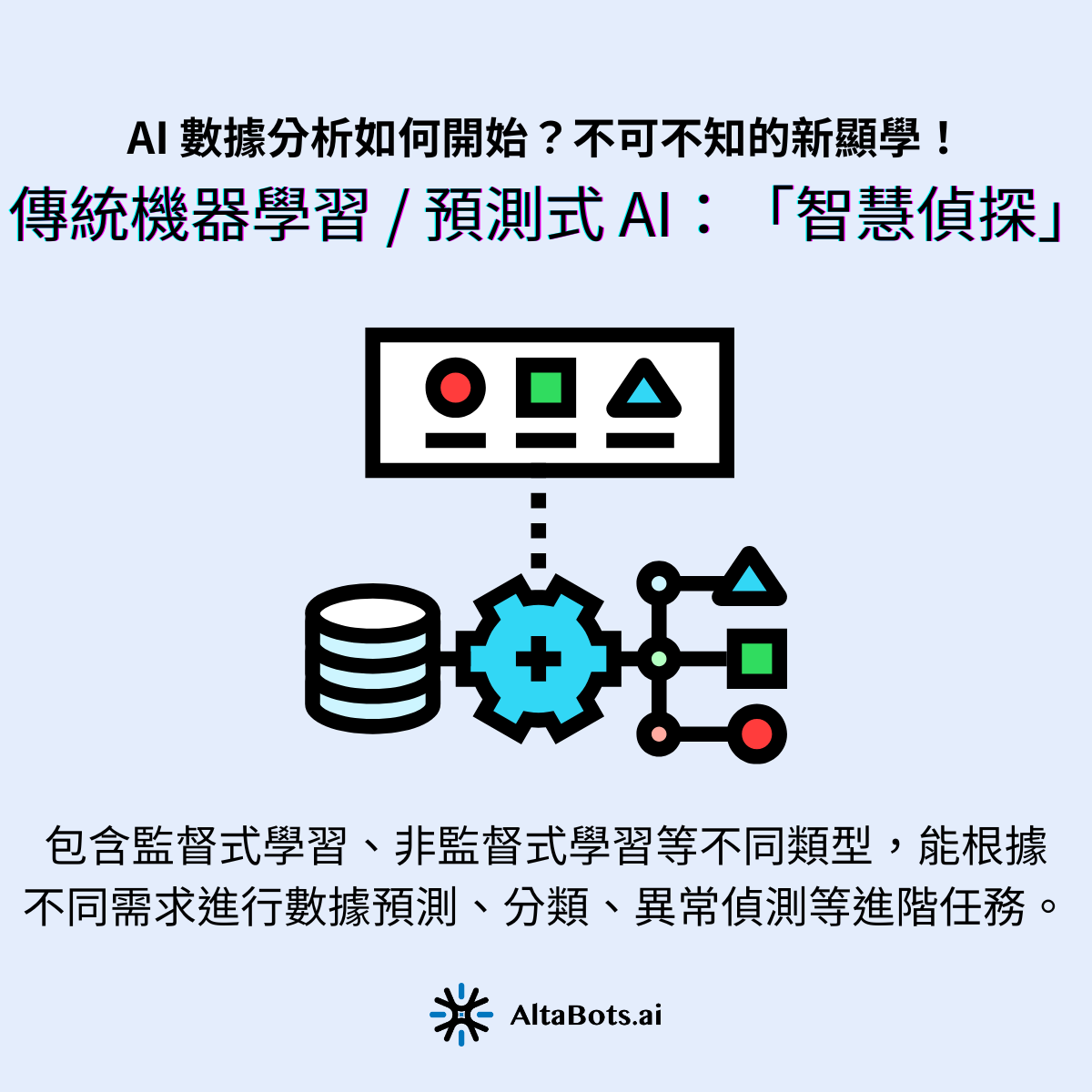
Machine learning and predictive AI: the detective that finds patterns
If you want AI to do more than tell a story, to calculate and spot problems on its own, machine learning and predictive AI are the first choice. They handle advanced tasks such as prediction, classification and anomaly detection.
There are three main applications. Supervised learning is used to predict customer churn, sales and credit risk. For example, an ecommerce company can train on a year of member behavior data to predict which customers may churn in the next three months, with accuracy that can exceed 85%. Unsupervised learning is used for customer segmentation, market segmentation and anomaly detection. Reinforcement learning is used for dynamic pricing and personalized recommendations. Its limitation is that it handles structured data well (Excel, databases, transaction records) but cannot explain the business context behind the numbers, and that is where an LLM comes in.
What is composite AI? Why it is the mainstream approach in 2026
In this section: calculate with machine learning, explain with an LLM, and avoid the trap of AI getting numbers wrong
Composite AI combines machine learning and LLMs: machine learning handles precise calculation and prediction, and the LLM interprets the results and generates reports. This is the approach used by today's most advanced business intelligence (BI) solutions.
A simple formula: machine learning for precise prediction and calculation, plus an LLM to generate an interpretive report, equals composite AI. Its value is in covering the gaps of any single technology. Gartner's risk predictions for data and analytics also warn [3] that companies that rely on LLMs alone for data analysis face both "AI hallucination" and the cost of wrong decisions. Using the precision of machine learning to hold the numbers steady is the point of composite AI.
Which two types of tools do companies meet when using AI for data analysis?
In this section: an LLM is a smart secretary and an AI Agent is an all-round assistant, so the tasks differ
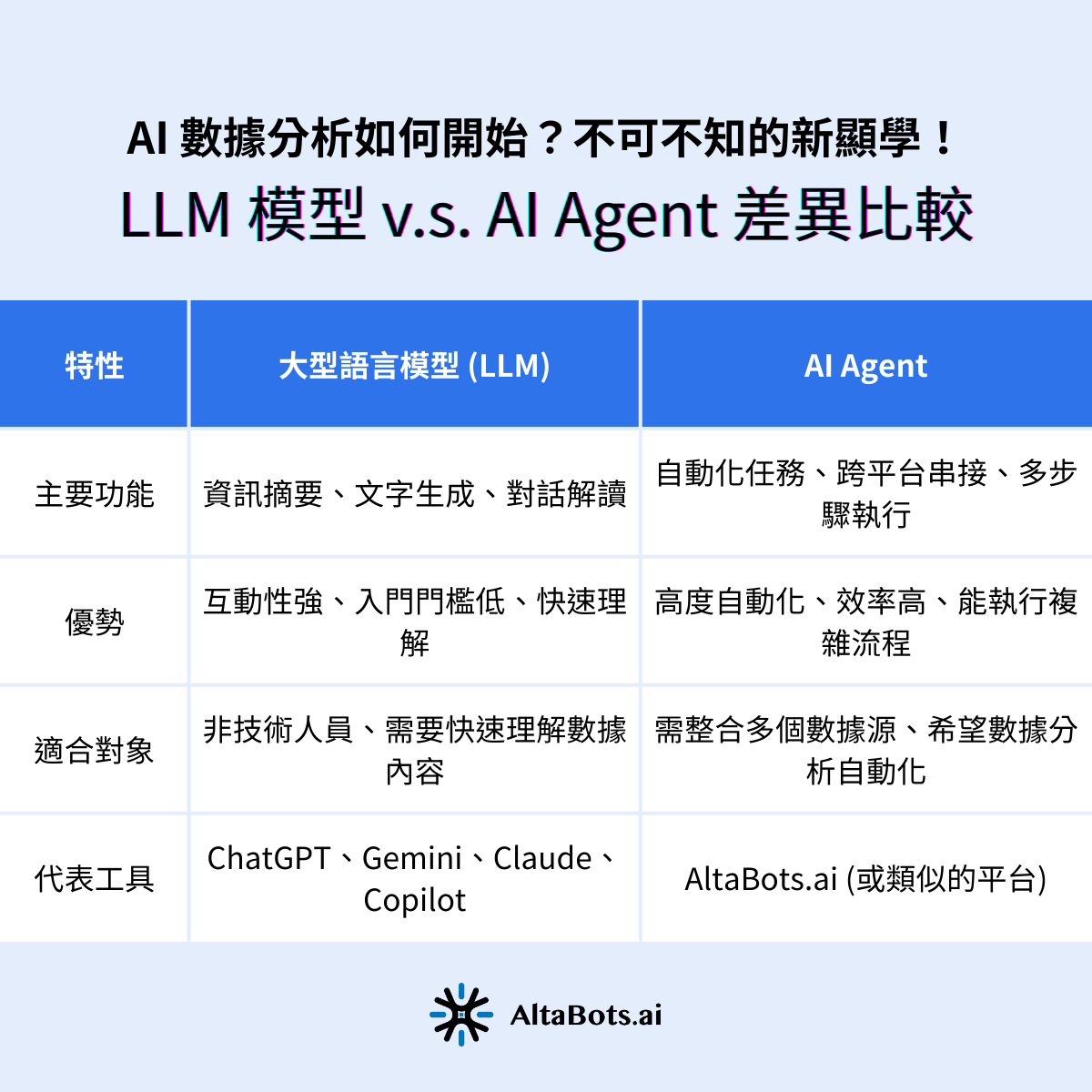
In enterprise practice, AI data analysis tools fall first into two types. Large language models (LLMs) play the role of information summary and plain-language explanation. AI Agents can connect multiple data sources and run multi-step tasks automatically, which is the role of automated task execution.

Large language models (LLMs): your data "translator"
ChatGPT, Gemini, Claude and Copilot all belong here. You can paste in a complex report and ask it to summarize key trends and anomalies, or simply ask "What does this report say?" and it explains in plain words, and can even draft an opening and conclusion. The limitation is as noted above: it does not guarantee correct numerical calculation, so important figures still need manual review or should go to a machine learning module.

AI Agent: your "smart data assistant"
In contrast to the conversational role of an LLM, an AI Agent focuses on automated task execution. An advanced data analysis Agent usually combines three modules: a generative AI module for interpretation and communication, a machine learning module for precise calculation, and automation tools for connecting data sources and sending notifications.
In practice it works like this: every morning it pulls the previous day's website traffic, uses machine learning for trend forecasting and anomaly detection, then uses generative AI to turn the results into charts and written reports, and sends an alert to a phone or by email when sales fall below a preset threshold. According to a Databricks report [5], adoption of moving from a single Agent to multi-Agent collaboration grew 327% within 4 months. Data analysis in the future will probably have a manager Agent coordinating several specialist Agents. To see the difference between connecting ChatGPT yourself and using a ready-made Agent platform, see "Build your own AI Agent or just use ChatGPT".
Three steps to build your own automated data workflow
In this section: you do not need a data science team, and a manager can start alone
Building an automated data workflow takes three steps: define KPIs and data silos, choose a platform that supports APIs and has an Agent architecture, and set up trigger-to-action automation logic. With a No Code platform, marketing and sales managers can start on their own.
Step 1: Define key metrics and data silos
AI needs fuel. First, take stock of where your data is scattered: ERP, CRM, Google Sheets, each ad platform's back end? Then define the KPIs you most want to monitor, such as customer churn rate, inventory turnover and ROAS. Without clear metrics, an Agent is just a talking decoration.
Step 2: Choose a tool that supports an Agent architecture
Do not look only for a BI tool that can draw charts. Choose a platform that connects to APIs and has Agent features, acting like glue that links scattered data sources and carries out tasks. Ask three key questions: does it support Webhooks and APIs? Does it have prebuilt templates? Are permissions and audit trails clear enough?
Step 3: Set up "trigger, analyze, act"
Chain the logic together. Trigger: when this week's customer churn rate is above 5%. Analyze: call a machine learning model to find the causes of churn and use an LLM to generate a summary. Act: automatically email the sales manager with a list of high-risk customers and suggested talking points.
How LLMs and AI Agents differ: two tables at a glance
In this section: choosing the wrong tool wastes money, so see each one's ceiling first
In short, an LLM suits one-off questions and summaries, while an AI Agent suits automation tasks that are continuous, span data sources and involve multiple steps. Compared with traditional BI as well, the real difference among the three is who makes the decision for you.
How to choose AI data analysis tools: three categories and where each fits
In this section: do not rush to pick a tool; first work out which stage you are stuck at
AI data analysis tools fall into three categories: visual BI tools for looking at data, conversational LLMs for asking questions of data, and automated Agent platforms for making data act on its own. The key is not which tool is strongest but which of three problems you need to solve: not understanding the data, not getting answers fast enough, or not being able to act.
The list of tools on the market is long, but knowing the categories first saves a lot of detours. Visual BI tools solve "not understanding", turning messy data into clear charts; their drawback is that they stop at the chart layer and do not proactively offer recommendations. Conversational LLMs solve "not getting answers fast enough", with instant summaries and plain-language interpretation; their drawback is that they are not connected to your live data and do not know your industry know-how. Automated Agent platforms solve "not being able to act", letting analysis run automatically and proactively pushing recommendations; the cost is that you must define logic and permissions first.

In one sentence: add BI if you cannot understand the data, use an LLM if you cannot get answers fast enough, and use an Agent platform if you cannot act or want automation. For more trends and cases of AI Agents in different industries, see our "AI Lab column".
AltaBots.ai: make composite AI and Agents usable by drag and drop
Once you understand the three types of tools, you may be at a decision point: connect data sources, tune models and write logic from scratch yourself, or use an integrated platform and go live directly? For an engineering team, building it yourself is a learning process. For an operations lead or digital transformation owner, time cost is real, and a No Code platform with consultants who design the workflow for you is often what is needed.
In this section: leave the technical barrier to the platform and consultants, and you only need to know what to ask
AltaBots.ai is a No Code enterprise AI Agent platform from Data-DI. It combines the understanding ability of LLMs with the precision of traditional data analysis, so marketing, operations and customer service teams can build automated data workflows by drag and drop.
Its value is not in the number of features but in the steps it saves you. No coding: connect Google Analytics, Salesforce or databases through a drag-and-drop interface. No designing from scratch: built-in scenario templates such as operations data analysis and store sales analysis are ready to use. No one watching: once the logic is set, it works as a data assistant around the clock, running in LINE or embedded by iframe. Visit the "AltaBots.ai website" to see the full platform.
In practice: the boss wants answers from data, and the analyst is always busy
Many retail and chain brand executives have met the same situation. The BI system works well and the dashboards are complete, but the data stops at the chart layer. The general manager sees the numbers but does not know what to do next. Managers want to ask which series sells best this quarter, whether running a promotion for new or returning customers is better value, or whether this batch of inventory should be marked down. All of it stalls at the analyst, a report takes three days, and the moment for the decision has passed.
Analysts have a hard time too. Each insight report takes three to four hours, about 80% of which goes to manually exploring hypotheses, and they serve several managers at once.
This is the problem we helped IMAG, a global luxury brand service provider, solve [7]. IMAG is one of the few companies with LINE's official dual certification and serves more than 50 international luxury brands; the monthly data report for each brand used to take 3 days by hand. After adopting AltaBots.ai's "LINE Data Insights Assistant", the Agent automatically extracts data from LINE reservations, sales guidance and ecommerce systems and uses RAG to produce structured reports in the form "data facts, cause analysis, optimization suggestions". The monthly data report went from 3 days to 1 minute, time spent collecting market data and cases was cut in half, and the original 3-person data team can serve 50 top global brands efficiently, with a customer satisfaction rate of 80%.
Another example is in manufacturing. At a manufacturer we advised, management used to wait for IT or analysts to pull a report whenever they wanted a figure. Using AltaBots.ai's Text2SQL capability, managers ask the database directly in natural language, for example "Why did overall net profit grow strongly in 2025/Q4?" The Agent generates and runs the SQL automatically, produces statistical charts and an insight report, and flags unusual trends, causes and improvement suggestions. Getting data goes from waiting for a report to instant self-service queries. When people at every level can ask for themselves, a data-driven culture takes hold.
This kind of integration usually connects to an existing database (such as MSSQL or BigQuery) or uploaded reports, and is embedded beside the current BI through an iframe or API. In most cases it goes live in about 2 to 4 weeks, and managers ask questions in plain language without learning a BI interface.
"BI already works well. Why do we still need AI?"
This is the question senior executives ask most, and our answer is: BI gives you charts, AI gives you decisions. As for how this differs from handing Excel to ChatGPT, there are three points. ChatGPT does not have your live data, does not know your industry know-how, and can only answer one question at a time. AltaBots.ai connects directly to your database, can take in your internal metric system, and uses a Flow Agent to run the multi-step process of pulling data, cleaning, comparing and producing recommendations in one go. It is not a replacement for analysts. It lets analysts move from people who run reports to people who do more valuable work.
Five points to remember in 2026
In this section: mindset, technology, process, tools and governance in one place
First, upgrade your mindset: move from asking AI questions to authorizing AI to carry out tasks. Agentic AI is the core of enterprise AI strategy in 2026. Second, mix technologies: do not rely on LLMs alone. Combining machine learning and LLMs into composite AI gives you both precision and ease of use. Third, automate the process: the end point of data analysis is action, not a report, so build automated workflows that turn insight directly into decisions. Fourth, choose the right tool category: use the three questions of not understanding, not getting answers fast enough and not being able to act to place your need, then pick a No Code Agent platform to validate quickly. Fifth, put governance first: Gartner notes that insufficient governance will cause a considerable share of agentic AI projects to fail [3], so work out permissions, audit trails and human intervention before adopting.
If you have sorted out the three types of tools and agree that composite AI is the mainstream in 2026, the next step is to see where your own data is stuck. Data-DI offers a free 30-minute AI data analysis assessment in which a consultant reviews your existing data sources, BI setup and the fastest parts to automate, and gives advice for your actual situation. You do not need to prepare data in advance: just tell us the tools you use now and the problem you want to solve. You can "book a free assessment" at any time.
References

[1] Gartner. (2025). Gartner Predicts 40% of Enterprise Apps Will Feature Task-Specific AI Agents by 2026, Up from Less Than 5% in 2025. Gartner Newsroom.
https://www.gartner.com/en/newsroom/press-releases/2025-08-26-gartner-predicts-40-percent-of-enterprise-apps-will-feature-task-specific-ai-agents-by-2026-up-from-less-than-5-percent-in-2025
[2] Gartner. (2026). Hype Cycle for Agentic AI, 2026. Gartner.
https://www.gartner.com/en/articles/hype-cycle-for-agentic-ai
[3] Gartner. (2026). Gartner Announces Top Predictions for Data and Analytics in 2026. Gartner Newsroom.
https://www.gartner.com/en/newsroom/press-releases/2026-03-11-gartner-announces-top-predictions-for-data-and-analytics-in-2026
[4] McKinsey & Company. (2025). The State of AI in 2025: Agents, Innovation, and Transformation. McKinsey QuantumBlack.
https://www.mckinsey.com/capabilities/quantumblack/our-insights/the-state-of-ai
[5] Databricks. (2026). 2026 State of AI Agents Report. Databricks.
https://www.databricks.com/resources/ebook/state-of-ai-agents
[6] Artificial Intelligence Foundation (AIF). (2026). 2026 Taiwan Industry AI Adoption Survey (n=228) (in Chinese). AIF.
https://aif.tw/event/ai-research/files/2026-ai-research-report_zh-TW.pdf
[7] Business Next. (2025). IMAG adopts AltaBots.ai for data insights: case report (in Chinese). Business Next.
https://meet.bnext.com.tw/articles/view/52997
FAQ
FAQs about this article
Where should AI data analysis start?

First take stock of where your data is scattered (ERP, CRM, ad platforms) and define key KPIs. Then choose a No Code platform that supports APIs and has an Agent architecture, and set up trigger-to-action automation logic. The point is to build a workflow, not to paste reports into ChatGPT.
In AI data analysis, how do LLMs and AI Agents differ?
An LLM (such as ChatGPT) is like a smart secretary. It is good at summaries and plain-language interpretation, but works one question at a time and its numbers need manual review. An AI Agent is like an all-round assistant: it connects multiple data sources, combines machine learning for precise calculation, and runs multi-step tasks automatically.
What is composite AI, and why is it the mainstream approach in 2026?
Composite AI combines machine learning and LLMs. Machine learning handles precise calculation and prediction, and the LLM interprets results and generates reports. This avoids the AI hallucinations that make LLM-only analysis prone to wrong numbers, and gives both precision and readability.
What AI data analysis tools are there, and how should I choose?
There are roughly three types: visual BI tools for looking at data, conversational LLMs for asking questions of data, and automated Agent platforms for making data act on its own. The key is not which is strongest but whether you need to solve not understanding, not getting answers fast enough, or not being able to act.
We already have BI dashboards. Why do we still need AI?
Traditional BI mostly leaves data at the chart level, so managers still have to decide the next step themselves. An AI Agent goes one step further and gives decision recommendations directly, such as which batch of inventory to mark down, shortening the decision delay from days to near real time.
More articles


訂閱我們的電子報
每月 8 日定期發送最新趨勢與實用資訊!



