

Autopilot vs. copilot: what it is and a 5-question diagnostic
Autopilot is a service model in which AI completes a whole task by itself; Copilot is an assistive tool. Using Sequoia Capital's framework and AIF's 2026 survey, a five-question diagnostic helps you find your first entry point. Book a free process review.


Autopilot is an enterprise AI service model in which AI completes a task from start to finish on its own, with no person checking along the way; Copilot is an AI tool that helps employees work faster. One sells results and the other sells tools. This framework comes from a March 2026 view by Sequoia Capital, and it is reshaping how companies decide on AI.
But the reality in Taiwan is this: according to the AI Foundation's 2026 survey, 85.8% of companies plan to adopt or expand AI applications this year, yet only 6.6% have integrated AI into core processes [3]. Between willingness and putting AI into daily use lies a wide execution gap.
This article uses five dimensions of judgment to help you clarify which stage you are at now and where to start with your first Autopilot scenario.
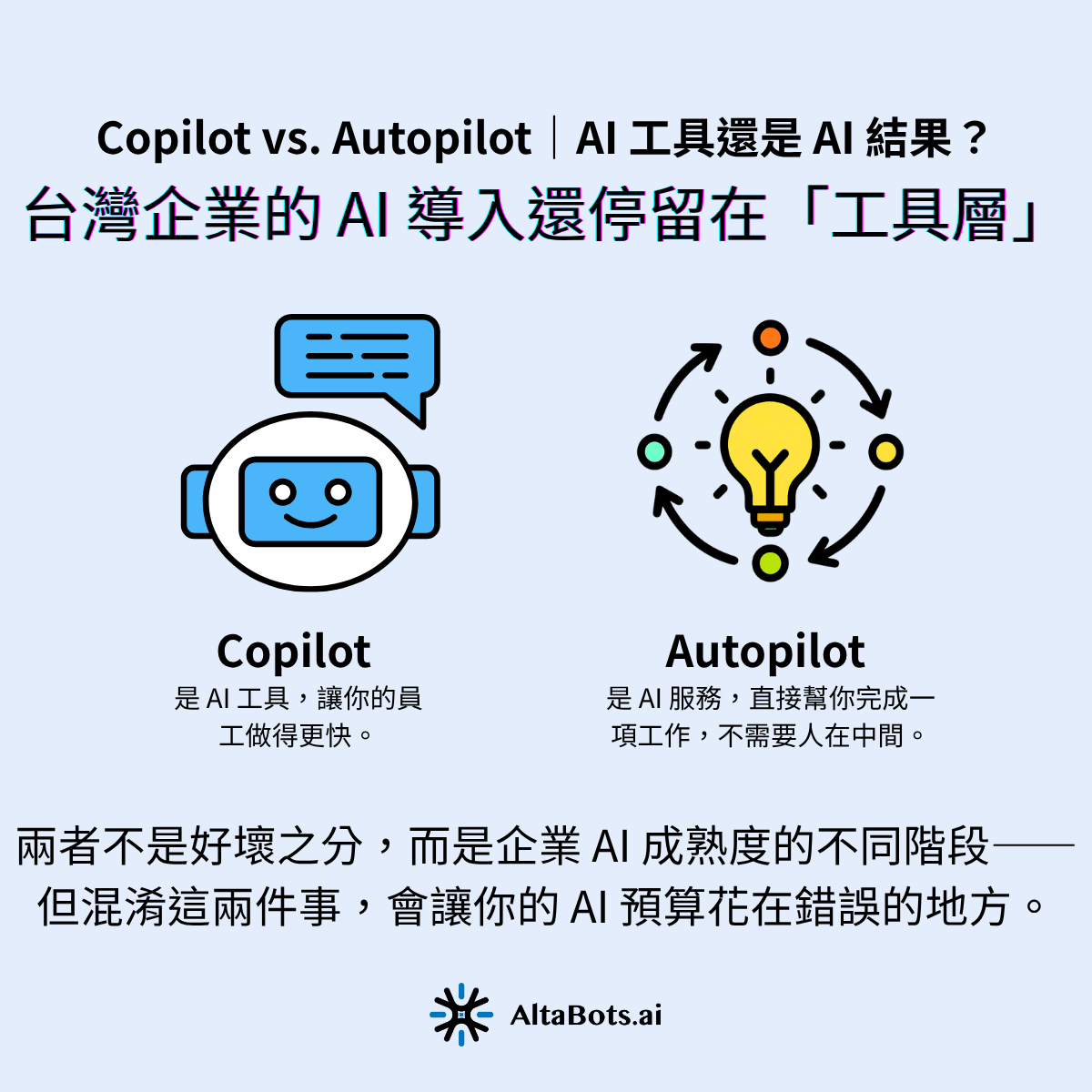
Are you buying a tool or a result? Settle this first
Copilot is an AI tool that lets your employees work faster; Autopilot is an AI service that completes a task for you directly, with no person in the middle. Neither is better than the other; they are simply different stages of enterprise AI maturity. But confusing the two will send your AI budget to the wrong place.
In March 2026, the top US venture firm Sequoia Capital published a widely discussed article, "Services: The New Software" [1]. Its author, partner Julien Bek, put forward a core proposition: the next company worth 1 trillion US dollars will not sell AI tools but "work done by AI".
Most AI adoption at Taiwanese companies still sits at the "tool layer": buying ChatGPT Enterprise, subscribing to Microsoft Copilot, adding a few AI plug-ins and letting employees use them. There is nothing wrong with that; this is the Copilot model and an important starting point. But if your competitor is already using AI to take over workflows directly and produce results automatically, then while your employees' efficiency rises 20%, their costs fall 60%. That gap is not competition on the same order of magnitude.
This article uses plain language to explain the essential differences between Copilot and Autopilot, where Taiwanese companies stand today, and how to find your own first Autopilot entry point.
1. why is this question only now becoming important?
AI model capability has just crossed a critical line
For the past three years, the mainstream form of AI tools has been "assistance": you type, it suggests; you ask, it answers; you draft, it polishes. This model rests on a premise: AI is not yet accurate enough, so a person has to stand by and check.
That premise is fast losing its force.
Sequoia's report notes that in software engineering, for example, a year ago most developers treated AI as an autocomplete tool; today, more than half of tasks are initiated and executed by AI Agents on their own, with developers handling only the final judgment and decisions [1]. Software engineering is the first function to cross the threshold, but it will not be the last.
When AI can "finish the job" and not just "help with the job", the whole logic of buying AI tools has to be rethought.
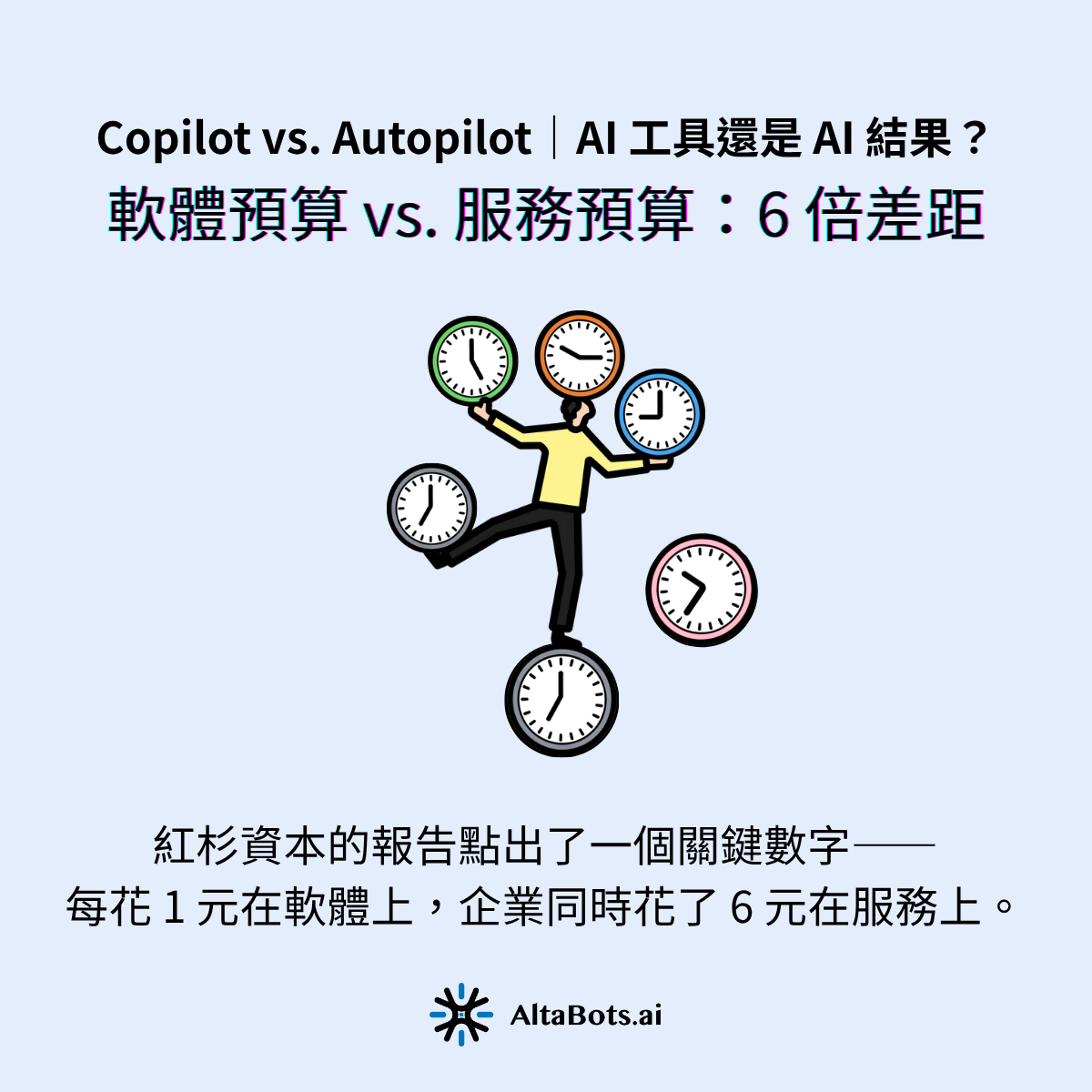
Software budgets vs. services budgets: an underestimated 6x gap
The most common mistake Taiwanese companies make when evaluating AI adoption is treating AI as a software purchase rather than a services purchase.
Sequoia's report highlights a key figure: for every 1 dollar a company spends on software, it spends 6 dollars on services [1]. In other words, the software tools market is only one sixth the size of the services market.
Take a scenario familiar to Taiwanese companies: a manufacturer may spend NT$500,000 a year on ERP subscription licenses, while spending NT$3,000,000 on the labor cost of data organization, report production, outsourced customer service and procurement processes. AI tools aim at that NT$500,000; AI services (Autopilot) aim at that NT$3,000,000.
This does not mean AI tools are unimportant. It means that when you evaluate the real ROI of AI, the question to ask is: is this AI saving me software fees or labor costs? The two differ in scale by 6 times.
According to Gartner's latest forecast, by the end of 2026, 40% of enterprise applications will have AI Agents that execute autonomously built in, up from less than 5% in 2025 [2]. This is not a distant trend; it is a competitive reshuffle already under way.
Where are most Taiwanese companies now?
According to the AI Foundation's 2026 Taiwan Industry AI Adoption Survey (survey period January to March 2026, sample of 228 companies), Taiwan's AI adoption has reached the tipping point of mainstream diffusion: companies at the Ready AI and Scaling AI stages together reach 47.8%, up nearly 19 percentage points from 28.8% in 2025 [3].
Behind the jump, however, lies a structural gap. The same survey shows that after adopting AI, 57.1% of companies say employees gained AI-related skills, but only 6.6% have fully integrated AI into regular company processes. More worrying, in 61.8% of companies internal AI use sits entirely outside company oversight: employees use generative tools on personal accounts, and the company has neither rules nor any management mechanism [3].
At Taiwanese companies, the tools are there and individual efficiency has improved, but the organization's operating model has not been upgraded along with them. In one sentence, most companies are on the plateau of the Copilot model: they know the next step must be taken, but do not yet know where to step out from.
That starts with understanding your own types of work. If you want to first assess your company's current AI adoption maturity, you can refer to our Five Risks to Know Before Adopting an AI Agent, and then come back to keep reading.
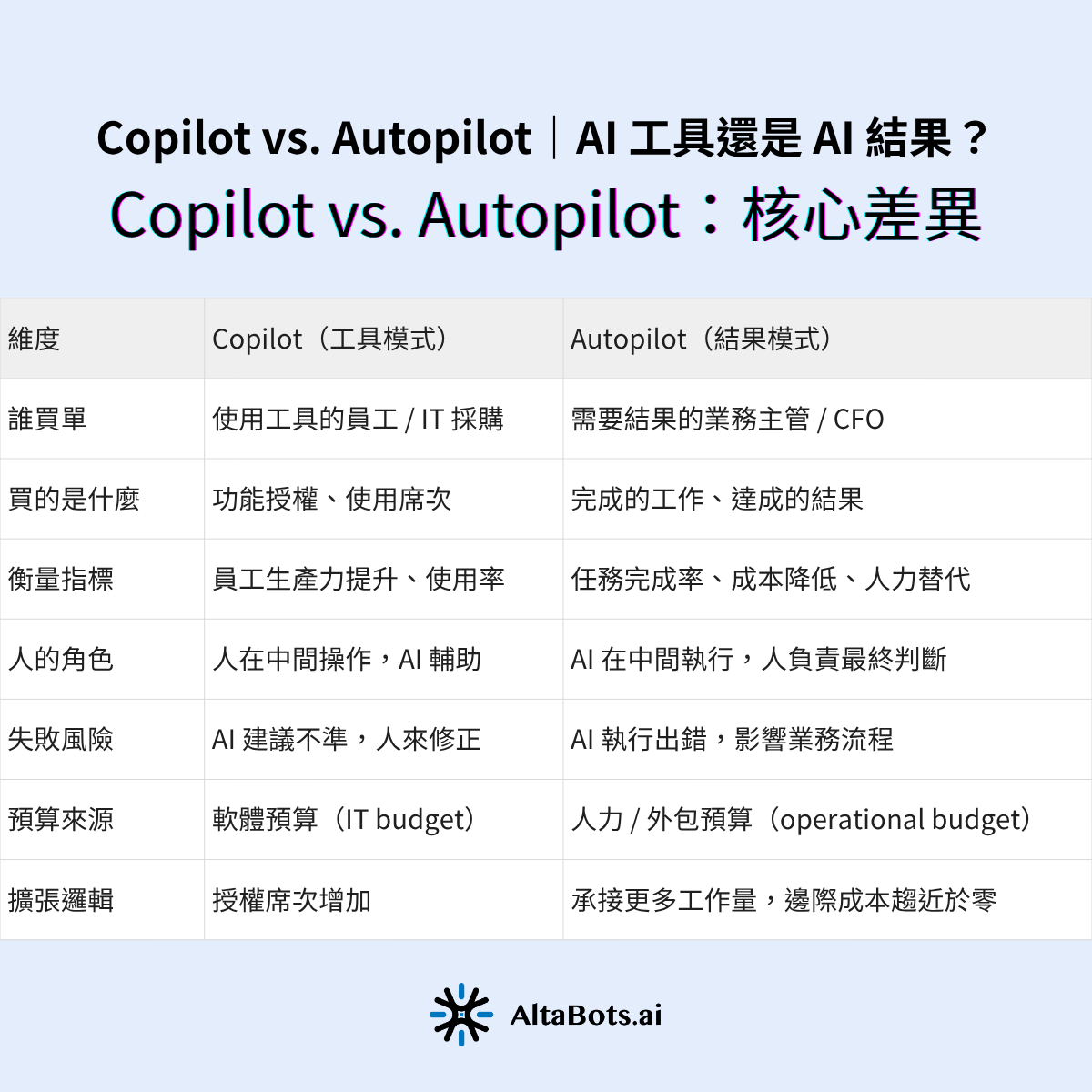
2. copilot vs. autopilot: the core differences in one table
Autopilot originally means "self-driving"; in the enterprise AI context it refers to an execution mode in which AI completes a whole task on its own, with no person checking step by step. Copilot refers to a collaboration mode in which AI assists and people stay in charge. First, to be clear about scope: the Autopilot in this article is an autonomous execution mode for enterprise AI, and has nothing to do with Tesla's self-driving feature or with forex or crypto "copy trading" tools.
Many people's first reaction to the word Copilot is Microsoft 365 Copilot. But the Copilot discussed here is a broader concept: any AI tool that "makes people more efficient" belongs to the Copilot model. Microsoft Copilot is one product among them, but ChatGPT Enterprise, Notion AI and the many AI plug-ins are in essence all Copilots.
Autopilot is entirely different. It does not make you faster at the task; it gets the task done directly.
Understanding the essential differences in one table
Copilot strengths and fitting scenarios
The biggest strengths of the Copilot model are low risk and fast adoption. Employees stay in charge, the AI only suggests and assists, and the effect of errors can be controlled. For companies with a high share of judgment-based work, or whose internal processes are not yet standardized, Copilot is the right starting point.
Fitting scenarios include: managers writing external proposals, marketers generating first drafts of copy, sales staff organizing customer meeting notes, and engineers debugging and reviewing code. What these have in common is that whether the result is good needs an experienced person to judge, and the AI's role is to speed things up, not to replace.
Autopilot strengths and fitting scenarios
The core strength of the Autopilot model is scalability. A well-designed Autopilot can handle 10 or 100 times the workload without adding staff. Its cost structure is fundamentally different: from "hire more people" to "let the AI run more times".
Fitting scenarios include: automatic replies to common customer service questions, automatic classification and filing of order data, automatic generation of first contract drafts, scheduled automatic report production, and automatic screening and scoring of lead data. What these have in common is clear rules, verifiable output and highly repetitive processes.
The "red queen dilemma" facing Taiwanese companies
According to the AIF 2026 survey, Taiwan's industries face a structural contradiction: after adopting AI, 55.5% of companies report improved organizational processes and generally higher individual efficiency; yet only 20.9% have developed new products or services, and the same 20.9% have built new business models [3].
This echoes the "Red Queen effect" mentioned in the survey report: when AI effectiveness rises across the whole industry, a jump in individual efficiency is no longer a differentiating advantage but just the market's survival threshold. Companies that stay at the Copilot level, at best, only keep pace with competitors; what truly opens the gap is companies that let AI take over workflows directly and free up people for higher-value judgment.
This is also why moving from Copilot to Autopilot is not only a matter of efficiency but of competitive position. To see how AltaBots.ai helps companies build their first Autopilot process, you can start with our Complete Guide to No-Code AI Build Platforms.
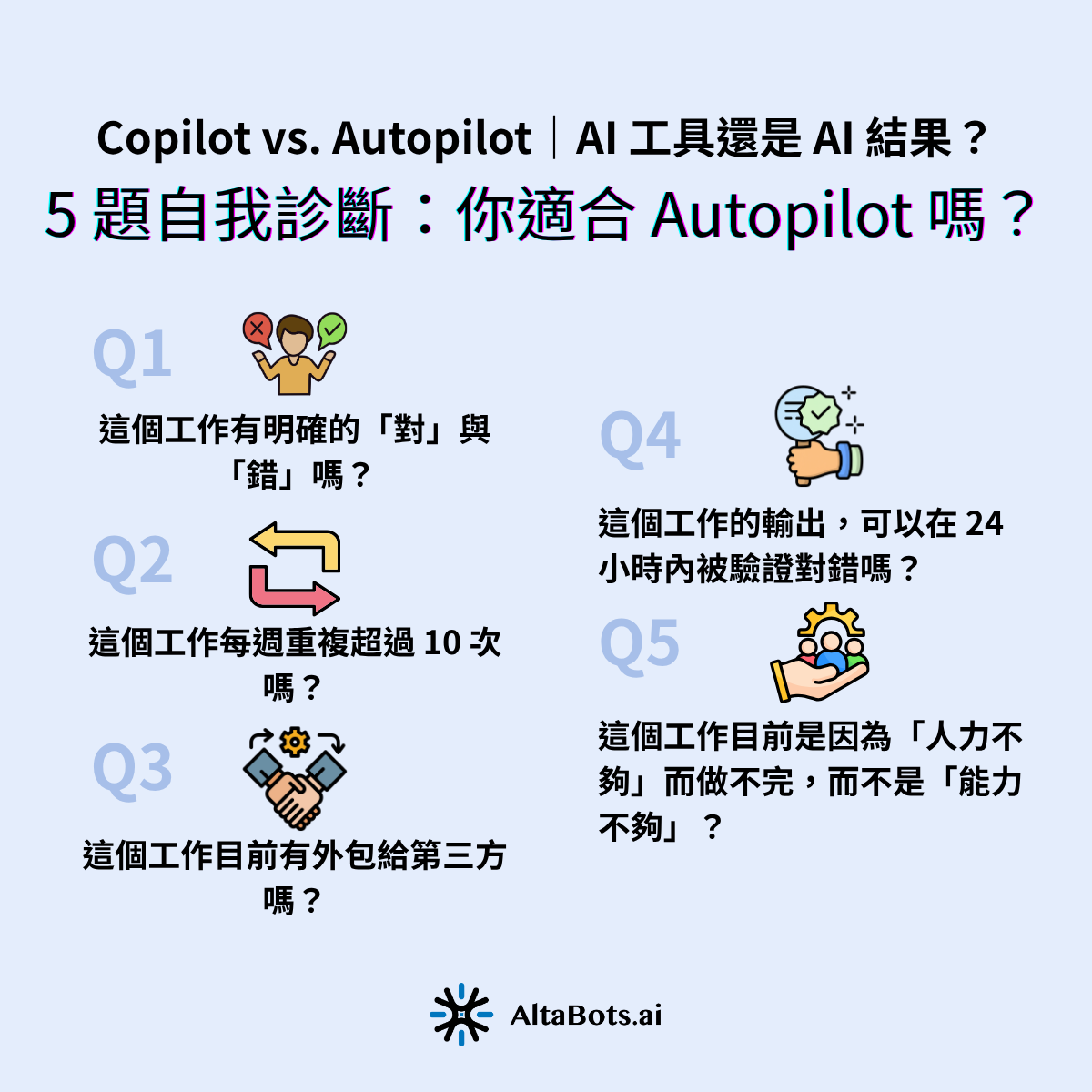
3. 5-question self-diagnosis: is your process suited to autopilot?
Whether you can adopt Autopilot depends not on technology but on the nature of your workflow. There is really one question at the core of the judgment: does this work have clear rules, or does it depend heavily on experience and intuition?
Work with clear rules that is verifiable and highly repetitive: AI can complete it from start to finish on its own, and this is Autopilot's main field. Work that needs experienced judgment and involves complex context: AI still needs a person to check it for now, and it suits Copilot assistance.
According to the AIF 2026 survey, the scenarios where Taiwanese companies concentrate AI use are, in order: content generation and translation (84.8%), knowledge management and summarization (77.5%), and programming assistance (69.6%). All three are Copilot-type uses: AI assists a person to finish the work rather than executing on its own. By contrast, process automation (62.3%) and intelligent customer service (55.0%) are the main entry scenarios into Autopilot territory, and the starting points where ROI is easiest to quantify [3].
Use the five questions below to assess any workflow you have; the more "yes" answers, the more suitable the process is for Autopilot first:
- Q1: Does this work have a clear "right" and "wrong"? For example, whether a service reply solved the problem, or whether order data was filled in correctly. Work with a standard answer is easier for AI to take over.
- Q2: Is this work repeated more than 10 times a week? Repetition is the core source of Autopilot ROI. If a process repeats 50 times a day, Autopilot's benefit is 50 times that of Copilot.
- Q3: Is this work currently outsourced to a third party? Outsourcing means a budget line already exists, the company has already accepted external execution, and what is bought is the result rather than the process; these three conditions bring adoption resistance to a minimum.
- Q4: Can the output of this work be verified as right or wrong within 24 hours? Quick verification means quick iteration. AI does it, a person confirms, AI corrects; the shorter this cycle, the faster Autopilot's accuracy improves.
- Q5: Is this work unfinished now because of "not enough people" rather than "not enough capability"? Work limited by headcount is Autopilot's most direct entry point; the aim is to cover the part people cannot finish, and people's role is not replaced. The AIF survey shows 61.8% of Taiwanese companies have internal AI use outside organizational oversight, and a large part of the reason is that processes are not standardized and staffing gaps are filled by individual improvisation. Autopilot can turn this unstable manual improvisation into controlled system execution.
Number of "yes" answers
4-5: Adopt Autopilot first; fastest ROI
2-3: Standardize the process with Copilot first, and reassess an upgrade after 6-12 months
0-1: Stay with the Copilot model; this process involves too much judgment
If you have found a process that meets 4-5 of the questions, the next step is to confirm where to enter with the least effort. Sequoia's advice is very clear: the answer is in your existing outsourcing contracts.
4. autopilot entry strategy: start with "outsourced tasks"
Once you know a process suits Autopilot, the next question is: where do you begin?
Sequoia's advice is very clear: start with tasks that are already outsourced. The reasons are direct:
The budget line already exists: replacing an outsourcing fee is "changing supplier", not "requesting a new budget", so procurement resistance is far lower than opening a new project.
The organization already agrees: outsourcing means the company accepts that this work is done externally, so there is no internal resistance of "AI replacing employees".
What is bought is the result: outsourcing contracts are judged on quality of result and cost, which is entirely consistent with the procurement logic of Autopilot.
In Sequoia's words: replacing an outsourcing contract is changing supplier, while replacing employees is reorganizing the company. The resistance to the former is far smaller than to the latter.
This logic applies especially well in Taiwan. The AIF 2026 survey shows that one of the biggest barriers to AI adoption at Taiwanese companies is "insufficient strategic awareness": more than half of companies are willing but have no concrete framework for action [3]. Starting from outsourced tasks is the lowest-resistance path for turning "we want to adopt" into "we have a reason to move now".
Three common autopilot entry scenarios for Taiwanese companies
Scenario 1: outsourced customer service to AI auto-reply
Mid-sized and large Taiwanese retail, e-commerce and financial companies commonly outsource customer service. Common questions make up 60-80% of service volume, with clear rules and standardized answers, a typical scenario suited to Autopilot. After adopting an AI Autopilot, common questions are handled entirely by AI, and only complex ones are transferred to a person. The outsourced service fee changes from per-head billing to per-conversation billing, a fundamental change in cost structure.
According to the AIF survey, intelligent customer service is already the fourth-largest AI use scenario at Taiwanese companies (55.0%), but most remain at Copilot-type assistance and have not yet moved to fully automatic execution. This means this scenario has the most room to upgrade, and is a window in which competitors have not yet fully positioned themselves.
Scenario 2: outsourced data processing to AI auto-organizing and classification
Compiling quality reports in manufacturing, entering trading companies' order data, first-round screening of resumes in HR departments: this kind of work is highly repetitive with clear rules but consumes a lot of labor, and is usually outsourced to part-time staff or data-processing companies. An AI Autopilot can receive raw data, classify it by rule and output a standard format, running 24 hours a day with an error rate lower than manual work.
The AIF survey also points out that Taiwanese companies still have a huge gap between "having data" and "being able to use data": the score for technical-level data application is only 36.84, far below data access capability [3]. Automating data processing is the most direct entry point for closing this gap and getting existing data actually flowing.
Scenario 3: outsourced report production to AI auto-generation
Regular reports (weekly, monthly, inventory reports, sales summaries) are a pain point for many companies. Data sources are scattered, formats need to be unified, and deadlines are fixed. After an AI Autopilot connects to the data sources, it can produce reports in the required format on a schedule, with no manual compilation, and a manager only needs to confirm at the end.
The path from outsourced autopilot to internal work
Outsourced tasks are a wedge, not the end point. Once an Autopilot runs stably on outsourced tasks, the system has accumulated your company's proprietary data and business context, accuracy keeps improving, and the team has built trust in AI doing the work.
At that point, you can begin pushing the Autopilot's boundary into repetitive work that internal employees used to do, freeing people from mechanical execution to focus on work that needs judgment. In the AIF survey, only 6.6% of companies have completed this shift, but these companies' competitive advantage is already on a different order of magnitude.
If you want a fuller assessment before you start, you can refer to our 30-Day POC Guide. Or you can directly book a Data-DI free process review, and we will help you find, from your existing outsourcing contracts, the first Autopilot scenario you can start right away.
5. no engineers: how do you build your first autopilot?
Once the framework is understood, the question asked most often in practice is: "Our company has no engineers and no IT team. Can this be done?"
This is exactly the problem AltaBots.ai was designed to solve.
What Is AltaBots.ai?
AltaBots.ai is a no-code enterprise AI Agent platform from Data-DI Solutions that lets marketing, customer service, operations and sales teams build automated workflows by drag and drop. It suits mid-sized and large companies that want to depend less on IT and put AI into daily use quickly. It is a build platform for turning your "knowledge work processes" into Autopilots, not an AI chat tool or another SaaS subscription.
Placed in the framework above: AltaBots.ai is the infrastructure that helps you move from Copilot to Autopilot.
This positioning matters especially in Taiwan's 2026 market. The AIF survey notes that 22.9% of Taiwanese companies name commissioning a system integrator (SI) to develop a solution, or buying a solution with built-in AI hardware and software, as their main source of models [3]. This shows most companies want to "adopt a usable solution directly" rather than build from scratch. AltaBots.ai's no-code architecture is the key design that lowers the barrier on this path to a minimum.
Three real scenarios: how AltaBots.ai works
Manufacturing: automatic quality-anomaly notification and handling process
A Taiwanese manufacturing customer used to handle quality anomalies by filling in anomaly forms manually, notifying the relevant departments and tracking progress, taking an average of 4 hours to complete one anomaly-reporting cycle. After adopting AltaBots.ai, the system automatically detects anomalous data, generates a standardized anomaly report, notifies the responsible person and tracks the handling status until closure. The whole process went from 4 hours to 15 minutes, and runs 24 hours a day.
This scenario maps directly onto a core pain point of manufacturing in the AIF survey: manufacturers lagging in AI often are not short of willingness but are held back by data lock-in from equipment vendors, so AI use stays at the office level. AltaBots.ai's workflow integration capability is the key to helping manufacturers break through this barrier.
Retail: customer segmentation and automatically triggered remarketing
A retail marketing team has to manually filter qualifying customer groups from the CRM every week, write the matching messages and schedule the send times. After AltaBots.ai builds an automated workflow, the system filters customer groups by rule every day and triggers the matching remarketing messages. Marketers only need to set the rules and review message content, and the execution layer is handled entirely by AI.
According to the AIF survey, retail is the industry where AI adoption grew most noticeably in 2026, but this momentum comes mainly from individual-level tool use and has not yet fully reached the organizational level. This scenario shows how to upgrade individual-level AI use into organization-level automated processes.
Cross-department: automating the first-pass review of contracts
Legal or procurement departments receive large numbers of contracts every week that need preliminary review to confirm that basic terms meet company standards. After AltaBots.ai connects to the contract documents, it automatically compares key clauses, flags anomalies and produces a first-review summary, so legal staff only handle complex clauses that need human judgment, cutting first-pass time from an average of 2 hours to 10 minutes.
Your first autopilot starts with a free process review
The three scenarios show the same thing: Autopilot does not need to start with the most complex process, but with the most repetitive, most standardized step that currently takes the most labor. Get one scenario running stably, then expand outward.
Adopting AltaBots.ai does not require the IT department or any code. But before you start, the most important step is to find the right first scenario: pick the wrong one and the whole adoption plan stalls; pick the right one and you can see quantifiable results in 4-6 weeks.
If you are not sure where to start, you can first book a Data-DI free process review. Based on your industry and existing workflows, we will help you find the first Autopilot entry point with the highest return, with no preparation required. You can also first read our Complete Guide to AI Agents for Smart Manufacturing in 2026, to learn the most common Autopilot scenarios and adoption details in manufacturing.
6. what should you do now? Three triggers for action
You understand the framework and have seen the scenarios. One last question: have you reached the time to upgrade?
Copilot is not wrong, but three signals tell you it is time to move forward.
Signal 1: an outsourcing contract is about to expire
The renewal point of an outsourcing contract is the window with the lowest resistance to adopting Autopilot. Rather than signing for another year, assess whether AI can deliver the same quality at lower cost. According to the AIF 2026 survey, in Taiwanese companies' resource priorities for the coming year, 51.3% plan to invest in data collection and organization equipment and 42.7% plan to buy ready-made generative AI accounts. But if these two investments are not paired with process-automation planning, they are likely just widening Copilot-level spending rather than moving toward Autopilot. The expiry of an outsourcing contract is the best time to reallocate this budget.
Signal 2: a process failed last quarter for lack of staff
If a process collapses in the busy season, nobody handles it on holidays and hiring is not working, this is the problem Autopilot is meant to solve, not something to solve by hiring more. The AIF survey shows Taiwanese companies score only 29.17 on AI talent development strategy, the weakest of the three assessment dimensions, and 44.7% of companies have not yet set up any AI talent training practice. This means the staffing gap will not disappear in the short term, and strategies of filling it through recruitment work less and less well. Using Autopilot to cover the part people cannot finish is a more realistic and more sustainable solution.
Signal 3: your AI tool use is concentrated in a few heavy users
When Copilot's benefits do not spread, the cause is usually not the tool but a process that is not standardized. The AIF survey data states the phenomenon directly: 57.1% of companies say employees gained AI-related skills, but only 6.6% have integrated AI into regular company processes. Individuals using it does not mean the organization is using it. Autopilot forces the process to be systematized, so the benefit does not depend on individual habits and the whole organization gains; this is the key leap from "a few people feel it" to "the whole company feels it".
3 steps to start your first autopilot scenario
You do not need to reorganize the whole company at once. The right way to adopt Autopilot is to start with one small scenario, produce results, and then expand.
- Step 1: Pick One "Boring" Knowledge Process - Find the work nobody likes but that has to be done every week. Do not start with the most important process; start with the most repetitive, most standardized one whose results are easiest to verify. Using the 5-question diagnosis above, a process that meets 4 or more questions is a candidate.
- Step 2: Define What "Done" Means - Before building the Autopilot, write down the acceptance standards for the output: what the format is, what accuracy must be reached, and in which cases a person must step in. The clearer the standard, the more stably the Autopilot runs. This is also the step Taiwanese companies most often skip in the AIF survey: most companies rush to adopt tools without first defining "what counts as success".
- Step 3: Run Two Weeks of Human-AI Parallel First, Then Hand Over - For the first two weeks, let the AI produce results, have people verify them and record the error types. Once trust is established, the handover goes smoothly. Completing one scenario through these three steps usually takes 4-6 weeks.
Ready to Start?
If you check the three signals and find that one or more have already occurred, now is a reasonable time to start your first Autopilot scenario. You do not need to wait until you are "ready"; Autopilot's learning curve only truly begins once it is actually running.
Book a Data-DI free process review, and within 60 minutes we will help you do three things: confirm which process is best to adopt first, estimate the ROI visible within 3 months, and give you an assessment summary you can take straight to your manager. No preparation is needed; just bring the one repetitive task that bothers you most right now.
You can also first read the related articles for a deeper look at the practical details of AI Agent adoption: Five Risks to Know Before Adopting an AI Agent, Complete Guide to No-Code AI Build Platforms, and Real Cases of AI Agent Enterprise Automation in 2025.
Conclusion
Taiwanese companies have moved past debating "whether to do AI adoption". According to the AIF 2026 survey, 85.8% of companies plan to adopt or expand AI applications this year, and the race has formally begun. Now there is only one question: are you buying tools, or buying results?
Copilot lets your people work faster. Autopilot gets the work done directly. Both have value, but in terms of enterprise competitiveness they are not on the same order of magnitude.
Sequoia's observation points to a harsh reality: if you sell tools, you are racing against every model upgrade; if you buy results, every model upgrade makes your service better, costs lower and competitors harder to catch.
But Taiwan's data tells us willingness alone is not enough. In the AIF survey, 57.1% of companies have employees with AI skills, yet only 6.6% have truly integrated AI into core processes. This gap is not a technical problem; it is that for the step "from Copilot to Autopilot", most companies have not yet found the right starting point.
The starting point does not need to be big. Find a boring, repetitive process that is still outsourced and turn it into your first Autopilot. Once it runs stably, you will see one thing: AI's greatest value has never been making people faster, but making some things no longer need people.
If you want to find your own starting point, you are welcome to book a Data-DI free process review. In 60 minutes, we will help you confirm the scenario best suited to adopt first, estimate the visible ROI, and produce an assessment summary you can take straight to your manager. No preparation is needed; just bring the one repetitive task that bothers you most right now.
References

[1] Julien Bek, Sequoia Capital (2026). Services: The New Software.
https://sequoiacap.com/article/services-the-new-software/
[2] Gartner (2025). Gartner Predicts 40% of Enterprise Applications Will Include Agentic AI by End of 2026.
https://www.gartner.com/en/newsroom/press-releases/2025-08-26-gartner-predicts-40-percent-of-enterprise-apps-will-feature-task-specific-ai-agents-by-2026-up-from-less-than-5-percent-in-2025
[3] AI Foundation (AIF) (2026). 2026 Taiwan Industry AI Adoption Survey: The New Game After AI Becomes Widespread (in Chinese).
https://aif.tw/event/ai-research/
FAQ
FAQs about this article
What does Autopilot mean?

Autopilot originally means self-driving. In the enterprise AI context it is a service model in which AI completes a whole task on its own with no person checking in the middle, in contrast to Copilot, which assists people at work. The two represent different stages of enterprise AI maturity, and the test is whether the process rules are clear and verifiable.
How is Autopilot different from RPA?
RPA runs fixed steps from a fixed script and breaks when formats change or exceptions appear, so people must maintain the script; an AI Autopilot can understand unstructured input, handle exceptions and adjust from errors. They are not substitutes, and complex processes can use both together.
Can a company without an IT department adopt Autopilot?
Yes. Taking the no-code platform AltaBots.ai as an example, marketing, customer service and operations teams can build automated workflows with a drag-and-drop interface, with no coding or IT maintenance. The key to adoption is defining acceptance standards clearly, such as output format, accuracy and conditions for human intervention.
Where do Taiwanese companies most often get stuck when adopting Autopilot?
There are three common barriers: processes are not standardized, so AI has nothing to take over; data is scattered and of uneven quality; and there are no clear acceptance standards. All three come from upfront definition, not technology; starting from outsourced tasks and writing acceptance standards clearly first is the lowest-resistance path.
How long does it take to move from Copilot to Autopilot?
The first scenario takes about 4-6 weeks from choosing the process to stable operation: two weeks of process mapping and rule definition, two weeks of human-AI parallel validation, and two weeks of adjustment and handover. The biggest variable is whether the acceptance standards are clear; once it runs stably, the second scenario usually shortens to 2-3 weeks.
More articles


訂閱我們的電子報
每月 8 日定期發送最新趨勢與實用資訊!



