

Manufacturing AI Agent guide 2026: 12 scenarios | Alta.DI
Manufacturing AI Agent adoption is said to have grown 4 times year over year in 2026, but 40% of projects are expected to fail. This article uses 12 scenarios and a 3-stage approach to show which 3 scenarios to start with. Book a consultation.


In 2026, the question around AI Agents has changed from whether to do it to where to start. According to the 2026 survey by the AI Foundation (AIF), Taiwan's industry AI index rose from 36.77 to 46.32 in one year, and 47.8% of companies have reached the Ready or Scaling AI stage (28.8% in 2025), approaching the 50% threshold that diffusion of innovation theory treats as mainstream adoption [1]. The same survey also shows that the average AI index for traditional manufacturing is only 43.87, below the overall average, and many factories are stuck in a gap between awareness and putting AI into daily use. This article answers the most practical question a manufacturing manager has: where should I start so that I can show the boss within 3 months that it is worth continuing to invest?
What is happening in your factory at 8 a.m. on Monday?
In this section: an AI Agent can pick up these everyday breakpoints.
At 8 a.m. on Monday, the plant manager of Plant A walks into the meeting room and meets four breakpoints. The line supervisor reports two stoppages over the weekend, and a quality engineer spent 40 minutes paging through a PDF manual to find a fault code. Purchasing says a long-term supplier has delayed delivery again, but nobody was watching it in the system, and it was only found when the order was placed. Sales is asking about the RFQ quote, but the quote sheet is still with an engineer because the BOM has to be compared manually. This is not an isolated case. It is everyday life in mid-sized and large Taiwan manufacturers in 2026.
Over the past two years you have probably heard many times that AI Agents will change manufacturing, but what really decides whether to adopt is not the technology. It is one question: where should I start so that I can show the boss within 3 months that it is worth continuing to invest? This article is meant to answer that question.
The reminder comes at the right time. Gartner warns through its industry predictions that more than 40% of AI Agent projects will be canceled by the end of 2027, mostly because of unclear goals, runaway costs and vague value [2]. MIT's GenAI Divide report also notes that after companies adopt generative AI, only about 5% actually scale up and produce measurable business value, while the other 95% stay at the pilot stage with no real contribution to profit and loss [3]. This article aims to help you avoid being in the latter group and to be in the former.
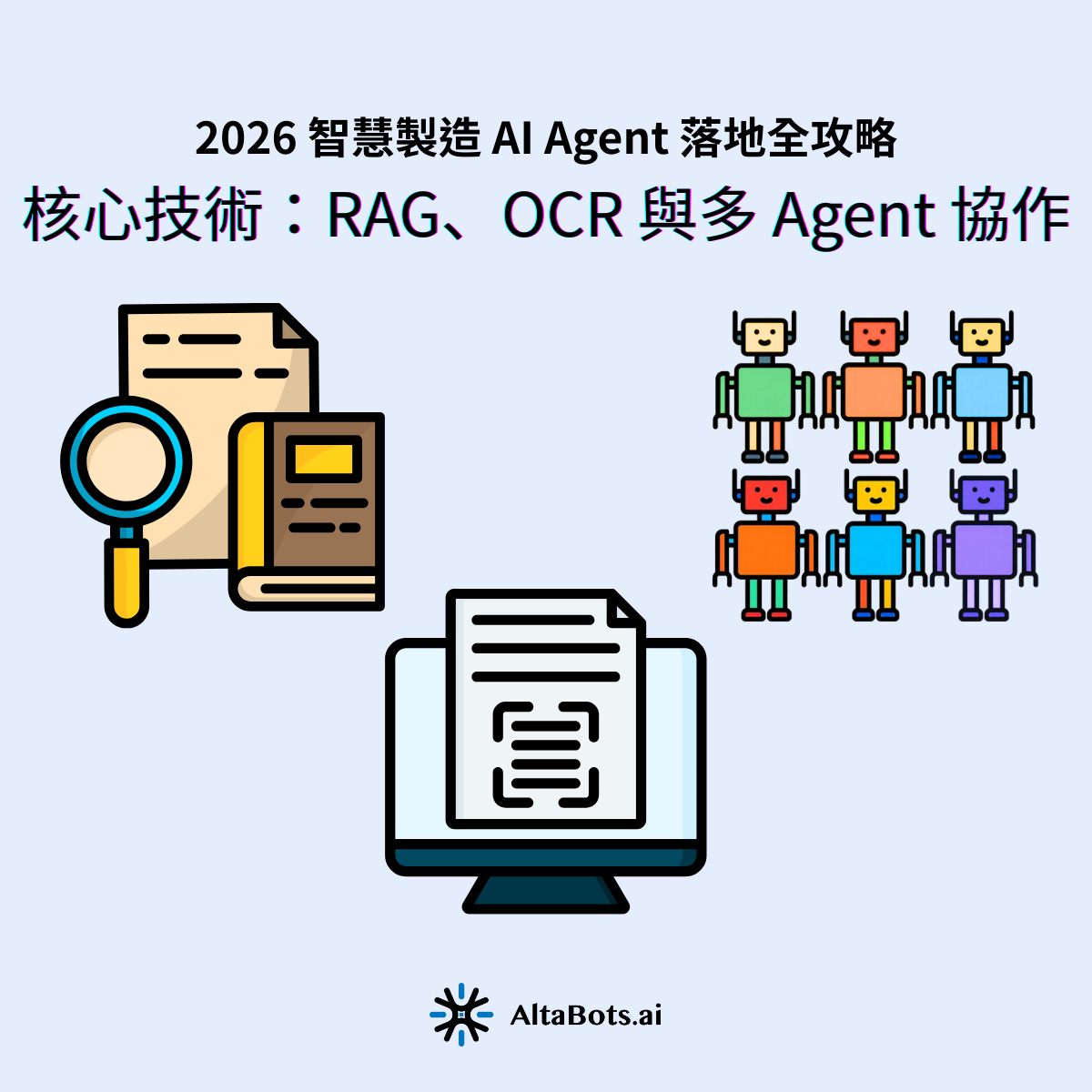
Core AI Agent technologies: how do RAG, OCR and multi-Agent differ?
In this section: understand three terms, and you can make decisions without the technical detail.
An AI Agent is a software module that can sense, plan and carry out multi-step tasks on its own according to a goal. It links the lookup, recognition, analysis and notification work in a factory into one automated flow, and suits manufacturing units that need to operate at scale, such as process, quality, purchasing and finance. You can decide without knowing the technical detail, but you need to tell three terms apart: RAG is "can find it", OCR is "can read it", and multi-Agent is "can run it". These are not new technologies, but the maturity gains of 2025 to 2026 are what let AI Agents actually go live in factories.
RAG (retrieval-augmented generation)
RAG lets the AI look up your own SOPs, repair manuals and past work orders, rather than answering only with public information from the web. An engineer enters a fault code, and the AI finds the matching handling steps in your internal document library within 10 seconds. This is the underlying reason new-hire training can be 30% shorter.
OCR (optical character recognition)
OCR lets the AI read handwritten work orders, screenshots of gauges and PDF customs documents. The value is not in the recognition itself but in compressing "manual entry into the ERP" into "scan, AI check, automatic write-in". After one large electronics manufacturer adopted it, the work order rejection rate fell from 5% to below 1%.
Multi-Agent collaboration
Multi-Agent collaboration links "analysis, report, check, notification" into one line. Gartner predicts that by 2028 at least 15% of day-to-day work decisions will be made autonomously by agentic AI (0% in 2024), and that 33% of enterprise software will have agentic AI built in [2]. That prediction depends on a multi-Agent architecture: what a single Agent can do is limited, and the real value is in dividing the work. To learn more, see ourMulti-Agent explained.
What are the AI Agent scenarios in manufacturing, and which 3 should come first?
In this section: you do not need to do all 12 scenarios at once. Start with 3 that are easy to quantify.
AI Agent applications in manufacturing fall into three directions, knowledge transfer, automation that cuts costs and real-time insight, with 12 scenarios in total, but the order of adoption matters more than the number of scenarios. The 12 scenarios below combine our practical projects in Taiwan manufacturing with Latentview's 2026 review and case summary of agentic AI in manufacturing [5].
The most common reason AI Agent adoption fails is trying to do too much at once. The AIF 2026 survey shows that in traditional manufacturing, the share of companies that have fully integrated AI into routine company processes is 0%, and 46.2% are still at the stage of trials in some projects only [1]. This shows that putting AI into daily use is a contest of pace, not of specifications. Below is the three-stage approach we have summarized from helping more than 30 Taiwan manufacturers:

Stage 1 (0-3 months, POC validation)
Start with 3 scenarios that are easy to quantify and verify: an equipment maintenance knowledge base, a new-hire training bot, and shipping and receiving document recognition. What these 3 have in common is that results are easy to quantify (search time, time to ramp up and rejection rate all have clear numbers), and they can produce concrete ROI within 3 months so you have results to show the boss.
Stage 2 (3-6 months, extending to key business processes)
Add production line yield monitoring, smart quoting and supply chain alerts. At this stage you start to connect with MES, CRM and purchasing systems, which needs cross-department collaboration, but the trust built in stage 1 makes the push much easier.
Stage 3 (6-12 months, scaling up)
The remaining scenarios go live in turn by department need, and you start designing collaboration among multiple Agents, which is when you truly enter the scaling stage. In the AIF survey, 88.8% of manufacturing leaders have announced an AI strategy, but only 11.1% have a complete roadmap [1]. Having a vision but lacking an execution blueprint is the piece most worth filling in before scaling.
When veteran technicians retire, how do you keep 20 years of experience?
In this section: turn senior intuition into a searchable knowledge base so new hires can ask and get answers on the spot.
A knowledge-transfer AI Agent uses a RAG architecture to structure SOPs, repair records and equipment manuals into a searchable knowledge base, so a new hire can ask in natural language and instantly get the experience of senior engineers. It suits factories facing the loss of senior staff and skill gaps. The most underrated risk in manufacturing is not equipment failure but veteran technicians retiring: 20 years of floor intuition leaves with the person, and a new hire needs 3 to 5 years to catch up, during which line yield, repair speed and ability to respond all show gaps. The AIF 2026 survey also shows that talent is the lowest-scoring of the three dimensions for Taiwan companies (39.73), and that 46.2% of manufacturers have not yet set any AI talent training practice [1]. This gap widens every year.
⭐ Equipment maintenance knowledge base (featured scenario 1)
Before adopting it, field engineers at a Taiwan electronics factory spent an average of 30 minutes paging through PDF manuals when equipment faults occurred, and sometimes still could not find the matching fault code and had to wait until the shift leader was free. After adopting an equipment maintenance AI Agent, the veteran technicians' repair experience and past cases were all structured and uploaded. A new hire only needs to enter the problem or scan the equipment number to get the best handling steps and similar cases within 3 minutes.
More importantly, the record after each repair is written back to the knowledge base automatically, and the next person with the same problem benefits directly. This mechanism makes the knowledge base grow thicker every month instead of standing still after one build. Six months after going live, this customer's night-shift calls to supervisors fell from 12 a week to 3, and supervisors could finally sleep properly.
⭐ New-hire onboarding training bot (featured scenario 2)
It integrates SOPs, common error scenarios and assessment Q&A, so new hires can learn on their own 24/7 without waiting for a senior colleague to be free. Time to ramp up is shortened by 30% on average, and trainers carry far less repetitive explanation, so they can put their time into more complex fault-finding judgment and cross-department coordination. That is where a trainer's real value lies.
On-site work guidance assistant
Scan a work order or equipment number to get operating steps, safety rules and exception handling flows instantly. It is especially suited to factories with multi-model lines or frequent seasonal changeovers, so shift leaders do not have to answer "how do I do this step" all day.
Process specification analysis assistant
When a customer provides a BOM or drawings, the AI parses the specifications automatically and converts them into unified production parameters. For make-to-order manufacturers, this directly shortens the time between receiving an order and confirming manufacturability, so sales can commit to delivery dates faster.
Which repetitive tasks should go to AI so that people make the real judgments?
In this section: move the form filling and cross-checking away, and keep people for work that needs trade-offs.
The value of an automation AI Agent is not to replace people but to take away work such as filling in forms, organizing and cross-checking, which uses time but needs no judgment, so people can focus on tasks that need trade-offs and decisions. It suits manufacturers whose back office is full of administration, meetings and repetitive processes. Heavy administration, time-consuming meeting minutes and back-office work crowded with repetitive processes are common pain points in manufacturing.
⭐ Shipping and receiving document recognition (featured scenario 3)
The finance team at a large electronics manufacturer spent 60 hours a month cross-checking delivery notes, acceptance forms and customs documents, with a work order rejection rate above 5%, and every rejection meant running the process again. After adopting an OCR Agent, key fields are recognized and synced straight to the ERP, the rejection rate fell below 1%, ERP inventory accounting accuracy reached 99%, and finance staff save more than 40 hours a month. This is not 40 hours of overtime pay. It is one more person's worth of time that can go to work needing professional judgment, such as month-end analysis or tax optimization.
This is also the scenario we usually recommend for the first batch: the results are the most direct to quantify, cross-department coordination is the simplest, and the impact on IT systems is the smallest, which helps most in building senior management's confidence in AI.
Smart quote automation
It connects the BOM and CRM and generates quotes automatically from customer requirements. Sales goes from "manual material lookup, manual form filling, approval, sending" to an AI draft followed by one-click confirmation from the manager, and quoting speed rises by about 60%. When a customer asks 3 suppliers for quotes and picks whichever replies fastest, this speed converts directly into orders.
Purchasing RFQ assistant
It integrates past purchasing data and the supplier list and drafts inquiry letters and price comparison analysis automatically. This lets purchasing move time from making Excel sheets to real negotiation strategy: which suppliers can be bundled for negotiation, which part numbers need a backup source, and which long-term contracts need renegotiating.
Meeting minutes and follow-up assistant
It organizes transcripts automatically, produces a list of decisions and to-dos by owner, and tracks execution across departments. Managers can confirm within 24 hours whether every action item has been picked up, which addresses a common organizational problem in manufacturing: decisions are made but execution drops the ball. For more scenarios, see our collection of2026 AI Agent enterprise automation cases.
With so much manufacturing data, how does AI move from showing numbers to giving guidance?
In this section: the problem is not a lack of data but spotting problems and pointing to the next step.
A real-time insight AI Agent continuously compares current parameters with historical data, finds anomalies on its own, proposes root-cause hypotheses and suggests actions. It upgrades the factory floor from reading reports after the fact to receiving guidance beforehand, and suits manufacturing units where yield, supply chain and cost swings need immediate response. Manufacturing does not lack data. It lacks the ability to see problems in the data and say what to do next.
⭐ Production line yield monitoring assistant (featured scenario 4)
This is the scenario most worth investing in at stage 2. At a precision parts factory before adoption, yield anomalies were caught by engineers taking turns watching the MES dashboard, so problems were found 4 hours late on average, and root-cause analysis took another 1-2 days. After adopting a yield monitoring Agent, the system continuously compares current parameters with historical yield, sends an alert within 5 minutes of an anomaly, and at the same time lists the 3 most likely root-cause hypotheses with a suggested order of verification.
The biggest value of this kind of Agent is not finding problems faster than people, but being able to compare historical data, propose hypotheses and shorten engineers' debugging time all at once. McKinsey research indicates that AI-driven predictive maintenance can reduce equipment downtime by up to 50% and maintenance costs by 10-40% [4]. If you are planning MES data integration, see AltaBots.ai's No Code integration architecture.
Why might your data not be in your own hands?
Here is a blind spot specific to manufacturing that is often overlooked: data ownership. The AIF 2026 survey found that among traditional manufacturing leaders, 33.3% still keep data on the machine or equipment vendor's side, and among laggards it is as high as 43%, with only 9.5% directly usable for analysis [1]. In other words, for many factories wanting AI yield monitoring, the first hurdle is not the model but whether the data can be retrieved.
The same mismatch appears in compute allocation. Even in the scenarios that most call for edge computing, the share of manufacturers choosing edge or on-device processing is only 24% for visual defect inspection (AOI) and 26% for equipment predictive maintenance [1]. The need for strict data privacy and keeping data off the cloud is widely underestimated. This is why AltaBots.ai treats on-premises deployment and keeping data on the factory's internal network as core capabilities: take data ownership back first, and the later scenarios can run.
Supply chain alert radar
It monitors raw material price swings and supplier delivery anomalies and warns of shortage risk in advance. The AI scans every day and flags high-risk part numbers, so schedulers have a response before the problem happens.
Operations report analyst
It generates SQL queries from natural language and produces data analysis and charts instantly. A manager can ask the AI "Which production line had the highest unit cost last week?" and get an answer and chart in seconds, so every weekly meeting is backed by data. Further reading:The new focus of AI data analysis.
Receivables and order tracking
It integrates receivables and orders, monitors overdue risk by customer or product category, and automates collection. It can go further and combine credit scoring, so the AI flags customers who are "paying more and more slowly" and sales can step in early, before the customer actually runs into trouble.
How does AltaBots.ai help you go from POC to scale?
In this section: choosing the right scenario at the right pace matters more than how strong the platform is.
A real story says more than any list of platform strengths. In Q3 2025, a listed Taiwan electronics manufacturer came to us. Six months earlier they had tried two overseas AI platforms, and the technical team ran a POC with a beautiful demo, but as soon as they had to connect with the internal SAP, comply with the personal data law and serve different plants, everything stalled. The project sat in a state of "technically feasible but unable to scale" for 5 months, and the boss had lost patience.
The first thing we did on entering was not write code. We spent 2 weeks narrowing the 8 planned scenarios to 2: the equipment maintenance knowledge base and shipping and receiving document recognition. The reason was simple: these two had the clearest quantitative metrics and the least cross-department resistance, and could show the boss concrete numbers within 90 days. This step fills the link most adoption projects lack. The AIF 2026 survey says plainly that most Taiwan IT service providers "are used to chasing the latest technology but cannot clearly identify the problem the company really needs to solve", and a common practice is to sell existing system products directly to customers, without the coaching capacity to drive process redesign [1]. Our role is not to sell tools. It is to help you design the process right first, and then work alongside you until it produces results.
On the technical side, AltaBots.ai's on-premises deployment keeps sensitive BOM and customer data on the factory's internal network, which resolved the information security officer's original insistence on staying off the cloud. The No Code architecture means IT does not have to schedule programming time, and power users in the business units could start changing workflows within two weeks. The built-in PII de-identification module turned personal data law compliance from "a separate 3 months of work" into "built into the platform". But these features are not the point. The point is the pace of "choose the right scenario, validate quickly, then expand investment", and we only shaped the platform to fit that pace.
After 90 days, both scenarios produced concrete ROI: the maintenance knowledge base cut night-shift calls to supervisors by 75%, and document recognition saved finance 40 hours a month. At the meeting on day 91, the boss said "let's do the next 3 scenarios". This customer is now in stage 3 with 10 scenarios live.
The point of the story is not how strong AltaBots.ai is. It is that the 40% of failed projects Gartner warns about mostly die from trying to do too much at once, not from technology that is not good enough [2]. Find the right scenarios first, get results quickly and build trust, and the rest follows naturally.
Glossary
AI Agent: a software module that can sense, plan and carry out tasks on its own according to a goal, commonly used for automated decisions, data analysis and process execution.
RAG: Retrieval-Augmented Generation. It combines knowledge base retrieval with generative AI, so the AI can look up internal documents in real time and generate answers specific to the company.
OCR: Optical Character Recognition. It automatically recognizes text in images, PDFs and handwritten documents, and is commonly used to automate work orders and forms.
Multi-Agent system: several AI Agents divide the work, each responsible for a different task (such as data analysis, work order checking and quality comparison), improving overall operating efficiency.
PII de-identification: Personally Identifiable Information Anonymization. It automatically masks sensitive information such as names, ID numbers and credit card numbers to prevent data leaks.
API integration: Application Programming Interface. It lets different systems (such as ERP, MES and AI Agents) exchange data securely.
ERP / MES: enterprise resource planning (ERP) and manufacturing execution systems (MES), which manage internal company resources and production processes respectively and are the core platforms of smart factory digital transformation.
Conclusion: 3 points you can use in an internal briefing
In this section: three arguments to put straight into your next presentation.
By this point, what you need is not more trend analysis but how to push this forward when you walk into the office tomorrow. We suggest putting the three arguments below straight into your next briefing for the boss.
Argument 1 (why now): 2026 is the turning point when AI Agents move from trials to scale. The AIF survey shows Taiwan's industry AI index rose from 36.77 to 46.32 in one year, and nearly half of companies have entered the Ready or Scaling stage [1]. Delaying adoption by half a year means letting competitors lead by half a year.
Argument 2 (why it will not fail): Gartner warns that 40% of projects will be canceled, but failures concentrate in trying to do too much at once [2]. We plan to control risk with a pace of "2-3 scenarios in stage 1, with concrete ROI visible in 90 days", and the brakes can be applied if the agreed benefits are not met.
Argument 3 (why it is worth investing in): the first batch of three scenarios, the equipment maintenance knowledge base, new-hire training and document recognition, is expected to bring within 3 months a 90% reduction in search time, a 30% shorter ramp-up, and an extra 40 hours of finance time each month, so ROI is predictable and quantifiable. More importantly, after adoption do not stop at "individuals get faster". The AIF survey indicates that only 6.6% of companies have truly integrated applications into core processes after adopting AI, and 23.0% see no clear results yet [1]. Connecting scenarios back to core operations is the key to turning efficiency into competitiveness.
Behind these three arguments are concrete scenarios, quantified benefits and risk control mechanisms. The next step is to be clear about which 3 first-batch scenarios suit your factory.Book a free conversation with an AltaBots.ai expert, and we will use 1 hour to complete a scenario assessment and provide matching estimate data. You do not need to prepare data first. Just give us your current pain points and existing systems.
References

[1] Artificial Intelligence Foundation (AIF). (2026). 2026 Taiwan Industry AI Adoption Survey: A New Game After AI Becomes Widespread (in Chinese). Artificial Intelligence Foundation.
[2] Gartner. (2025). Gartner Predicts Over 40% of Agentic AI Projects Will Be Canceled by End of 2027. Gartner Newsroom.
https://www.gartner.com/en/newsroom/press-releases/2025-06-25-gartner-predicts-over-40-percent-of-agentic-ai-projects-will-be-canceled-by-end-of-2027
[3] MIT NANDA. (2025). The GenAI Divide: State of AI in Business 2025. MIT Project NANDA.
[4] McKinsey & Company. (2026). The state of AI / Where AI will create value. McKinsey & Company.
[5] Latentview Analytics. (2026). Agentic AI in manufacturing: Real-world examples and use cases. Latentview Analytics.
https://www.latentview.com/blog/agentic-ai-in-manufacturing/
FAQ
FAQs about this article
How much does it cost to adopt an AI Agent?

It varies widely by scenario complexity. A single-scenario POC (for example, an equipment maintenance knowledge base) can be validated for roughly NT$500,000 to NT$800,000, and scaled deployment of 3 to 6 scenarios roughly NT$2 million to NT$5 million. AltaBots.ai uses a subscription plus implementation service fee. We suggest asking sales for an ROI estimate directly, which can usually give a cost range for your industry during the consulting conversation.
How long until I see ROI?
Scenarios such as equipment maintenance, document recognition and new-hire training show concrete numbers within 3 months. Scenarios involving system integration, such as yield monitoring and smart quoting, take about 4 to 6 months. We suggest discussing result checkpoints in the stage 1 POC contract, and the scope can be adjusted if the agreed benefits are not met.
If adoption fails, how is the risk handled?
The biggest risk is not technical failure but choosing the wrong first scenarios, which is also the main reason Gartner warns that 40% of AI Agent projects will be canceled. The approach is to do only 2 to 3 scenarios that are easy to quantify in stage 1, with the contract paid in 3 installments each tied to a KPI, so you keep the option to stop if it does not fit. This is also an important risk control point to include when briefing the boss.
Our data is sensitive. Can it be deployed on-premises?
Fully supported. AltaBots.ai can be deployed on-premises on an internal network server, or as a hybrid cloud, so data does not leave the company. The AIF 2026 survey shows that edge AI use in manufacturing for scenarios such as AOI and equipment predictive maintenance is still low, and that data is often stored on the equipment vendor's side and hard for companies to retrieve. On-premises deployment is the key reason semiconductor, precision machinery and medical device customers choose us over pure SaaS options.
How is an AI Agent different from traditional automation or RPA?
Traditional RPA is a script that runs on fixed rules and stops when it meets an exception. An AI Agent can look up an internal knowledge base, recognize unstructured documents, decide the next step on its own and connect multiple Agents to complete cross-system flows. For a factory, the difference is that RPA can only do "carrying with clear rules", while an AI Agent can handle scenarios that need interpretation and flexibility, such as fault code matching, quote drafting and yield root-cause hypotheses.
More articles


訂閱我們的電子報
每月 8 日定期發送最新趨勢與實用資訊!



