

Choosing enterprise AI customer service: 3 paths, 5 criteria
How does enterprise AI customer service differ from a standard chatbot? This article compares building in-house, buying a platform and working with consultants, across five criteria including credibility, go-live and governance. Book a free enterprise AI customer service assessment.


Enterprise AI customer service is AI customer service that can go live reliably within security and compliance requirements, is governed and audited by the company, and can connect to systems to complete multi-step tasks. It differs from a standard chatbot that only answers FAQs. This article compares three paths (build in-house, buy a general platform, work with consultants alongside you) across five criteria: credibility, resolution, adoption, go-live readiness and governance, and uses real scenarios and cases to show how it works in practice and how to evaluate it.
What are you actually comparing when you choose enterprise AI customer service?
The short answer: you are not comparing features. You are comparing three paths.
Enterprise AI customer service is AI customer service that can go live reliably within compliance requirements, is governed and audited by the company, and can connect to systems to complete multi-step tasks. Compared with a chatbot that only answers FAQs, the difference is not how fast it answers. It is whether it can go live and whether it can withstand governance.
It is eleven at night, a big sale is still running, and unread messages keep stacking up in the customer service back office. All ten agents went home long ago. Tomorrow morning you will open the inbox to find a wall of "is it in stock?" and "I need to change my address", and a whole row of customers who already ordered from someone else. What you need at that moment is not a chatbot that chats better. It is a system that actually gets things done while the team sleeps.
Every vendor on the market says it can do this. A general cloud-based conversational AI platform is enough for standard Q&A and shopping guidance. But when your product line is complex, you have many stores and channels, or customer data must stay in an environment you control, your needs go beyond that, and the comparison changes. It is no longer about who chats better. It is about these three things: the pilot (PoC) worked well for six months but the production environment never goes live; once it finally goes live, your manager asks who is responsible when the AI answers wrongly and whether customers' personal data is at risk; and the person who approved the budget has to explain in a meeting what the money bought.
So what you are choosing is not "which customer service bot" but "how adoption will go": build in-house, buy a general platform and figure it out yourself, or have consultants work alongside you from decision to go-live. This article lays out the three paths across five criteria and explains each criterion with a real scenario, so you leave with a decision basis you can present internally and use as a checklist.
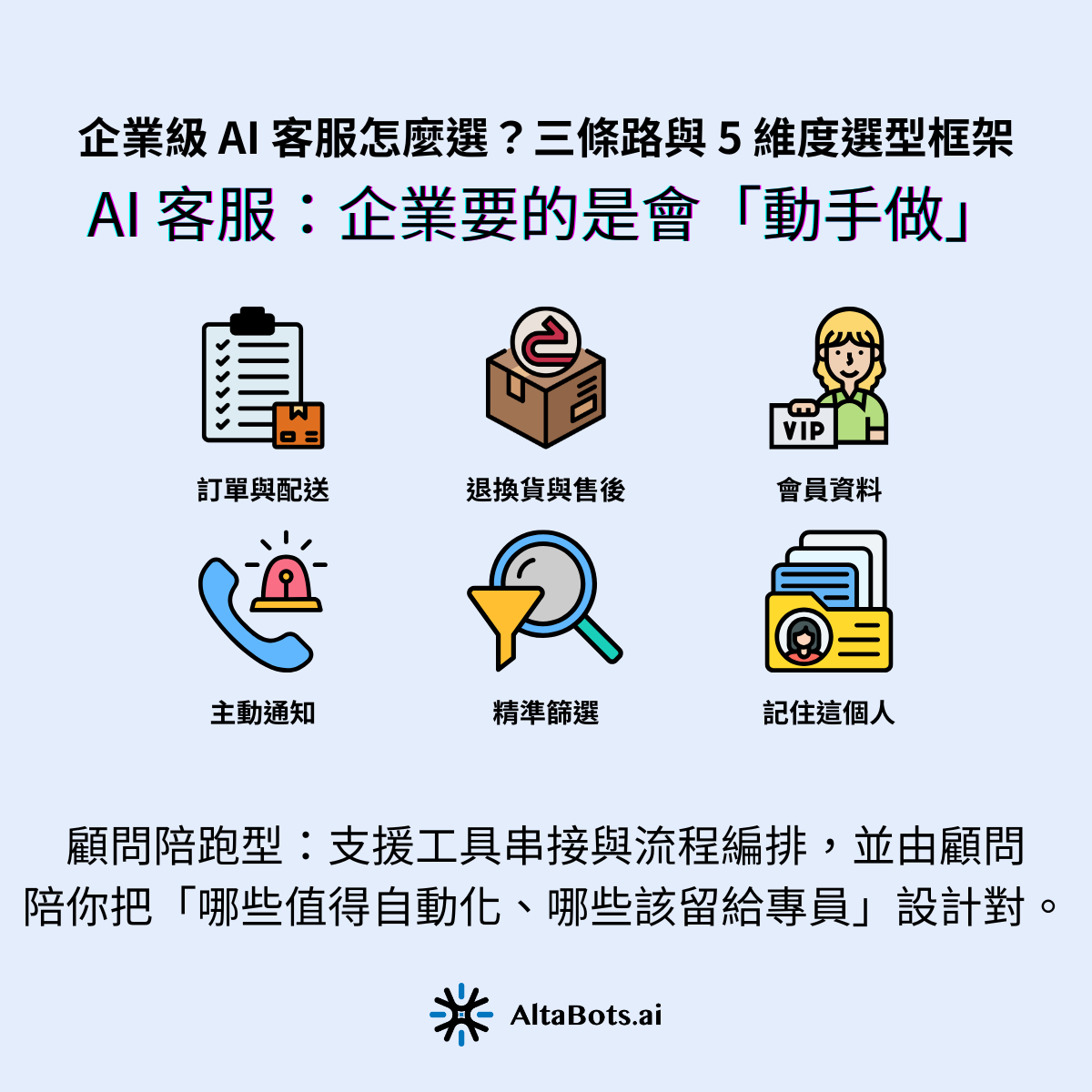
General AI customer service only "answers"; enterprises need one that "does"
Key point: if it can look up, act and notify, it counts as resolved.
An AI customer service Agent (agentic AI customer service) is AI customer service that understands the full intent, breaks it into steps on its own, and connects to systems to finish the task. It is not a traditional chatbot that matches keywords and hands over to a person after answering. The difference is that it delivers a resolved outcome, not just an answer.
A scene you will know well: a customer says, "The order I placed last week hasn't arrived. I'd like it sent to my office instead, and if that's not possible, just refund me." A traditional AI customer service bot reads this as "order lookup" and replies with a delivery status. The customer has to say "I want to change the address" again, and in the end it still goes to a person. Three rounds of conversation, and the customer's patience is gone. A customer service Agent understands the whole chain of intent at once: check the order, decide whether the address can be changed, change it and confirm if it can, or start a refund if it cannot. One conversation, done. The automation rate of traditional chatbots is often stuck at 30 to 40%, not because the answers are not good enough but because they can only answer and cannot act.
Once a customer service Agent is connected to enterprise systems, it can handle a whole class of real actions:
- Orders and delivery: check order status, track shipping and arrival, convenience-store pickup and reasons for delays.
- Returns, exchanges and after-sales: generate return orders, arrange pickup and report refund progress.
- Member data: look up points, tiers, coupons, birthday gifts and member-only events.
- Proactive notifications: update customers or internal teams on progress through email, LINE and SMS.
- Precise filtering: when a customer wants "a list of products that meet specific conditions", semantic search often misses. In that case the AI runs an exact query on the product data table, filtering out exactly matching results the way SQL does, for example "recommend Panasonic refrigerators of 40L or more".
- Remembering the person: it remembers that a customer said "oily skin, dislike heavy textures" and applies it to every later recommendation, so the customer does not have to repeat it.
Being able to act does not mean handing everything to AI. In practice, AI takes the front line and handles highly repetitive, standardizable questions, then passes conversations that need judgment, emotional reassurance or high value to an agent, bringing along the order and member data it already looked up so the agent does not start from scratch. For a ten-person customer service team, this means agents are no longer "repeat-reply machines" but handle only the difficult cases that need a person, and also go back to monitor the quality of the AI's answers.
This is not a future scenario. Gartner predicts that by 2029 agentic AI will autonomously resolve 80% of common customer service issues and bring operating costs down by 30% [1]. A Cisco survey of nearly 8,000 enterprise decision-makers also expects that by 2028, 68% of customer service and support interactions will be handled by agentic AI [2].
The question then becomes this. If you want it to "act" in each case: building in-house means developing, testing and monitoring every API connection yourself, and adding one scenario means another round of engineering. General AI customer service platforms mostly stop at FAQs and forms, so the actions they can connect are limited. The consultant-led type natively supports tool integration and workflow orchestration, and the consultants work alongside you to design which actions are worth automating and which should be left to agents. Whether it can complete tasks is only the first criterion. Next, all three paths are laid out together.
How should you compare enterprise AI customer service? Start with the three paths
Key point: all of them are called AI customer service, but the three paths end in very different places.
There are really only three paths for a company adopting AI customer service: build in-house, buy a general AI customer service platform and use it on your own, or choose a consultant-led enterprise customer service Agent. The most common mistake at the comparison stage is to put them in the same category and compare features. Once the comparison standard becomes "which bot has more features", you end up choosing a tool with many features and nobody to accompany you to go-live. Change the standard and the differences become clear:
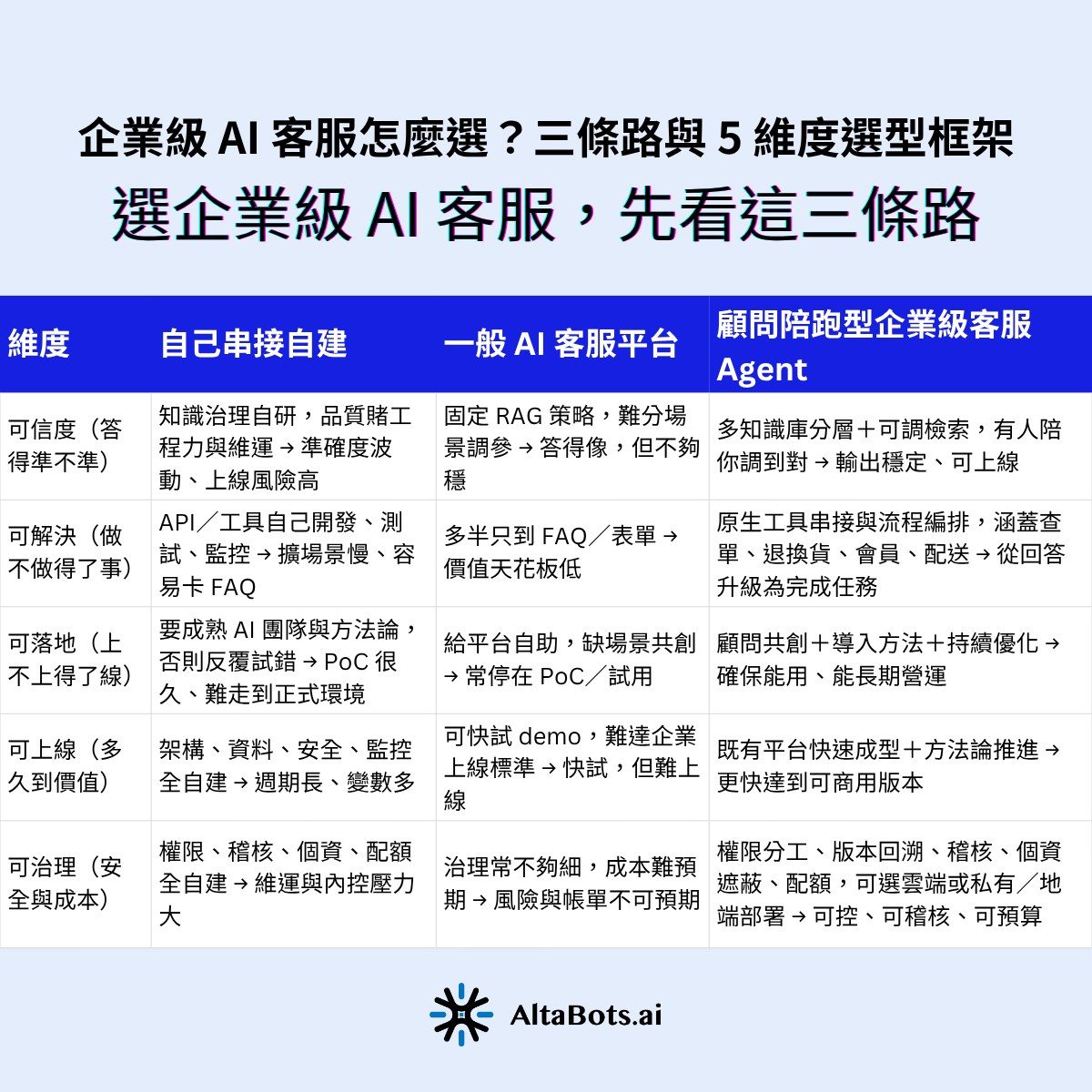
Plain-language notes on the table: tool integration and workflow orchestration = the "ability to act" that lets AI not only reply but also look up orders, change addresses and send notifications; personal data masking = personal data in conversations (names, phone numbers, order numbers) is masked automatically and does not flow into the AI model.
Read across the rows and it is clear at a glance: building in-house means "carrying all five checkpoints yourself", a general platform means "you get the tool and do the rest on your own", and the third path means "someone works alongside you through all five checkpoints to go-live". None of the three paths is absolutely right or wrong. If you have a mature AI engineering team and methodology, building in-house gives the most freedom, and the full trade-offs of that path are in AI Customer Service: Build vs. Buy Decision Framework. But for most retail, e-commerce and brand companies that have no dedicated AI team but do have complex product lines and many stores, the difference comes down to a very practical question: at the moment of go-live, do you fill the missing pieces yourself, or does someone fill them with you?
You do not need to worry about all five checkpoints at once. If resources are limited, press hard on go-live and governance first. They map to the two most serious fears: it never goes live (the money shows no results), and when something goes wrong nobody is accountable (you cannot answer to your manager or internal control). Credibility and resolution are about how well it works; go-live and governance are about whether it can be used and whether you dare to use it. Secure the last two first, then move on to the first two. The next four sections explain how each checkpoint actually works.
Hundreds of knowledge documents and the AI still answers Inaccurately. what now?
Key point: accuracy does not come from a stronger model but from tuning retrieval correctly.
Start with a moment when it goes wrong. A customer asks, "Can I still use this coupon during the anniversary sale?" The AI digs up the rules of the previous campaign and confidently answers "yes". The customer happily checks out, finds the discount does not apply, and a complaint comes in. The AI is not stupid. Among more than a hundred documents, it retrieved the wrong one.
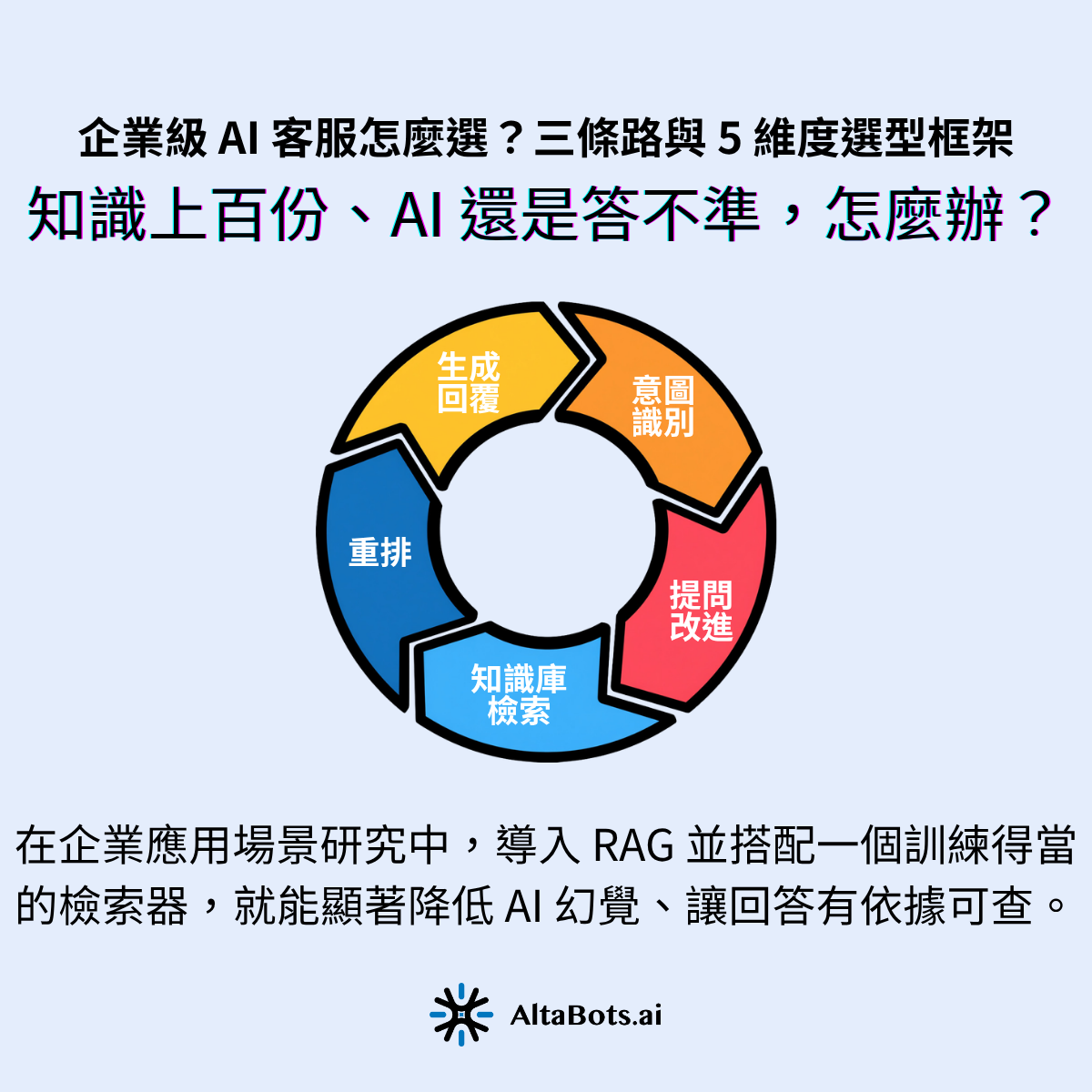
The problem lies in "how it finds answers". Before an enterprise AI customer service system speaks, it actually performs a series of steps you cannot see. It first understands whether the question is about a campaign, a return or after-sales, turns the customer's incomplete spoken phrasing into a precise query, pulls a few relevant documents from the knowledge base, ranks the best one first, and finally answers only from those documents instead of improvising from impression. Every link in this chain is tunable: how many documents to retrieve, how similar counts as a match, whether to search by keyword or by meaning, and whether to re-rank. Inaccurate answers are often caused by these dials being set wrongly, not by a model that is not smart enough.
What is worse is "all the data crammed together". Pile product specifications, return policies, marketing campaign schedules and store SOPs into one folder, and of course the AI mixes return rules into product descriptions. So in practice, knowledge is split into separate libraries: products with products, campaigns with campaigns, customer service scripts with customer service scripts, and the AI opens the right cabinet for the question at hand. Just sorting the data into the right cabinets and setting those dials correctly greatly reduces mixed-up answers and outdated information. Research in enterprise settings also confirms that RAG paired with a well-trained retriever significantly reduces AI hallucination and gives every answer a source that can be checked [3]. Accuracy is tuned step by step like this, not left to luck.
So who does this tuning? If you build in-house, you need to keep a team to study these dials and tune them correctly, and worry about them leaving. A general platform gives you one fixed configuration and gets stuck on your particular scenarios. With the consultant-led type, someone sits down with your documents, splits the libraries with you and works alongside you until the parameters are right. The difference is not whether the feature exists but whether someone works with you until it is truly accurate. For more technical detail, see RAG and Knowledge Re-ranking Explained.
AI answering wrongly, customer personal data, costs spiking: how does enterprise AI customer service handle governance?
Key point: whether you dare to put it on the front line depends on whether governance holds.
Governable, put plainly, means this: when AI faces customers directly, can you control its answer boundaries, customer personal data, who can change it and how much it costs, and when something goes wrong, can you explain clearly "why it replied that way and who changed what". For a brand that wants to put AI on the front line, this is not a bonus. It is the precondition for letting go.
Imagine two kinds of incidents during a big sale: one is the AI giving a customer an expired discount, and the other is it reading a customer's phone number and order number aloud in the conversation. The first is a complaint, the second a personal data concern, and either one takes a week to clean up. An AI customer service system that can hold the front line must stop these before they happen. It masks names, phone numbers and order numbers in conversations automatically so they do not flow into the model; it blocks inappropriate or sensitive requests automatically, even refusing "write me a scam email"; it keeps a record of what changed in every configuration version, so that when you need to trace "why did it answer that way at the time" you can pull it up; it separates who can edit from who can only view, so not everyone can change things; and it sets a daily usage cap for each user, so that when big-sale traffic rushes in the bill does not explode with it. If you need customer data to stay in an environment you control, it can also move from cloud SaaS to a private cloud or on-premises deployment, which most purely cloud-based conversational platforms cannot offer.
And this bar will only rise. In the Cisco survey, 99% of enterprise decision-makers said that to work with a technology partner, they must first see that the partner has sound AI governance [2]. When protecting customers' personal data is a legal obligation and responsibility for wrong AI answers falls on the brand, only an AI customer service system that can be explained clearly, traced and controlled, and that is provided by a company with ISO/IEC 27001 certification, can truly be put on the front line.
On this checkpoint, the gap between the three paths is the most practical. If you build in-house, you must construct the masking, permissions, auditing and quotas above one by one. General platforms often give governance that is not detailed enough and costs that are hard to pin down. The consultant-led type makes these standard features, so they are controllable, auditable and budgetable. For how to keep watching the quality of AI answers after go-live, see Agent Error Analysis and Evals in Practice.
How do you avoid getting stuck at the PoC and actually go live?
Key point: when it does not go live, the cause is usually not technology but that nobody worked with you to finish it.
Stuck at the PoC means the AI customer service pilot worked well but never reaches formal go-live. Usually the model is not the problem. What is missing is the people and the method to design the scenario correctly and to finish the testing and governance work.
Consider a real case. A nationwide 3C electronics retail brand we worked with has more than 300 stores across Taiwan. Three regional managers were asked every day by store managers across a hundred stores things like "how is the commission calculated for this campaign?" and "how does this SOP run?", leaving them no time even for their own management work. Store staff were also slow to look up specifications and offers for customers and gave inconsistent answers. The solution was not to drop in a chatbot but a three-layer structure: workflow routing to judge the type of question, knowledge base RAG to find product information and rules, and data table queries for exact conditions, then embedded into the store platform through an iframe with cloud documents synced on a schedule, so stores nationwide use one set of answers. The result is that stores get answers the moment they ask, and the three regional managers went from "around-the-clock answerers" back to "knowledge managers".
It runs because of two layers of design. One layer has the AI divide work like a team: the system first judges what type of question the customer is asking, then hands it to the right Agent. Product recommendation, order lookup and customer service specialists each manage their own area, with their own knowledge base and the model best suited to it, instead of one all-purpose bot that half-understands everything. The other layer is how adoption proceeds: consultants first work alongside you to review pain points and pick the scenario most worth doing first, build it with No Code, test it live, collect feedback and adjust quickly, and once it is confirmed useful, expand to the next department, moving forward in weekly steps instead of putting the entire production environment at stake at once.
This also points to something else. AltaBots.ai is at its core an enterprise AI Agent platform, and customer service is only its most common use. The same platform can also serve as a store SOP assistant, a practice partner for new sales staff, or a way to query reports in natural language. What you adopt is not a single-purpose tool but a foundation that can grow more applications. Its consultants come from a data consulting and strategy background, and they work alongside you to judge "whether to do it and which scenario to do first" before taking it to go-live. This is the biggest difference among the three paths: a large platform gives you capability but leaves you to master it; a general platform leaves you to feel your way to go-live on your own; the consultant-led type accompanies you from the decision stage onward. The meaning of third-party recognition (EE Awards Asia 2025, ISO 27001, selection for a Microsoft startup accelerator) is to lower the risk of "what if it fails" after you sign off.
Don't overlook this: enterprise AI customer service is also a marketing insight engine
Key point: every question a customer asks is a free market survey.
Besides saving customer service costs, enterprise AI customer service has a value that is often overlooked: it turns every customer question into analyzable data. The customer service Agent automatically classifies conversations and tags them with topics and sentiment, so you get insights that used to require paid market research, for example "the top 10 questions asked about a product line", "the most frequently asked needs that currently have no matching offer or content", and "a keyword list suited to feature topics or campaign plans".
For marketing and product teams, this means planning no longer rests on intuition alone: you know what customers are actually asking, where they get stuck, and what they want but have not yet been given. This is also what "Let Data Speak, Let AI Act" looks like in practice: the same AI customer service lightens the load for the service team and is a demand radar that keeps running for the marketing team. An FAQ-only customer service bot cannot give this layer, because it does not structure the conversations and has no analyzable data foundation.
Next step: confirm which checkpoint you are stuck at
Key point: do not rush to choose a platform; first work out which checkpoint you are stuck at.
Back to the opening line: when choosing enterprise AI customer service, you are comparing not features but how you plan to bring it to go-live. What decides the destination is which of the five checkpoints (credibility, resolution, adoption, go-live and governance) you are currently stuck at. If resources are limited, hold go-live and governance first, since they map to the two most serious risks: never going live, and nobody accountable when something goes wrong.
Every company gets stuck in a different place: some because there is so much knowledge that the AI answers inaccurately, some because of personal data and governance when AI is put on the front line, and some because the PoC has run for a long time and still will not go live. If you want to first clarify which checkpoint you are actually stuck at, Data-DI offers a free 30-minute enterprise AI customer service assessment, in which consultants review your current customer service pain points, existing systems and adoption constraints with you, and give a next step you can act on right away for your situation. You do not need to prepare data in advance; just share your current situation and the tools you use, and this applies whether or not you eventually choose us. You can directly book a free enterprise AI customer service assessment, or first learn about the AltaBots.ai enterprise AI Agent platform.
References

[1] Gartner. (2025). Gartner Predicts Agentic AI Will Autonomously Resolve 80% of Common Customer Service Issues Without Human Intervention by 2029 [press release]. Gartner Newsroom.
https://www.gartner.com/en/newsroom/press-releases/2025-03-05-gartner-predicts-agentic-ai-will-autonomously-resolve-80-percent-of-common-customer-service-issues-without-human-intervention-by-20290
[2] Cisco. (2025). Agentic AI Poised to Handle 68% of Customer Service and Support Interactions by 2028 [press release]. Cisco Newsroom.
https://newsroom.cisco.com/c/r/newsroom/en/us/a/y2025/m05/agentic-ai-poised-to-handle-68-of-customer-service-and-support-interactions-by-2028.html
[3] Béchard, P. & Marquez Ayala, O. (2024). Reducing Hallucination in Structured Outputs via Retrieval-Augmented Generation. arXiv:2404.08189.
https://arxiv.org/abs/2404.08189
FAQ
FAQs about this article
How does enterprise AI customer service differ from general AI customer service?

The difference is whether it can go live and be governed, not only whether it answers accurately. General AI customer service mostly stops at answering common questions. The enterprise type must go live reliably within compliance requirements, be audited by the company, and connect to systems to complete multi-step tasks such as order lookup and address changes.
How is an AI customer service Agent different from a traditional chatbot?
A traditional chatbot matches keywords and stops after answering, and its automation rate is often stuck at 30 to 40%. An AI customer service Agent understands the full intent, breaks it into steps on its own and connects to systems to finish the task. It delivers a resolved outcome, not just an answer.
When AI customer service is put on the front line, how do you control the risks of customer personal data and wrong answers?
Look at whether the governance guardrails are complete: automatic personal data masking, content screening, version rollback, role-based permissions and cost quotas. A complete enterprise solution makes these standard, and lets you choose cloud, private cloud or on-premises deployment as needed, so that data stays in an environment you control.
Why does AI customer service adoption so often get stuck at the PoC and fail to go live?
Usually it is not a technology problem. What is missing is the people and the method to design the scenario correctly and finish the testing and governance work. A pilot that works does not mean it is ready for production. Having consultants work alongside you from the decision stage through design, testing and refinement to go-live is the most direct way past this checkpoint.
Is it better to build enterprise AI customer service in-house or buy it?
It depends on whether you have a mature AI engineering team and methodology. Building in-house gives the most freedom, but you carry all five checkpoints of credibility, go-live and governance yourself. For companies without a dedicated team, a consultant-led solution usually goes live faster and with lower risk.
More articles


訂閱我們的電子報
每月 8 日定期發送最新趨勢與實用資訊!



