

Build vs. buy AI customer service: 2026 matrix and costs | Alta.DI
This article uses a decision matrix, a cost map and an ROI estimate to break down adoption paths for Taiwanese companies, with a 5-week go-live roadmap and advice for phone-based service teams. Book a free consultant diagnostic.


"Should we build or buy AI customer service?" is the first question Taiwanese companies ask most often in 2026 when they evaluate a customer service upgrade.The short answer: for most small and mid-sized companies in Taiwan, buying a mature SaaS AI customer service platform is the path with a higher return on investment and lower risk; building suits only the few companies that have an in-house ML/MLOps team and must handle extremely sensitive core data. This article uses a decision matrix, a cost map and a 5-week adoption roadmap to break the decision down clearly.
Why is AI customer service a must-answer question in 2026?
In 2026, AI customer service has moved from a "nice-to-have" to a "baseline." Gartner predicts that by 2029, agentic AI will autonomously resolve 80% of common customer service issues and cut operating costs by 30% [1]. McKinsey's 2026 global survey further shows that 40% of large companies with annual revenue above US$1 billion have scaled up their AI agent deployments, and so have 22% of smaller companies [2]. The question for your competitors is no longer "whether to do it" but "how far along they already are."
Back in the Taiwan market, three realities directly affect your decision:
- Conversation channels are highly fragmented: The LINE official account is the main battleground, while Facebook, Instagram, WhatsApp and website live chat all bring in messages at the same time. Without a single platform to govern them centrally, missed messages and inconsistent replies directly erode satisfaction and conversion.
- From chatbot to agentic AI: Traditional FAQ bots can only answer by script and often "get stuck." Agentic AI can understand context, complete tasks on its own and, in complex situations, hand the full conversation context to a human, which is "AI × human collaboration."
- RAG keeps the risk of hallucination down: With retrieval-augmented generation, the AI answers from the knowledge base the company uploads, which sharply lowers the risk of "confidently saying wrong things" and makes customer-facing automatic replies controllable.
These trends map to scenarios you may know well: customers of a property development keep asking about location and layout and you want to know whether AI can reply automatically; your customer service is mainly by phone and you are not sure where AI should begin; or you have already decided to adopt but have no idea yet about the cost structure and go-live process. This article breaks down all three questions at once.
The practical adoption order is to first turn on internal assistance in the customer service workspace (suggested replies, conversation summaries, knowledge recommendations), and open customer-facing automatic replies only after quality is stable. This carries the lowest relative risk and gains the highest team acceptance.
When to build and when to buy? The decision matrix at a glance
The dividing line between build and buy is not technical ability but whether "running an AI system is part of your core competence." The table below is the decision matrix we give Taiwanese companies:
If you are still unsure whether to use an FAQ bot, a flow bot or an AI Bot, you can first read How to Choose AI Customer Service? A Selection Guide to FAQ, Flow and AI Bot, to clarify the level of need before coming back to the build route.
Hybrid model: build the core, buy the periphery
You do not have to choose one of the two. Take a common architecture in the healthcare industry: appointment booking and health education inquiries run on a SaaS platform, which gives fast go-live and LINE integration, while the medical record lookup module that involves sensitive personal data is built in-house by the hospital and connected through an API. This "build the core, buy the periphery" hybrid strategy is a practical way to balance security and efficiency.
How much does building AI customer service cost? Cost map and ROI estimate
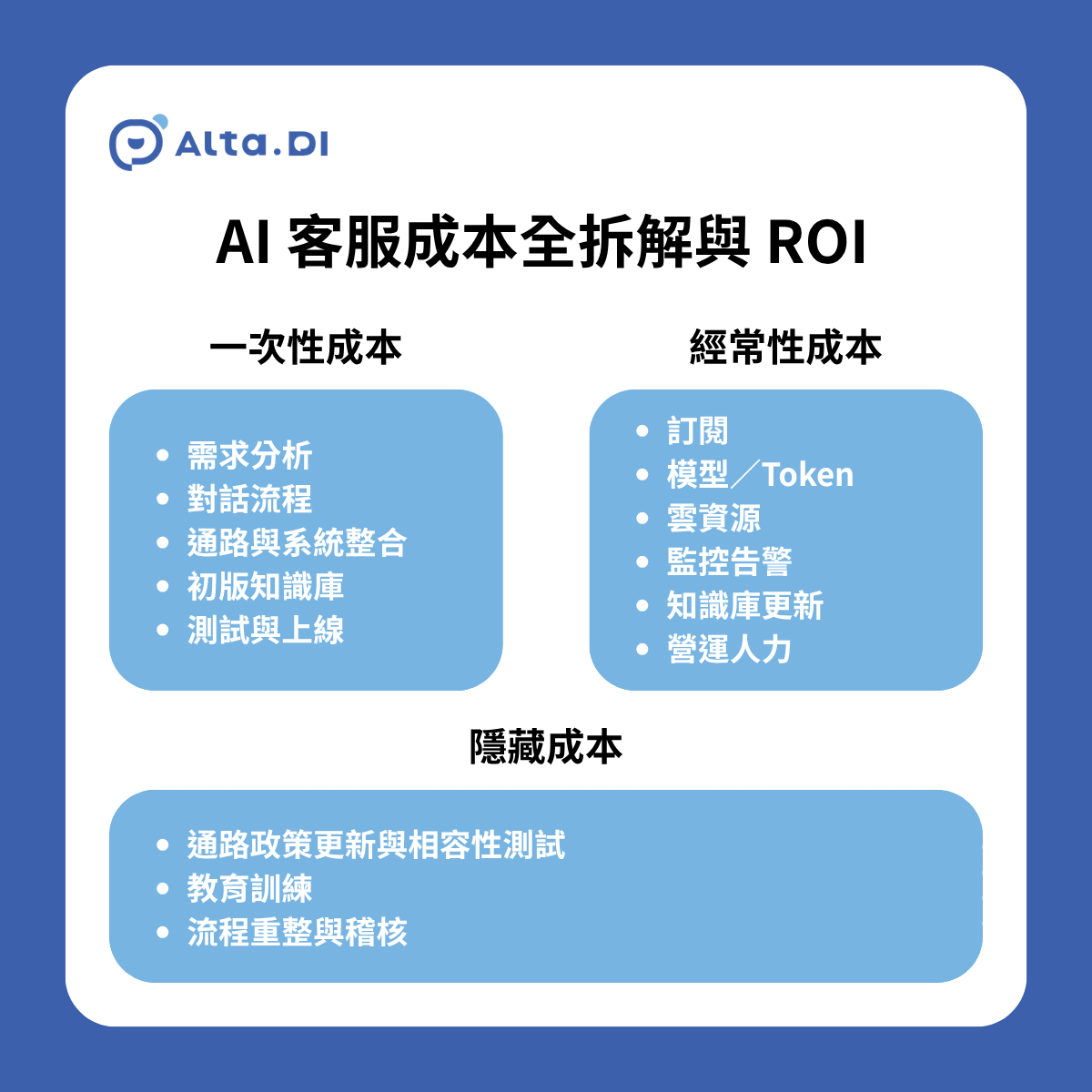
The total cost of building AI customer service goes well beyond the system build fee. The real trouble hides in the recurring spending after launch. The full cost map has two layers:
- One-time cost (CAPEX): Requirements analysis, conversation flow design, system integration and initial development.
- Recurring cost (OPEX): Token bills for model APIs, model drift monitoring and retraining, data labeling, and the engineering staff needed to keep up with LINE and Meta API policy updates.
This is exactly what building most easily underestimates: token bills swing with conversation volume, and every API policy change means pulling engineers in to fix things. These are all long-term fixed expenses. Buying a SaaS platform folds that complexity into the "subscription plus usage-based billing." Taking Alta.DI as an example, the platform uses an AI credit consumption model and supports switching between AI models of different tiers. Each reply consumes different credits depending on the model, and a company can adjust them flexibly on the dashboard according to budget and reply quality needs, so cost is visible and controllable.
ROI formula: ROI = (benefit - cost) ÷ cost
Here is an illustrative estimate for a 10-person customer service team (the figures below are a simulated scenario, not the results of a specific client): after adopting an AI customer service platform, average handling time (AHT) falls by 25%, freeing about 2.5 people's worth of capacity (worth about NT$137,500 per month). Subscription and AI credit costs total about NT$80,000 per month, for a monthly ROI of about 72%. If you also count the conversion growth that faster response brings, the annual benefit grows further. Actual figures vary with conversation volume, channel count and plan, so we suggest working them out in detail from your own call and chat volume.
Also a reminder: low-priced plans on the market often hide restrictions in credit billing, channel count and feature tiers, so before signing it is worth reading The Hidden Pitfalls of Budget AI Customer Service, and working out the total cost of ownership (TCO) before you decide.
Can a phone-based customer service team adopt AI too?
Yes, and you do not have to start over. For many Taiwanese companies the main customer service load is still inbound calls, and a common question is "Does AI customer service only handle text?"
In practice there are two parallel paths:
- Text channels first: Hand the repetitive inquiries on LINE and website live chat to AI first, and call volume will naturally fall. Most "calling to ask about an order or a location" needs are really the result of text channels that have not been well run.
- Redesign the call structure: Once the text channels are stable, you can go on to evaluate voice automation (for standardized scenarios such as delivery notifications and outbound marketing calls). We suggest discussing the exact scope with consultants based on your actual call structure.
In other words, for a phone-based team adopting AI, the point is not to "replace the phone" but to get the text channels right first and then adjust how call work is divided step by step.
How long until a bought solution goes live? A 5-week adoption roadmap
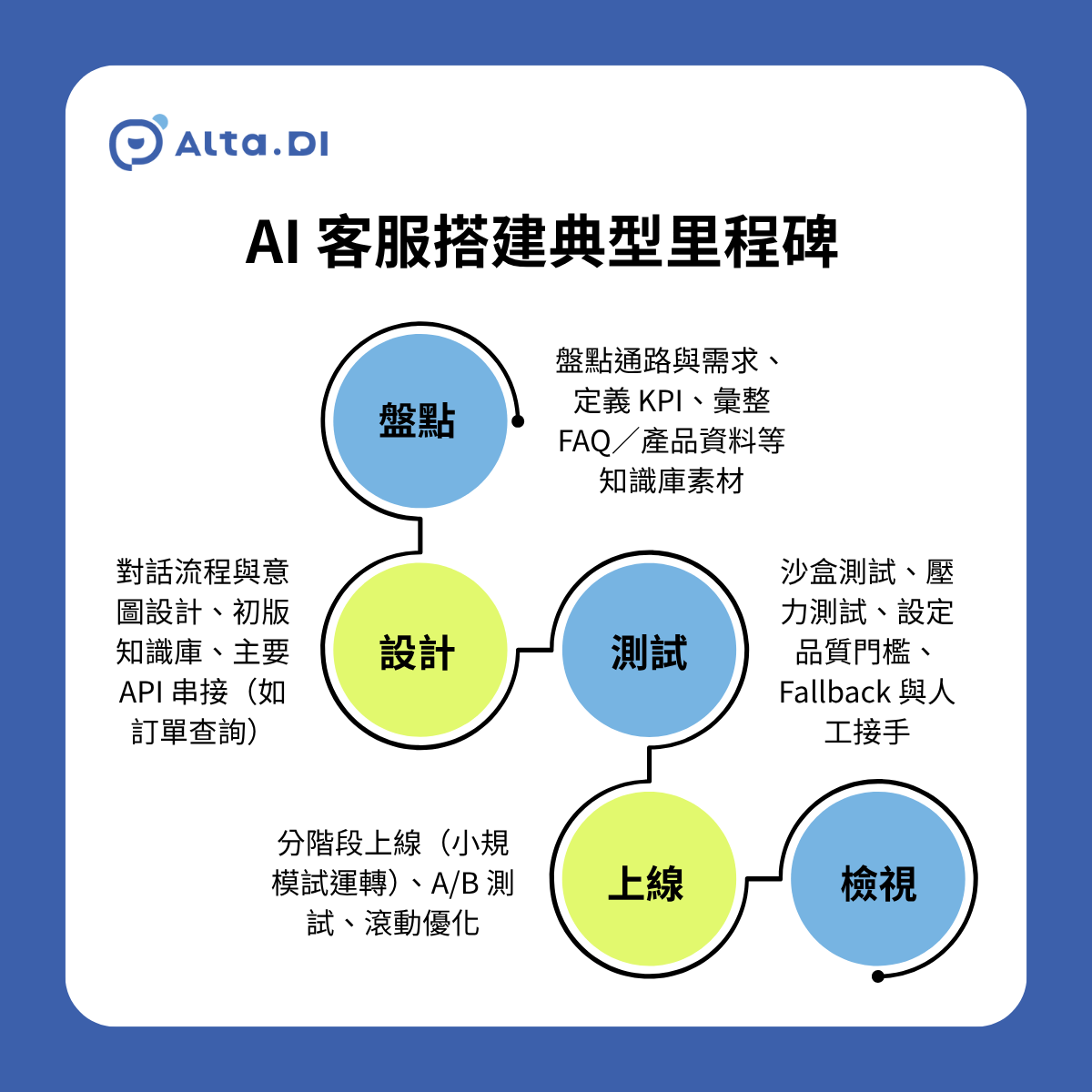
After choosing the buy route, the standard adoption rhythm is 5 weeks in three phases, with consultants working alongside you:
- Week 0: Needs diagnosis - Align on the transformation pain points and use scenarios, and confirm the channels to connect (LINE / Facebook / Instagram / live chat).
- Week 1: Build and training - Standard module setup, API integration, organizing FAQs and product data into a knowledge base, and AI training.
- Weeks 2 to 3: Testing and training - On-site testing and verification, hallucination checks, user training and practice drills.
- Week 4: Go-live and improvement - A small-scale pilot that starts with human-AI collaboration (Agent Assist) mode to ensure quality, then raises the share of automatic replies step by step and keeps adjusting based on performance data.
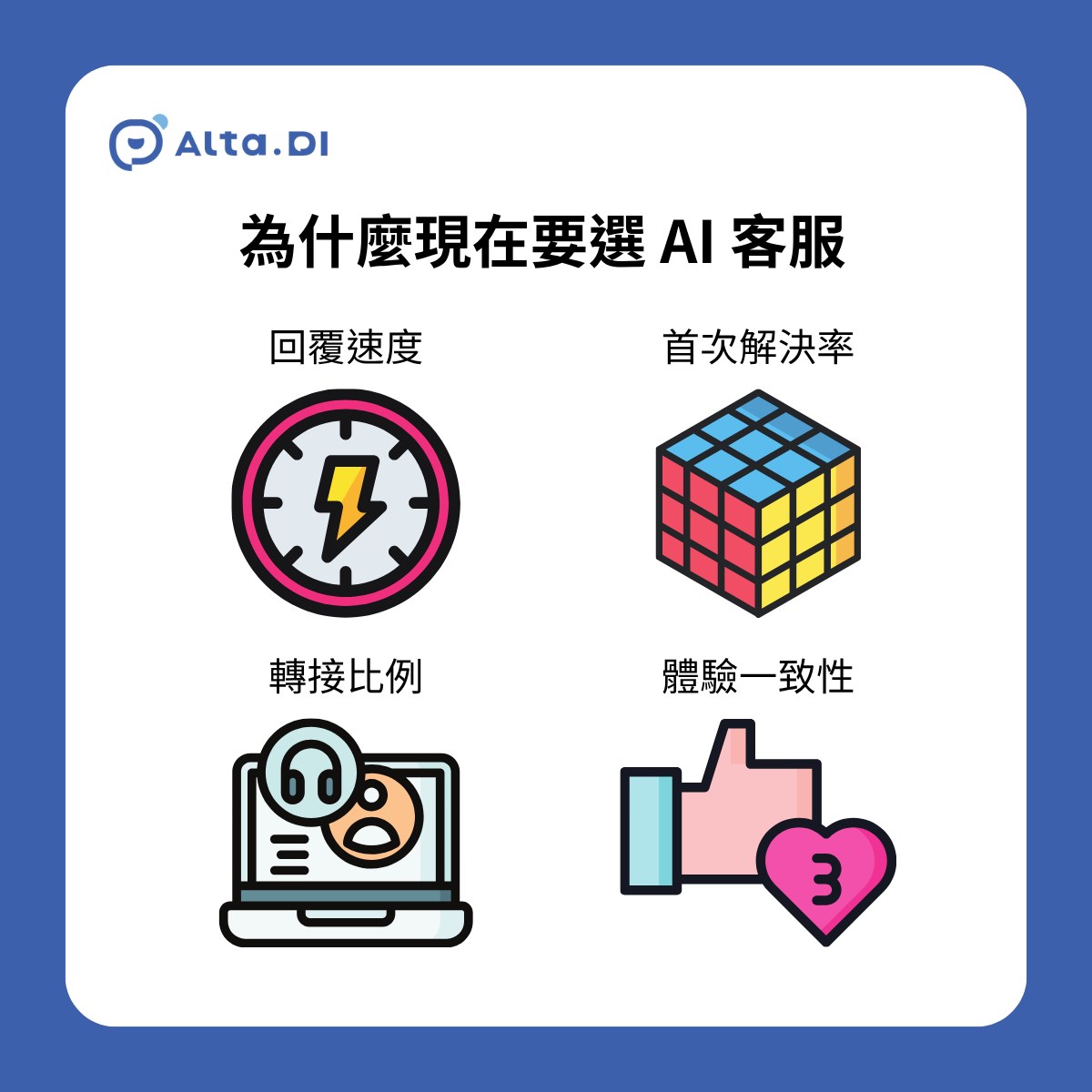
After launch, tracking four metrics is enough: response speed (from tens of minutes to seconds), first contact resolution, human handoff rate and consistency of experience across channels.
What risks should each route guard against? A 2026 compliance guide
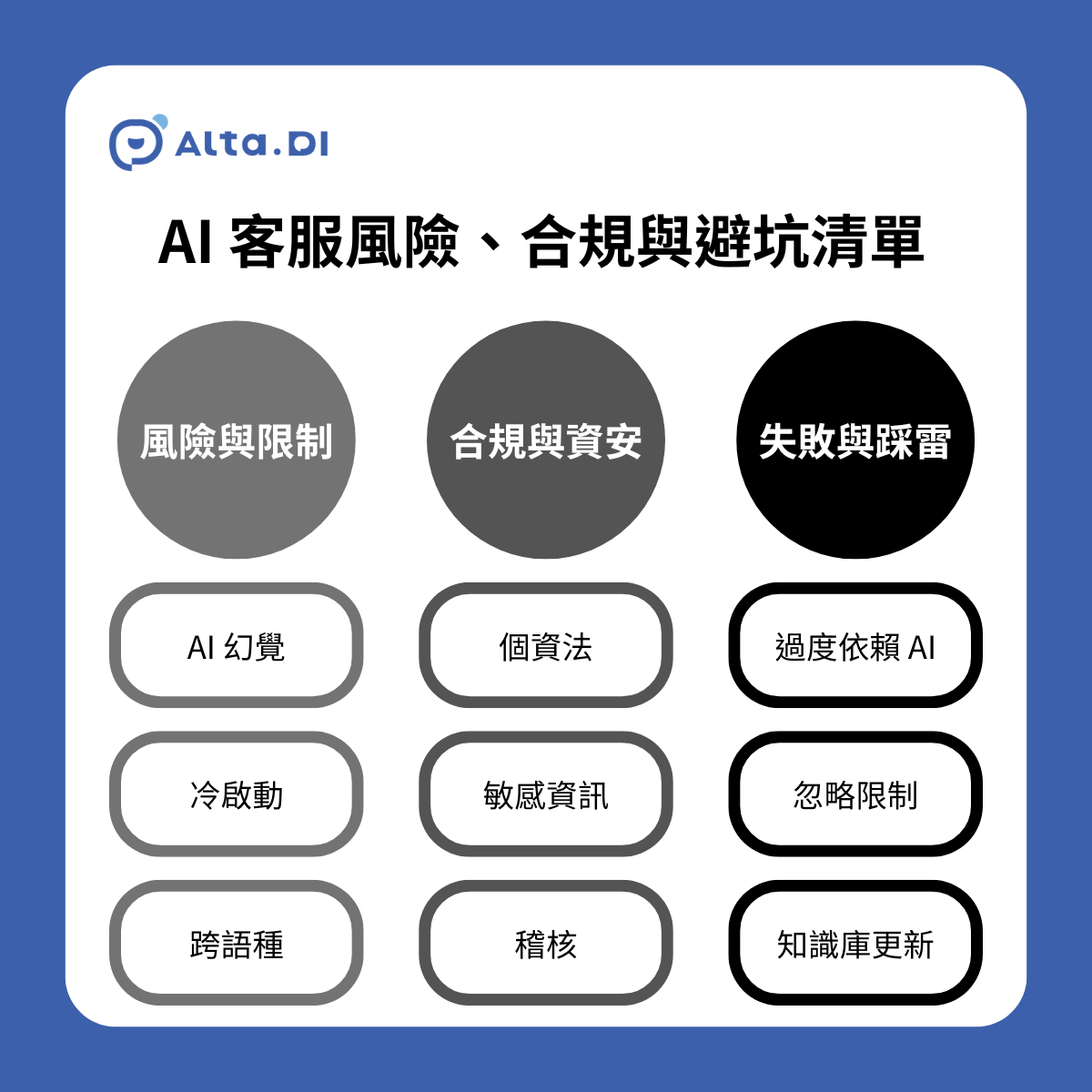
Whichever route you take, security and legal compliance cannot be avoided in 2026:
- AI hallucination risk:Prefer a platform that supports a RAG knowledge base and reply guardrails. For example, Alta.DI lets you set a "default reply prompt": when the AI cannot find knowledge, it responds with your custom wording instead of making up an answer, and it can hand over to a human when needed to avoid misleading the customer.
- Personal data law compliance:Confirm that the vendor holds information security certifications such as ISO 27001. Sensitive personal data (national ID numbers, credit card numbers) should be masked through the API and not kept in conversation records.
- Platform compatibility risk:LINE and Meta update their API policies often, and self-built systems frequently suffer service interruptions because they cannot keep up. When you buy SaaS, the vendor handles maintenance, and this "hidden insurance premium" is already included in the subscription fee.
How does Alta.DI support a "mostly buy, flexibly extend" route?
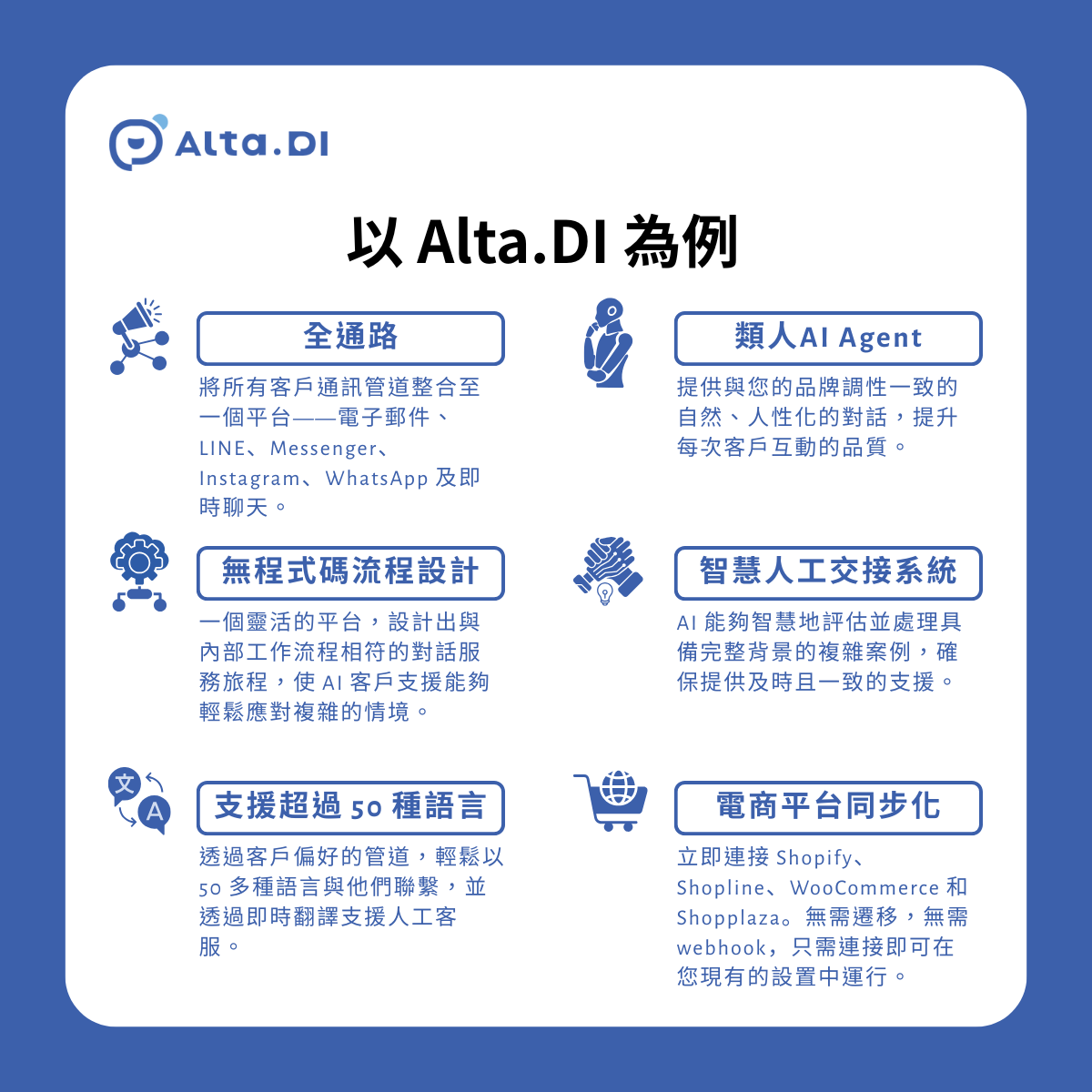
Alta.DI is a channel-agnostic AI customer service platform, covering all channels and all data, so service is wherever your customers are. Against the decision framework in this article, it addresses three questions:
- Scattered channels:A single back end integrates live chat, LINE, Facebook, Instagram and WhatsApp (from the Professional plan), with consistent cross-channel reply rules and no missed messages.
- Answer quality:Supports uploading PDF and Excel files to build a RAG knowledge base, combined with switchable AI models and default reply guardrails. After actual adoption by cross-border brand clients, most common questions are answered automatically by AI, so human agents can focus on high-value cases.
- Flexible extension:Marketing and customer service managers can adjust conversation flows themselves through a visual interface, without queuing for IT. In e-commerce scenarios it connects directly to Shopify, Shopline, WooCommerce and TikTok Shop, so order data goes straight into the conversation context.
-
What matters more is how adoption works: Data-DI consultants help design the workflow and work alongside you until you see results, rather than handing over a system and walking away. For more real-world cases and feature breakdowns, see the Alta.DI article series.
Conclusion: what is the next step?
Adopting AI customer service is not just switching tools but redesigning the customer experience. We suggest this order for the decision: first position yourself with the decision matrix (buy, build or hybrid), then work out TCO with the cost map, and finally go live in stages on the 5-week roadmap and adjust continuously with data.
Every company starts from a different place. Some are stuck with too heavy a phone load, some with missed messages across channels, some with no idea how to set the budget. If you want to work out which path to take, Data-DI offers a free 30-minute consultant diagnostic. A consultant reviews your current channels and pain points, estimates your monthly AI credit usage and expected ROI, and gives you a tailored adoption roadmap. You do not need to prepare any data first. Book a free 30-minute consultant diagnostic, and tell us where you stand today.
References

[1] Gartner.(2025.03). Gartner Predicts Agentic AI Will Autonomously Resolve 80 Percent of Common Customer Service Issues Without Human Intervention by 2029. Gartner Newsroom.
https://www.gartner.com/en/newsroom/press-releases/2025-03-05-gartner-predicts-agentic-ai-will-autonomously-resolve-80-percent-of-common-customer-service-issues-without-human-intervention-by-20290
[2] McKinsey & Company.(2026.08). The State of AI: Global Survey 2026. McKinsey QuantumBlack.
https://www.mckinsey.com/capabilities/quantumblack/our-insights/the-state-of-ai
FAQ
FAQs about this article
Should we build or buy AI customer service?

For most small and mid-sized companies in Taiwan, buying a mature SaaS AI customer service platform is the lower-risk path with a faster payback. Building suits only organizations that have a dedicated ML team and must handle extremely sensitive data, such as defense or financial core data. A hybrid model of "build the core, buy the periphery" is also possible.
What hidden costs of building AI customer service are easy to underestimate?
Hidden costs concentrate in recurring spending: token bills for model APIs, model drift monitoring and retraining, data labeling staff, and engineering maintenance whenever LINE and Meta update their API policies. Over time these expenses often exceed the initial build cost.
Can a phone-based customer service team adopt AI?
Yes. Hand the repetitive inquiries on text channels such as LINE and website live chat to AI first, and call volume will naturally fall. Once the text channels are stable, evaluate voice automation. The point is to redesign how call work is divided, not to replace the phone.
How much budget does it take to adopt an AI customer service platform?
Taking Alta.DI as an example, the Growth plan starts at NT$9,980 per month (excluding tax) and includes automation bots and a monthly AI credit allowance. The actual budget varies with channel count, conversation volume and model usage, and we suggest working out a detailed estimate from your own call and chat volume first.
How long does it take to get a bought AI customer service solution live?
The standard adoption timeline is about 5 weeks: needs diagnosis in week 0, module setup and knowledge base building in week 1, testing and training in weeks 2 to 3, and the official launch in week 4. It starts in human-AI collaboration mode to ensure quality before raising the share of automatic replies.
More articles


訂閱我們的電子報
每月 8 日定期發送最新趨勢與實用資訊!



