

Choosing AI customer service: FAQ vs Flow vs AI Bot | Alta.DI
Peak-season volume, hard 3C technical questions, detailed property listings: which scenario calls for an FAQ Bot, Flow Bot or AI Bot? This guide covers the differences, four questions to ask before buying and 2026 Gartner data, with a free customer service diagnostic.


Your service team cannot keep up with replies, messages flood in whenever a promotion starts, the technical questions on your 3C products get harder one by one, and cross-border sellers also have to handle several languages. You have known for a while that you should adopt AI customer service. What actually holds you back is the next question: the market is full of terms such as FAQ Bot, Flow Bot and AI Bot, so which type should you choose, and which vendor? This article walks you through the choice in three layers: first the real differences among the three types of Bot, then which one to prioritize for your pain points and industry, and finally 4 questions to ask before you buy. After reading, you can take a conclusion straight to your boss and make the decision, instead of being stuck on "I don't know which type to pick."
You already know you need AI customer service, but not which type or which vendor?
You do not lack tools. You need to pick the right Bot for your pain point.
The split in AI customer service selection comes from three underlying architectures. An FAQ Bot matches keywords, a Flow Bot follows a preset flow, and an AI Bot uses RAG to understand questions from a knowledge base and generate answers. Their capability limits, suitable scenarios and cost of failure are completely different, yet most platforms support only one of them, which is why selection gets stuck.
It is not that you do not know you need to adopt it. You are caught in the middle: your boss is pushing from behind, your service staff is short, and the market is full of terms with no clear way to choose. You are not imagining this pressure. A Gartner survey of 321 customer service leaders in February 2026 found that 91% of leaders are being pressured by senior executives to implement AI this year, while 58% have already begun converting customer service roles into knowledge management specialists [1], because they found that buying a tool alone does not solve the problem. If the knowledge base is not fed accurately, even the strongest AI is wasted.
So what you lack has never been a tool. It is the judgment of "which type of Bot matches my situation right now." How important is this? The Salesforce State of Service, Seventh Edition, shows that AI rose from 10th to 2nd in customer service leaders' priorities within a year [2]. But the real gap comes after: the share of cases actually handled by AI is projected to reach half only in 2027, and was only 30% in 2025. In many cases the stall comes from choosing the wrong type. Buy the wrong tool, and no budget will turn it into performance.
The rest of this article takes you through the choice in three layers: first the real differences among the three types of Bot, then which one to prioritize for your pain points and industry, and finally 4 questions to ask before you buy. Whether you cannot find hands for peak-season volume, you sell 3C products and keep pulling in engineers for every question, or your property listing is flooded with location and floor-area questions on weekends, this article gives you a selection map for three scenarios: choose the Bot type first, then the vendor.
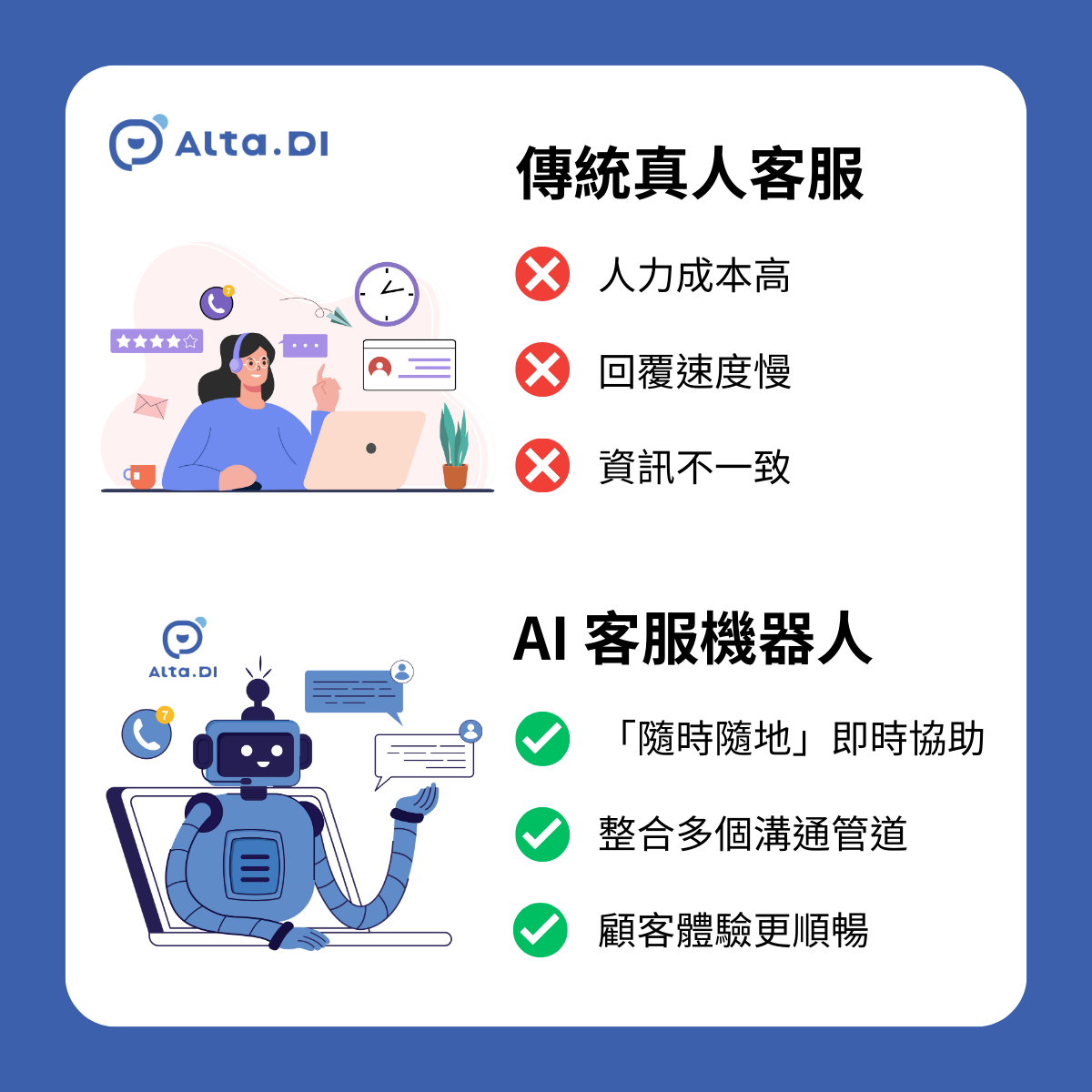
What is the real difference among FAQ Bot, Flow Bot and AI Bot?
The difference is not the technology. It is "how complex a question each can handle."
The key difference among the three Bots is not their surface features but the "semantic complexity" they can handle and the "cost of a wrong answer." An FAQ Bot recognizes only fixed keywords, and a wrong answer costs little. A Flow Bot follows preset paths, and a wrong answer usually means the menu was not well designed. An AI Bot uses RAG to generate answers from a knowledge base. A wrong answer costs the most, but it is the only one that can handle open-ended questions.
Do not treat these three terms as "different grades of the same thing." They are three different ways of working. Each is good at a different stretch of conversation, and each fails in a different place. Below, the three are broken down from four angles: how it works, what it suits best, what it can really do, and what happens when it goes wrong.
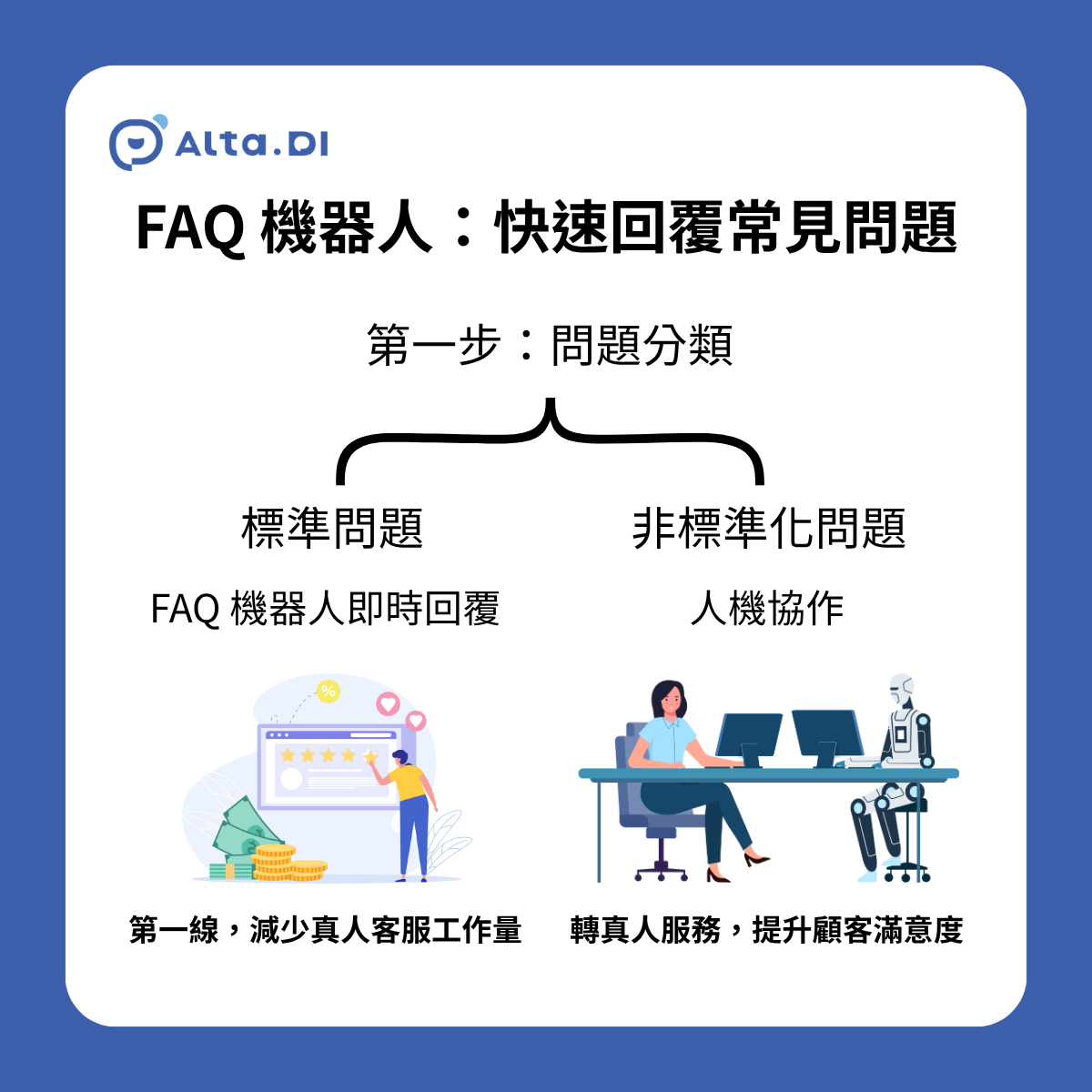
FAQ Bot: the first filter for standard Q&A
An FAQ Bot is automated customer service that matches keywords to return fixed answers, and in essence works like looking up a dictionary. It suits repeated questions whose answers do not change, such as business hours, shipping fees and return deadlines, and it can hold off standard questions before they reach human agents. Of the three Bots, it is the cheapest and the easiest to start with as a first line of defense.
Its ceiling is also obvious: it gets stuck whenever a customer does not use the preset keywords. When a customer types "Can I exchange the bag I bought last week?", an FAQ Bot can only reply "Please enter: return / exchange." The experience is poor, but the upside is that a wrong answer causes no business loss. At worst the customer finds it clumsy. So an FAQ Bot suits the role of "first-layer gatekeeper" and not the role of main workhorse.

Flow Bot: a guided menu that moves customers step by step toward a goal
A Flow Bot is guided service that follows preset branching flows, where the company draws the conversation paths in advance: "tap A and jump to B." It suits scenarios with clear steps, such as proactive shopping guidance, member registration and event sign-up, and it can move the conversation step by step toward a conversion goal before the customer even asks.
A Flow Bot's failure point hides at the "fork": if the menu is not well designed and the customer's question is not among any of the options, the customer finds no exit and leaves. So a Flow Bot's value depends heavily on "how well the flow is designed," not on "how strong the technology is." This is also why "who helps you design the flow" becomes a key question later in procurement.
AI Bot: a semantic Bot that reads context and generates its own answers
An AI Bot is semantic customer service that uses RAG (retrieval-augmented generation) to understand questions from the company knowledge base and generate answers. It uses NLP to understand customers who "say it another way" and can handle open-ended questions such as "Can I use this skincare product on sensitive skin?" Questions like this often make up more than half of a company's total service inquiries, and they are exactly what the first two Bots cannot handle. It understands content from the PDFs, Excel files and website links you upload and generates specific, grounded answers instead of reciting preset replies. What you need to prepare is your existing product descriptions, return and exchange policies and FAQs, in PDF, Word, Excel, Notion or website links, any format will do, and consultants work alongside you to test which documents feed accurately and which need supplementing. An AI Bot that can ground its answers usually needs solid RAG knowledge base setupas its engine.
An AI Bot is also the only one of the three that can "hurt the brand": when the knowledge base is not fed well and there are no RAG constraints, the AI can "hallucinate" wrong answers. It is not answering you. It is making up a story. When a customer asks about the return policy and it invents its own rules, a screenshot posted on social media becomes a brand disaster. Incidentally, many companies think "just connect ChatGPT and it can be customer service," which is another trap. For more, see the fundamental differences between AI customer service and ChatGPTto understand why "can chat" does not mean "can serve as customer service."
Which situation am I in, and which Bot should I start with?
Do not ask which is strongest. First list which stage of your service flow hurts most.
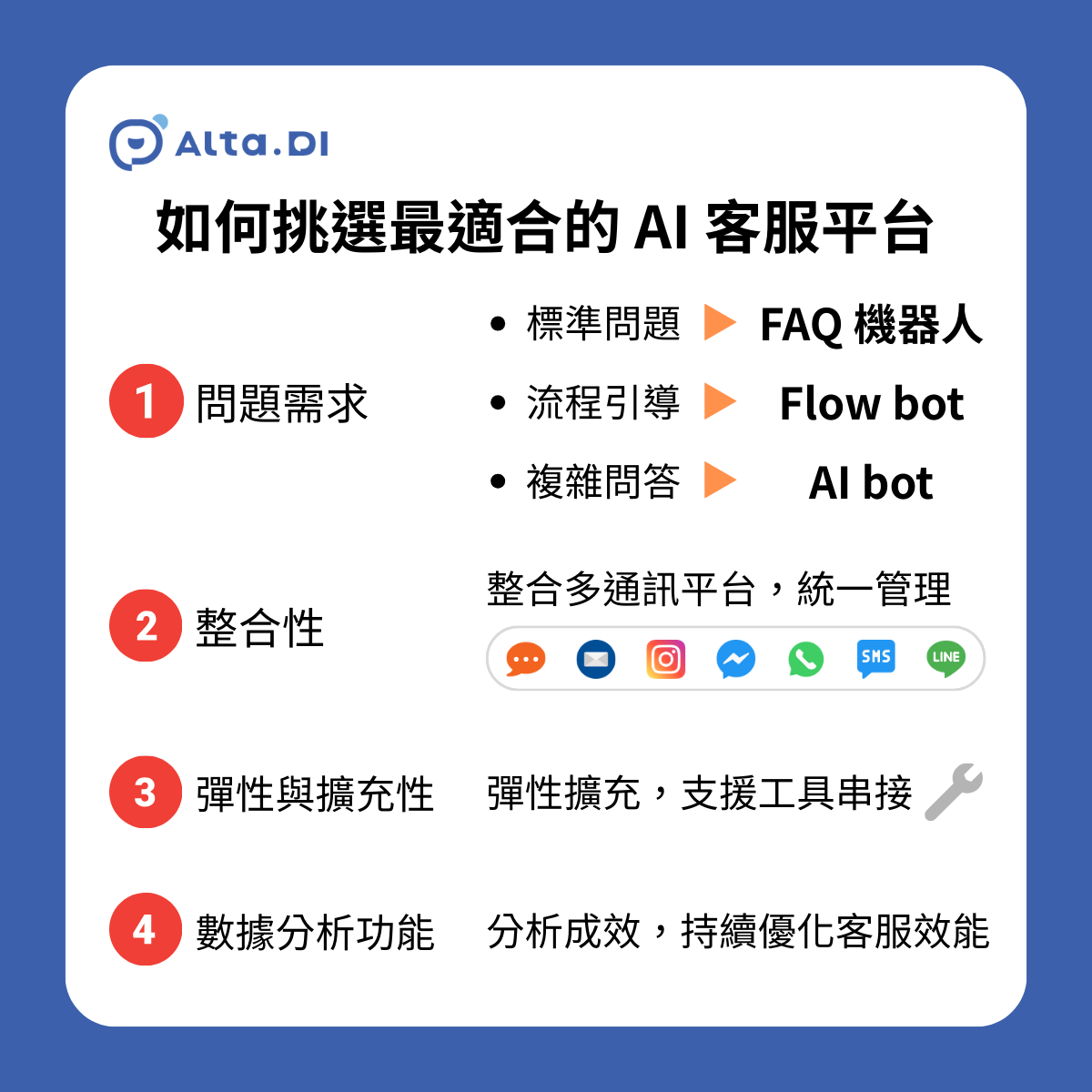
The right order for choosing a Bot is not to compare technical strength but to first list which stage of your current service flow hurts most, then match a Bot to that pain point: an FAQ Bot for high-volume repeated questions, a Flow Bot for guided purchases, and an AI Bot for open-ended consultations. Most companies eventually find they need all three, but "which one to start with" depends on your most painful point right now.
Rather than memorizing the specs of three Bots, find your own position directly. The table below maps common customer service situations to "which to adopt first, how to combine them and why." Find the row that looks most like you, and that is your starting point.
When the table says "FAQ Bot + AI Bot relay" or "Flow Bot + AI Bot," it describes how the three modes divide work within the same platform. It does not mean you have to buy two systems. The table has one rule of use: find the row that hurts most and start with that Bot, instead of trying to buy the strongest of everything at the start. The misjudgment we see most often when advising is a company that goes straight to the strongest AI Bot, sends even "What are your business hours?" to the AI Bot and loses control of token costs. The reverse also happens: companies that buy only an FAQ Bot leave real sales opportunities such as "I want to order but I'm a bit unsure" outside the preset menu. For more practical content broken down by industry, browse our Alta.DI AI customer service article series.
What does a wrong choice cost? 4 questions to ask before you buy
Ask these four wrongly, and in three months the system sits in a corner
When buying an AI customer service platform, most failures are not "poor technology" but the wrong questions at the procurement stage: RAG reliability, channel coverage, the No-Code operating threshold and integration with existing systems. These four dimensions decide whether the system actually gets used after launch, instead of a tool you paid for that nobody uses or updates.
Question 1: Does it use RAG, and how does it handle "questions it doesn't know"?
You have surely seen those demos: the AI answers fluently and the resolution rate is claimed at 90%. Do not get excited yet. That is usually a hand-picked showcase case, and in your real mix of questions the number shrinks noticeably. Salesforce itself also projects that AI will handle only about 50% of customer service cases by 2027 (30% in 2025) [2]. The point is not how high the vendor claims but what it does when it meets a question it cannot answer. How to check: ask the vendor to throw in a question outside the knowledge base on the spot. A good system honestly says "I don't know" and hands over to a human instead of making up an answer.
Question 2: Which messaging channels does it support?
Have you ever had Instagram messages pile up while your system connected only to LINE, with no time to switch over and look, and customers who got no reply turned to a competitor? Taiwanese customers' entry points are scattered across LINE, Messenger and Instagram, and cross-border businesses also need WhatsApp and email. Without full channel coverage, you lose customers. How to check: list the message volume of every service entry point you have now, and ask the vendor to show the actual interface of "one back office receiving all messages" on the spot. Do not rely on slides alone.
Question 3: Does it support truly No-Code setup?
Think back: the last time you wanted to change one AI reply, did you have to queue up for IT again? Marketing and service managers should be able to adjust the tone and edit replies themselves, without filing a ticket every time. If a system fails this test, it will be left aside within half a year, because nobody wants to bother engineers just to change one sentence. How to check: ask directly "Can a service manager add an FAQ and publish it on their own?" If the answer is "ask IT," the maintenance cost will be far higher than you expect.
Question 4: How well does it integrate with existing systems?
The most painful picture is this: a customer clearly says "I want to place an order," and you are still copying and pasting data into the back office. Whether it can connect to your CRM or e-commerce back office (Shopify, Shopline) decides whether the "service to sales" path works. Without integration, AI customer service is just an isolated Q&A machine. How to check: list your existing tools (CRM, e-commerce back office, CDP) and ask the vendor to explain the integration method and cost for each.
After these four questions, an earlier question will probably come up: why not build one yourself? Most companies underestimate the ongoing knowledge base updates and maintenance costs of building in-house. Thinking this through at the procurement stage can save 12 months of internal friction afterward. See the decision framework for building vs buying AI customer serviceand then decide.
Why does almost no company need just one type of Bot?
The customer journey is never just one kind of conversation
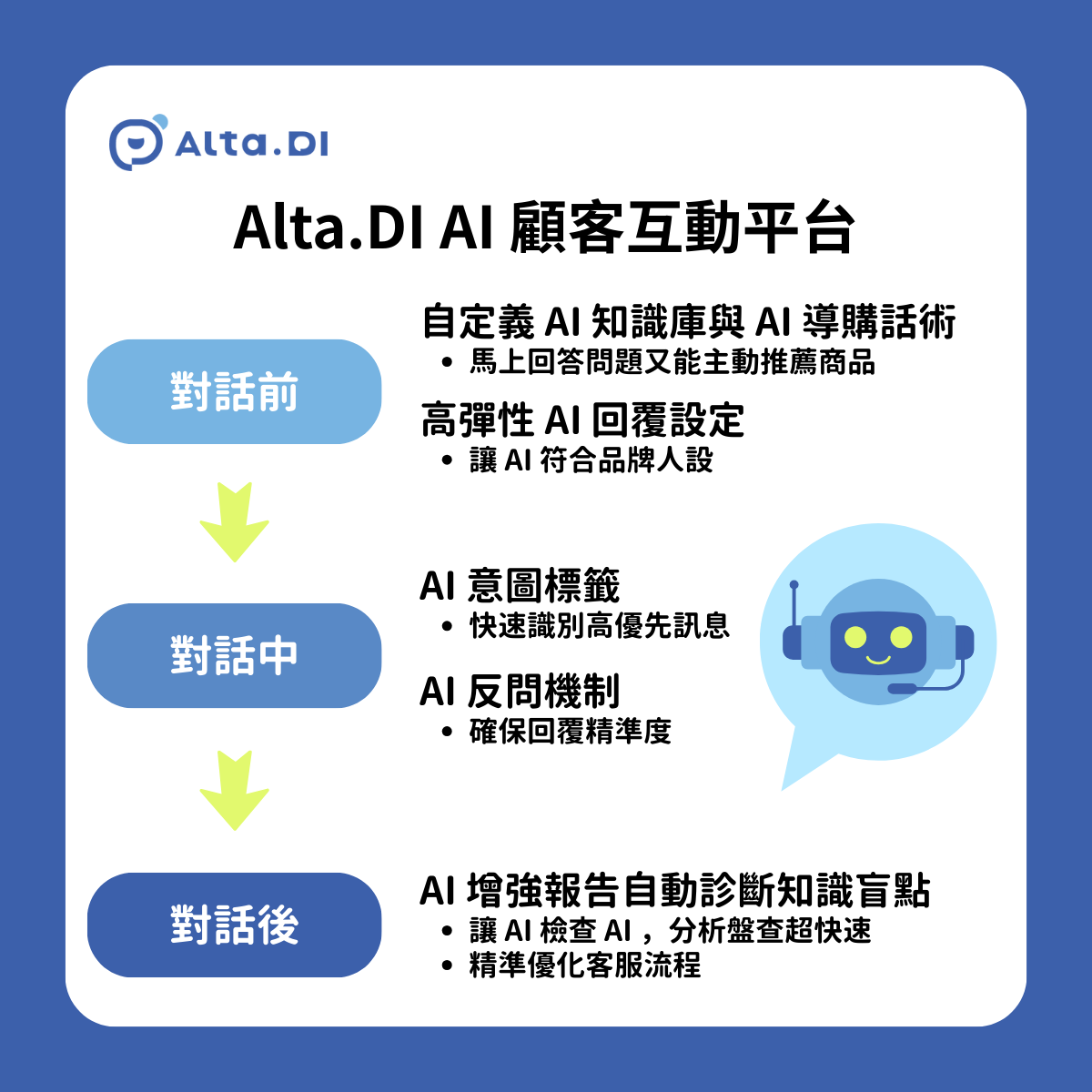
From first contact to placing an order, customers go through several kinds of conversation: a simple question about shipping, hesitation over which model to buy, deeper questions about product details and finally, possibly, a human to calm a complaint. Mixing the three Bots is not greed. It is the necessary choice once you reproduce the real customer journey, and it is why combining all three modes on one platform is becoming more common.
First, see how "choosing only one" breaks down in practice. A pure FAQ Bot cannot handle variations in wording, and customers get stuck when they phrase things differently. A pure Flow Bot simply breaks when "my question is not among the options." A pure AI Bot used for standard questions such as "What are your business hours?" burns token costs for nothing. Companies that choose a single mode usually find within 3 to 6 months of launch that they need to add the other two.
This integration trend is backed by data. Salesforce's 2026 survey shows that the share of service organizations that have adopted AI customer service agents jumped from 39% to 66% in one year, growing 1.7 times, and that seventy percent of organizations saw measurable results within 60 days [3]. AI-using service staff also gain about 4 more hours per week on average to handle high-complexity cases [2]. But this efficiency appears only when the division of labor is "AI handles the right cases and humans handle the right cases." Send everything to the AI Bot and costs run out of control. Send everything to the FAQ Bot and real sales opportunities are blocked.
Four stages of conversation, each handed to the most suitable Bot
When a customer comes in, a mature flow divides the work like this: first a Flow Bot routes the customer (wants to buy vs wants to ask) → those who want to buy enter shopping guidance → those who want to ask go to the AI Bot, which generates answers from the knowledge base → when the AI judges a question to be out of scope, it hands over directly to a human with the full conversation record attached. The key is never "which Bot is strongest" but "using the most suitable tool at each stage of the conversation." This is also the core product logic of Alta.DI: you combine FAQ Bot, Flow Bot and AI Bot flexibly by scenario on the same platform, instead of being forced to gamble on one of three.
All channels, not tied to a single channel
When choosing a platform, many people only compare whose AI Bot is stronger and overlook something more critical: your customers will not stay at a single entry point. Quite a few AI customer service tools on the Taiwan market are "LINE only," but your customers may leave messages on IG DM, your website and WhatsApp at the same time, and some will even reply to the EDMs, SMS and in-site notifications you send out.
Alta.DI brings these entry points (LINE, Facebook Messenger, Instagram, WhatsApp and email, plus non-social channels such as EDM, SMS and in-site messages) into the same back office. Service staff do not have to switch between several windows, and conversation data goes into one analytics back office. "All channels" here covers the full conversation, including the service experience itself, beyond connecting social commerce. This is what we mean by a channel-agnostic AI customer service platform: all channels, all data, and we are wherever your customers are. To see what the platform actually looks like, go to the Alta.DI product pagefor more.
Consultants help you design the flow, and do not disappear after selling the tool
One level deeper on the differences: most AI customer service platforms sell you the tool and leave you to figure out the rest. Data-DI designs the flow and works alongside you until there are results, and this covers the main sticking point of each of three kinds of people inside your company at once.
For you, the consultant helps you get right "which conversation uses which Bot, what to feed the knowledge base, and when a human takes over." You do not need to do it the hard way, and after launch it can be changed, it holds up under peak volume, and colleagues do not end up finding it hard to use and going around it. Upward, the person who approves the budget wants visible results for the money, and with a consultant alongside you until results appear, you can account for it, instead of ending up three months later with a project nobody mentions. Sideways, IT wants something that connects to the existing CRM and e-commerce back office, keeps data from leaving, and does not lock the company into one channel or vendor. These are covered together when the flow is mapped, so IT does not have to fight fires every day after launch.
And these consultants come from data consulting and strategy advisory backgrounds, so they work with you from the decision stage of "whether to do it and how." This is how the parent brand's line, "Let Data Speak, Let AI Act," plays out in customer service.
Conclusion: selection is not hard. What is hard is admitting you need more than one tool.
List your most painful flow first, then choose the right Bot and the right partner
Back to the question at the start: you already know you need to adopt AI customer service but are stuck on which type to pick. By now the answer should be clear. The essence of selection is not a technical comparison. It is first listing which stage of your service flow hurts most, solving it with the matching Bot, and then adding the other two on top.
Almost no company needs just one type of Bot, which is why "can one platform combine all three modes, and does someone help you design the flow" deserves more of your evaluation time than "which single Bot is strongest." Gartner predicts that by 2029 agentic AI will autonomously resolve 80% of common customer service issues and reduce operating costs by 30% [4]. But that future will not carry you there by itself. Only companies that choose the right solution and design the flow right today can catch this ride. With the wrong tool, no budget changes the outcome: the system just sits in a corner.
Not sure how to arrange your customer service flow? Book a free 30-minute customer service diagnostic
Every company's customer service pain points are different. Some are stuck on multi-channel message integration, some on a RAG knowledge base that is not fed accurately, and some on service managers who cannot adjust AI replies themselves. Whether you have only LINE today or already sell across IG, your website and several e-commerce platforms, it is worth a conversation first, and a consultant will look at your current volume and pain points and suggest which Bot to start with. If you want to work out where your service funnel is actually stuck and which Bot to adopt first, Data-DI offers a free 30-minute customer service diagnostic, in which a consultant reviews your current service flow, existing tool mix and quick wins you could make, and gives recommendations for your actual situation. You do not need to prepare data in advance. Just give us your website address and the tools you use now.
Book a free customer service diagnostic
References

[1] Gartner. (2026.02). Gartner Survey Finds 91% of Customer Service Leaders Under Pressure to Implement AI in 2026. Gartner Newsroom.
https://www.gartner.com/en/newsroom/press-releases/2026-02-18-gartner-survey-finds-ninety-one-percent-of-customer-service-leaders-under-pressure-to-implement-ai-in-2026
[2] Salesforce. (2025.09). State of Service Report, Seventh Edition. Salesforce News.
https://www.salesforce.com/news/stories/state-of-service-report-announcement-2025/
[3] Salesforce. (2026.05). State of Service: AI Agents Edition: AI customer service agent adoption grew 1.7 times in a year. Salesforce News.
https://www.salesforce.com/au/news/stories/state-of-service-ai-agents-edition-2026/
[4] Gartner. (2025.03). Gartner Predicts Agentic AI Will Autonomously Resolve 80% of Common Customer Service Issues by 2029. Gartner Newsroom.
https://www.gartner.com/en/newsroom/press-releases/2025-03-05-gartner-predicts-agentic-ai-will-autonomously-resolve-80-percent-of-common-customer-service-issues-without-human-intervention-by-2029
FAQ
FAQs about this article
My service team cannot keep up and peak-season volume is surging. Which type of Bot should I adopt first?

Start with an FAQ Bot as the base and an AI Bot as relay. The FAQ Bot holds off standard questions such as shipping, arrival and returns or exchanges, the AI Bot handles product consultations such as "Is it in stock? Is it right for me?", and human agents are kept for complaints and emotional reassurance. After the peak period ends, evaluate whether to add a Flow Bot for guided routing.
I sell 3C or functional products with many technical questions. How do I choose AI customer service so it does not answer wrongly?
Do not pick the "strongest AI." Pick an AI Bot with RAG constraints. Feed specifications, compatibility and warranty policies into the knowledge base so the AI answers from documents, and ask the vendor to show how it handles questions it cannot answer. A good system says it does not know and hands over to a human instead of making up an answer.
I do cross-border business and need multilingual customer service. What should I look at when choosing?
Look at two things first: languages and channels. Multiple languages rely on the AI Bot's semantic understanding, not word-by-word dictionary translation. Then confirm whether the platform can bring LINE, Instagram, WhatsApp and email into one back office. If you already use Shopify or Shopline, also confirm whether it can connect to the e-commerce back office.
I already have a LINE Official Account. Do I still need a dedicated AI customer service platform?
It depends on your customer entry points and the complexity of questions. The built-in auto-reply of a LINE Official Account goes only to FAQ Bot level, cannot handle open-ended questions and does not integrate with a CRM or an e-commerce back office. If your customers only use LINE and the questions are all standard, the built-in feature is enough. Once you add IG or customers start asking about details, you need a dedicated platform.
How can I tell whether an AI customer service tool uses real RAG or only recites preset answers?
Test it with three questions on the spot. First, ask something the knowledge base does not cover and see whether it honestly hands over to a human. Second, ask a rephrased variation and see whether it depends on keywords. Third, ask it to cite the source of its answer. One that can give sources, stops hallucination and handles variations is real RAG.
More articles


訂閱我們的電子報
每月 8 日定期發送最新趨勢與實用資訊!



