

AI customer service vs ChatGPT: what differs? 2026 data | Alta.DI
Thinking of using ChatGPT as customer service? 2026 data shows the entry point moving to brands' own channels. This article sets out the differences, multi-brand tone management and a 6-step rollout, with a free 30-minute health check on offer.


AI customer service is a dedicated system that enterprises use to handle conversations on their website, social channels and orders, turning model capability into a service process that is controllable, traceable and able to hand off. It suits retail and e-commerce teams that operate externally and manage conversations across several channels. When people think about bringing AI into customer service, the first reaction is often "then just use ChatGPT to reply." But 2026 market data gives a different answer: ChatGPT is a general-purpose conversation tool (a model entry point), while AI customer service is an enterprise system (a process entry point). The former is good at language understanding and generation, and the latter is good at putting that capability to work inside your website, social channels, tickets, orders, marketing and reports.
The latest Similarweb data shows that ChatGPT's share of global web visits fell from 79.0% in May 2025 to 53.9% in May 2026. Over the same period Google Gemini grew from 7.6% to 27.9%, and Anthropic's Claude grew nearly 9 times year on year to 9.2% [1]. This is not ChatGPT usage falling; the whole market is expanding and other entry points are taking a share of the growth. General-purpose chat entry points no longer hold a monopoly, and this is the key starting point for companies to re-understand what "AI customer service" means.
Why is the entry point for customer service in 2026 no longer ChatGPT but the brand's own channels?
When customers have a question, they take the shortest path and will not go out of their way to open ChatGPT.
When users hit a situation that needs customer service, the shortest path is usually not to open the ChatGPT website but to:
- Ask on the brand's website
- Message in LINE, WhatsApp or Messenger
- Ask in the app's built-in customer service
- Ask directly on the e-commerce order page
Statistics compiled by Azumo also show that the share of daily active users on ChatGPT mobile in the US fell from about 69% to about 45.3%, indicating that on mobile, users prefer chat tools "built into the brand's flow" over jumping to a single general-purpose entry point [2]. The focus of competition for companies is therefore no longer "which model to use" but "whether you can offer an AI experience that solves problems at your own entry point."
What is the difference between ChatGPT and an AI customer service system?
One table to see it all and understand the differences in 5 minutes.
ChatGPT is like the "brain," and an AI customer service system is like the "body plus nervous system." Having only a brain does not mean you can actually get something done in an enterprise process [5]. Laid out concretely, the differences are:
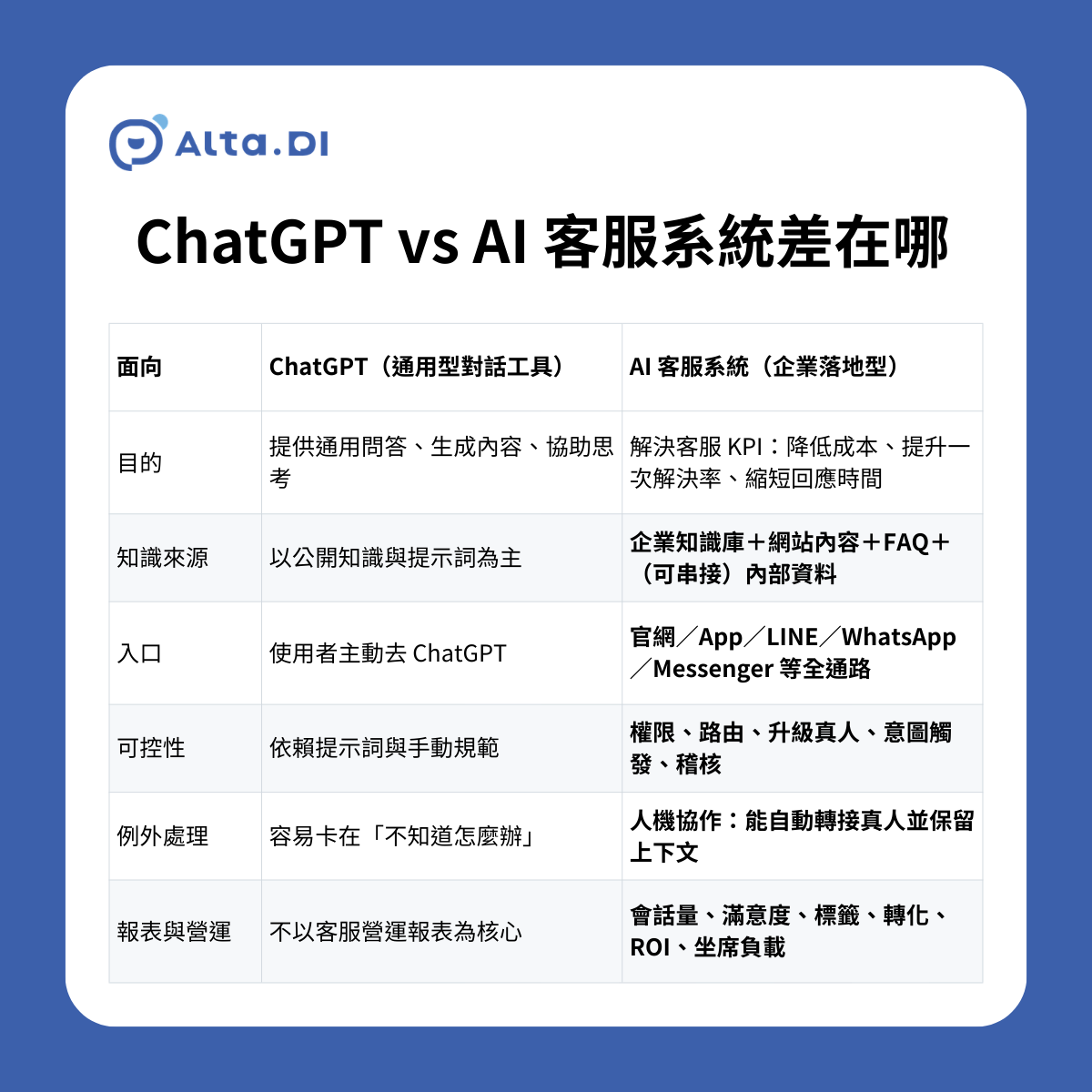
Having read the table, the key gap comes down to one sentence: ChatGPT gives you language capability, and an AI customer service system packages that capability into a process that can be put to work, managed and explained to your manager in terms of results.

What problems do companies run into when using ChatGPT directly as customer service?
The problem is not that it talks poorly; it is the system integration hurdle at rollout.
TTMS's summary notes that using ChatGPT for customer service can indeed improve response speed and handle many inquiries at once, but a real rollout meets several hard problems: data connection, permission control, consistent brand tone and system integration [4]. These are exactly the reasons an "AI customer service platform" exists.
The one most easily underestimated is the multi-brand situation. If your company runs two or three brands, each with a different tone (one lively, one steady, one emphasizing professionalism), maintaining several sets of System Prompts by hand to imitate different tones can cope in the short term. But when customer service staff change and scripts have to follow business changes, the maintenance cost stacks up with the number of brands and is hard to manage at scale. This is one of the first questions many companies ask when evaluating an AI customer service system: can one system hold several brands with completely different tones, instead of working out a new set of prompts each time a brand is added?
From an enterprise architecture view, academic research also points out that for an LLM to work well in enterprise customer service, it usually needs to be paired with a knowledge base, monitoring mechanisms and human review to reduce errors and compliance risk, and to steadily improve metrics such as first response time, first-contact resolution and satisfaction [7]. This is also why "sounding human" was never the end point of AI customer service. Being controllable and auditable is.
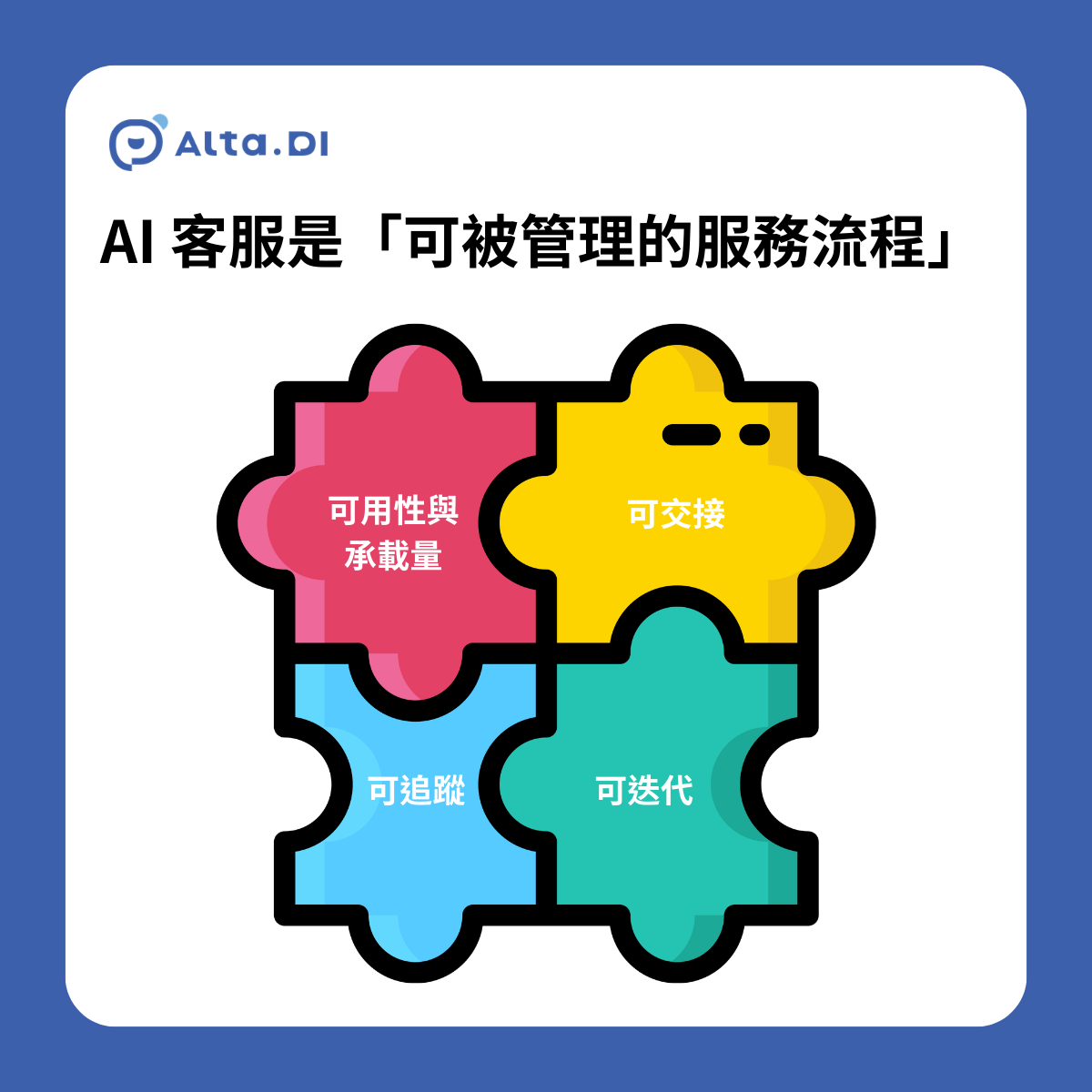
AI customer service is not "chatting" but a "service process that can be managed"
ROI has never come from sweet talk; it rests on these 4 things.
In front-line customer service practice in 2026, the reason AI can really bring ROI is often not "how human it sounds" but four things:
- Availability and capacity: 24/7, able to handle many conversations at once
- Handoff: quick transfer to a person for emotion, exceptions and disputes
- Traceability: knowing which questions are asked most and which scripts bring conversions
- Iteration: updating the knowledge base and process from conversation feedback
For this reason, most "AI customer service result figures" actually come from complete system rollouts, not from simply putting ChatGPT on a website. ChatMaxima's compilation of 2026 statistics says that after adopting AI customer service, companies can on average cut customer service costs by 30% to 40% and shorten response time by up to 74% (the basis of compilation varies by source) [8]. The point is that these improvements usually come with process, routing, knowledge and reporting going live together.
What does enterprise AI customer service look like? Five Alta.DI features as an example
Below, Alta.DI's features are used as a conceptual comparison to help you see the elements of putting AI customer service into practice at a glance.
Multi-channel integration: reply wherever the customer is
The first value of AI customer service is the "entry point": placing customer service where your business happens, instead of asking customers to go to some website. Alta.DI supports channels such as LiveChat, WhatsApp, LINE, TikTok, FB Messenger, Instagram Direct, Zalo and Amazon, and handles them together in the back end. When one parent company runs several brands, you can set up separate stores and, in each store's Agent prompt area, customize the bot's personality and style. The model generates answers based on the main prompt and guides the conversation, so there is no need to work out a new set of scripts for each brand.
Compare Elfsight's summary of chatbot trends: brands often embed chatbots on their website, app, Messenger, WhatsApp and other channels, and connect them to CRM and order systems before they can truly complete lookups and tracking [9]. To learn more about how full-channel integration works in practice, see the 5-step guide to full-channel integration (OMO).
Knowledge base and training: make the AI answer with your rules, not general web knowledge
What companies care about most is not whether the AI can chat but whether it will "say the wrong thing." Alta.DI's AI Bot supports uploading PDF, XLSX, DOCX, TXT and CSV files, can also import website links and keep expanding from chat records, and can build a Q&A FAQ library. This is closer to what SearchUnify describes as the enterprise need: customer service requires an LLM plus enterprise-grade product capabilities, including knowledge retrieval, reporting, self-service success tracking and a multi-model strategy, not a single model by itself [6].
Testing and reply analysis: run a "mock acceptance" before launch
Many teams get stuck on the anxiety of "whether it can really go live" and also worry whether they can change things themselves after launch. Alta.DI's Playground provides a simulated environment to test replies, and "reply analysis" helps you judge whether the script needs changing or the knowledge needs adding, so you do not need to call an engineer in every time you adjust. This is consistent with the research view that an LLM rollout needs monitoring, human review and governance to balance results and risk [7].
Human-AI collaboration and escalation: AI does 80%, and the remaining 20% goes to people
YourGPT's 2026 comparison notes that AI chatbots far surpass people in 24/7 availability, speed and concurrency, but for emotional understanding and complex exceptions, a person still has to take over [3]. Alta.DI's approach corresponds as follows: intent triggers can recognize specific intents and transfer to a person or call a Flow Bot; a clarifying-question mechanism actively asks for key information to reduce off-target answers; customer profile cards and real-time multilingual translation let a person get up to speed faster on takeover; and AI tags automatically generate emotion and business tags, helping to identify urgent or high-value conversations.
Beyond customer service, automating conversion: Flow Bot plus marketing plus ROI
The second battlefield for "AI customer service" in 2026 is turning conversations into conversions. Alta.DI's Flow Bot can set up common flow scenarios (FAQ, product introductions and so on) and monitor trigger counts, engagement and completion, and combined with marketing modules (Email, SMS, LINE, abandoned-cart recovery) and short video interaction, it can move customer service from a cost center toward a revenue lever.
How do you start adopting AI customer service? 6 steps
- Step 1: define 3 KPIs first; do not start by asking "how human is it"- We suggest choosing at least three: first response time (FRT), first-contact resolution (FCR), and human escalation rate (Escalation Rate) or CSAT. These three numbers are the basis for explaining results to your manager after launch.
- Step 2: list the knowledge that "must be correct" - For example return, exchange and warranty policies, payment, shipping, delivery timelines, membership rules and discounts, and dispute handling processes (damage, delay, missing items). Feed documents and website content into the knowledge base, and build Q&A.
- Step 3: set intent triggers to escalate "questions that can cause trouble" straight to a person - Common high-risk types: refunds, chargebacks, complaints, negative reviews; personal data, payment, security; and legal and contractual commitments, especially in B2B situations.
- Step 4: run 30 scenario tests in Playground - Each should include at least: the question (including colloquial phrasing and typos), the key points of the expected answer, what must not be said (such as overpromising), and the clarifying-question strategy for when it is unsure.
- Step 5: after launch, iterate weekly using tags and reports - Look at three things: which questions are most common but answered poorly, which conversations are most often escalated to a person, and which scripts bring orders or lead information.
Step 6: put AI customer service at your real entry point (all channels)
The website is only the starting point. In 2026 the point is to place AI where users ask most often: LINE, Messenger, WhatsApp, IG direct messages, e-commerce platform messages and so on.
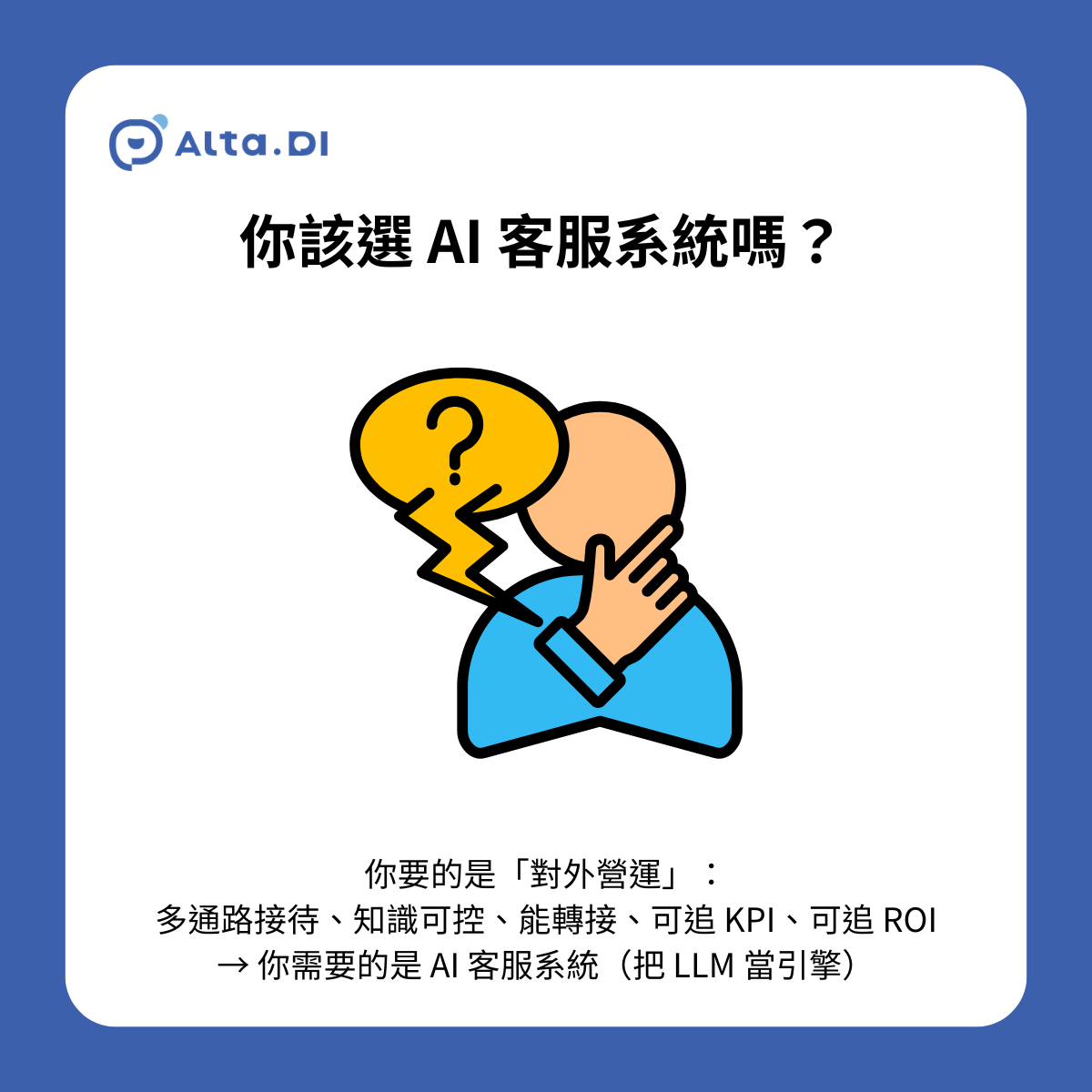
Should you choose ChatGPT or an AI customer service system?
Use ChatGPT internally, and choose a dedicated system for external operations.
The way to decide is not complicated. Look at whether you are solving for internal efficiency or external operations:
If you only want to "raise customer service efficiency internally," for example writing reply templates, summarizing and translating, a ChatGPT-type tool can be very effective. If you want "external operations," meaning multi-channel reception, controllable knowledge, the ability to transfer, trackable KPIs and trackable ROI, you need an AI customer service system that treats the LLM as an engine and not as the product itself [6]. To first understand the cost and limits of the various ChatGPT models in customer service scenarios, you can also see ChatGPT model comparison 2026: how to choose between GPT-5.5 and mini for customer service; if you have already decided to go the AI customer service system route, the next step is how to choose AI customer service: FAQ / Flow / AI Bot selection guide, to clarify which mode to start with.
Conclusion: in 2026 the difference is not model strength but where you place AI
ChatGPT is still very strong, but it is more of a "general-purpose capability entry point." What companies need to win is to deliver a consistent, controllable and measurable AI service experience on their own website, app and social channels. As market entry points scatter and user habits turn toward "AI customer service built into the brand," beyond "whether to use ChatGPT," you need to think about "how to build your own AI customer service operations system."
If you are still unsure whether your current customer service process counts as one that "needs upgrading," Data-DI offers a free 30-minute AI customer service health check, in which a consultant reviews where your current ChatGPT or manual customer service actually gets stuck, and gives concrete recommendations for your channels and number of brands. You do not need to prepare data first; just tell us the current situation. You can also simply book a conversation. For more AI customer service trends and cases, see Data-DI's more trend articles.
References

[1] Momentic. (2026). Top AI Chatbots and Assistants by Market Share, July 2026 (citing Similarweb May 2026 data).
https://momenticmarketing.com/blog/top-ai-chatbots
[2] Azumo. (2026). AI Chatbot Statistics (including data on the decline in ChatGPT's mobile daily-active share).
https://azumo.com/artificial-intelligence/ai-insights/ai-chatbot-statistics
[3] YourGPT.ai. (2026). Live Chat vs AI Chatbots: Best Customer Service Option 2026.
https://yourgpt.ai/blog/general/live-chat-vs-ai-chatbots-customer-service
[4] TTMS. (2024). How AI and ChatGPT Can Revolutionize Customer Service.
https://ttms.com/how-ai-and-chatgpt-can-revolutionize-customer-service/
[5] KMSLH. Top 5 Use Cases for ChatGPT AI in Customer Service.
https://kmslh.com/blog/top-5-use-cases-for-chatgpt-ai-in-customer-service/
[6] SearchUnify. (2025). Top Large Language Models to Supercharge Your Enterprise Customer Support.
https://www.searchunify.com/resource-center/blog/top-large-language-models-to-supercharge-your-enterprise-customer-support/
[7] IJSRA. (2025). Innovation in AI-driven customer service: Impact of large language models on enterprise solutions.
https://journalijsra.com/sites/default/files/fulltext_pdf/IJSRA-2025-0049.pdf
[8] ChatMaxima. (2026). AI Customer Support Statistics and Trends for 2026.
https://chatmaxima.com/blog/ai-customer-support-statistics-2026/
[9] Elfsight. (2026). Chatbot Statistics and Trends.
https://elfsight.com/blog/chatbot-statistics-and-trends/
FAQ
FAQs about this article
What is the difference between AI customer service and ChatGPT?

ChatGPT is a general-purpose conversation tool that answers from training data. An AI customer service system relies on an enterprise-built knowledge base and has channel integration, risk control and conversion tracking, turning conversation into a service process that can be managed, not just chat.
What problems do companies run into when using ChatGPT directly as customer service?
Most often data connection, permission control, consistent brand tone and system integration. If a company runs several brands, it also has to maintain several tone settings by hand, which is hard to manage at scale when customer service staff change.
We have several brands and need different customer service tones. Can an AI customer service system do that?
Yes. Alta.DI can set the tone and the knowledge base scope separately for each store, managing several sets of settings in one back end and reducing the risk of mixing up scripts.
After adopting an AI customer service system, which key metrics should be tracked first?
We suggest three first: first response time (FRT), first-contact resolution (FCR) and human escalation rate (Escalation Rate). These three reflect actual results better than "how human the AI sounds."
Should I choose ChatGPT or an AI customer service system?
For internal efficiency, writing reply templates or summarizing, ChatGPT is enough; for external operations that need multi-channel reception, controllable knowledge and tracking of conversion and ROI, you need a dedicated AI customer service system.
More articles


訂閱我們的電子報
每月 8 日定期發送最新趨勢與實用資訊!



