


An AI customer service knowledge base turns the Q&A scattered across tickets, conversations and agents' heads into a structured database that AI can retrieve and answer from in real time. But for a business executive, what really needs deciding is not "do we understand AI" but three very practical questions: should we build this ourselves, how much will it cost and how long until it pays back, and who maintains it after launch.
If you arrived by searching "how to build an AI knowledge base", you most likely already know what it is. This article does not repeat the definition. It walks you through the decision roadmap from evaluation to launch: a seven-step build SOP, why you must pair it with RAG, how to estimate cost, how to choose between building and buying, and how far a one-month PoC must validate to count as a success.
First, a scene we actually met: a furniture manufacturer turned its product knowledge into an AI knowledge base. When a consumer asked, "Does the lift-up bed have safety features?", the AI did not only answer "Yes, it has a safety release button (pin) and a pneumatic slow-descent mechanism". It also added "You are welcome to try it in store" with the store address. One answer both resolved the question and guided the purchase. This is the value that an AI summary cannot replace once the knowledge base is done right: it gives more than an answer, and it moves the buyer to the next step.
Why build an AI customer service knowledge base? First, see which money problems it solves
The key point first: the value of an AI customer service knowledge base is not "being smarter" but automating high-frequency Q&A, freeing customer service capacity and making every conversation channel give the same answers.
For decision-makers, the two most direct levers are lowering AHT (average handling time) and raising FCR (first-contact resolution). Once common questions and standard answers are structured, AI can reply instantly or give agents "suggested replies", which frees capacity. McKinsey estimates that applying generative AI to customer service functions can bring productivity value equal to 30-45% of the function's current cost, and in banking, telecoms, utilities and similar fields can reduce human-serviced contact volume by up to 50% [1]. In one case of 5,000 customer service agents, after adoption issue resolution per hour rose 14%, handling time per contact fell 9%, and requests for escalation to a supervisor and agent attrition fell 25% [1].
The second value is consistency. The same body of knowledge serves the LINE Official Account, Facebook, Instagram, the website Live Chat and the agent workstation at once, so whichever channel a customer comes in from, the answers are the same and the brand message stays on point.
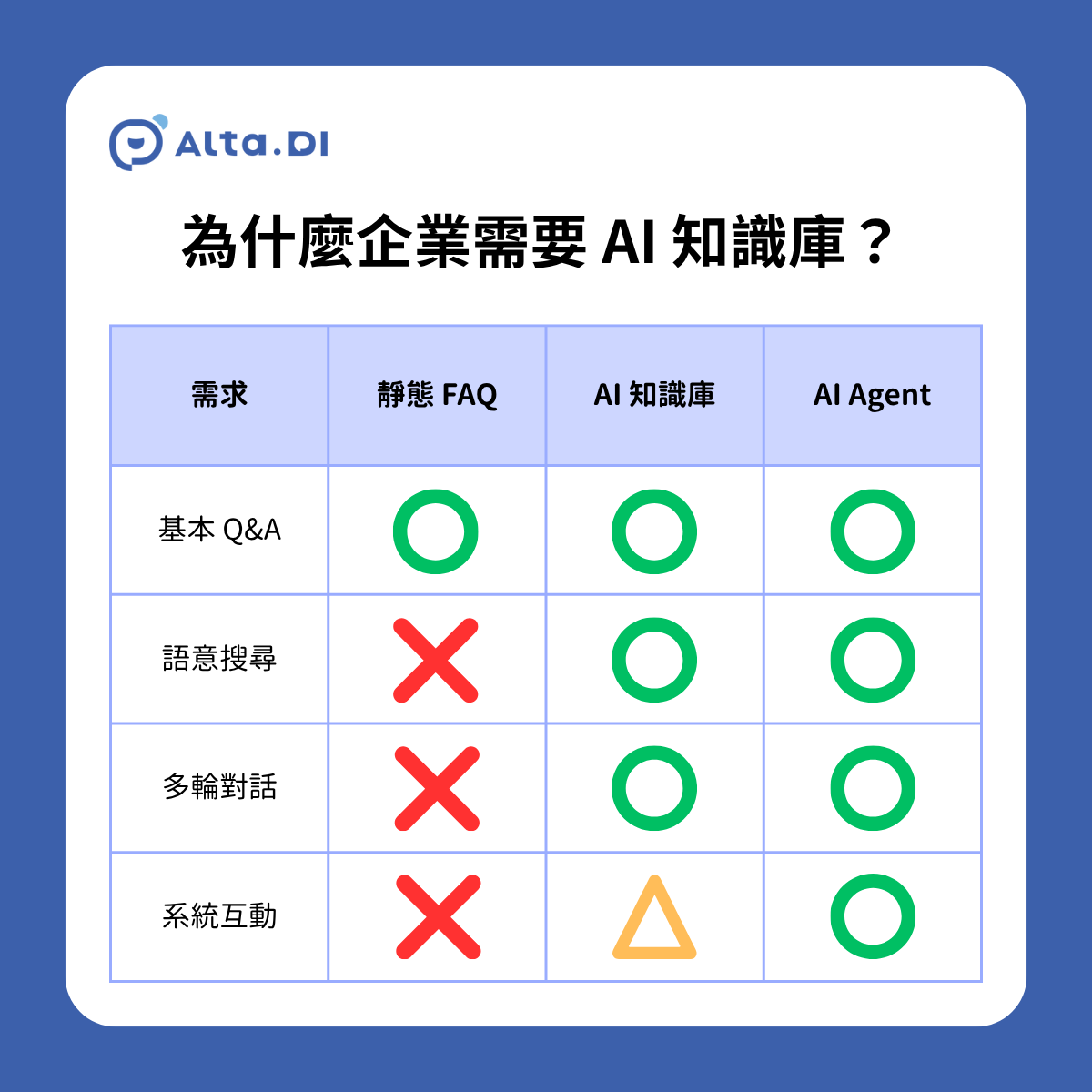
From a static FAQ to an AI knowledge base: when should you upgrade?
Not every company needs an AI knowledge base from the start. The test is simple: see which level your needs fall at:

Alta.DI's corresponding approach: the AI knowledge base plus RAG handles semantic understanding, multi-turn conversation and source citations; when action is needed, an AI Agent connects to the e-commerce platform to check orders and shipping progress; when more systems need connecting, an integration plan can be assessed with consultants through OpenAPI. The decision-making meaning is that you can invest in stages: automate Q&A first, and extend toward "getting things done" once it is proven to work.
How to build an AI customer service knowledge base? A seven-step SOP (with a real answer example)
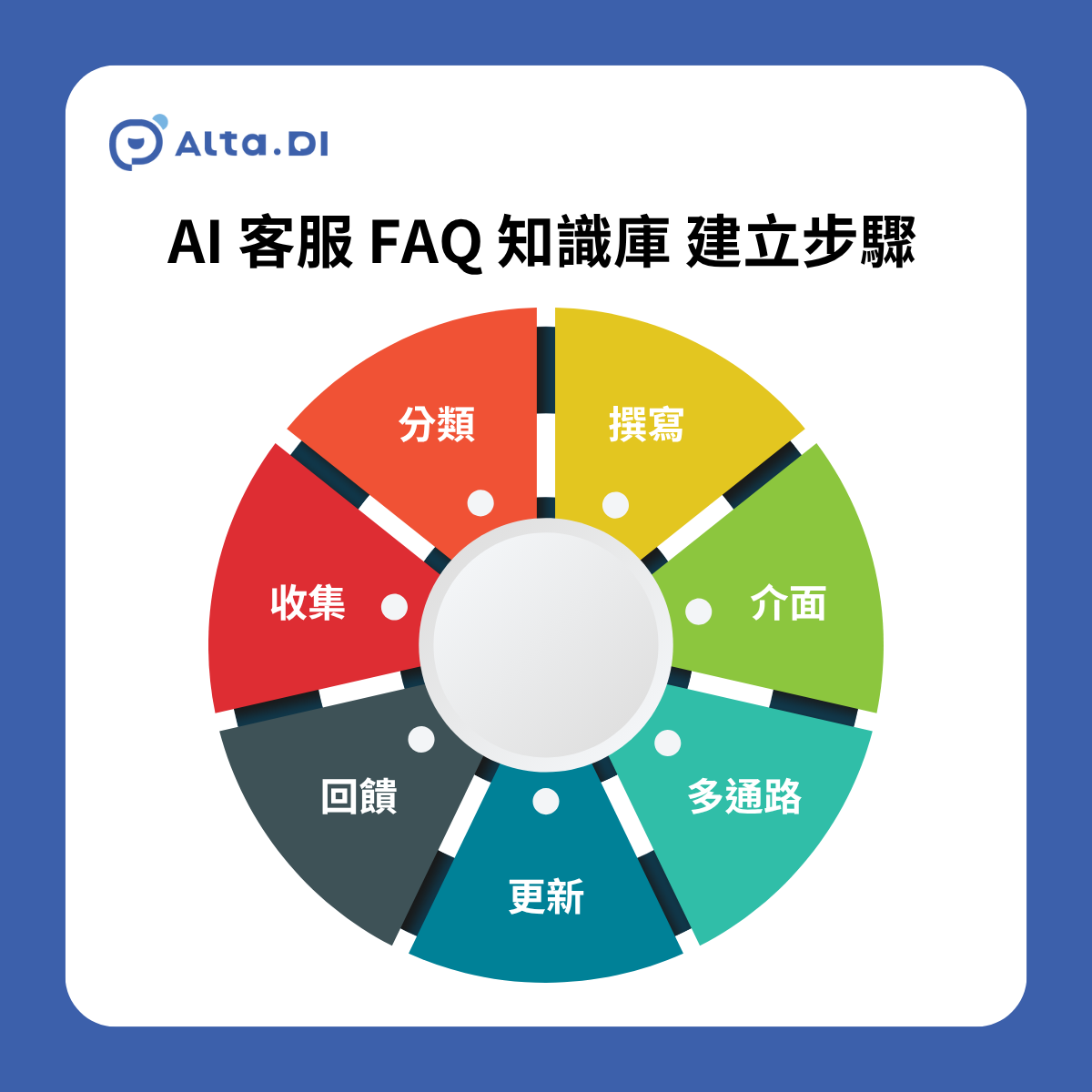
The key point first: build the knowledge base in seven steps, "collect, classify, write, interface, multi-channel, update, feedback", which you can use directly as your internal SOP.
- Collect common questions: sources are tickets, call recordings, LINE, FB and IG messages, on-site search and agent feedback. Start with the highest-frequency, most time-consuming questions from the last three months.
- Classify and structure: group by topic (product, order, account, returns and exchanges, technical), add tags and synonyms (for example "return / return process / return policy"), and set search weights and merging of similar questions.
- Write clear answers: use a "one-sentence conclusion + specific content + next action" template, and build a banned-words list to keep brand tone from drifting or touching sensitive terms.
- Design the interface and search experience: directory + search + similar-question suggestions, with clear titles and bulleted body text to raise the hit rate.
- Integrate multiple channels: sync to the LINE Official Account, FB and IG, the website Live Chat and the agent workstation, so the same knowledge supports both customer-facing service and agent assist.
- Review and update regularly: set content owners and reviewers, with version control and a change log.
- Build a feedback mechanism: add "Was this helpful?" and "What is missing?" under each answer, then use reports to track helpfulness rate, searches with no result and popular search terms, and adjust on a rolling weekly basis.
The third step, "write the answer", deserves the most care, because the structure of an answer decides whether it can move the business forward. Back to the furniture manufacturer from the opening: when a customer asks "Does the lift-up bed have safety features?", the answer in the knowledge base is not just one word, "Yes", but is composed from the template: first the conclusion (it has safety features), then the specifics (a safety release button (pin) and a pneumatic slow-descent mechanism), and last the action (you are welcome to try it in store, with the store address attached). For the same question, a definition-style answer only clears up the doubt, while an action-style answer brings the person to the store. That is the difference once the "answer template" is designed well.
Why must a knowledge base be paired with RAG? (But you need not get lost in technical detail)
The key point first: an AI customer service agent without RAG tends to "make things up", while one with RAG checks your documents first before answering and cites its sources. This is the precondition for companies to dare put AI on the front line.
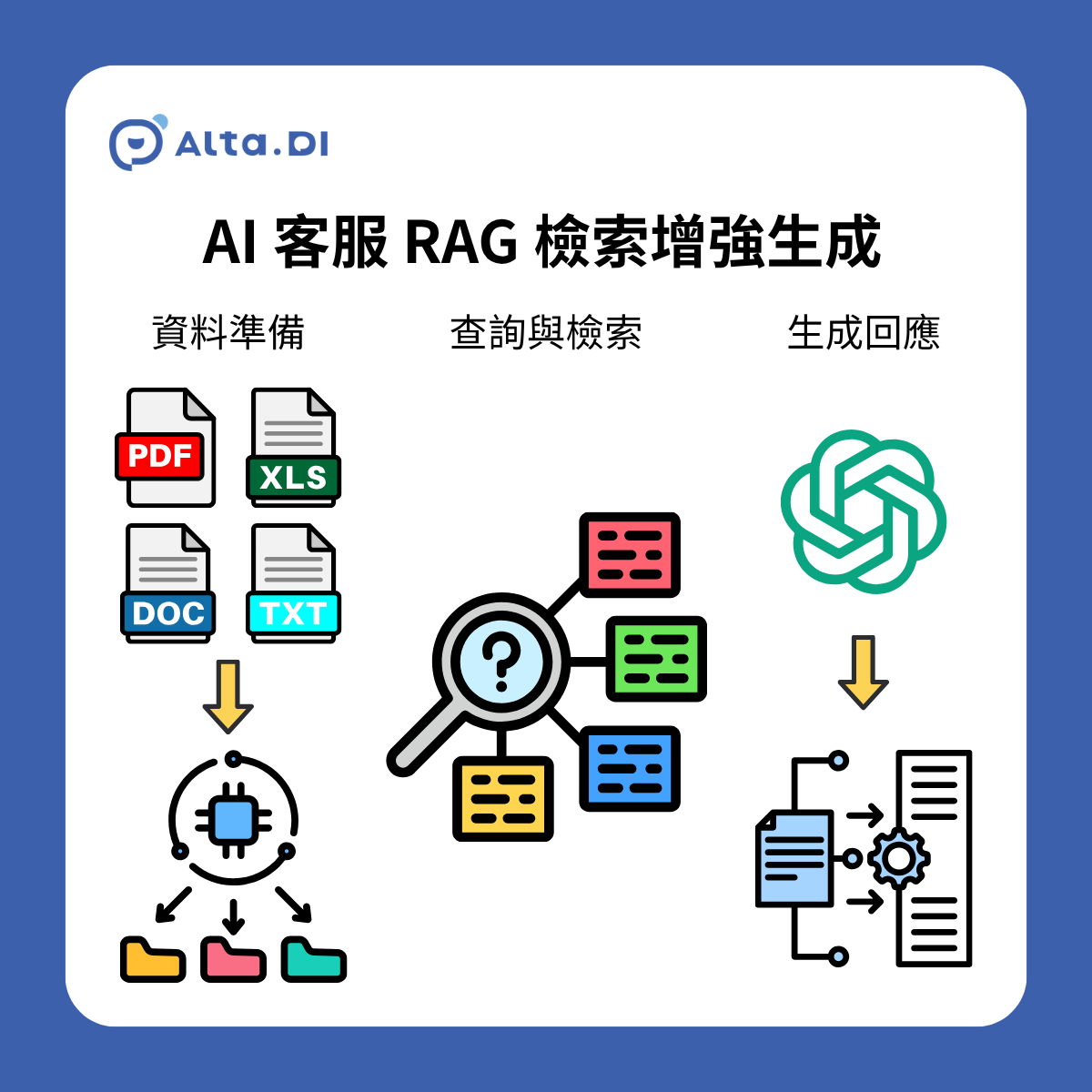
The plain-language version of RAG (Retrieval-Augmented Generation) is "retrieve first, then answer": before answering, the AI finds the relevant passages in your knowledge base, then generates the answer from them. The benefits are fewer hallucinations (making things up), cited sources, and answers that fit your policies and wording [2].
As a decision-maker, you do not need to tune the optimal chunking parameters yourself. You only need to know that two key checkpoints exist and are done right. One is that documents are cut into reasonably sized passages (commonly 300-800 characters in practice) with headings and field labels kept, so the hit rate is high and Tokens are saved. The other is that retrieval balances breadth and precision (semantic similarity search + keyword conditions + re-ranking), with a fallback path set for when no relevant knowledge is found (hand off to a human or guide to the FAQ).
Traditional Chinese also needs synonym and word-segmentation tuning (for example, treating "return / send back / exchange of goods" as the same intent). How deeply these settings are done directly affects answer quality. To learn how retrieval and re-ranking are implemented, see our article “RAG and Knowledge Base Application Examples”. Alta.DI's approach at this layer: it supports multi-format file upload, and the AI attaches the source when it answers, so both customers and managers can verify instantly.
Who maintains the knowledge base after launch? Governance, KPIs and three common obstacles
The key point first: a knowledge base is not finished once built. It is an asset that needs continuous feeding, and if no one owns maintenance, it starts to drift out of accuracy after three months.
A reasonable approach is cross-department co-governance: customer service, operations and brand or legal compliance maintain it together, avoiding a single viewpoint. In rhythm: small fixes weekly, a full review monthly, and immediate updates for major policy changes. For staffing, a mid-sized team often allocates 0.5-1 dedicated knowledge governance person (who can be shared between customer service and content teams). In small and medium-sized businesses, the customer service manager can take it on, spending one to two hours a week on review and half a day a month on a full check.
To measure results, we suggest watching these metrics:
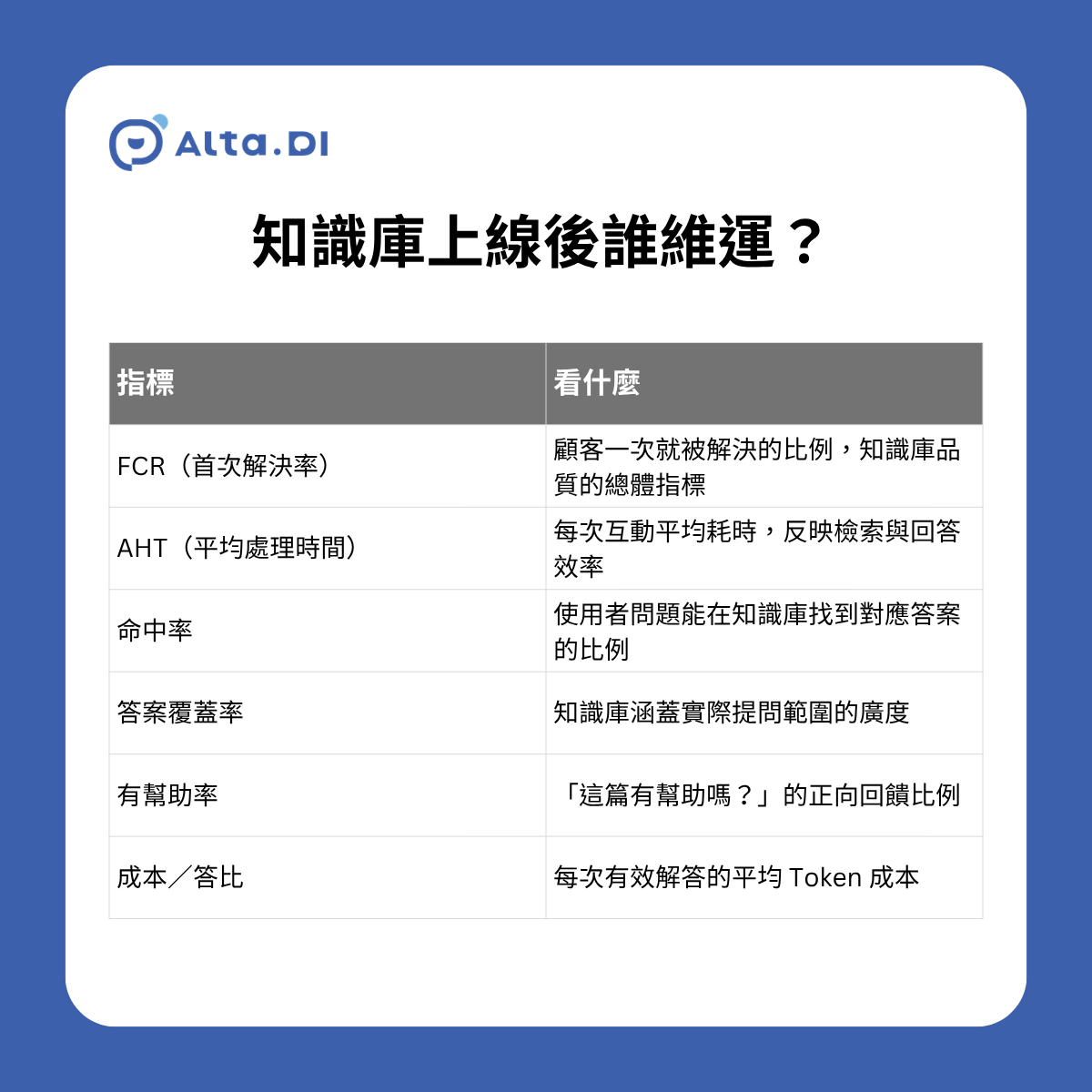
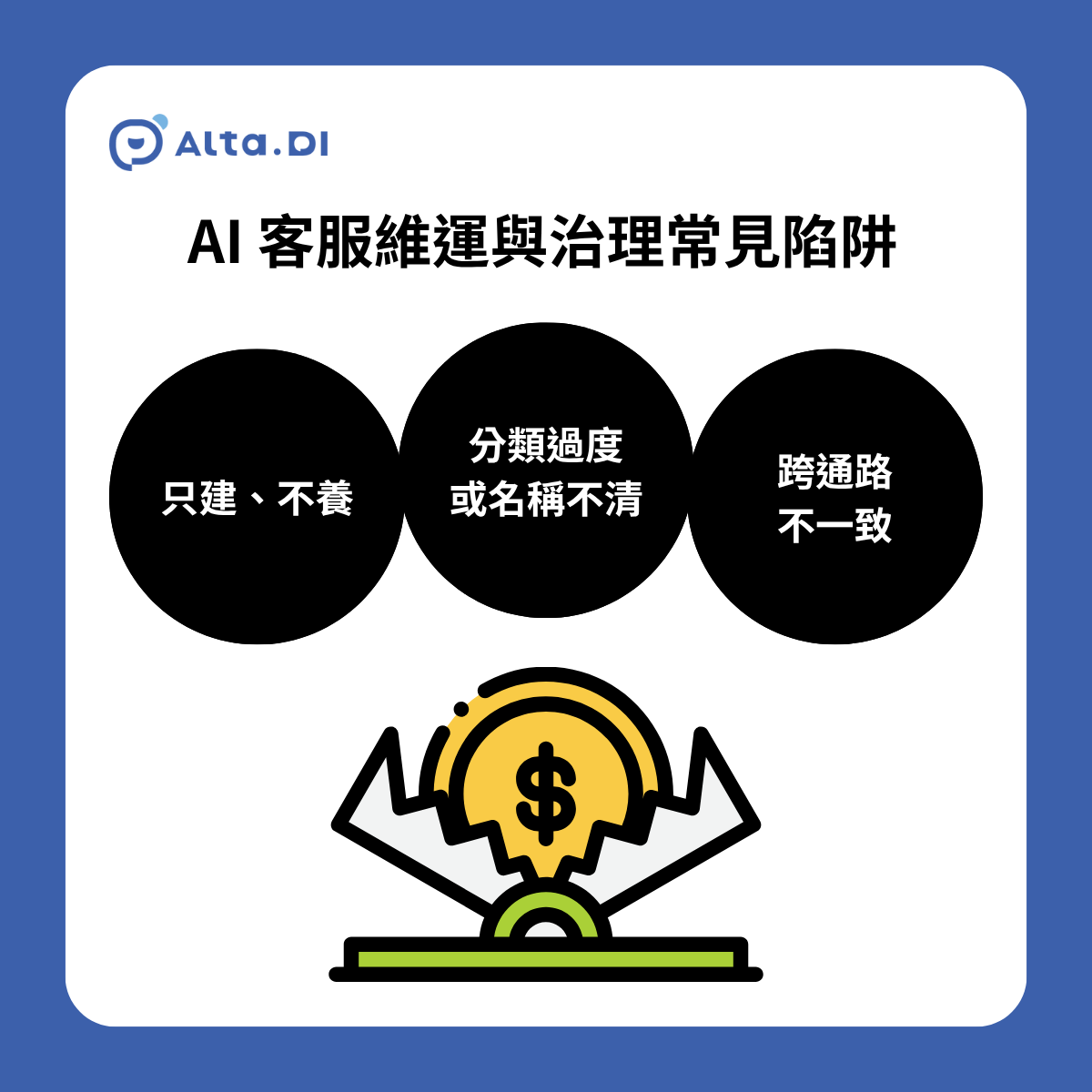
The three most common obstacles and their fixes: first, "build but never maintain": write maintenance into KPIs and responsibilities and run it on a fixed rhythm. Second, "over-classification or unclear names": name things in customers' language and simplify categories based on the data. Third, "inconsistency across channels": unify knowledge and rules on one platform to avoid each channel writing its own set.
How much does it cost to build an AI customer service knowledge base? Estimating cost and payback
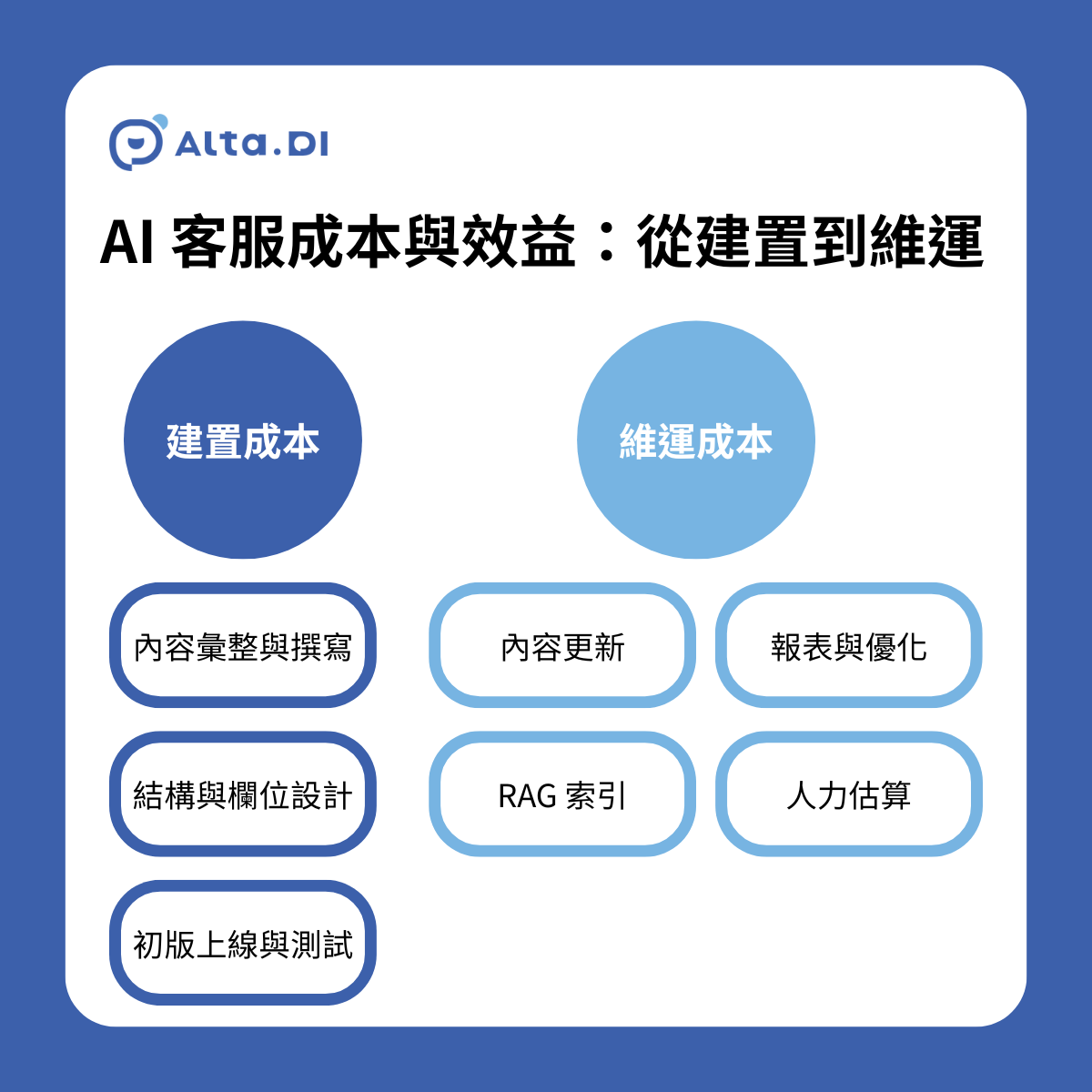
The key point first: cost splits into "one-time build" and "recurring maintenance", and what keeps changing and needs managing is the Token cost.
The build (one-time) covers content consolidation and writing, structure and field design, document upload, RAG indexing, interface setup and testing. Maintenance (recurring) covers content updates, index rebuilds and monitoring, report adjustments, and the 0.5-1 dedicated person mentioned above.
Token cost varies with conversation volume, model tier and reply length. There are three control points: use tiered models (a lightweight model for simple questions, a higher-tier model only for complex ones), keep replies concise, and tune the RAG pipeline (getting chunking and retrieval right raises the hit rate and lowers Token use at the same time). For payback evaluation, counting "freed customer service hours" together with "customer retention from higher FCR" is closer to the real benefit than looking only at labor cost.
Build it yourself or use a platform? How should a one-month PoC be validated to count as a success?
The key point first: unless you have ample engineering and data teams and highly customized needs, most companies will go live faster and carry a lower IT burden on a platform. But whichever route you take, validating with a one-month PoC before scaling is the lowest-risk path.
Building versus buying is not "which is stronger" but "which suits your resources and timeline right now":
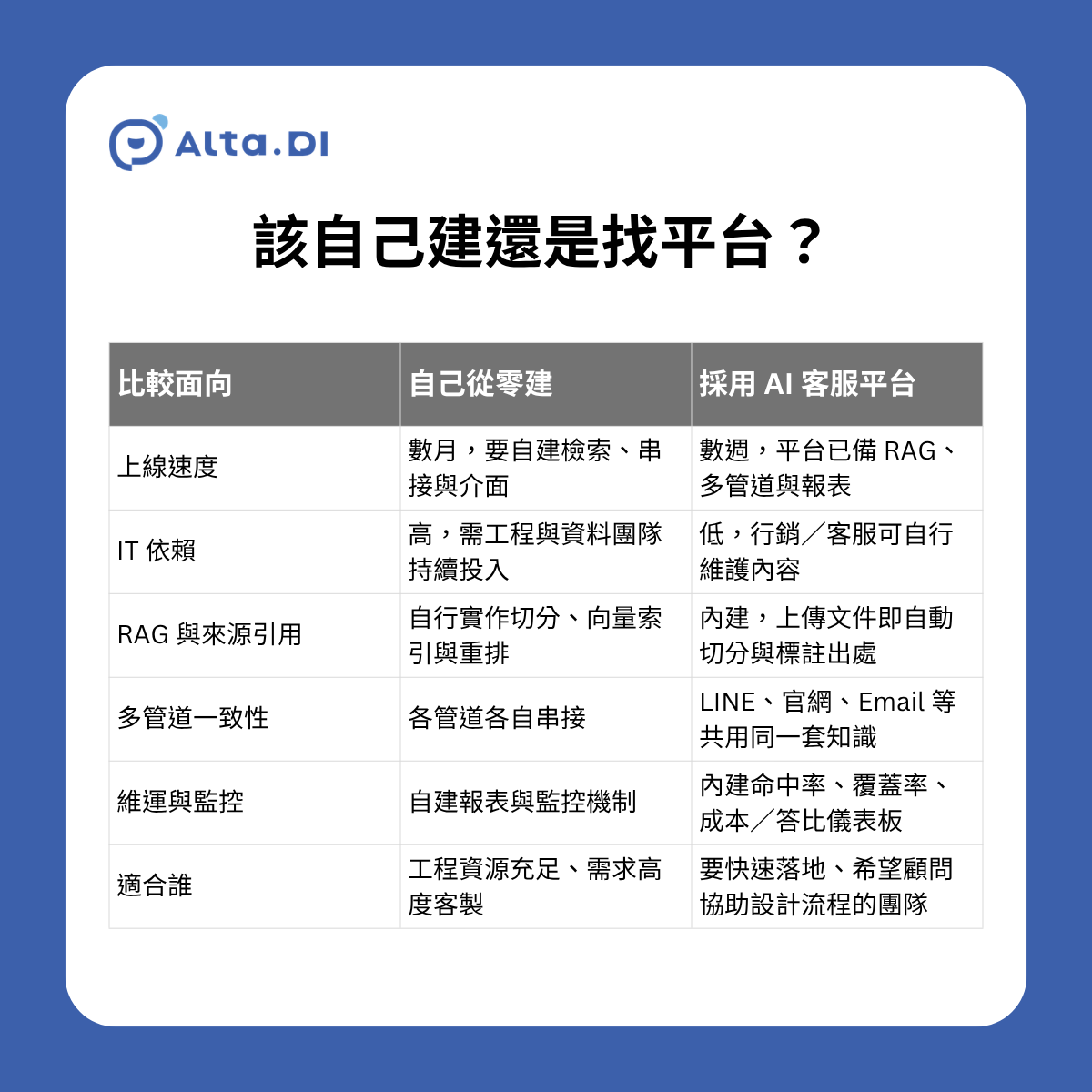
We break down the full trade-offs of building versus buying in more detail in our article “AI Customer Service: Build vs. Buy”. The point here is: before deciding the direction, validate your assumptions with a one-month PoC.
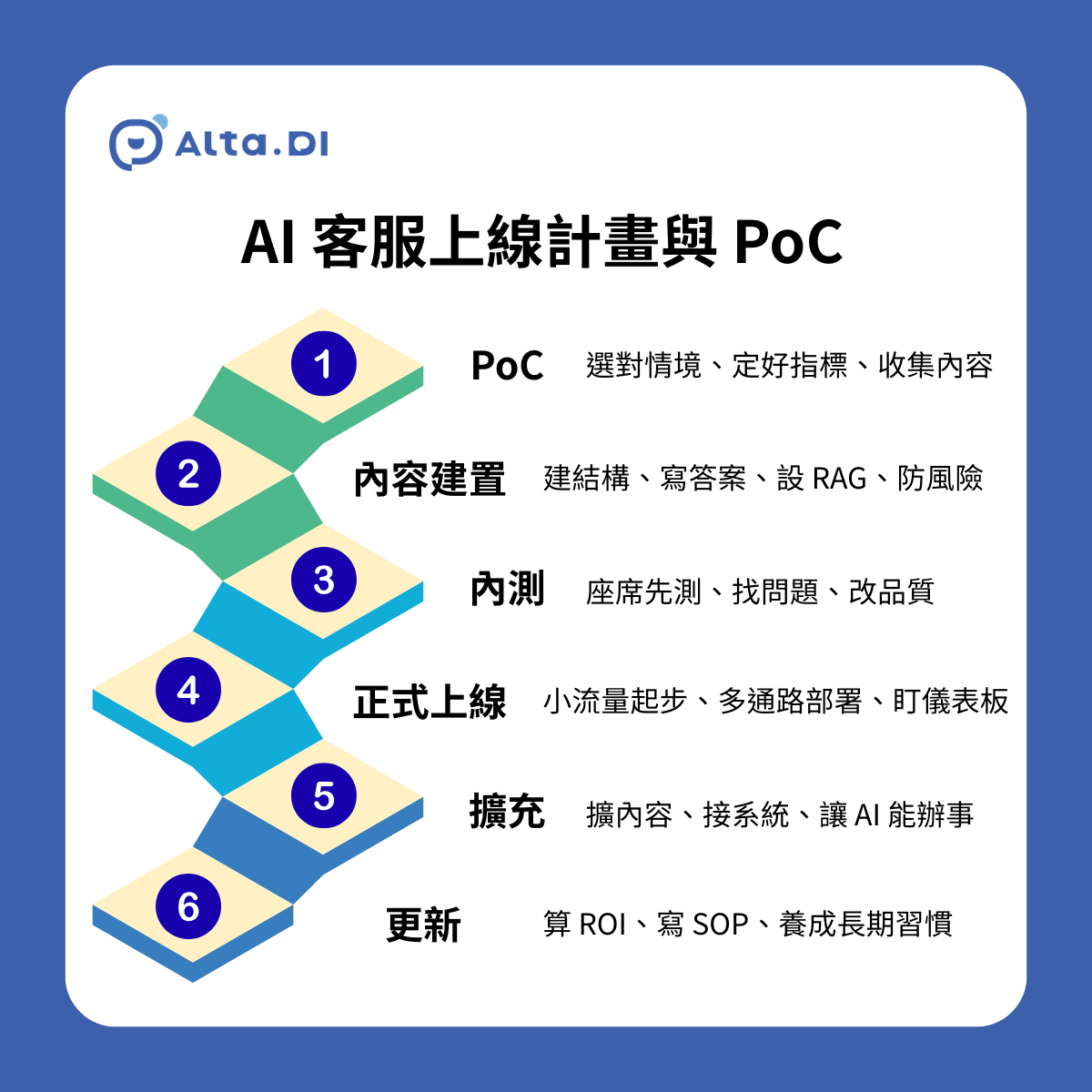
The PoC approach most likely to succeed is: choose 2-3 high-value scenarios (for example order inquiries, returns and exchanges, shipping progress) and define success thresholds in advance (how high FCR, AHT and hit rate must reach). Build the first batch of documents (PDF / Excel / CSV / policy pages), complete upload and chunking, and turn on RAG and source citation. First run it in "agent assist (human-AI collaboration)" mode for one to two weeks of internal testing by customer service, and open it to customers once quality is stable. Build risk control in throughout: fallback rules for when knowledge is not found, a Fallback safe reply, human takeover and an audit trail, so that go-live is traceable. For the information security part, we suggest aligning with the ISO/IEC 27001 information security management requirements [3], which is also the checkpoint that enterprise buyers care about most.
After validation passes, expand in stages: in the second stage, sync the knowledge base to each conversation channel and introduce a popular-answer cache; in the third stage, integrate orders, logistics and more external systems further through APIs, so the AI not only answers but can look up, write and get things done. Alta.DI, as the Alta.DI customer interaction platform, is positioned on this path to spare you from building retrieval and integration from scratch, so your time goes into "designing the right process" rather than "reinventing the wheel".
Next step: work out how your knowledge base should start
By now you should be able to tell which decision point you are at: whether to automate high-frequency Q&A first or integrate straight into an AI Agent that can get things done; whether to build yourself or validate quickly on a platform. Every company starts from a different place. Some are stuck with scattered, unorganized content, some with inconsistent answers across channels, and some are unsure how far a PoC must validate.
If you want to work out where your knowledge base should actually start, Data-DI offers a free 30-minute AI customer service diagnosis. A consultant reviews your current Q&A content, existing channel setup and quick wins that can be improved, and for your actual situation estimates Token and maintenance cost and plans a PoC that can be validated within one month. You do not need to prepare data first. Just tell us your current customer service scenario and the tools you use. To get started, you can book a free 30-minute diagnosis. If you would like to see more practical implementations and industry cases first, you can also browse our more AI customer service implementations and cases。
References

[1] McKinsey & Company.(2023.06)。The economic potential of generative AI: The next productivity frontier. McKinsey & Company.
https://www.mckinsey.com/capabilities/tech-and-ai/our-insights/the-economic-potential-of-generative-ai-the-next-productivity-frontier
[2] NVIDIA.(2023.11)。What Is Retrieval-Augmented Generation, aka RAG? NVIDIA Blog.
https://blogs.nvidia.com/blog/what-is-retrieval-augmented-generation/
[3] ISO.(2022.10)。ISO/IEC 27001 — Information security management systems. International Organization for Standardization.
https://www.iso.org/standard/27001
FAQ
FAQs about this article
Roughly how much does an AI customer service knowledge base cost, and how long until it pays back?

Cost splits into a one-time build (content, structure and RAG indexing) and recurring maintenance (content updates, reports, about 0.5-1 person), with Token cost varying separately by usage. For payback, count the freed customer service hours together with the retention benefit.
Should we build the AI customer service knowledge base ourselves or use an existing platform?
With ample engineering resources and highly customized needs, building yourself is more flexible but often takes months to launch. Most companies get into daily use faster with a platform and depend less on IT. The key is not which is stronger but which suits your resources and timeline.
How far must a one-month PoC validate before it counts as a success and can be scaled?
Choose 2-3 high-value scenarios first, define FCR, AHT and hit-rate thresholds in advance, build the first batch of documents and turn on RAG, test internally in agent-assist mode for one to two weeks, then open it to customers and move to expansion once the targets are met.
Who maintains the knowledge base after launch, and how many people are needed?
We suggest cross-department co-governance, with customer service, operations and legal compliance maintaining it together: small fixes weekly, a full review monthly, and immediate updates for major policy changes. In staffing, mid-sized teams often allocate 0.5-1 dedicated person, and in small and medium-sized businesses the customer service manager can take it on.
Why must AI customer service be paired with RAG? What happens without it?
RAG is "retrieve first, then answer": before answering, the AI finds relevant passages in the knowledge base and then generates, which reduces hallucination and attaches sources. An AI without RAG can give answers that do not match the facts, and companies will not dare put it on the customer-facing front line.
More articles


訂閱我們的電子報
每月 8 日定期發送最新趨勢與實用資訊!



