

What is RAG AI customer service? Fixing AI hallucination | Alta.DI
Does your AI customer service state wrong answers with confidence? RAG makes the AI look up your knowledge base before it replies, which tackles hallucination at the source. This article explains how it works with 2026 data, helps you judge whether you need RAG, and offers a free 30-minute diagnostic.


RAG AI customer service is a technology that lets AI retrieve from the company knowledge base before answering, then generate the reply from what it found. Its purpose is to stop the AI from making things up, and it suits e-commerce, retail and service businesses with a lot of product information and customers who phrase questions in many different ways.
You may have met this kind of customer service bot: a customer asks, "Will this jacket shrink?" and it answers, "Would you like to check an order?" That is the limit of keyword matching, and it is where most companies start when they want to upgrade their AI customer service. Before you act, three questions are worth settling: what RAG actually is, whether your situation really requires it, and what changes for frontline staff after adoption. This article answers them in order and ends with a way to judge for yourself.
Why are companies rushing to upgrade AI customer service in 2026?
Key point: 91% of customer service leaders are being asked to adopt AI. The wait-and-see period is over.
By 2026, AI customer service has moved from pilots to mainstream use. A Gartner survey shows that 91% of customer service leaders are under pressure from senior management to implement AI [1], and Salesforce reports that AI agent adoption in service teams grew from 39% to 66% within a year [2]. A system still stuck on keyword matching keeps telling customers "Sorry, I don't understand" at a time when competitors already reply in seconds.
The change in success metrics is even more noteworthy. Salesforce's "State of Service: AI Agents Edition" surveyed 3,075 customer service workers worldwide and found that the metric improving most after AI agent adoption was customer satisfaction, ahead of handling efficiency and response speed; 70% of companies saw measurable results within 60 days of going live [2]. The market's question is shifting from "Can AI save headcount?" to "Can AI get the service right?"
And getting the service right requires that every sentence the AI says rests on a source. That is why RAG exists.
What is RAG, and why does it solve AI hallucination?
Key point: Let the AI take an open-book exam, with answers tied to your knowledge base.
RAG (Retrieval-Augmented Generation) is a technique in which the AI first retrieves relevant content from the company knowledge base and then answers based on what it retrieved. It sharply reduces the chance of AI hallucination at the source.
Many companies hesitate to put generative AI on the customer service front line because of hallucination: the AI confidently invents promotions or return policies that do not exist. The reason is that traditional generative AI is like a student taking an exam from memory. If it never learned your company's latest rules, or remembers them wrongly, it guesses in a way that sounds plausible.
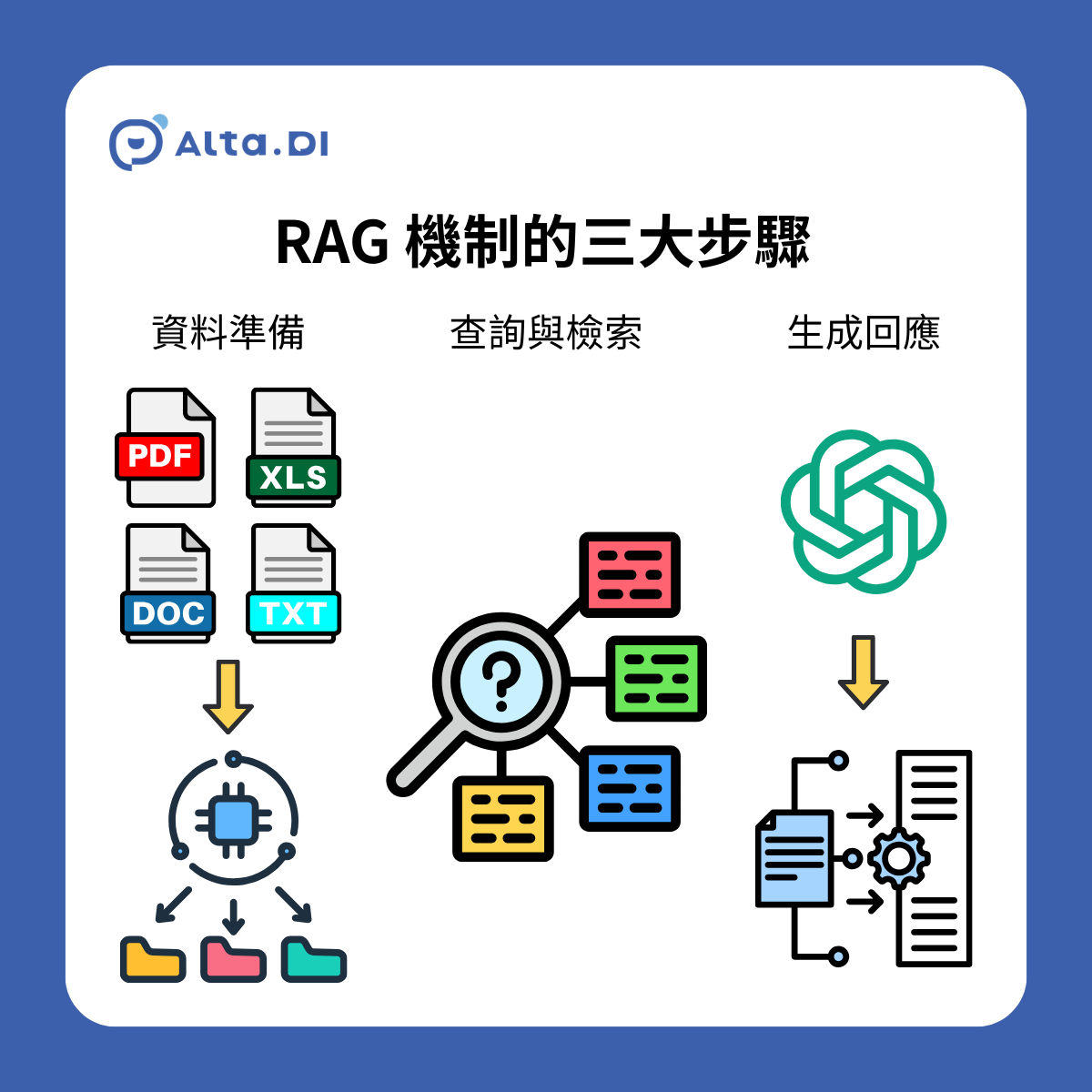
RAG is more like a top student who may consult the textbook during the exam. It answers in three steps:
- Retrieval: When a customer asks a question, the AI first looks through the "textbook" you provide (the company knowledge base) and finds the relevant passages.
- Augmentation: The correct information it found is combined with the customer's question.
- Generation: Based on that material, the AI generates a fluent answer that fits the context, and can cite its sources.
What makes this work is semantic search: the system understands the intent of a question, not its literal wording. If a customer types "my clothes got smaller in the wash," it can still match the correct entry even when the knowledge base says "shrinkage." Keyword matching cannot do that.

To go deeper into RAG retrieval and reranking, see A Complete Guide to RAG and Reranking.
How does RAG work? Three steps from data preparation to generating a response
Key point: Chunking, embedding, retrieval and generation. Four terms explain the whole flow.
In customer service, the full RAG flow has three stages: data preparation, query and retrieval, and response generation. Each stage involves specific technical actions.
Step 1: Data Preparation. Collect text from the company website, product manuals, FAQs and other sources to build the knowledge base. Next comes chunking: long content is cut into small pieces. For example, a product manual might be split into sections such as "specifications," "warranty" and "returns and exchanges," which makes retrieval more precise. Embedding then converts each piece into a numerical vector so the system can compare meaning, and the vectors are stored in an index for fast search.
Step 2: Query and Retrieval. When a customer asks a question, the system converts it into a vector in the same way and runs a similarity search over the index. It usually finds several of the most relevant pieces to use as the basis for the answer.
Step 3: Generating the Response. The system passes the customer's question and the retrieved pieces to a large language model, which produces an answer that is coherent, professional and consistent with the company's knowledge, avoiding wrong information or invented content.
For a customer service team, this flow has three practical benefits: answers are grounded in sources, the system can handle complex questions in specialised fields, and the knowledge base can grow at any time. Upload a new document and the AI's answers update with it.
Do you have to use RAG? Three situations to help you decide
Key point: If questions are fixed, a flow bot is enough. If knowledge keeps changing, you need RAG.
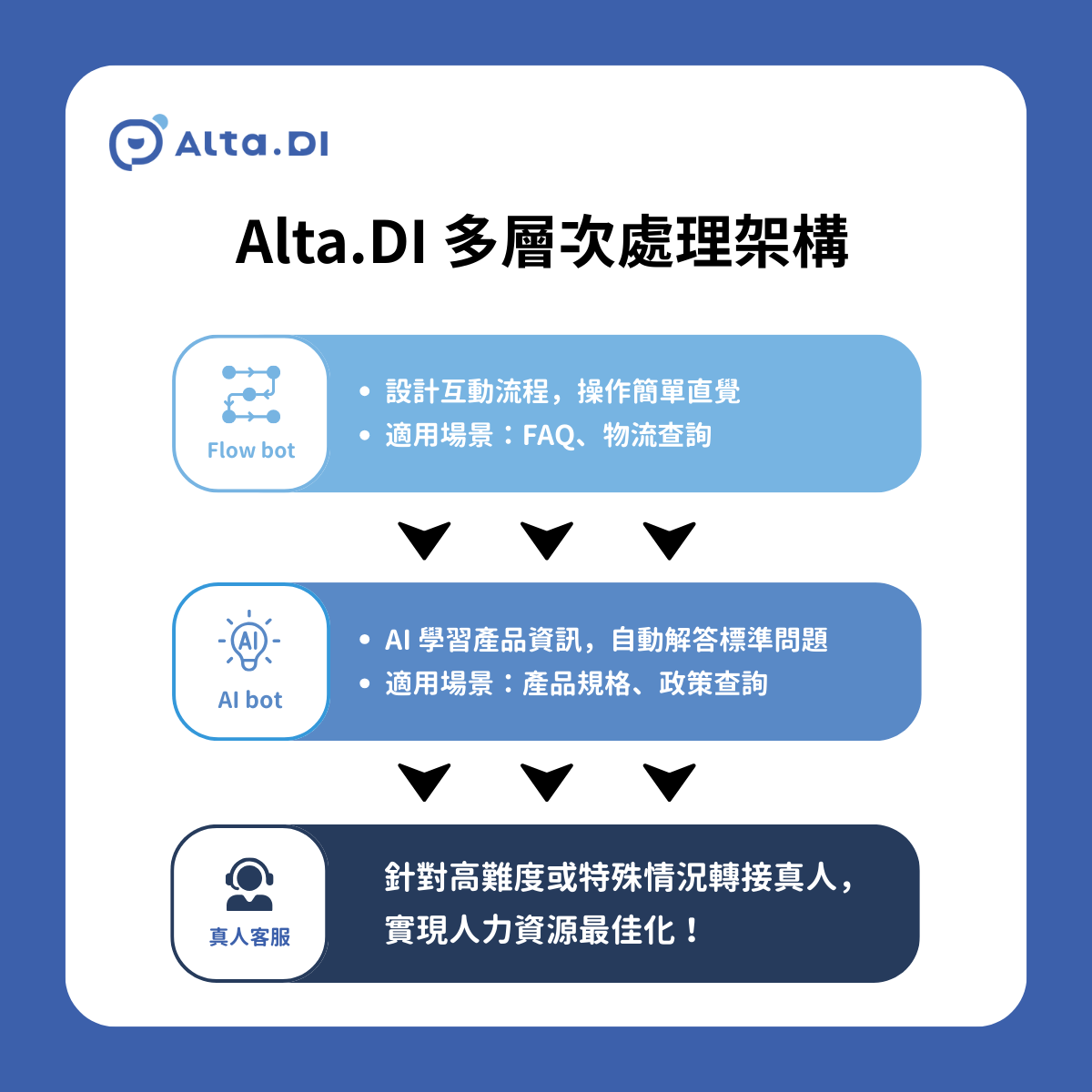
Not every customer service scenario needs RAG. Where questions are fixed and answers rarely change, a menu or flow bot can handle them. RAG is worth adopting where knowledge is updated often and customers phrase questions in many ways. This is the judgment call we are asked about most often in consulting sessions, and three situations make the comparison easy:
- Situation 1: The list of questions is fixed. For questions whose answers barely change, such as business hours, shipping rules and store addresses, an FAQ menu or a Flow Bot can handle them. Replies are fast and setup cost is low, so there is no need to adopt RAG for them.
- Situation 2: A large body of knowledge that changes often. Specifications for thousands of products, the details of every promotion, operating manuals that are revised frequently: in this kind of scenario, maintaining manual rules becomes unmanageable. This is where RAG has the advantage. Edit a knowledge base document and it takes effect, with no rules to rewrite.
- Situation 3: The system has to look things up and take action. For requests such as checking an order, changing an address or estimating shipping, looking up a knowledge base through RAG is not enough. The AI also needs to connect to order and logistics systems, so that it routes by situation: fixed questions follow a flow, knowledge questions go through RAG, and tasks that require action go through system integration.
All three situations often exist in the same company. To decide which kind of bot should handle which kind of question, see AI Customer Service Selection Guide: How to Choose Between FAQ, Flow Bot and AI Bot.
How does Alta.DI bring RAG into day-to-day customer service?
Key point: No engineer needed to build the knowledge base. The AI handles 80% of conversations and people handle the other 20%.
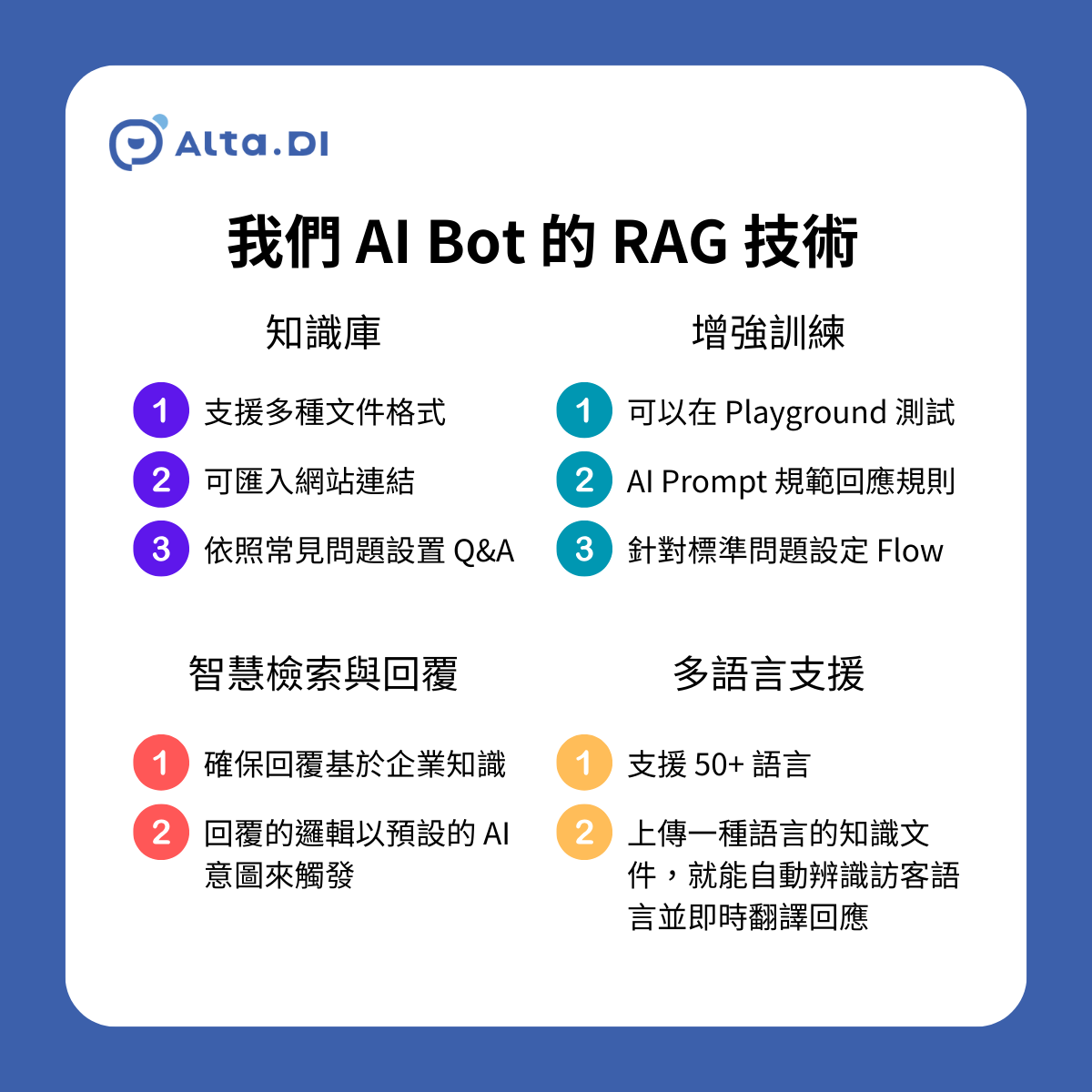
Alta.DI is a channel-agnostic AI customer service platform. It puts the RAG knowledge base, human-AI collaboration and multi-channel integration in a single back end, so the customer service team can go live without relying on engineers and can maintain it themselves.
Build and edit the knowledge base yourself
Building a knowledge base on Alta.DI requires no coding. Upload PDF, Excel (XLSX, CSV), Word (DOCX) or TXT files, or paste a website URL and let the system fetch the content. The system handles chunking and embedding automatically. The practical meaning for a customer service manager is this: when a promotion changes its rules, you upload the new file yourself and it takes effect the same day, with no need to file a request and wait for an IT schedule. For how to organize knowledge documents so the AI can retrieve them well, see A Guide to Building an AI Customer Service Knowledge Base.
The AI answers 80%, people take the other 20%
Routine inquiries and common questions are answered instantly by the AI around the clock. When the AI is unsure, for example with complex emotions or unusual cases, the system hands the conversation to a human agent, with the full conversation record and the AI's summary of its assessment attached, so the customer does not have to repeat the problem. This split between people and AI also matches where the market is heading: Gartner predicts that by 2029, agentic AI will be able to resolve 80% of common customer service issues autonomously [3]. The remaining 20%, which need empathy and judgment, are left to people.
Service is wherever your customers are
LINE, Facebook Messenger, Instagram, WhatsApp, email and website live chat are all managed in a single back end, and customer data from every channel is merged into one profile. Your customers will not stay in a single channel, and your customer service system should not be tied to one either. For the full features and plans, see Alta.DI Product Overview.
What changes on the front line after adoption? Two real scenarios
Key point: Instant answers to late-night questions keep orders. Customers who speak other languages no longer require extra hires.
The most direct change after adopting RAG AI customer service happens in the conversations that "nobody used to pick up." Below are the two scenarios Alta.DI clients see most often.
Scenario 1: The last question before an e-commerce checkout.
A customer asks late at night, just before checkout, "Does this shoe run large?" Nobody answers in time, and the cart sits until the next day and is forgotten. Alta.DI connects directly to Shopify, Shopline and WooCommerce. The AI retrieves the product data right away and replies, "This one runs half a size large. We suggest going one size down," keeping the hesitant customer on the checkout page.
Scenario 2: Multilingual support for cross-border business.
You want to serve customers overseas but cannot afford a multilingual service team. In practice you only need to maintain a Chinese knowledge base. Alta.DI's AI has real-time translation: when foreign customers ask in English, Japanese, Korean or any of more than 50 other languages, the AI replies precisely in their language based on the content of the Chinese knowledge base. This is also the feature clients have asked us about most often recently.
Conclusion: work out where you are stuck first, then decide whether you need RAG
Every company's customer service bottleneck is different. Some are stuck with nobody replying late at night, some with knowledge scattered across departments, some with channels that each work on their own. If you want to find out whether RAG suits your situation, Data-DI offers a free 30-minute AI customer service diagnostic. A consultant reviews your current service process, the state of your knowledge documents and your channel setup, and gives a concrete recommendation on whether to use a Flow Bot, use RAG, or organize the knowledge base first. You do not need to prepare any material in advance. Book a free diagnostic and tell us about your website and the tools you use today.
References

[1] Gartner.(2026). Gartner Survey Finds 91% of Customer Service Leaders Under Pressure to Implement AI in 2026. Gartner Newsroom.
https://www.gartner.com/en/newsroom/press-releases/2026-02-18-gartner-survey-finds-ninety-one-percent-of-customer-service-leaders-under-pressure-to-implement-ai-in-2026
[2] Salesforce.(2026). New Research: AI Service Agents Improve Customer Satisfaction(State of Service: AI Agents Edition). Salesforce Newsroom.
https://www.salesforce.com/news/stories/ai-service-agents-improve-customer-satisfaction/
[3] Gartner.(2025). Gartner Predicts Agentic AI Will Autonomously Resolve 80% of Common Customer Service Issues Without Human Intervention by 2029. Gartner Newsroom.
https://www.gartner.com/en/newsroom/press-releases/2025-03-05-gartner-predicts-agentic-ai-will-autonomously-resolve-80-percent-of-common-customer-service-issues-without-human-intervention-by-20290
FAQ
FAQs about this article
What is RAG AI customer service?

RAG AI customer service retrieves relevant content from the company knowledge base before answering, then generates the answer from what it found. Answers are grounded in sources, which greatly reduces the risk of the AI making things up.
How does RAG prevent AI hallucination?
RAG works like an open-book exam: the AI retrieves from the knowledge base to find relevant passages, then answers based on that content. Answers are tied to the data sources the company provides rather than to the model's memory, so hallucination drops sharply.
Do I have to use RAG for LINE customer service?
Not necessarily. If questions are fixed and answers rarely change, a menu or Flow Bot can handle them. RAG is needed when knowledge changes often, customers phrase questions in many ways and the system must understand meaning to keep answers accurate.
Does RAG AI customer service support multiple languages?
Yes. With Alta.DI, for example, you only need to maintain a Chinese knowledge base, and the AI can reply to foreign customers in real time in English, Japanese, Korean and more than 50 other languages, with no need to hire a multilingual team.
Do I need engineers to build a RAG knowledge base?
No. Alta.DI is designed as no code. Upload PDF, Excel or Word files or paste a URL, and the system chunks and embeds them automatically, so the customer service team can build and update the knowledge base on its own.
More articles


訂閱我們的電子報
每月 8 日定期發送最新趨勢與實用資訊!



