

AI customer service pricing: the NT$10,000 sweet spot | Alta.DI
The lowest monthly fee is not always the cheapest. A real TCO table shows why the NT$9,980/month tier is the sweet spot for small and mid-sized businesses, with a 137% ROI estimate and a 5-point checklist before you buy.


Why the cheapest plan costs the most: one table shows why Alta.DI's NT$9,980 plan is the right choice
Do you think choosing an AI customer service plan just means picking the lowest monthly fee? That is the most common mistake small and mid-sized business owners make in 2026.
Many owners see a plan at a little over NT$2,000 a month and buy it, only to find out later that it is not AI at all, just a more expensive answering machine. It cannot look up orders, it does not understand natural language, and once message volume spikes, hidden traffic fees push the bill above the cost of hiring a person.
The AI customer service market in 2026 is past the early-adopter stage, and price is no longer the only consideration. For businesses handling 5,000 to 20,000 inquiries a month, the NT$10,000-a-month tier (such as the Alta.DI Growth Plan at NT$9,980/month) is the most reasonable budget range. It comes with a high contact limit and a generative AI brain (AI credits), so it can actually take over work from staff and generate revenue. When you later need order lookup, you can upgrade to the Advanced Plan on the same platform to turn on the OpenAPI integration, with no need to start over. Below, we use a real cost table to show why the "cheapest" plan is often the most expensive one.
How much does AI customer service cost? Why the NT$10,000 tier is the sweet spot for small and mid-sized businesses
Don't choose a plan by its monthly fee.
A reasonable AI customer service budget depends on whether the plan covers three basics: message volume, order lookup, and generative AI. For businesses handling 5,000 to 20,000 inquiries a month, the NT$10,000 tier (about NT$9,980/month) covers all three in one plan. The market has plans of every kind, so we sorted them into three tiers, and one table shows the differences:
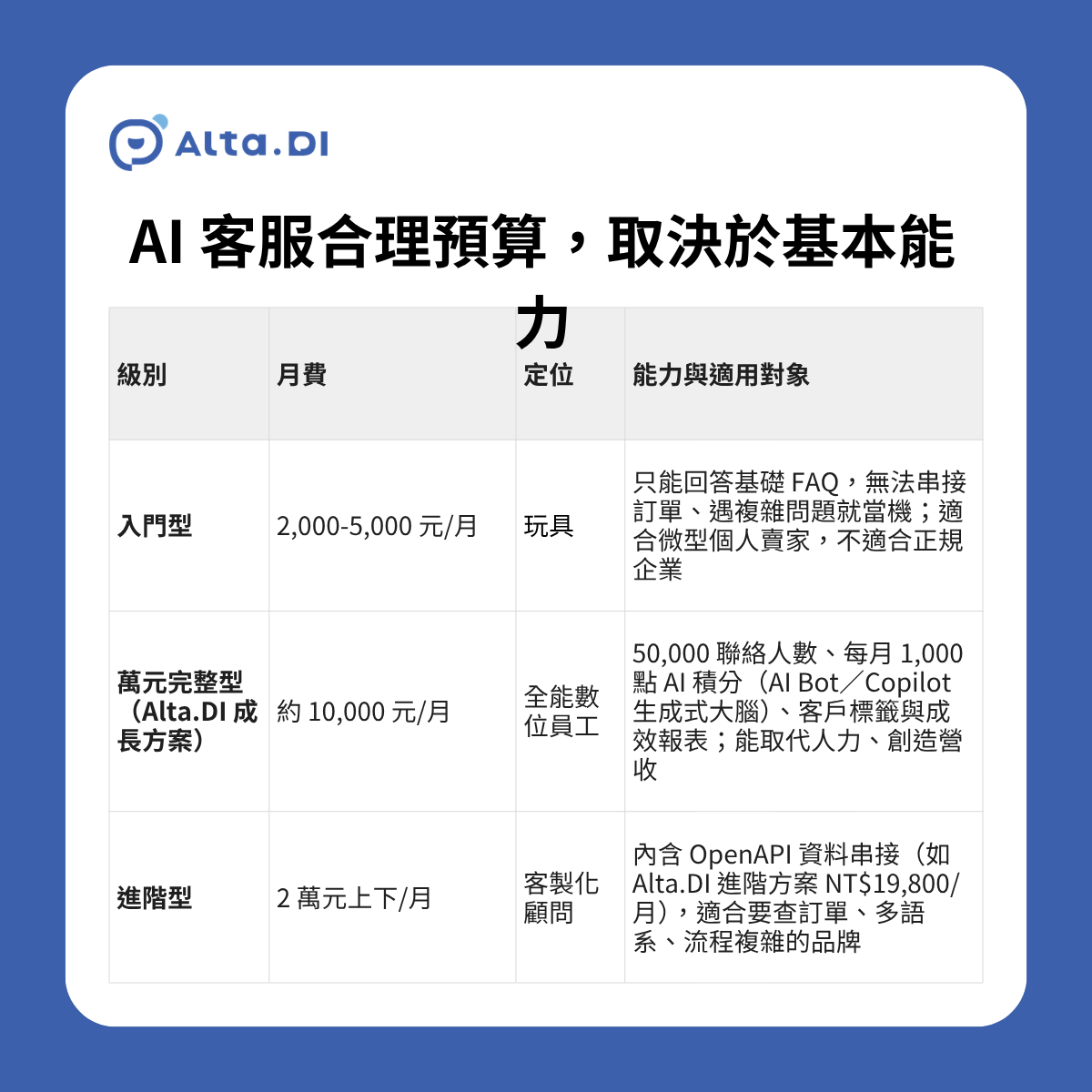
Don't save a few thousand dollars and end up with a "toy." The Alta.DI Growth Plan has generative AI features and full customer data management, without the premium that comes with a big brand, which makes it the best value tier. When you later need OpenAPI order lookup, you can upgrade to the Advanced Plan on the same platform. To see the full feature list of the Growth Plan first, read our guide Alta.DI AI Features Explained.
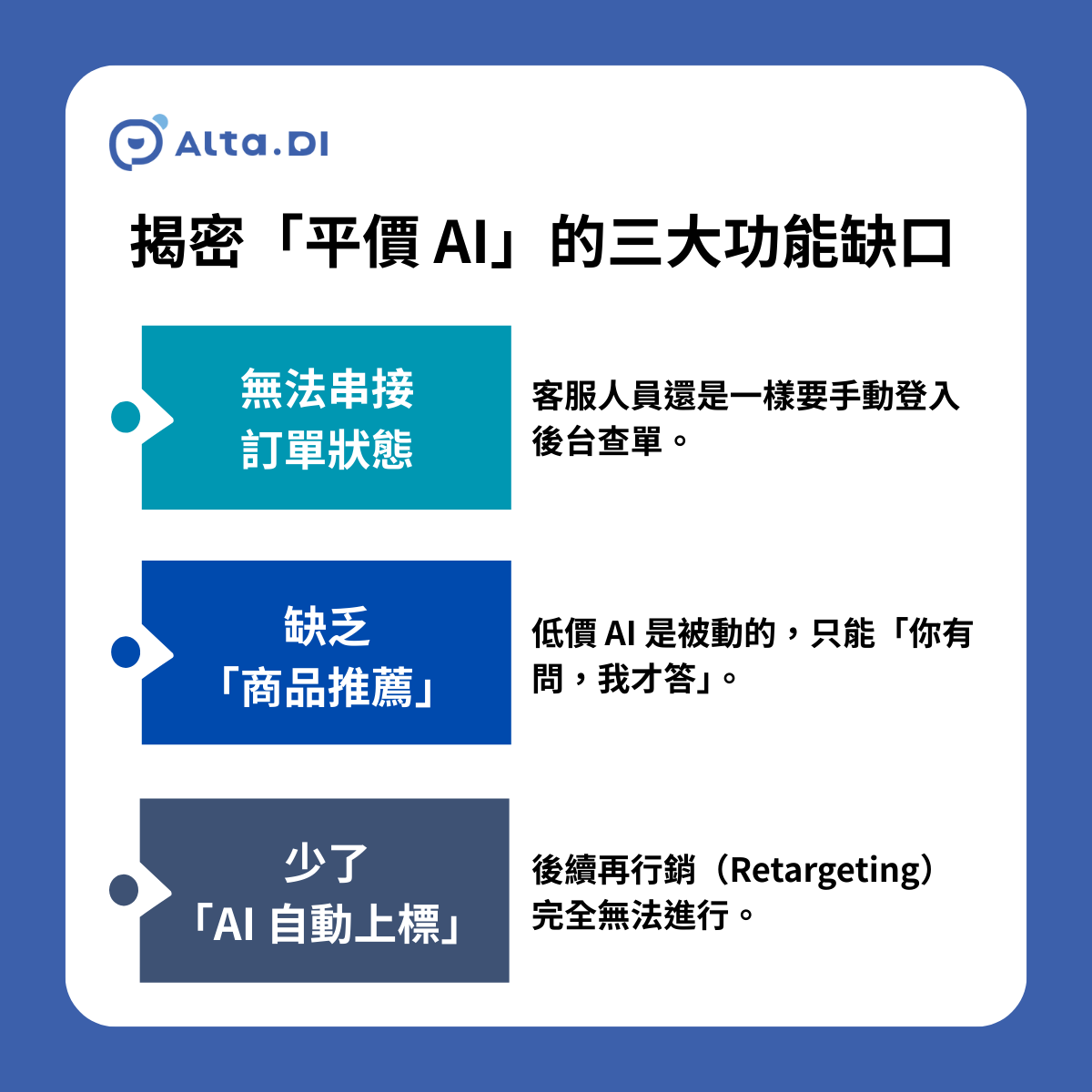
Why is FAQ alone not enough? Three feature gaps in budget AI customer service
These three features decide whether the bot can look up orders and whether it understands what people say.
The three most common gaps in budget AI customer service are no order integration, no semantic understanding, and no automated tagging. These are exactly the three features that turn customer service from a "toy" into a "digital employee that earns money." Comparing the Alta.DI plan specifications with low-priced plans on the market, these three gaps do the most damage:
Gap 1: No order status lookup, so support is still acting as a "lookup clerk"
This is the biggest pain point. When a customer asks "Has my package arrived?", a low-priced AI can only reply "Please wait while a person checks for you," which hands the work straight back to a human.
How Alta.DI solves it: The weak point of low-priced plans is that they never have a connection to order data. The Alta.DI platform offers OpenAPI data integration (included in the Advanced Plan), which supports order data from major e-commerce platforms: the customer enters a tracking number and the AI replies with the shipping status immediately. Integration with custom systems can be assessed with our consultants. You can turn it on by upgrading from the Growth Plan, and your knowledge base and conversation history stay as they are, so you don't have to switch systems and start over. Why integration depth varies so much comes down to system architecture, which our guide covers: How to Choose an AI Customer Service System: FAQ, Flow, or AI Bot.
Gap 2: No "AI credits," so the bot can't understand natural language
Most low-priced plans only do "keyword matching." If a customer adds one extra word, the bot fails to recognize the request, and the experience falls apart.
How Alta.DI solves it: The Growth Plan includes 1,000 AI credits every month, which adds two generative AI brains to your customer service system: AI Bot and AI Copilot :
- Semantic understanding: Instead of rigid keyword matching, the AI understands what the customer means and generates a reply automatically.
- Copilot assistance: When a human agent takes over, the AI suggests replies and polishes the tone, so a part-time student can work like a senior agent.
Gap 3: No "automated tagging" or data integration
Many low-priced plans have no automated tagging, which cuts off the data source for precise marketing later on.
How Alta.DI solves it: The Growth Plan provides customer tags and automatic tagging of social messages. The system sorts customers automatically (VIP, complaint risk, high potential), and the data can be exported to the performance summary table, which doubles the precision of your retargeting.
Why is cheap the most expensive? One table to understand TCO (total cost of ownership), the hidden cost
Saving NT$7,000 a month can mean spending NT$22,000 more in the first year.
TCO (total cost of ownership) is the real total spend in the first year of adopting AI customer service. Beyond the monthly fee, it includes overage traffic fees, AI token fees, and the internal labor cost of setting it up. Looking only at the lowest monthly fee often raises total spend rather than lowering it. This is the trap 90% of owners fall into.
We are not the only ones saying this. According to analysis by Gartner's customer service and support research team, once total cost of ownership is fully counted, the operating cost of a service team that adopts generative AI can end up higher than that of a human team of equal size. Several 2026 industry surveys also point out that hidden adoption costs (system integration, knowledge base preparation, overage usage) often push total spend 30 to 40 percent above the original quote.
Take an e-commerce company in its growth stage with 15,000 messages a month as an example. Here is the real first-year cost of a "budget brand A" on the market compared with the "Alta.DI Growth Plan":
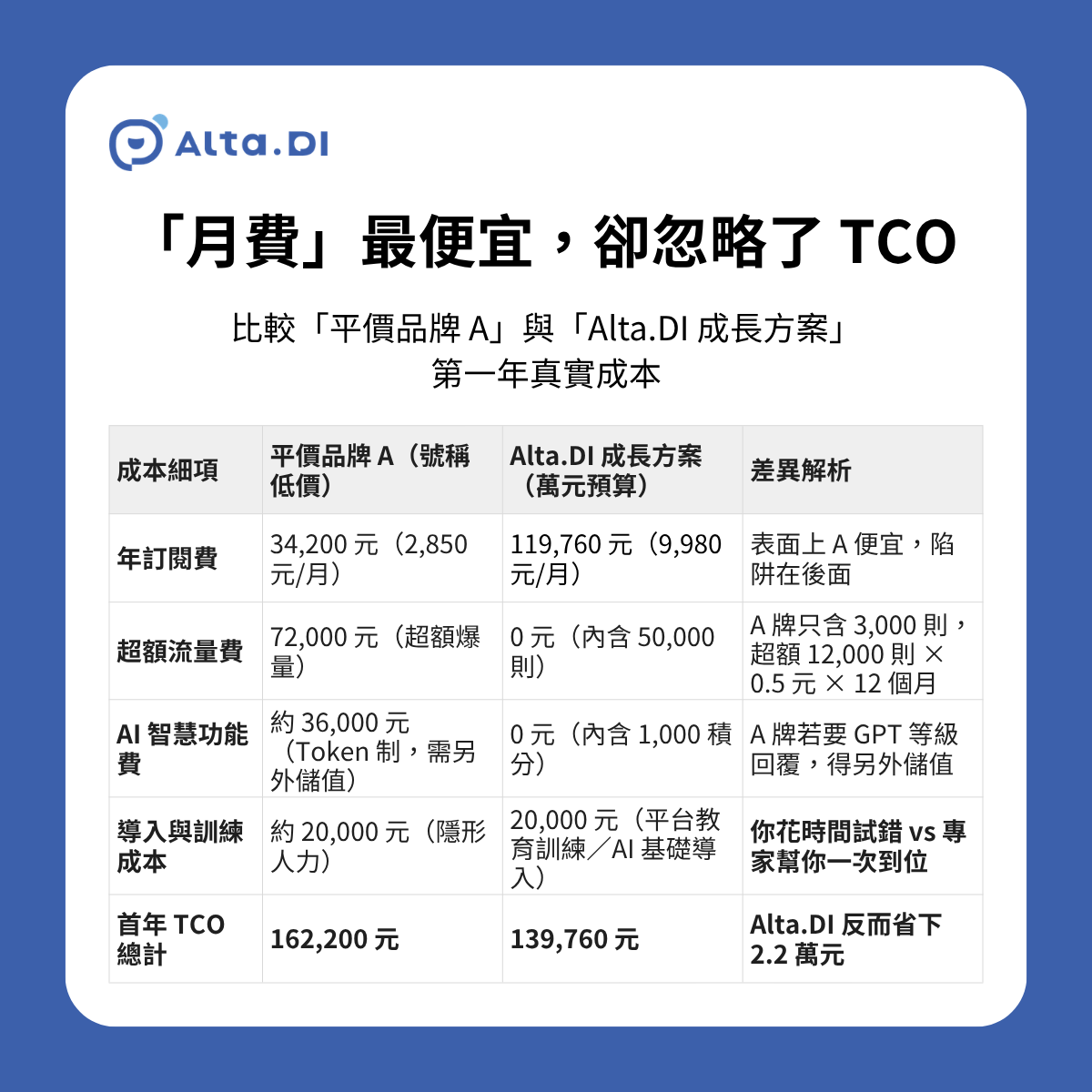
As the table shows, the monthly fee of many low-priced plans looks cheap, but once traffic fees and token fees are added, the actual cash outlay is higher. To evaluate which option has the lowest total cost among building in-house, outsourcing, or buying a platform, see our guide AI Customer Service: Build In-House vs. Buy, Fully Explained.
The more important item is the setup fee. Alta.DI's NT$20,000 setup fee covers "platform training and basic AI setup" (AI bot training plus customer service platform training), and what it buys is a higher chance of success. Competitors skip this fee, but the price is that you spend hundreds of hours of internal staff time researching it yourself, which is the most expensive hidden cost. We discuss why AI customer service adoption needs consultants working alongside you in Why AI Customer Service Adoption Needs Consultant Support.
How much does a NT$10,000 AI customer service plan earn back? ROI estimate: 137% in the first year
Labor savings plus recovered orders bring a first-year net return of 137%.
The return on the Alta.DI Growth Plan (including consultant-led setup, with a total first-year investment of about NT$140,000) comes from two sources: labor saved when AI handles about 70% of repetitive questions, and orders recovered through automatic replies at night and on holidays. For a growth-stage e-commerce company with 15,000 messages a month, first-year ROI is about 137%.
With the one-time setup fee included, ROI = (total benefit NT$332,000 - first-year investment NT$139,760) ÷ NT$139,760 × 100% ≈ 137%. From the second year there is no setup fee, so ROI only goes higher. In other words, the Alta.DI Growth Plan is not a "cost" but an "investment" with a high return.
How to choose an AI customer service plan? A 5-point checklist before you pay
If you can't answer even one of these 5 questions, don't pay yet.
Before choosing an AI customer service plan, confirm 5 things: whether the message quota includes traffic fees, whether there is an OpenAPI integration, whether there are generative AI credits, whether a human setup consultant is included, and whether there is automated tagging. If any one of them goes unanswered, you may be walking into the low-price trap.
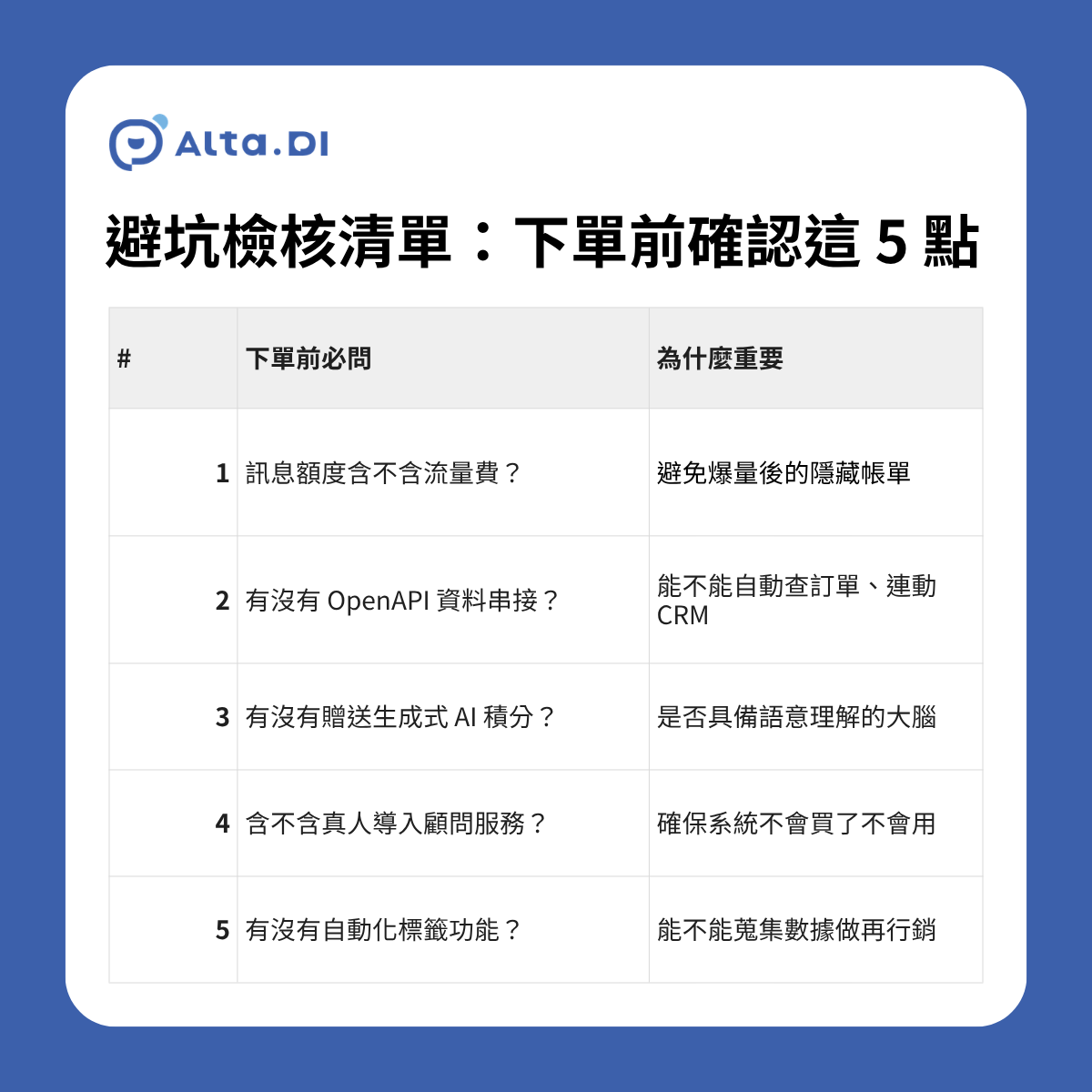
Ask every vendor these 5 questions. Only the ones that can answer "yes" to all of them deserve your budget.
Conclusion: getting it right the first time is the cheapest decision
On the road to digital transformation, the most expensive cost has never been the monthly software fee. It is "software that was bought but never used" and "customers who quietly leave." Buying the adoption success rate along with the software costs less in the long run, and that is the core value of the NT$10,000-tier Alta.DI Growth Plan.
The Alta.DI Growth Plan is designed for small and mid-sized businesses that care about efficiency. With consultant-led setup it supports putting AI into daily use, and it packs enterprise-level features into a NT$10,000 plan. It does not rely on a low-price trap. It gives you one choice that solves the problem the first time.
What can you do next?
- Book a free consultation: Based on your industry and size, we prepare a custom ROI estimate for you.
- Learn how AI credits are used: See how 1,000 credits a month can make your customer service smarter.
References

N/A
FAQ
FAQs about this article
Why is the lowest monthly fee often not the best choice when picking AI customer service?

Low-priced plans (about NT$2,000-5,000 per month) are usually positioned as "toys" that can only answer basic FAQs. These systems lack semantic understanding and data integration, tend to break on complex questions, and the hidden traffic fees and labor for maintenance (TCO) can push total spend above the cost of hiring a person. In the 2026 market, this kind of plan is regarded as a hidden killer of digital transformation.
Where is the budget sweet spot for AI customer service at a small or mid-sized business?
For small and mid-sized businesses handling 5,000 to 20,000 inquiries a month, the NT$10,000 tier (such as the Alta.DI Growth Plan at NT$9,980/month) is the most cost-effective range. This budget buys an "all-round digital employee" with a high message quota, OpenAPI data integration (such as order lookup), and a generative AI brain (AI credits), which can deliver real automation and a return on revenue.
What are the three common feature gaps in low-priced AI customer service?
No order status integration: Without an OpenAPI connection to the database, the AI can only ask customers to "wait for a person to check," so staff time is not actually freed. No semantic understanding: A system without "AI credits" can only do rigid keyword matching, cannot read conversational requests, and gives customers a poor experience. No automated tagging or data integration: It cannot automatically mark VIP or complaint-risk customers, so the company loses the data needed for precise retargeting.
What is TCO (total cost of ownership), and how does it affect the decision?
TCO includes not only the monthly fee but also traffic premiums, token fees, and the hidden cost of internal staff figuring things out on their own. Low-priced plans often make their money from expensive traffic and token fees, and without professional setup services they push companies to spend hundreds of hours of staff time on their own. The Alta.DI Growth Plan has a higher monthly fee, but it includes training and setup support from an AI manager, which helps the system succeed in practice, so total cost of ownership ends up lower over the long run.
What should I check before buying an AI customer service plan?
Does the message quota include traffic fees? (Avoids hidden bills that balloon.) Is OpenAPI data integration available? (Can it look up orders automatically and link to a CRM?) Are generative AI credits included? (Does it have a semantic understanding brain?) Is a human setup consultant service included? (Makes sure the system isn't bought and then left unused.) Is there automated tagging? (Can it collect data for retargeting?)
More articles


訂閱我們的電子報
每月 8 日定期發送最新趨勢與實用資訊!



