

How to choose an AI customer service system | Alta.DI
Why do many companies adopt AI customer service without results? Usually the AI is smart enough but the data is not organized. This article covers three criteria for choosing a system and what a system should look like to pass.


Many companies want to adopt AI customer service, but few get results. This article skips the catalog-style list of "what features Alta.DI has" and answers an earlier question: In 2026, what should you look at to decide whether an AI customer service system is worth adopting? Using Alta.DI's actual approach as the example, we walk through the three things that are easiest to overlook when choosing a system and that decide whether it succeeds: consistency across channels, whether answers have a basis, and whether the customer data behind it is clean enough.
AI customer service in 2026 is not what it was two years ago: from answering to getting things done
The Bar for AI Customer Service Has Moved from Chatting to Executing
The core capability of AI customer service in 2026 has shifted from "answering questions" to "finishing the task on the customer's behalf." This is the dividing line between generative AI (which produces content) and agentic AI (which plans and carries out tasks). Earlier chatbots could only return canned answers. Today's AI agents can understand intent, look up data, connect to systems, and complete a series of actions directly.
This shift is not marketing language. It is the current state of the market. According to Gartner's 2026 survey of CIOs and technology executives, only about 17% of organizations have actually deployed AI agents, while more than 60% expect to adopt them within two years, the most eager adoption intent among all emerging technologies [1]. Many want to do it and few have it running. That gap is exactly the pitfall this article helps you avoid.
Gartner also points out a key fact: most deployments are still limited to narrow tasks, fully autonomous AI agents are not yet suitable for most enterprise scenarios, and whether a deployment can scale depends on foundations such as data and governance, not on how smart the model is [1]. In other words, choosing AI customer service cannot be just a contest of whose AI talks better. To first sort out the difference between "can chat" and "can get things done," see our article How AI Customer Service Differs from ChatGPT.
How to choose an AI customer service system: three questions more important than the feature list
Don't be misled by the feature table. Ask these three questions first.
When choosing an AI customer service system, the real questions are not "are there enough features" but three that decide whether adoption produces results: can it give consistent answers across channels, are the answers traceable to a verifiable source, and is the customer data behind it clean enough, with a way for you to adjust things when something goes wrong. Feature lists all look about the same. These three things are what set systems apart.
We suggest this because most failed adoptions are not caused by too few features. They get stuck on one of these three points: a customer asking on LINE and on the website gets two different answers, the AI makes up a reply with no basis, or the bot gives a wrong answer and nobody knows why or can change it.
The next three sections each address one of these questions. If you want a fuller comparison for choosing a system, we also have an article, A Guide to Choosing Between FAQ, Flow, and AI Bot that you can read alongside this one. This article focuses on why these three questions matter most and what a system should look like to pass.
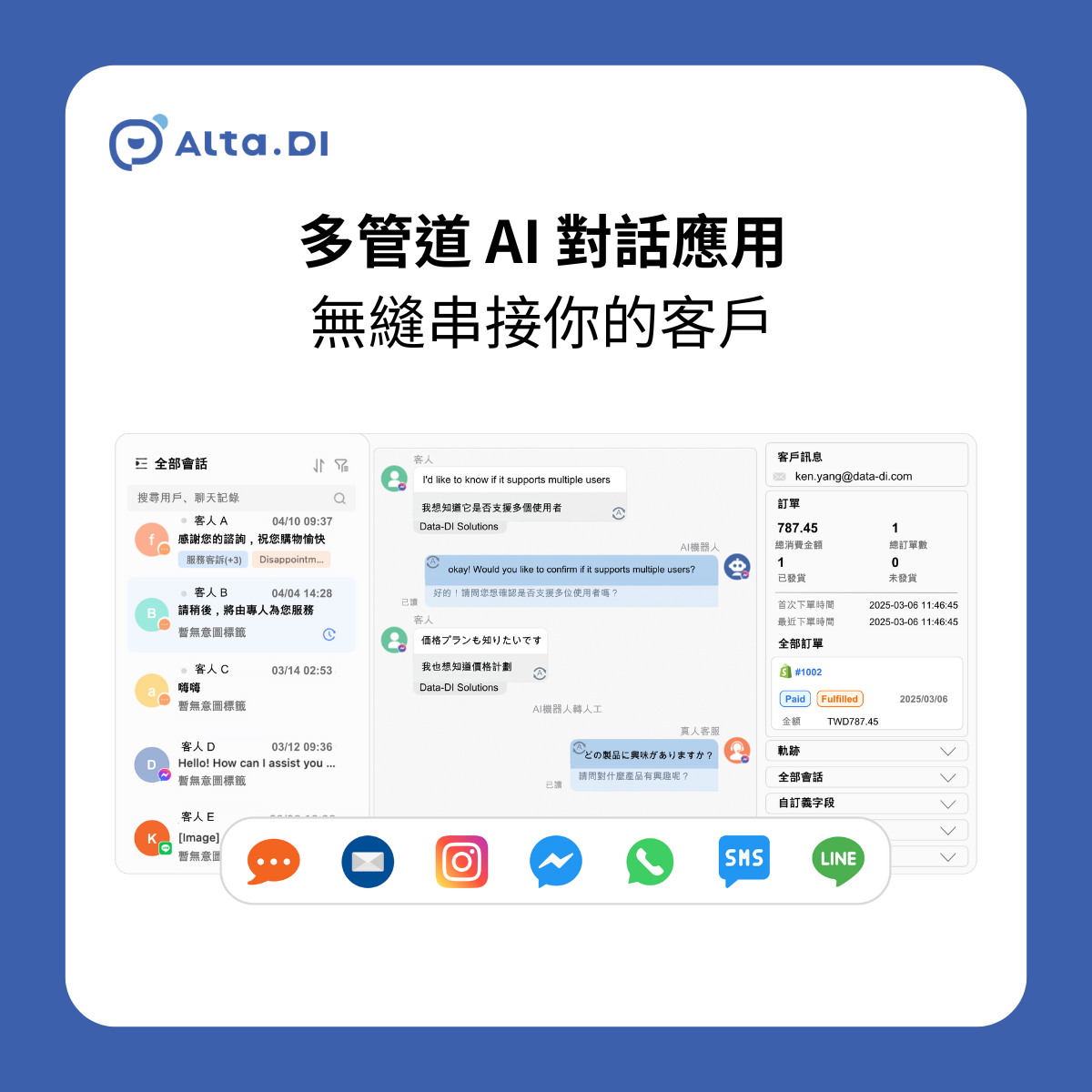
A customer asks the same thing on LINE, Facebook, or the website. Does the AI answer consistently?
Consistency across all channels keeps you from being locked into a single channel
Cross-channel consistency means that the same customer, whether they arrive from LINE, Facebook, Instagram, or website live chat, gets answers generated from the same knowledge base in the same tone. This is the baseline for AI customer service, yet it is where the most systems fall short, because the business model of many tools is tied to a single channel and stops working once you step outside it.
Alta.DI brings Livechat, LINE, FB, and IG into a single back end for unified management (WhatsApp is supported from the Advanced Plan), so the AI picks up the conversation wherever the customer comes from. Two mechanisms are worth noting:
- Store mechanism for managing multiple brands: You can set up multiple "stores" in the same back end. Each store is tied to its own combination of channels, and the bot personality and knowledge base are set independently in that store's Agent prompt area. When you run several brands, tone and knowledge do not contaminate each other.
- Reply guard mechanism: When the AI cannot find an answer, it replies with the wording you set instead of forcing out an answer. Whether the AI keeps responding while a visitor waits for a human can be switched on or off, and non-text messages such as images and videos can be handed to a human automatically.
One difference that is often overlooked is the billing logic. Marketing-oriented tools tied to the LINE ecosystem mostly bill by "message count," so the more you send, the more you pay. Alta.DI plan quotas are based on "number of contacts," so growth in service volume does not turn directly into a growing bill. To bring multiple channels into one workflow, see our Five-Step Guide to Omnichannel Integration.
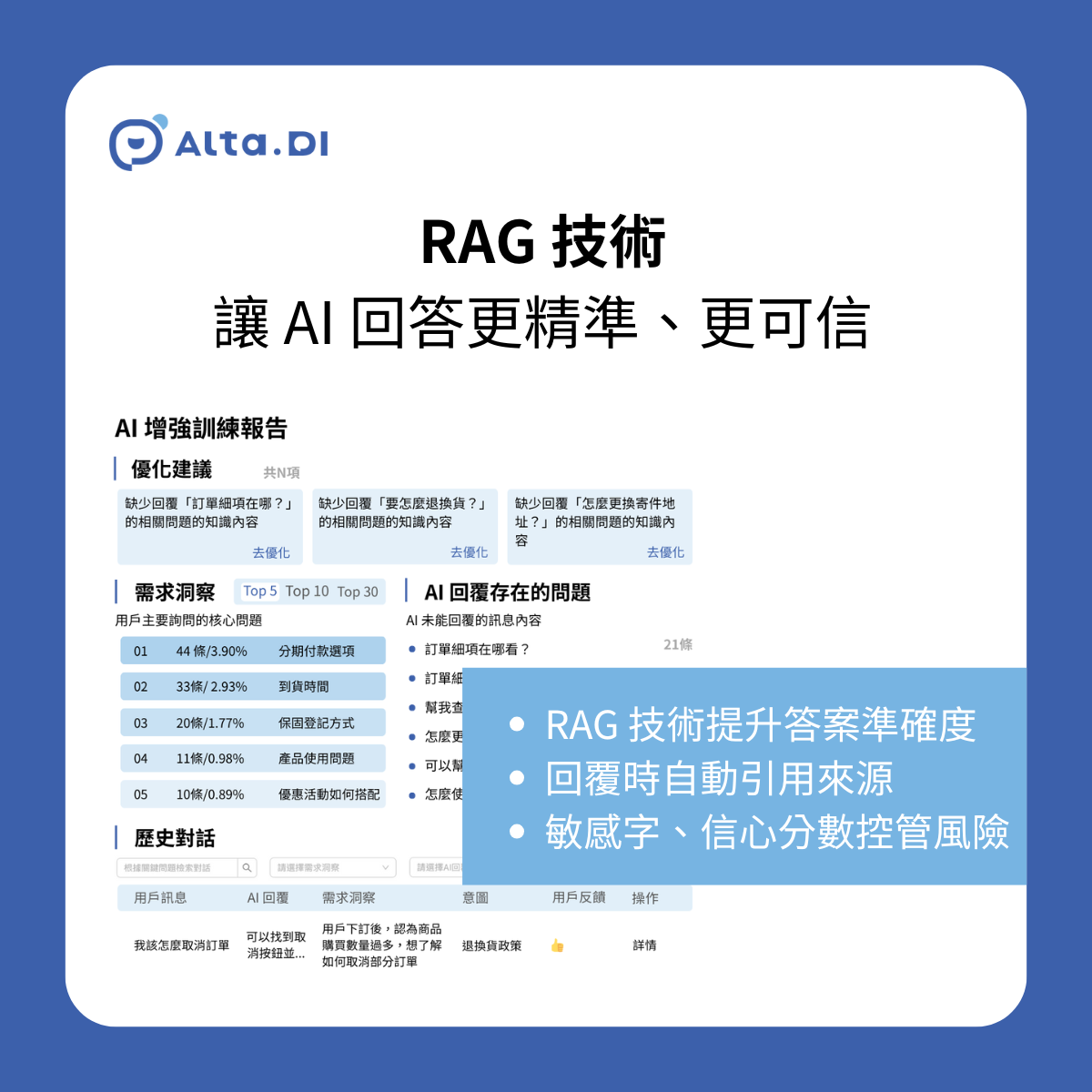
Why does AI give wrong answers? How RAG and the knowledge base keep it grounded
With sources and guardrails, the AI does not bluff
RAG (retrieval-augmented generation) is the technique that makes AI "look it up before answering." When a customer asks a question, the system first retrieves the most relevant passages from the knowledge base the company has authorized, then generates the answer from that content. This greatly reduces "hallucinations," where AI invents things from nothing. It is the technical core for judging whether AI customer service can be trusted.
In operation, Alta.DI has several mechanisms you can verify:
- Source citations: When the AI replies, it marks the documents and passages it cited, so you can check whether the answer really comes from your policy documents.
- Confidence score guard: The AI decides whether to respond based on a confidence score, and you can set sensitive words and banned terms (a feature from the Advanced Plan) to keep inappropriate content from going out.
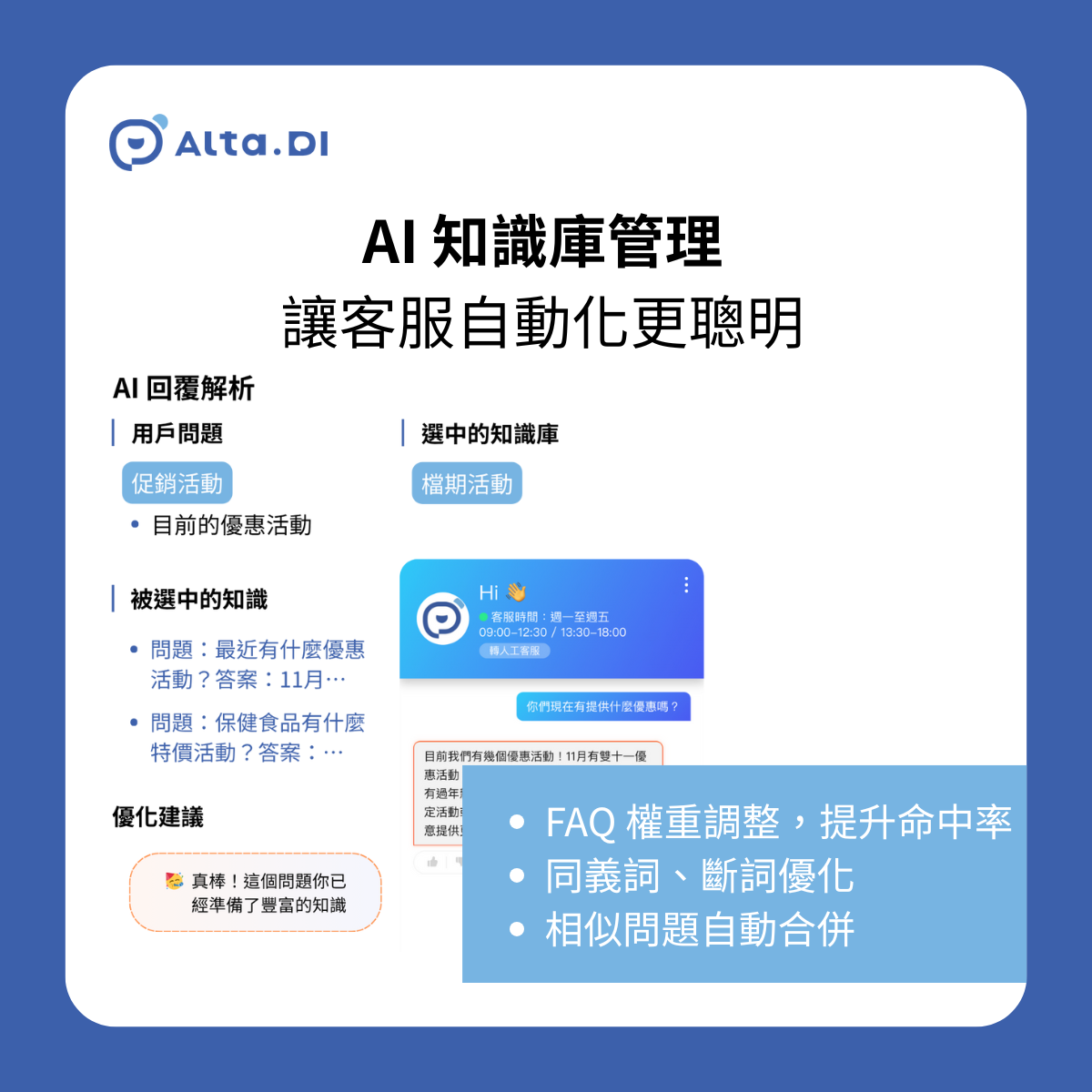
- Knowledge base tuning tools: You can raise the search weight of important FAQs, automatically merge questions that are worded differently but mean the same thing, and adjust synonyms and word segmentation for Traditional Chinese and Taiwanese usage.
These mechanisms address a very specific pain: when FAQ entries multiply and are worded inconsistently, the AI easily "picks the wrong answer." At a large travel agency we have supported, after more than 200 similar questions were merged and keywords adjusted, the AI picked wrong answers noticeably less often, and the share of conversations needing a human fell with it. For more on knowledge base and RAG setup, see RAG and Knowledge Bases in Practice.
The most common reason AI customer service adoption stalls: the AI is smart enough, but the data isn't organized
Clean data plus visible decisions is the real difference
The most common reason AI customer service adoption shows no results is not that the model is weak, but that the customer data behind it is messy and fragmented, so the AI has no reliable basis for its judgments. This matches Gartner's observation that whether a deployment can scale depends on foundations such as data, not on how smart the agent is [1]. It is also where Alta.DI differs most from most customer service tools.
Alta.DI is an AI customer service system built on a full CDP (customer data platform). This means a consumer's browsing behavior on the site is fed into the AI's context automatically, so the agent can combine it with algorithms to predict intent more accurately and trigger the matching action. This is different from tools that only handle social marketing data. Many tools on the market also talk about "data," but that is mostly a marketing data dashboard. Alta.DI's foundation is data consulting, and the difference is that the whole set of customer data is connected.
More important is whether you can see and adjust things when something goes wrong:
- Tracing visualization: Shows the full decision path by which the AI produced a given answer, including which knowledge bases it called and which tools it triggered, so "why did the bot answer wrong" is no longer a black box.
- Evaluation platform: You can upload a set of real questions for batch automated testing, using a large language model as the judge to score answers automatically on dimensions such as accuracy and relevance.
- Insight: The AI automatically compiles customer feedback and generates a VOC (voice of customer) analysis report with one click.
Behind these capabilities is something easily mistaken for an adjective: consultants. Some tools on the market give a software feature the name "AI consultant," but Alta.DI's consultants are real strategy consultants who work alongside you through a five-week, three-phase setup, from needs diagnosis and data inventory to module configuration, testing and validation, and post-launch tuning. According to field data from the platform provider's work with cross-border brands, companies that adopt this integrated architecture reach an AI automatic resolution rate of up to 77.6% and cut human handling volume by more than 65%. In a logistics consolidation case, the AI also took on about 75% of repetitive inquiries. To understand why adoption needs consultants, see Why AI Customer Service Adoption Needs Consultant Support.
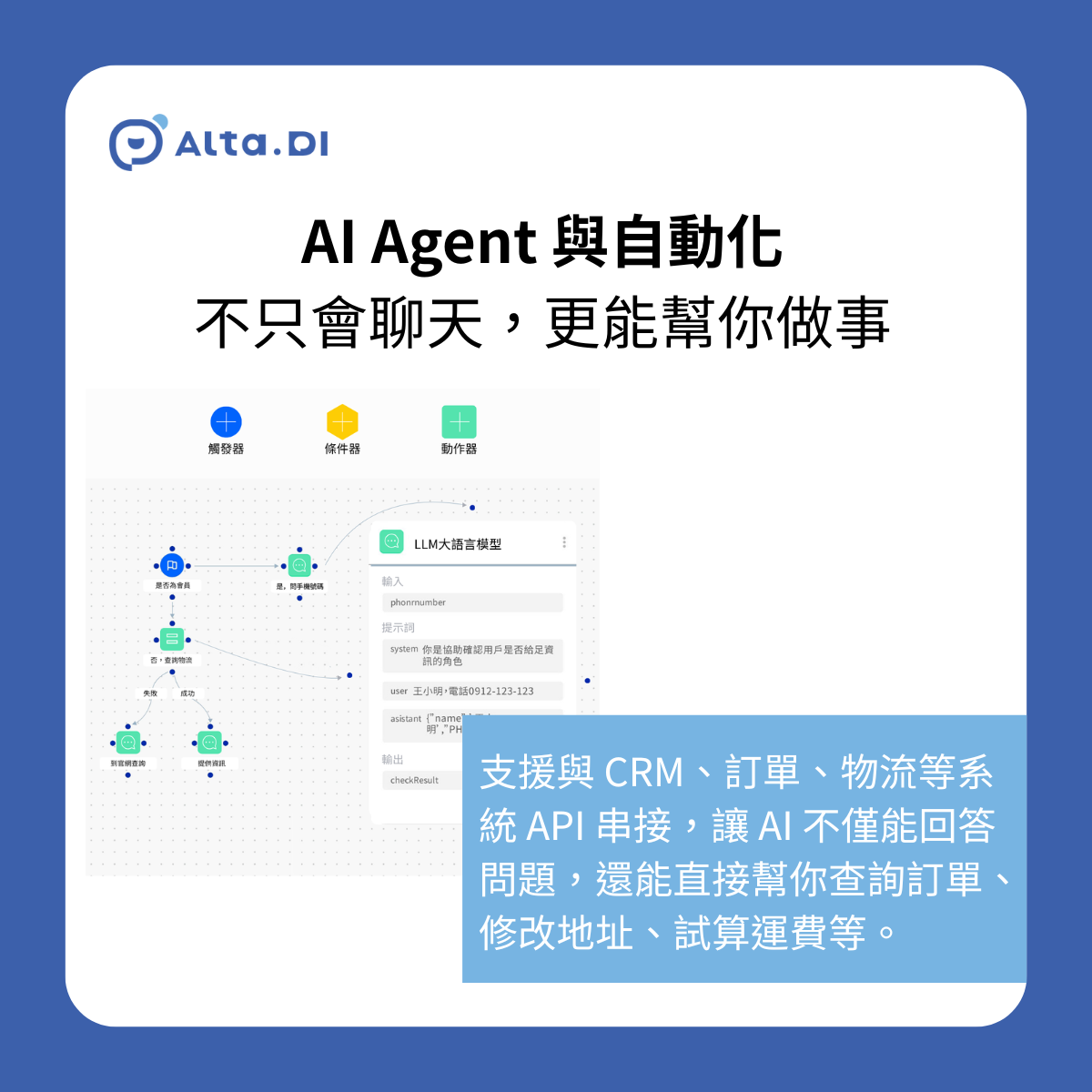
Chatting is not enough: can AI customer service actually finish the job for the customer?
An agent looks things up and gets things done
AI customer service that gets things done does more than answer questions. It finishes the task for the customer: checking order progress, helping with returns and exchanges, and triggering follow-up actions, rather than ending with "please contact a human agent." This is the biggest dividing line between a chatbot and an AI agent.
Specifically, Alta.DI connects to e-commerce platform order data through its OpenAPI data integration (included from the Advanced Plan). When a customer types "check order status" in the chat window, the AI replies with the progress directly, with no wait for a human. Note that the OpenAPI supports integration with e-commerce platforms and existing systems by default. If you need to connect your own custom system, the scope has to be assessed together with consultants, rather than "any database connects directly." Be sure to ask about this when choosing a system, so you don't find a gap only after adoption.
Besides order lookup, the platform also provides agents with divided roles: a chat agent that handles repetitive inquiries automatically, an email agent that helps expand and polish drafts, an after-sales agent dedicated to returns, exchanges, and troubleshooting, and a Voice Agent that can place outbound follow-up and notification calls. This means the AI does not hand problems back to a human but carries the customer's need through to the end.
Conclusion: find out where you're stuck before talking about adoption
For AI customer service in 2026, the question is no longer "whether to adopt" but "how to adopt without wasting money." Back to the three criteria in this article: can it stay consistent across channels, do the answers have a basis, and is the data clean, with errors visible when they happen. A system that passes all three is worth your investment.
Every company gets stuck in a different place: some on multichannel data integration, some on a messy knowledge base, some on being unable to measure results after adoption. If you want to find out where your customer service process is stuck, Data-DI offers a free 30-minute AI customer service diagnosis. Our consultants review your current service process, existing tool setup, and quick wins that can be improved, and give recommendations for your situation. You don't need to prepare data in advance. Just tell us which tools you use and what your situation is.
References

[1] Gartner. (2026). What the 2026 Hype Cycle for Agentic AI Reveals. Gartner. https://www.gartner.com/en/articles/hype-cycle-for-agentic-ai
FAQ
FAQs about this article
How is Alta.DI different from an ordinary AI chatbot?

An ordinary chatbot can only answer questions, while Alta.DI can carry out tasks. It connects to e-commerce platform order data through OpenAPI so the AI can look up orders and help with returns and exchanges directly, instead of passing customers to a human. The core difference is "gets things done," not just "can chat."
How does RAG solve the problem of AI giving wrong answers?
RAG lets the AI first retrieve the most relevant passages from the company's authorized knowledge base and then generate an answer from them, which greatly reduces invented content. Alta.DI attaches the source document and passage to its replies for checking, decides whether to respond based on a confidence score, and does not force an answer when it cannot find one.
Can AI customer service serve LINE, Facebook, and the website at the same time?
Yes. Alta.DI brings Livechat, LINE, FB, and IG into a single back end (WhatsApp is supported from the Advanced Plan). The same customer gets answers from the same knowledge base in a consistent tone no matter which channel they come from, and the customer service team does not need to handle each platform separately.
Why do many companies adopt AI customer service without results?
The most common reason is not that the AI isn't smart enough, but that the customer data behind it is messy and the AI has no reliable basis. Gartner also points out that whether a deployment can scale depends on foundations such as data. Alta.DI is built on a full CDP customer data platform and offers consultant-led adoption to cover this gap.
After adopting Alta.DI, how do I know whether the AI is doing the right thing?
Alta.DI provides Tracing visualization, which shows the full decision path behind each answer, and an Evaluation platform where you can upload a set of real questions for batch testing with automatic scoring. When the bot gives a wrong answer, you can see the cause and adjust it, so it is not a black box.
More articles


訂閱我們的電子報
每月 8 日定期發送最新趨勢與實用資訊!



