

Why AI customer service adoption needs a consultant | Alta.DI
80% of AI customer service rollouts fail to deliver results, mostly because management signs off while the front line cannot use the tool. This article covers eight hurdles, plan-tier differences and a roadmap with 2026 data, and you can book a free adoption diagnostic.


Why bring in a consultant to adopt AI customer service? Because it is an operating-system overhaul, not software that runs by itself once you buy it. A consultant's job is to connect technology, data, workflows, KPIs and team adoption into one line, so you actually get from "trial" to "something you can run long term."
E-commerce and brand websites feel this most (promotions change daily, there are many channels and peak seasons swing widely), but it is really a hurdle shared by every company adopting AI customer service. What separates companies is not who bought which tool, but who actually got it into use.
And where most companies get stuck is often not technology but the same scene. The boss finally approves the budget and the system goes live. Three months later, the front-line agents either cannot use it or simply bypass it and reply on their own. Money was spent, no work was saved, and at the year-end review it becomes the project people ask about with "why did we buy this in the first place?"
Why do most AI customer service rollouts fail? Mostly "we bought the system, but nobody actually uses it"
When AI customer service adoption fails, in more than eight cases out of ten the cause is not the model or the technology, but data, workflows and people's adoption not coming together. In "The GenAI Divide: State of AI in Business 2025," MIT Project NANDA found that about 95% of organizations see no measurable profit-and-loss contribution from their generative AI pilots, and only about 5% have scaled the value [1]. RAND research also notes that more than 80% of AI projects fail to deliver their intended business results [2]. An S&P Global enterprise survey shows that 42% of companies abandoned most of their AI projects in 2025, a sharp jump from 17% the year before [3].
The gap is not in "whether you use AI" but in "whether you have made it operational." McKinsey's global survey shows the same split: 88% of companies have adopted AI in at least one business function, but only 39% see a real effect on the bottom line [4].
In customer service, the split has a more concrete face: a training gap. According to Zendesk's "CX Trends 2026," 72% of customer service leaders believe the company has provided enough training for generative AI tools, yet 55% of front-line agents say they "have not received any training at all." Only 45% say they have been trained, and of those only 21% are satisfied with the quality of the training. More tellingly, only 34% of agents truly understand the company's AI strategy, while 65% say "more training" is what would best help them do their jobs [5].
In the "boss pays, staff cannot use it" pattern, the people who sign off (the senior executives who hold the budget) assume training is taken care of, while the people handling conversations every day feel the tool is not in place and nobody taught them. When the front line loses trust in AI, they bypass it and go back to the old methods, and the system starts to gather dust. This is not a technical failure. Nobody walked the last mile of adoption alongside them. A consultant's value is to connect that line: not to teach you which button to press, but to help you produce ROI.
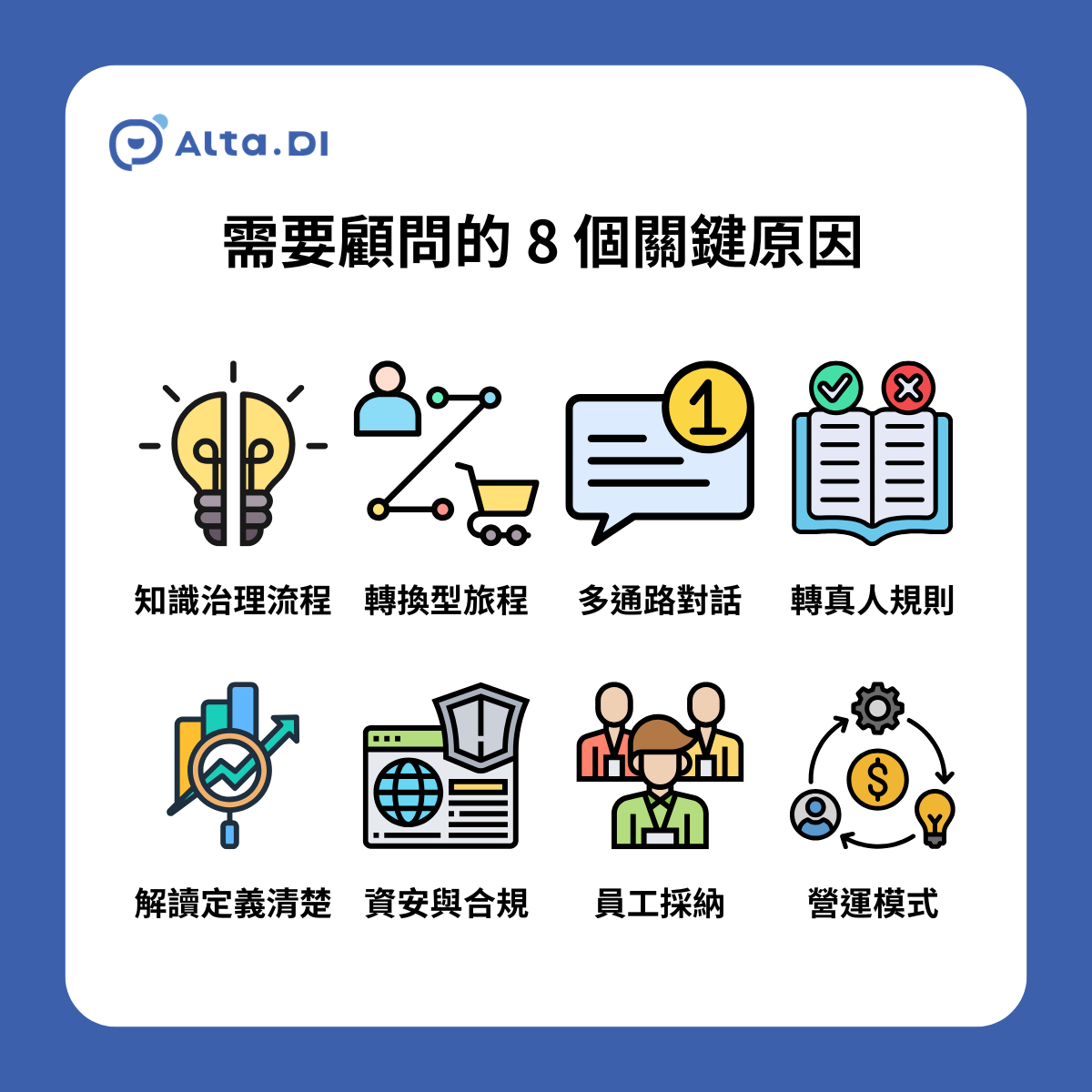
Why do companies adopting AI customer service especially need a consultant?
Because AI customer service succeeds through a full methodology (knowledge, workflow, escalation, human-AI collaboration, measurement and training), not luck. The "basics that are easy to get wrong" below are exactly what a consultant helps you lay down first. E-commerce websites are where these problems concentrate, and they apply equally to companies in other industries.
1. Knowledge changes fast: once a rule changes, the AI answers wrong
The first place AI customer service loses accuracy is where knowledge cannot keep up with how fast the business changes. Free-shipping thresholds, discount codes, pre-order shipping and return exceptions change almost daily in e-commerce, and outdated, fragmented knowledge is the most underestimated obstacle [6]. Inconsistent data quality also makes it hard to monitor model performance steadily [7].
A consultant helps you build a "maintainable" knowledge mechanism: which rules need a single authoritative version, how campaign pages and the customer service SOP stay in sync, and who signs off after content is updated. In Alta.DI, the knowledge base supports multiple document formats and website content import, but the consultant has to get the "knowledge governance process" right first so the AI can keep up with your pace.
2. Answers at the service entry point directly affect orders and returns
Every answer customer service gives affects whether the customer buys and whether they return. The common questions on e-commerce and brand websites are usually "Is this right for me, when will it arrive, can I return it?" A precise answer closes the sale, and a vague one loses it.
A consultant designs AI adoption around "conversion journeys": product comparison and delivery expectations for new customers, order lookup and address changes for those who have ordered, and returns, exchanges and warranty after the sale. In Alta.DI, Flow Bot can configure scenarios so visitors click to trigger a fixed flow. This suits high-value conversion paths that must stay under control, and lowers the risk of the AI improvising. Order lookup connects to the order data of your e-commerce platform, and the scope of that integration depends on your platform and plan; the consultant will confirm it with you first.
3. High message volume across channels: without integration, messages will be missed
When the same customer messages through the website, LINE and Instagram at once, and customer service cannot see the context, the experience falls apart immediately [8].
A consultant helps you set "channel priorities" and a "same-person identification strategy," and builds a cross-channel SOP. In Alta.DI, the workspace integrates mainstream channels such as LiveChat, LINE, Instagram and Facebook Messenger (WhatsApp starts from the Professional plan), and together with the 360-degree customer profile it brings conversations scattered everywhere into one service thread.
4. Escalation design is the lifeline: if it is not set up well, you get either overload or complaints
If the rule for "when should AI hand over to a human" is not set well, either human agents are buried in pointless conversations or customers sink deeper into complex problems. The most common situation after go-live is a surge in handoffs to humans and agents losing trust in the AI [9]. The worst experience is neither pure AI nor pure human, but "the AI takes it first and hands it to a human only after getting stuck." The customer has to explain everything again, and satisfaction drops sharply.
A consultant writes the escalation rules as executable routing: always escalate (refund disputes, payments, legal commitments), ask first and then decide (missing order number or delivery details), and a handoff format (summary, sentiment, solutions already tried, next step). In Alta.DI, intent triggers can hand over to a human under specific intents, and from the Professional plan, AI conversation tags can automatically label sentiment and business type so agents handle high-risk conversations first.
5. Unclear KPIs: adoption will "feel effective" but fail to show ROI
Without clear KPIs you can reconcile, adoption ends up as "feels effective." This is also one of the core failure causes that studies repeatedly identify [10]. A consultant will usually help you define a set of metrics you can track and reconcile, in three dimensions:
- Cost: hours saved per month, customer service cost per order, human workload
- Service: first response time (FRT), first contact resolution (FCR), CSAT, human handoff rate, complaint rate
- Revenue: conversion rate from conversational selling, cart-abandonment recovery, GMV
In Alta.DI, the analytics and CDP modules cover chat analysis, AI Agent analysis and marketing campaign ROI. The consultant's value is to define clearly which metrics you should watch and how to read them, so you avoid a pile of reports that makes decisions more confused.
6. Security and compliance: personal data and payment information, so the later you fix it the more it hurts
Whenever customer service handles personal data, orders and payment information, data protection and compliance are often-underestimated landmines [11], and one of the key sources of resistance when pushing AI customer service forward [9].
A consultant helps you set up minimum governance: what information the AI must not record or reply with (such as full credit card or national ID numbers), who can edit knowledge, who can see conversations (permissions and audit), and a risk-response strategy for uncertain cases (guide the customer to the correct process instead of forcing an answer). In Alta.DI, the back end supports role permissions and organization management, and the consultant can set up the permission matrix and audit process first.
7. Staff adoption: if agents do not trust AI, they will bypass it
This is exactly the core of "bought it but nobody uses it" above. The Zendesk numbers above are clear: the training gap is not a small matter but the line that decides whether adoption succeeds [5]. If AI is treated as a one-time cost-cutting project, the result is often that it cannot scale, staff do not trust it and the experience gets worse [12].
A consultant provides practical training and SOPs: when to let the AI answer first, how to give feedback when it answers wrong, and how a new hire gets up to speed within a week. In Alta.DI, real-time translation in more than 50 languages, customer profiles and (from the Professional plan) AI tags only make agents feel "this saves me time" when a consultant practices alongside them, rather than being one more system to learn.
How do the consulting and adoption services in the Professional plan make adoption "more solid"?
If what you fear is exactly "the boss approved the purchase, but the front line cannot use it," then what to look at is not only the monthly fee but whether the plan includes adoption and training. This is layered across the plan tiers:
- Growth plan: Platform training and basic AI setup are available as an add-on (a one-time adoption fee that covers AI bot training and customer service platform training). It suits companies whose teams already know the tools and only need the platform itself.
- Professional plan: Platform training and basic AI setup are included, along with OpenAPI data integration and enhanced AI training. From this tier on, adoption and training are not extras but part of the plan itself, which speaks directly to the pain point of "don't leave the front line untaught."
- Enterprise plan: Includes a dedicated customer success manager and a dedicated consultant service. It suits organizations with complex processes, multiple departments and a need for long-term support from consultants alongside them.
There is also an "AI consulting service" layer (including Flow workflow setup and post-launch AI operations), available as an add-on to Growth and Professional and included in Enterprise. This corresponds to points 2 and 4 in this article: conversion paths and escalation routing need someone to design them for you, rather than leaving the front line to figure them out alone.
Adoption itself does not end once the system is switched on. Alta.DI's adoption timeline is about 5 weeks in three phases, with consultants working alongside you: the early phase covers needs diagnosis and scenario alignment, the middle phase covers module configuration, knowledge base building and AI training, and the late phase covers the official launch and performance improvement. After launch, the Alta.DI team provides technical support and regularly helps review the data and make improvement suggestions. Those 5 weeks are the timeline for "getting the system live stably." To reach an ROI you can reconcile, you usually need the longer roadmap below.
If you are comparing different plans, you can also read our guide The Hidden Pitfalls of Budget AI Customer Service and How to Choose a Plan, to separate "cheap" from "actually usable."
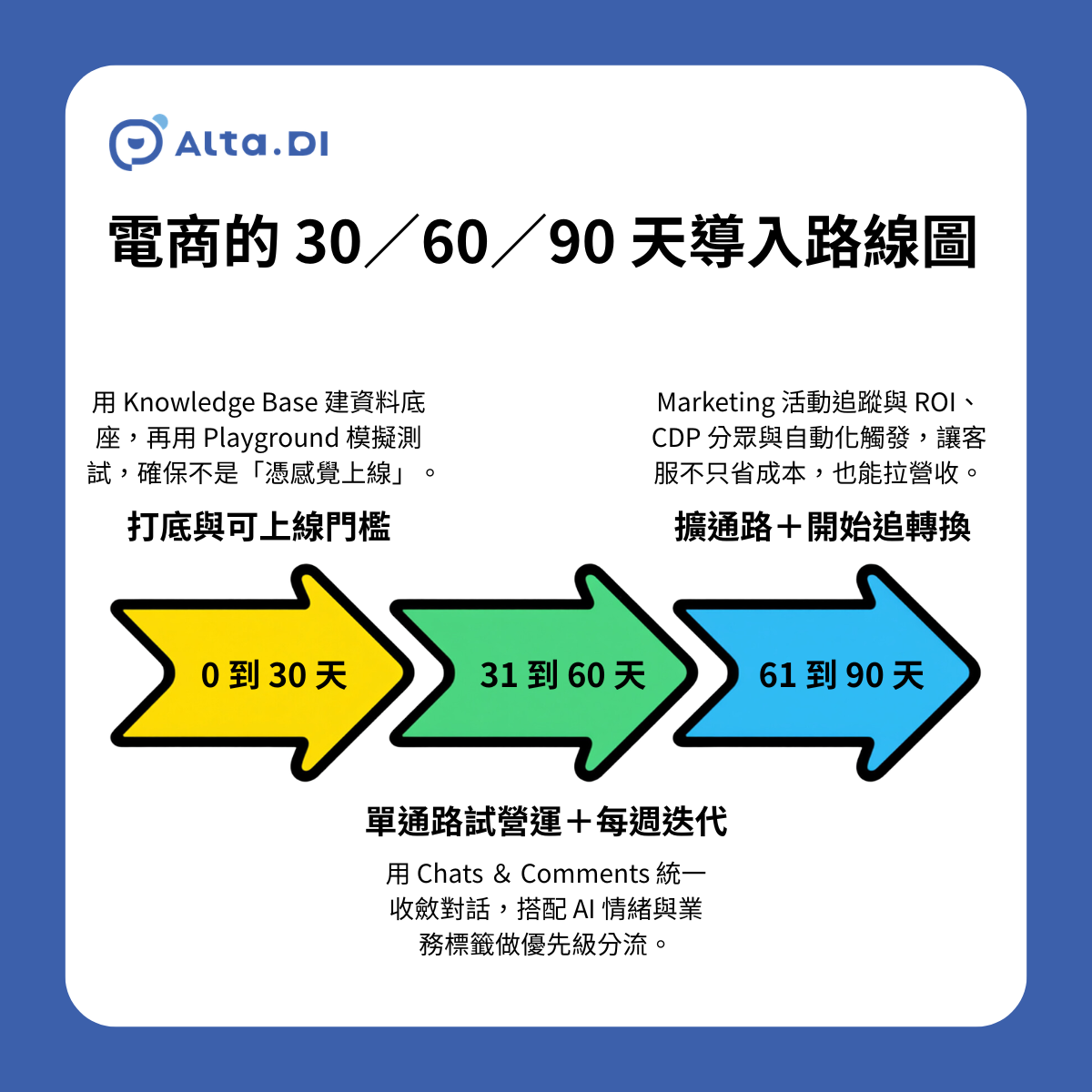
A 30/60/90-day AI customer service adoption roadmap
To take AI customer service from "live" to "delivering ROI," we recommend moving forward in three stages of 30/60/90 days, each with clear outputs and metrics to observe.
Days 0 to 30: Groundwork and the go-live threshold
Define KPIs (FRT, FCR, CSAT, human handoff rate), build the knowledge base (policies, shipping, returns and exchanges, campaign rules), define escalation rules (a list of high-risk intents and the handoff format), and run pre-launch acceptance testing (a sample of at least 30 to 50 scenario questions). In Alta.DI, build the data foundation with the knowledge base, then run simulated tests in AI Playground so you do not go live "on gut feeling."
Days 31 to 60: Single-channel pilot with weekly iteration
Launch on either the website or LINE first and observe the error types (missing knowledge, wrong routing, too few clarifying questions, inconsistent tone). Set a weekly meeting rhythm to keep adding knowledge and tuning intents, and train agents on the takeover SOP and feedback process. In Alta.DI, bring conversations into the unified workspace and use AI sentiment and business tags to prioritize routing.
Days 61 to 90: Expand channels and start tracking conversion
Expand to high-volume channels such as Instagram, Facebook and WhatsApp, add Flow Bot scenarios (product recommendations, return flows), connect marketing (abandoned-cart recall, coupon push) and set up a monthly report that presents CSAT alongside cost and conversion to management. In Alta.DI, marketing campaign tracking and ROI, CDP segmentation and automated triggers let customer service not only save cost but also drive revenue.
How to choose an AI customer service adoption consultant so you are not "bought and abandoned"
When choosing a consultant, check them in reverse with these 3 questions to filter out partners who are "responsible only for go-live, not for results":
- Can they provide a risk list and metrics to watch for "the first 2 weeks after launch"? (Not just how to go live) [13]
- Can they give you executable escalation rules and a table of high-risk intents? [9]
- Can they connect customer service metrics to your revenue metrics (for example cart-abandonment recovery and GMV)?
Taking Alta.DI adoption as an example, we suggest focusing consultant time on three key points: pre-launch acceptance, fixes in the two weeks after launch and building the first ROI report. These three tend to matter most. If you want to evaluate delivery quality more systematically, you can also read A Selection Guide to FAQ, Flow and AI Bot for AI Customer Serviceand clarify your needs first.
Conclusion: AI customer service succeeds through methodology, not luck
Data from MIT, RAND and Zendesk all point to the same thing: to get results from AI customer service, you have to design it as an "end-to-end operating system" covering knowledge, workflow, escalation, human-AI collaboration, governance, measurement and training. The part most easily left out is "making sure the front line can actually use it."
Alta.DI is a channel-agnostic AI customer service platform, covering all channels and all data, so service is wherever your customers are. Data-DI's role is to work alongside you from strategy to deployment and see this through, so the budget you worked hard to get approved does not become a project nobody mentions three months later. To find out which stage your adoption is stuck at, you are welcome to book a free adoption diagnostic , or take a look first at how the Alta.DI platform can handle your customer service scenarios. For more on this topic, browse our AI customer service article series.
References

[1] MIT Project NANDA.(2025)。The GenAI Divide: State of AI in Business 2025. MIT NANDA Initiative.
https://nanda.media.mit.edu/
[2] RAND Corporation.(2024)。The Root Causes of Failure for Artificial Intelligence Projects. RAND.
https://www.rand.org/pubs/research_reports/RRA2680-1.html
[3] S&P Global Market Intelligence. (2025). Voice of the Enterprise: AI & Machine Learning 2025. (cited from CIO Dive)
https://www.ciodive.com/news/AI-project-fail-data-SPGlobal/742590/
[4] McKinsey & Company.(2025)。The State of AI: Global Survey 2025. McKinsey QuantumBlack.
https://www.mckinsey.com/capabilities/quantumblack/our-insights/the-state-of-ai
[5] Zendesk.(2026)。AI Customer Service Statistics(CX Trends 2026). Zendesk Blog.
https://www.zendesk.com/blog/ai-customer-service-statistics/
[6] CobbAI.(2025)。AI Customer Service Challenges. CobbAI Blog.
https://cobbai.com/blog/ai-customer-service-challenges
[7] Dixa.(2024)。7 Common Challenges When Implementing AI in Customer Service. Dixa.
https://www.dixa.com/ebooks-and-reports/7-common-challenges-when-implementing-ai-in-customer-service
[8] Chatarmin.(2024)。Challenges of AI in Customer Service. Chatarmin Blog.
https://chatarmin.com/en/blog/challenges-of-ai-in-customer-service
[9] Ema.(2025)。Challenges of AI Agent in Customer Support. Ema.
https://www.ema.co/additional-blogs/addition-blogs/challenges-ai-agent-challenge-customer-support
[10] AIDesk.(2025)。AI Customer Support Implementation Roadmap 2025: Avoid Failures. AIDesk Blog.
https://aidesk.us/blog/ai-customer-support-implementation-roadmap-2025-avoid-failures
[11] Bluetweak.(2026)。Implementing AI Customer Support: Challenges. Bluetweak Blog.
https://bluetweak.com/blog/implementing-ai-customer-support-challenges/
[12] McKinsey & Company.(2025)。Building Trust: How Customer Care Leaders Pull Ahead with AI. McKinsey.
https://www.mckinsey.com/capabilities/operations/our-insights
[13] Fin AI.(2025)。Implementing AI Customer Service. Fin AI.
https://fin.ai/learn/implementing-ai-customer-service
FAQ
FAQs about this article
Why is the failure rate of AI customer service projects so high?

Research shows that more than 80% of AI projects fail to deliver the results they were expected to, and the cause is usually not technology but "going live too fast, messy data, workflows not redesigned, and nobody who actually knows how to use it." A consultant's value is to treat it as an operating-system overhaul and get the basics right first.
How do we fix "we bought the system but nobody uses it"?
Start with training and adoption design. A Zendesk survey shows a large gap between managers and the front line in their perception of whether training happened, which leads agents to bypass the AI. The fix is a clear usage SOP, a feedback mechanism and an onboarding process for new hires, so the front line actually trusts and uses it.
What is the difference between the Alta.DI Growth and Professional plans in adoption support?
The difference is whether adoption and training are an add-on or included. In the Growth plan, platform training and basic AI setup are purchased separately. The Professional plan includes training and also supports OpenAPI and enhanced AI training, which suits teams worried the front line will not learn the tool.
How long does it take to adopt an AI customer service system?
About 5 weeks to get the system live stably, in three phases (needs diagnosis, module configuration and training, official launch) with consultants working alongside you. To reach an ROI you can reconcile, we suggest moving on in 30/60/90-day stages, from groundwork and pilot to expanding channels and tracking conversion.
How should we choose an AI customer service adoption consultant?
Check them in reverse with three questions: Can they provide a risk list and metrics for the two weeks after launch? Can they give executable escalation rules and a table of high-risk intents? Can they connect customer service metrics to revenue metrics? A consultant who can do these will stay with you until you see results.
More articles


訂閱我們的電子報
每月 8 日定期發送最新趨勢與實用資訊!



