

What is an FDE? How Taiwan companies can apply the trend
How does an FDE help companies take AI from requirements into daily work? Using a Data-DI manufacturing quotation case, this article explains FDE duties, three approaches for Taiwanese companies and how to prepare before a consultation.


Why does one cable quotation go back and forth between sales and engineering three to five times?
The customer sends a drawing. Sales first passes it to an engineer to interpret safety standards such as UL and VDE, then looks up components and calculates the BOM. After engineering finishes the calculation, sales still has to enter the data item by item into the CRM to create a cost sheet. If the customer changes the specification, the whole route runs again.
This was the everyday quotation routine at Muzi, a manufacturer of electronic wire and connectors. Colleagues spent each day moving data and waiting for replies. The main obstacle was that safety-standard knowledge, component costs and customer data were scattered across engineering experience, Excel and the CRM.
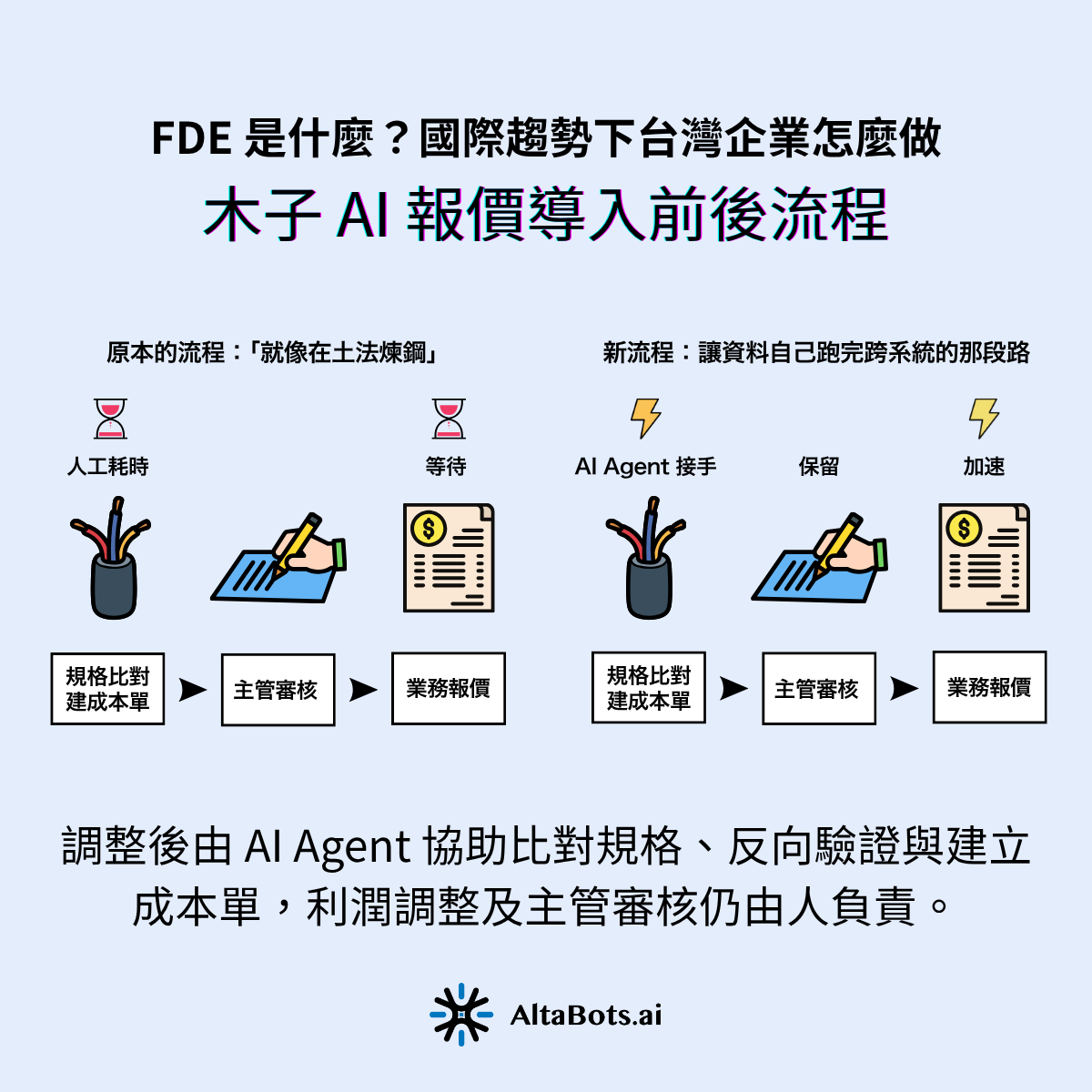
Data-DI did not first plan an AI system that does everything. Together with Muzi we picked one segment: "automatically creating the CRM cost sheet after the BOM stage". The IT manager prepared the CRM's API documentation, engineering organized safety-standard knowledge and the calculation rules for different materials, and the AI Agent then read the data, compared specifications, ran reverse verification and created the cost sheet. The profit margin and manager review are still decided by people.
According to the records from before and after the Muzi project, quotation generation time dropped to under two minutes, the round-trip time between sales and engineering fell by about 80%, and the manual entry error rate went from 20% to close to zero. These are Muzi's results in a specific process and do not mean every company will get the same numbers. Only after the customer had actually used the feature did they know what they wanted to solve next. The scope of cooperation therefore grew from a quotation assistant into a dedicated workstation that fits internal processes, and then added an assistant that can handle multiple tasks.
We did not use the name FDE at the time, but the way of working was already close: the engineering role took part directly in the customer's working situation, solved one specific problem first, stayed alongside the system as it entered daily work, and kept revising it based on usage records and feedback from the floor.
This engineering approach of starting from one task and revising after use is the main difference between an FDE (Forward Deployed Engineer) and one-off delivery.
What is an FDE? A job title alone does not tell you the duties
An FDE usually takes part in problem judgment, software development, system deployment and post-use revision all at once. This set of responsibilities can be carried by one engineer or shared by a fixed working group. The work does not stop at handing over requirements, giving a demo or acceptance. Once the system is in use, someone must also handle the new ways of asking, exception rules and data gaps that appear.
At some companies, PMs, FAEs or software engineers already discuss problems directly with customers, modify live systems and watch how they are used afterward, so their work may overlap heavily with an FDE's. If the work still stops at handing over requirements and coordinating schedules, switching to the FDE title changes nothing about how the collaboration works.
A company can use four questions to judge whether the current collaboration has the traits of an FDE:
- Who decides with frontline users which task to handle first?
- Who can modify the live system based on feedback from the floor?
- Who looks at the logs and errors once the system is in use?
- Who leaves the rules, integration methods and evaluation methods learned this time for the next use?
If these four things are spread across different roles, every change has to re-explain the background. In that case the company first needs to connect the responsibilities, and whether to create a separate job title can be decided later.
Why are OpenAI, Microsoft and AWS all starting to talk about FDE?
In recent years international AI companies have made frequent moves, and FDE has gone from an internal role at a few software companies to being written into formal enterprise services.
- OpenAI has included FDEs in the OpenAI Deployment Company, which starts by co-developing from the customer's specific problem and, after validating results, organizes reusable methods. [1]
- Microsoft set up the Frontier Company in 2026, extending existing FDE practice so that industry and engineering experts go into companies to co-design, deploy and continuously improve AI systems. [2]
- AWS set up a dedicated Forward Deployed Engineering organization and organizes domain knowledge, evaluation methods and system components into assets that can be reused later. [3]
Looking at the three approaches together, in each case engineers deal directly with business problems, enterprise data, code and live results. As model capability keeps changing, companies actually spend much of their time on two things: "what exactly to use AI for" and "how to revise it after first use".
Even though large AI companies are institutionalizing this kind of engineering service, that does not mean FDE has become widespread, and it certainly does not mean every company should now add this job opening. What Taiwanese companies should confirm first is whether their existing way of working can take on the needs that appear after use.
Why can't an AI project finish asking about requirements at the start?
Consultant interviews, system integration, PM management and acceptance in traditional projects are still important. They give budget, responsibility, security and schedule clear boundaries. What an AI project adds is the difficulty that many requirements do not yet exist at the first interview.
Take Muzi's quotation process as an example. Only after work began could we see the differences in drawing formats, exceptions in safety-standard interpretation, the calculation method each material should follow, and which decisions must be left to managers. These situations appear only after the system meets real data and cannot be fully asked about in the first interview.
We organize this change into "three confirmations":
The three confirmations give each round of discussion real data to look at, and they do not require three extra rounds of meetings. If an engineering role only receives a change request, it usually sees only "what to change". An FDE who stays involved also learns why the user wants the change and whether this change will affect the steps before and after.
In November 2024 the Market Intelligence & Consulting Institute (MIC) surveyed 316 business leaders and main-department staff at Taiwan's electronics and information manufacturers. Among respondents whose companies were already putting AI into practice, 80% faced data-related challenges. MIC also noted that whether data is usable often only shows once execution begins, and companies should first confirm the application scenario, then identify the gap between existing data and requirements. [4]
What can Taiwanese companies do without hiring a full-time FDE?
FDE is a set of responsibilities that someone must carry, not necessarily a job opening to post right now. Depending on the number of AI tasks running at once, internal engineering capability and data constraints, a company can choose among three approaches:
If there is currently only one task to validate, having a project-based role follow it from requirements confirmation through live use usually makes the staffing needs easier to see. Once several departments have systems that need continuous revision, and external handover already takes more time than building the capability in-house, evaluating a full-time FDE will have a firmer basis.
One more judgment that is often overlooked: does the vendor only offer demos and workshops, or will it modify live systems, accompany testing and take on problems after activation? The former helps a company understand the tools, while the latter comes closer to the FDE collaboration this article describes.
From quotation assistant to dedicated workstation: requirements were not written out at the start
Muzi's first stage handled only the most stuck segment of the quotation process. This choice let results be checked against quotation time, back-and-forth between departments and entry errors, and let engineering and sales give feedback on the same thing.
Only after the customer found it helpful did they raise more needs closer to internal processes. The second stage therefore grew into a dedicated workstation, and later an assistant that can handle multiple tasks was added. Here "multiple tasks" were added one by one after confirmation, and it does not mean a single assistant can handle everything in the company.
If we had drawn up a full blueprint for a do-everything assistant for Muzi at the start, we would likely have spent time on assumptions that had not yet happened. Letting quotations enter daily work first lets each real use answer the next step: which needs are worth adding, what data is needed, who reviews, and how the existing systems connect.
Muzi's experience also shaped Data-DI's judgment on FDE: each build must pick up where the last use left off, and how long a consultant stays at the customer's side is actually not the key. Besides adding features, the company also keeps organized knowledge, integration methods, judgment rules and manual checkpoints.
How does AltaBots.ai help companies in a way close to FDE?
AltaBots.ai is an enterprise AI Agent platform. Data-DI provides AI building and consulting support as needed, in a way of working close to FDE. The platform hosts AI Agents, knowledge bases and workflows, while the consultant and engineering collaboration connects the company's work rules, data and existing systems, and keeps adjusting according to live usage.
When we first discuss requirements, we set the number of Bots and model names aside and ask which task is worth handling, who does it every day, which step it is currently stuck on, and what result can be used to judge this investment.
The company still needs people to provide data and permissions, explain exceptions, take part in testing, and decide which business judgments cannot be left to AI. Data-DI can help turn these conditions into a testable system, handle integration and revisions, and then look together at the problems that appear after use.
If you want to compare other approaches yourself, you can continue with How Building Your Own AI Agent Differs From Using ChatGPT, and Practical Checkpoints for Choosing an AI Agent Consultant。
What can a company prepare before booking a consultation?
This kind of collaboration has no fixed price or schedule that suits every company. Cost is affected by the scope of work, how well data is organized, the number of systems to connect and permission requirements; before a formal estimate, the first task, available data and acceptance method must be confirmed. If you start with an AltaBots.ai PoC, you can use three weeks as one validation cycle: confirm requirements and test data in week one, build and have the company test in week two, and gather feedback and decide whether to continue in week three. A formal project still needs a separate estimate based on integration and data conditions.
Responsibilities should also be written down before starting. The company provides data and permissions, names an owner who can set priorities, and arranges for frontline users to join testing; Data-DI turns the confirmed conditions into a testable system and handles integration and later revisions. If results fall short of the metrics agreed in advance, both sides decide from the records whether to add data, narrow the scope or stop, rather than leaving the unfinished problem with a single department.
You do not need to write a full specification first. Preparing the following five items is enough to begin the first discussion:
- A work example: Find a representative quotation, work order, customer service record or internal request, and avoid just saying "we want to improve efficiency".
- The current work path: Explain where the data comes from, which people and systems it passes through, and where it finally goes.
- The segment that gets stuck most: Note where there is waiting, repeated entry or likely errors, and roughly how often it happens.
- Judgments that cannot go to AI: For example, price, credit terms, manager approval or decisions involving sensitive data.
- Baseline numbers to compare against: Keep the current time required, number of round trips or error count, so you can later judge whether the system is worth continuing to use.
Data-DI's first discussion will first help judge whether the problem suits an AI Agent, what data is needed, which judgments must stay manual, and which segment to start from. If you already have a task that recurs and involves several people or systems, you are welcome to book a consultation, and we will work out together whether an existing role can take it on, a project-based collaboration fits, or you already need an internal FDE.
References

[1] OpenAI。(2026.05)。OpenAI launches the OpenAI Deployment Company to help businesses build around intelligence。OpenAI。https://openai.com/index/openai-launches-the-deployment-company/[2] Microsoft。(2026.07)。Microsoft Frontier Company: AI engineering that amplifies and protects your intelligence。Microsoft Blog。https://blogs.microsoft.com/blog/2026/07/02/microsoft-frontier-company-ai-engineering-that-amplifies-and-protects-your-intelligence/[3] AWS。(2026.06)。Introducing Forward Deployed Engineering for Partners: Winning the Future of Enterprise AI。AWS Partner Network Blog。https://aws.amazon.com/tw/blogs/apn/introducing-forward-deployed-engineering-for-partners-winning-the-future-of-enterprise-ai/[4] Market Intelligence & Consulting Institute (MIC), Institute for Information Industry (2025.03). 80% of Electronics Manufacturers Face Data Challenges: How Companies Can Break Through With Data Engineering (in Chinese). MIC. https://mic.iii.org.tw/research.aspx?id=710
FAQ
FAQs about this article
Must an FDE be stationed at the client company long term?

Not necessarily. The key test is whether the engineering role can take part directly in the working situation, modify the live system and take on feedback after activation. Collaboration can mix on-site and remote work depending on the project.
Does an FDE need to know the company's industry from the start?
They do not need to understand all the industry knowledge on day one, but they must be able to work with frontline users to organize rules, exceptions and ways of judging, and carry what they learn back into the system and later versions.
How should an FDE project be accepted?
Set comparable metrics for the selected task, such as handling time, number of round trips, error count and manual checkpoints. Once the system is in use, use the records to confirm whether the results hold.
What internal company data will an FDE touch?
It depends on the work and may include knowledge documents, operation records and existing system data. Before the project starts, access permissions, scope of use and which data must not go to AI should be written down clearly.
Can an FDE project go ahead if the existing system has no open API?
It depends on whether the first task needs system integration. A company can start with knowledge lookup or standalone data processing. If you want to write into the existing system automatically, other import methods or system changes still need to be evaluated.
More articles


訂閱我們的電子報
每月 8 日定期發送最新趨勢與實用資訊!



