


AI Agents have started carrying out tasks inside companies. They fill in forms across systems, connect departmental processes and reply to customers automatically. The question is: when an Agent makes a mistake, or makes a decision it should not have, does anyone in your organization own it?
Deloitte's "2026 State of AI in the Enterprise" surveyed more than 3,000 business leaders worldwide. Nearly three quarters of companies plan to deploy agentic AI within two years, but only 21% have a mature Agent governance framework. In other words, AI is running in most companies, while oversight has not kept up [1]. Google Cloud's "AI Agent Trends 2026" report also names this gap directly: companies urgently need a new role to define Agents' task boundaries, quality standards, governance rules and KPIs. The report calls this role "Agent Orchestrator" or "Chief of Staff for AI", and this article uses the term more familiar in Taiwan's market, "AI PM" [2].
This article sets out the management implications behind the five trends in the Google Cloud report, and offers a 5-step AI Agent adoption approach that B2B companies can use as a reference, taking AI from pilot to a production environment that can be governed and scaled. To see our reading of reports from various research institutions in one place, browse the 2026 AI Trends Analysis Hub。
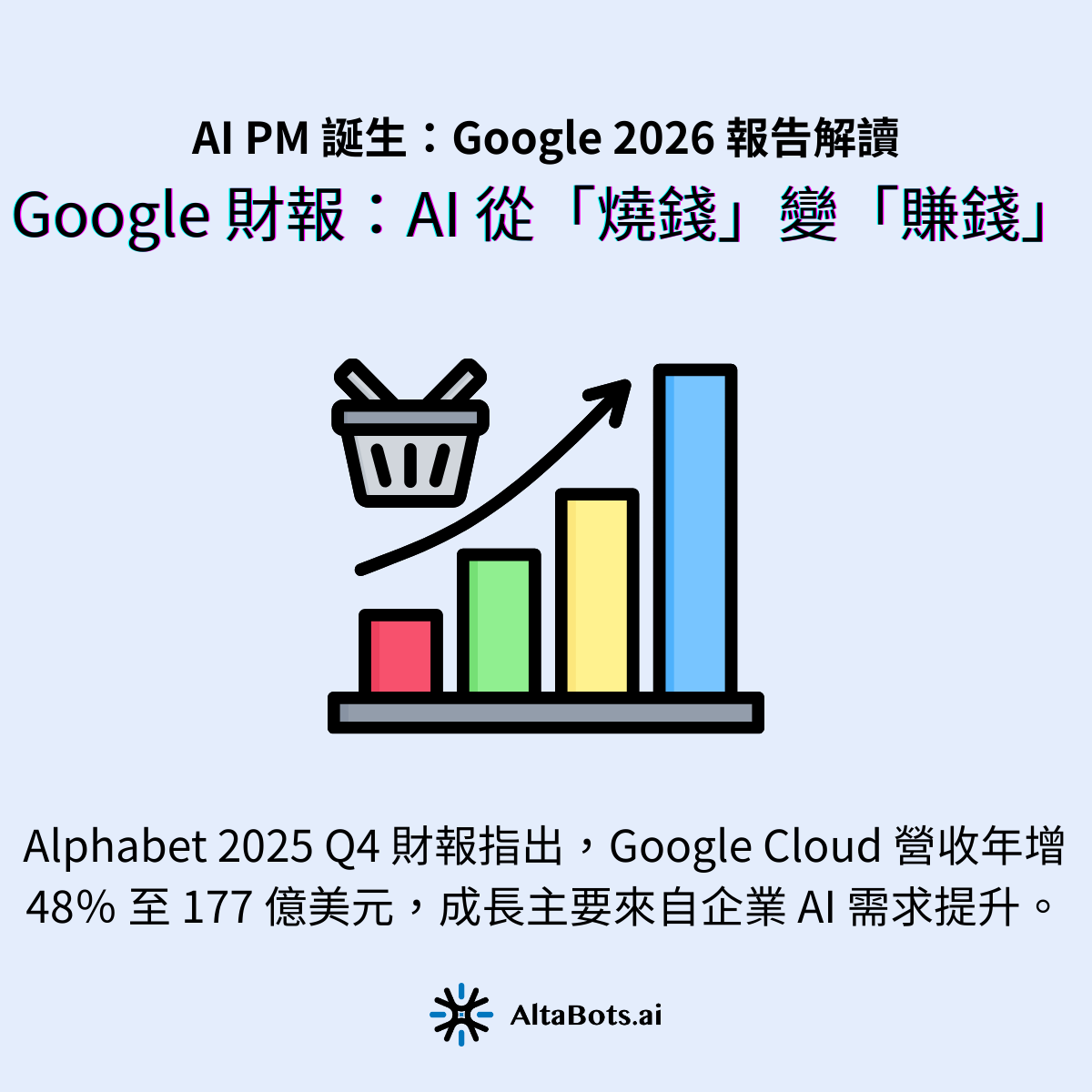
First, read Google's earnings: AI has gone from "burning cash" to "making money"
Enterprise AI is moving from pilots to scale, and where procurement budgets flow is the most direct proof.
Alphabet noted in its Q4 2025 earnings that Google Cloud revenue grew 48% year over year, with growth driven mainly by rising demand for enterprise AI infrastructure and core cloud services [3]. In the same period Alphabet also gave clear guidance on 2026 capital expenditure, showing that AI infrastructure investment is still accelerating. This means AI is no longer just an R&D topic but a core capability that companies are willing to keep paying to expand. Deloitte's survey confirms this trend: 84% of companies are increasing AI investment, yet only 25% of respondents say they have moved more than 40% of their AI pilots into production. The budget is moving, but scaling is stuck, and the cause is not that the technology is not good enough but that the question of "who is responsible for managing it" has not been resolved [1].
What comes next is not about who uses AI first, but who can bring AI into processes, governance and a system of accountability.
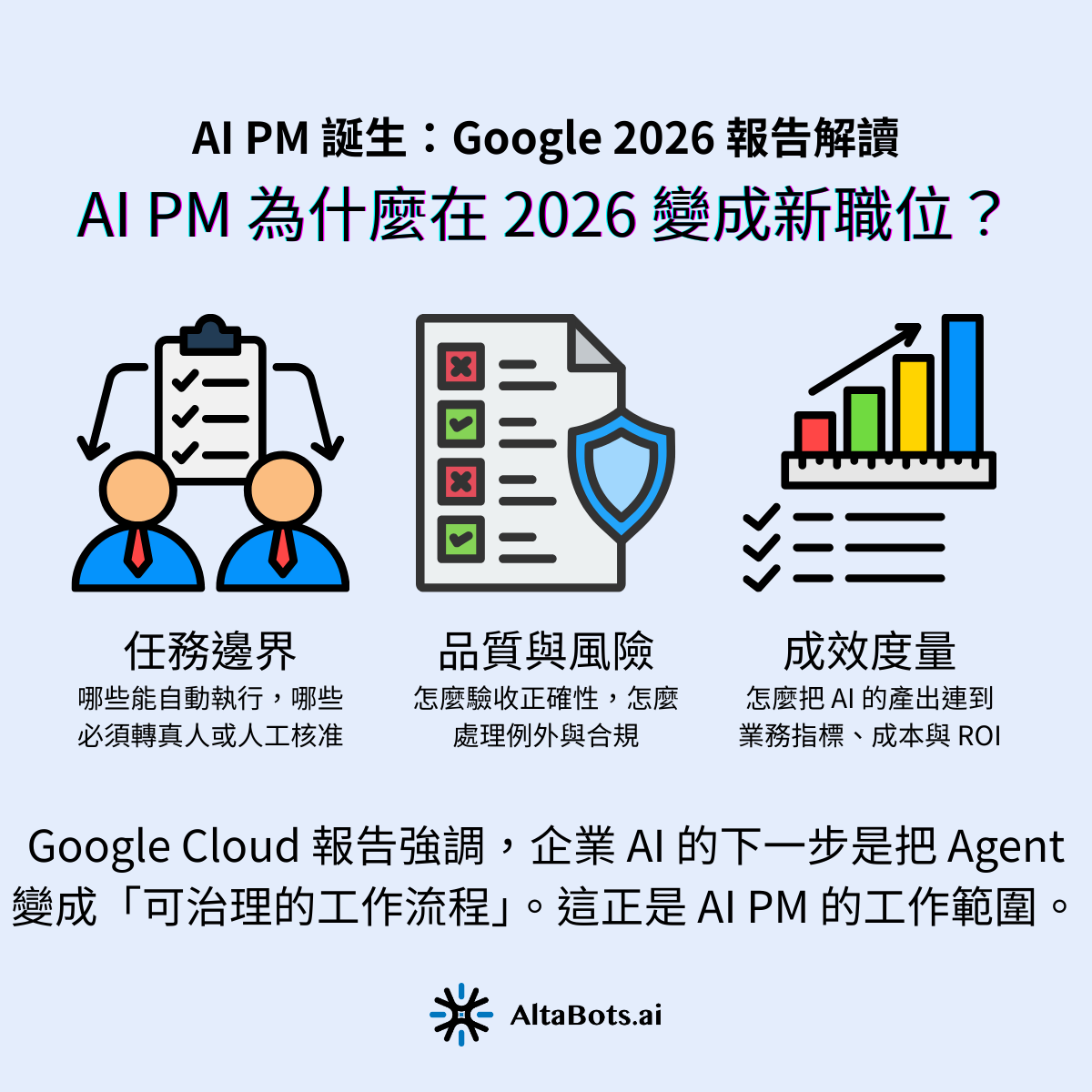
The new role Google's report names: what is an AI PM?
An AI PM (AI Agent product manager) is the person responsible for turning AI Agents into workflows that are "governable, scalable and measurable". The core responsibilities cover defining task boundaries, quality acceptance and KPI tracking.
The Google Cloud report states plainly that in 2026 employees' responsibilities will expand to Agent management and orchestration, and it names this skills gap directly: the professional capability to become an "Agent Orchestrator" or "Chief of Staff for AI" does not currently exist in the market [2].
This article calls the role "AI PM", as a localized interpretation for Taiwan's market. A traditional PM's work essentially ends once features are delivered, while an AI PM's work only truly begins after delivery. Whether quality is drifting, whether exceptions are surging, whether escalation rules are reasonable, whether metrics really improve: all of this falls within the AI PM's daily responsibility. In one sentence: a traditional PM is accountable for versions, while an AI PM is also accountable for "behavior after launch".
The AI PM's core responsibilities can be split into three:
- Task boundaries: what can run automatically, and what must go to a human or human approval
- Quality and risk: how to verify correctness, and how to handle exceptions and compliance
- Performance measurement: how to connect AI output to business metrics, cost and ROI
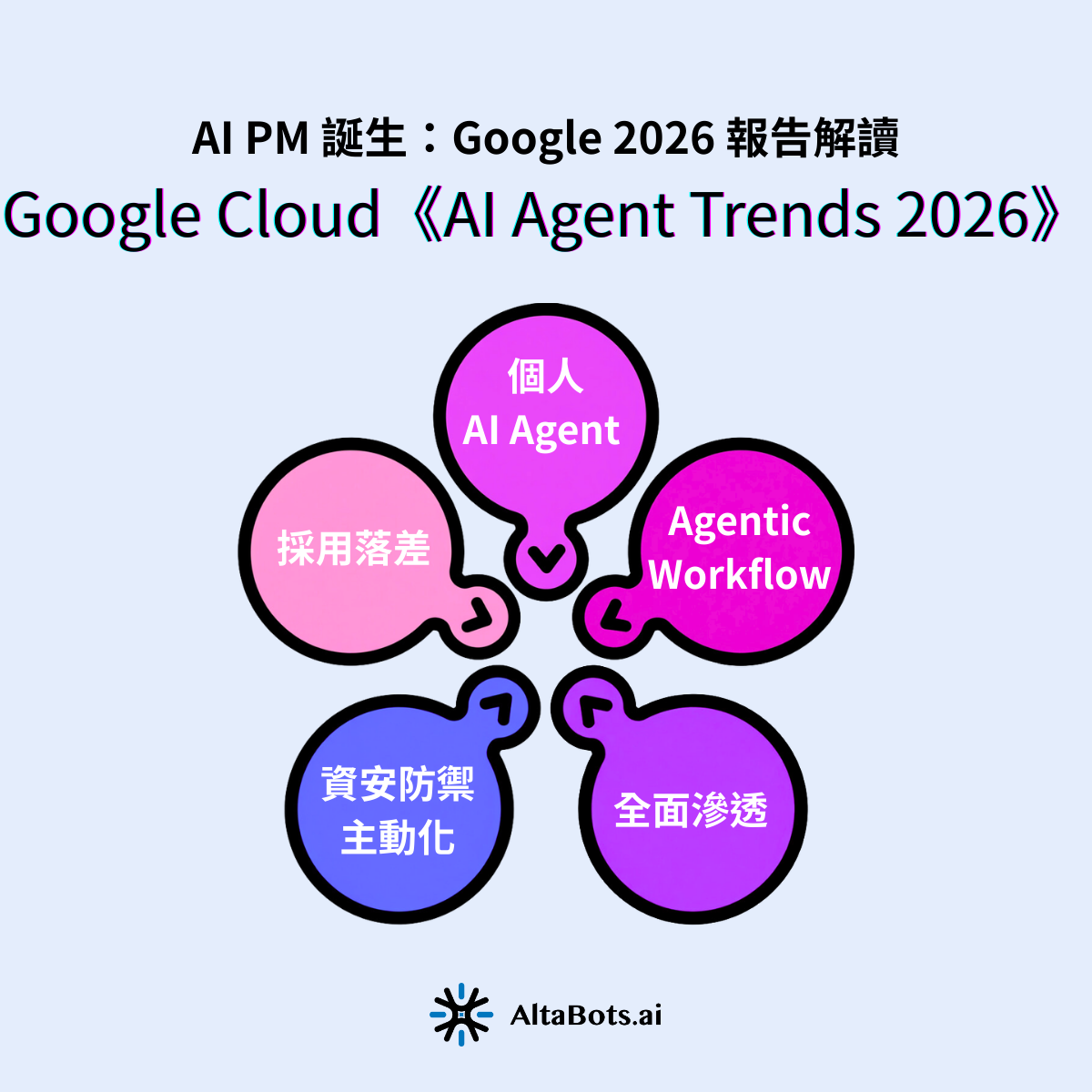
Reading Google Cloud's "AI agent trends 2026": five trends and the management questions behind them
One of the quantitative data sources for the Google Cloud report is the survey of 3,466 business decision-makers worldwide in "The ROI of AI 2025". Behind each of the five trends below sits a management question that an AI PM must take on.
Trend 1: Equipping every employee, the era of personal AI Agents arrives
The employee's role is shifting from "producing it yourself" to a supervisor who "assigns tasks, checks results and makes the final judgment". This means responsibility for workflow design moves from the level of personal skill to the level of system architecture.
Implication for the AI PM: you must design the human intervention points. Which outputs must be confirmed by a person, which can run automatically, and how to roll back after an error all have to be written into the specification before launch, not added after an incident.
Trend 2: Connecting every process, the agentic workflow becomes the digital production line
AI Agents can execute multi-step tasks across systems, forming end-to-end workflows. The real challenge is not adopting a single tool but how to connect multiple Agents into a process that can be monitored and managed. If you are evaluating how to build an internal AI Agent workflow platform, you can refer to AltaBots.ai's No Code architecture。
Implication for the AI PM: you must be able to write the process as a specification: trigger conditions, branching logic, exception handling, permissions and auditing, built into deliverables that can be accepted and monitored.
Trend 3: Cross-department adoption, Agents move from single-point tools to full penetration
The report notes that among organizations with AI Agents deployed in production, 49% apply them in customer service and customer experience, 46% in marketing or security operations, 45% in technical support, and 43% focus on product innovation or research productivity [2]. Agents no longer stay in a single scenario but have spread widely into the core processes of every department. Implication for the AI PM: KPIs are defined differently in different departments, from first-contact resolution in customer service, to conversion impact in marketing, to incident response time in security.
AI PM Each scenario needs its own performance measurement framework, rather than applying the same table to all. For what it looks like when each department actually runs, see our AI Agent Enterprise Use Cases 2026。
Trend 4: Security defense becomes proactive, from alerts to remediation
When Agents can execute actions, security must move to automated remediation. Least privilege, auditability, traceability and rollback cannot be after-the-fact fixes and must be written into the product specification before launch.
Implication for the AI PM: the AI PM must translate compliance and auditing into product specifications and proactively design risk guardrails. The more automation, the more governance is needed. This is not solely the security team's responsibility but part of the AI PM's scope of delivery.
Trend 5: The adoption gap is the last mile
The report's data shows that 82% of decision-makers believe learning resources help keep them ahead in AI, and 71% of organizations saw revenue rise after adopting learning resources, yet only 29% say AI is widely championed within their organization [2]. The gap between willingness to buy and actual usage is the key reason most enterprise AI adoption plans ultimately fail.
Implication for the AI PM: the AI PM's delivery includes not only features going live but also the adoption curve. Training, SOPs, monitoring reports and a weekly iteration rhythm are all the AI PM's responsibility.
What is an AI PM? Why is a traditional PM not enough?
The most fundamental difference between an AI PM and a traditional PM is not the job title but the "time horizon of responsibility". A traditional PM's work essentially ends after product features are delivered; an AI PM's work truly begins after launch, continuously monitoring the Agent's behavioral quality, tracking metric attainment and stepping in proactively before problems occur.
In practice this difference shows up in four areas:
- Different quality standards
The quality of traditional products is relatively stable, and after features go live their behavior does not change by itself unless a version is updated. An AI Agent shows "drift" as knowledge becomes outdated, processes are revised and wording changes, so quality quietly worsens without anyone intervening. The AI PM must build a test set and monitoring mechanism so that quality changes are visible and traceable. - Different acceptance methods
A traditional PM accepts whether features "work according to the specification"; an AI PM accepts whether the Agent "makes the right judgment in real situations". This requires designing a scenario question bank of at least 30-50 questions, each defining the key points of a correct answer and what must not be said, so quality can be assessed objectively. - Different scope of cross-functional collaboration
A traditional PM mainly coordinates engineering and design; an AI PM must also align with security, legal, operations and the owners of each department's KPIs, making sure the Agent's behavioral boundaries meet compliance requirements and that each scenario's definition of performance is accepted by the business unit. - Different iteration rhythm
Traditional products iterate by version, on a cycle measured in months; quality management for an AI Agent must run weekly, classifying error types, adjusting rules and updating the knowledge base every week, so the Agent keeps improving and does not regress.
If you need to persuade management inside the company that "we need an AI PM", the most effective method is not to talk about job titles but to list concretely what the person can deliver: a task boundary document, test sets and acceptance criteria, a KPI dashboard, weekly iteration reports, governance rules and escalation procedures. These deliverables do not exist within a traditional PM's work framework.
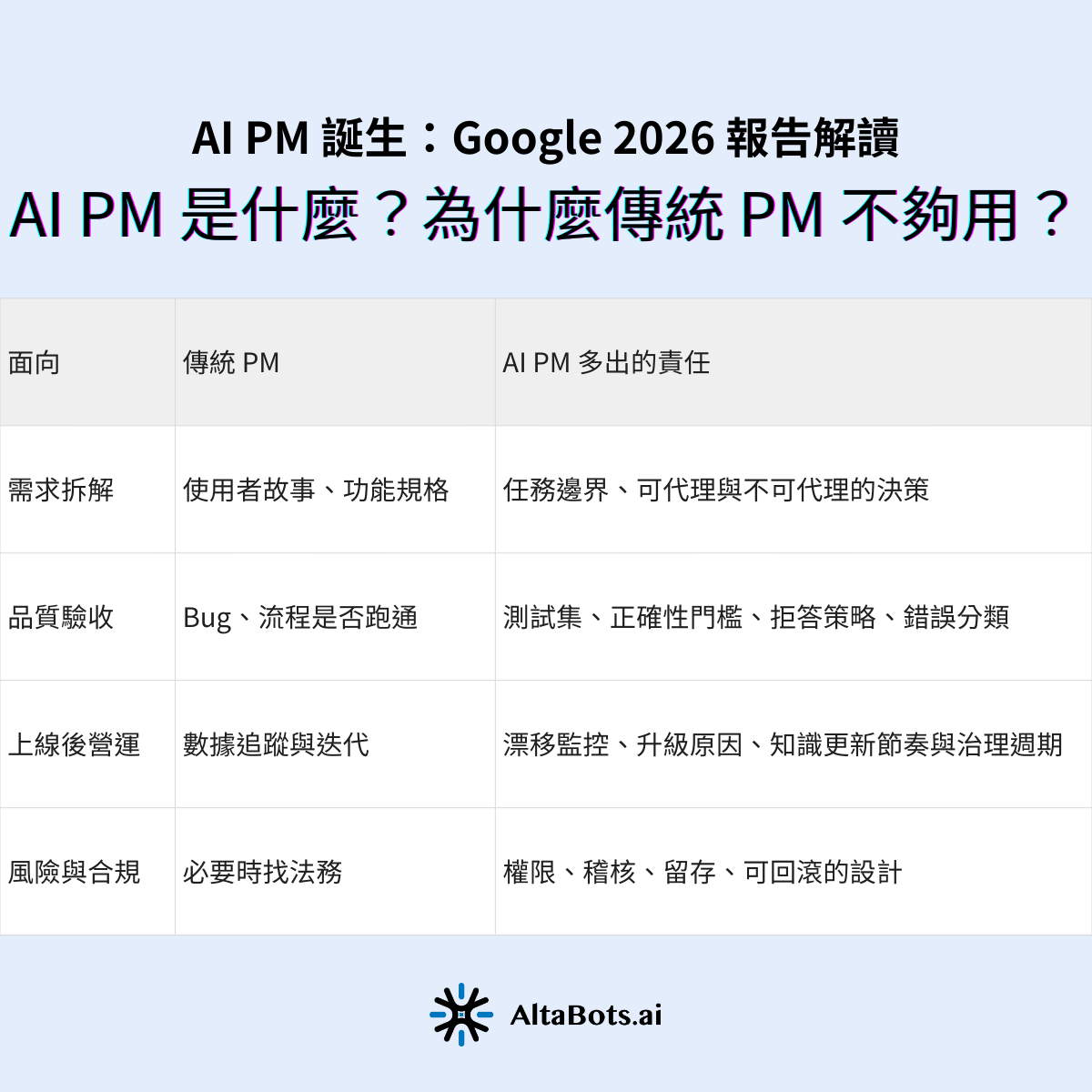
Checklist of core AI PM capabilities
If you need to persuade management inside the company that "we need an AI PM", the most effective method is not to talk about job titles but to list "what the person can deliver".
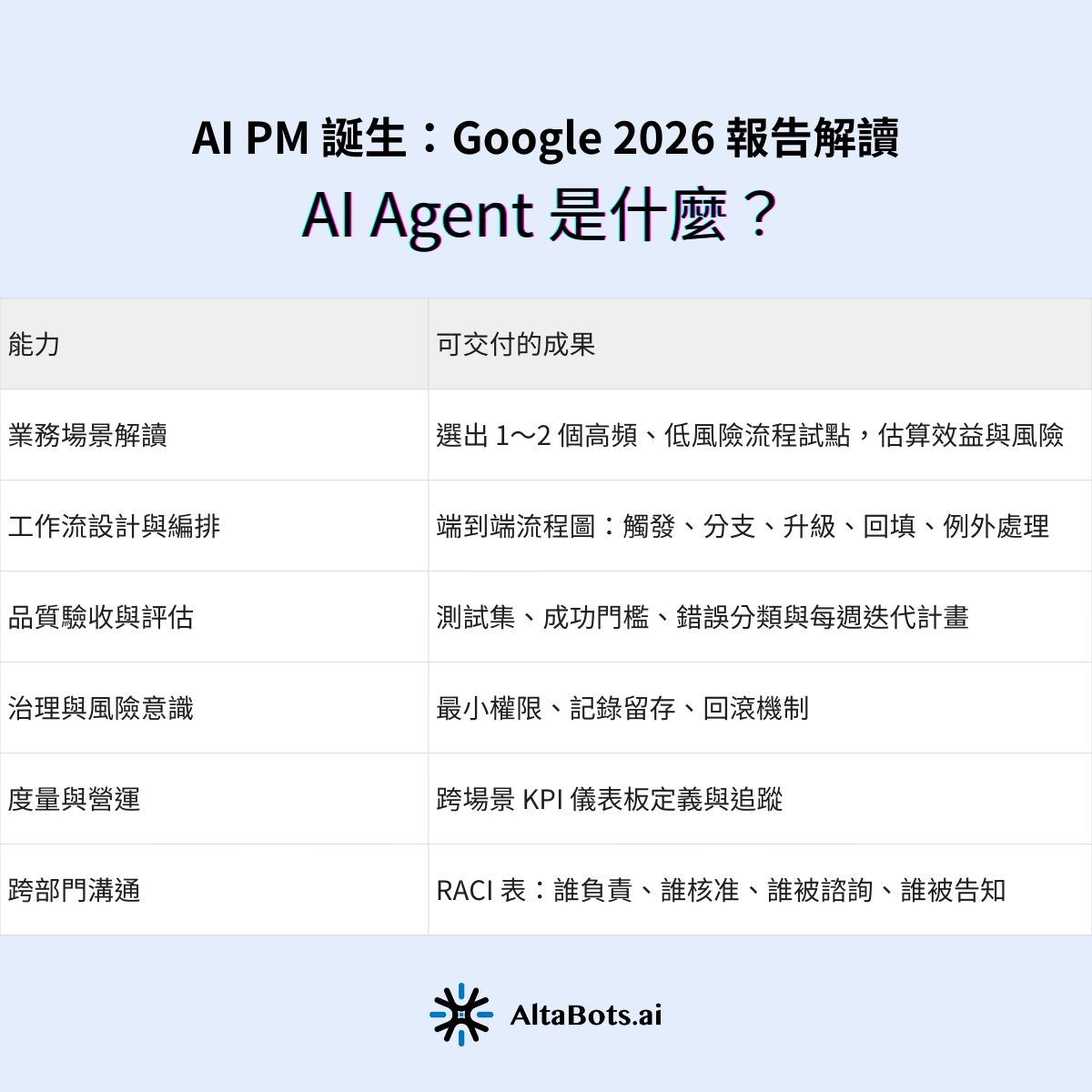
How should a company start adopting AI agents? A 5-step approach from the AI PM's perspective
Gartner predicts that more than 40% of agentic AI projects will be cancelled by the end of 2027, because of runaway costs, unclear business value or inadequate risk controls [5]. The most common failure mode when companies adopt AI Agents is not choosing the wrong technology but choosing the wrong scenario at the first step: picking a high-risk, highly complex process as the pilot, and when it fails the whole plan stalls. The 5 steps below start from the AI PM's governance perspective and help companies move AI Agents from PoC to a production environment that can be operated. If your team is planning its first Agent scenario, you can refer to the AltaBots.ai consultant-led adoption plan, which starts fitting from the pilot to lower the cost of stepping on mines.
- Step 1: Start with "high-frequency, low-risk" processes
Suitable pilots common across industries include equipment maintenance knowledge Q&A in manufacturing, document review pre-processing in finance, marketing data consolidation in retail, and employee training FAQs common to all companies. What these processes share is that the scope of damage from errors is controllable, performance data accumulates easily, and organizational resistance is relatively smallest. To validate a scenario at the lowest cost first, see our 30-Day AI PoC Process and Pitfall Guide。 - Step 2: Write down task boundaries and human handoff rules clearly
Task boundaries are the key to whether an AI Agent can be managed at all. If boundaries are not clearly defined, no one knows how to handle things when the Agent errs, and organizational trust collapses quickly. We recommend first confirming these three kinds of situations that must go to a human: decisions related to compliance review, major complaints or highly emotional conversations, and operations involving personal data and payments. The clearer the boundary definition, the more controllable the scope of damage when the AI errs. - Step 3: Build a test set and success thresholds (the most often skipped step)
This is the step companies adopting AI Agents most easily skip and most easily regret skipping. Without a test set, there is no way to accept objectively and no way to track whether quality is drifting. We recommend preparing at least a 30-50 question scenario bank, each defining "key points of a correct answer" and "what must not be said", completing a baseline test before launch and rerunning it monthly after launch. How to design the test set and how to classify errors are covered in full in Evals and the 6-Step SOP for AI Agent Error Analysis , which breaks down the entire process. - Step 4: Monitor with KPIs after launch, and iterate weekly with "error classification"
The key to quality management after an Agent launches is not the monitoring tool but the habit of "error classification". Common error types include: missing knowledge, misjudged intent, missing clarifying questions, inconsistent tone, and handoff-to-human rules that are too loose or too tight. Classifying errors once a week is the lowest-cost way to keep AI improving, and it is the AI PM's most central daily work. - Step 5: Lock in the governance framework before the second process goes live
After the first process succeeds, the most common mistake is to copy it straight to a second and third scenario without first confirming the governance rules. The result: scaling only amplifies the first process's problems. Databricks data from real-world use at more than 20,000 companies worldwide shows that companies with an AI governance framework push 12 times as many Agent projects into production as those without, and companies that use evaluation tools push 6 times as many [6]. Governance does not slow things down; it is the precondition for speeding up volume production. Before expanding, four questions must be answered: who can change the process specification? Who can update the knowledge base? How are changes reviewed? How is a rollback done when something goes wrong? Only when these four questions have answers is there a governance foundation that can scale.
Conclusion: the 2026 question is not "whether to use AI" but "who is accountable for AI's results"
From Google Cloud's trends report to Deloitte's global survey, the direction is the same: AI Agents are moving into production, but most companies' governance capability has not kept up. Deloitte notes that about 80% of companies lack mature Agent governance capability [4]. McKinsey's 2026 AI trust maturity survey also found that only about a third of organizations reach sufficient maturity in strategy, governance and agentic AI controls, and that survey listed "agentic AI governance and controls" as a separate evaluation dimension for the first time, reflecting that autonomous Agents have fundamentally changed the rules of governance [7].
When AI starts executing tasks, responsibility does not disappear. It only moves to the people who "define the rules, monitor quality and answer for the KPIs". That person is the AI PM. Wherever your company is in adoption now, whether still evaluating scenarios, running a PoC, or already live but with unstable quality, an AI PM mindset is the key to taking AI from pilot to an operable state.
A dedicated AI PM is not always needed, but someone in the organization must take on three things: defining task boundaries, quality acceptance and KPI monitoring. Otherwise AI adoption can easily stay at the pilot stage forever. If your team is about to bring AI Agents into departmental processes but lacks experience in workflow design, quality acceptance and governance rhythm, you are welcome to start through an AltaBots.ai consultation fitting from the first scenario, so AI reaches an operable stage sooner.
Glossary of terms (short version)
- AI Agent: AI that can carry out multi-step actions to complete a task. It does more than reply with text, it runs processes and operates across systems.
- Agentic Workflow: an end-to-end workflow made up of multiple Agents and systems, including trigger conditions, routing logic, write-back and monitoring mechanisms.
- Orchestration: the design that lets multiple Agents collaborate by rules, including trigger conditions, boundary definitions, permission settings and exception handling.
- Escalation (handoff to a human): the mechanism by which an AI hands a task or conversation to a human when it is uncertain or faces a high-risk situation. Designing clear handoff rules is the first line of defense in AI Agent governance.
- Evaluation Set: a set of scenario questions and standard answer points used to accept and continuously monitor AI quality. Without a test set, there is no way to judge objectively whether the AI is improving or regressing.
- Drift: the phenomenon of an AI Agent's quality declining over time after launch. Common causes include outdated knowledge, process revisions and changes in wording. Regularly rerunning the test set is the lowest-cost way to detect drift.
- Governance Framework: the overall system that defines an AI Agent's decision boundaries, audit rules, change procedures and accountability. Deloitte's 2026 survey notes that nearly three quarters of companies plan to deploy agentic AI within two years, but only 21% currently have a mature governance framework. The speed at which governance capability is built decides whether companies can scale safely.
References

[1] Deloitte.(2026)。2026 State of AI in the Enterprise. Deloitte Press Room.
https://www.deloitte.com/us/en/about/press-room/state-of-ai-report-2026.html
[2] Google Cloud.(2026)。AI Agent Trends 2026(Report PDF).
https://services.google.com/fh/files/misc/google_cloud_ai_agent_trends_2026_report.pdf
[3] Alphabet Inc.(2026)。Alphabet Announces Fourth Quarter and Fiscal Year 2025 Results(Earnings Release PDF).
https://s206.q4cdn.com/479360582/files/doc_financials/2025/q4/2025q4-alphabet-earnings-release.pdf
[4] Deloitte Insights.(2026)。AI Agents: Scaling Faster.
https://www.deloitte.com/us/en/insights/topics/emerging-technologies/ai-agents-scaling-faster.html
[5] Gartner.(2025)。Gartner Predicts Over 40% of Agentic AI Projects Will Be Canceled by End of 2027. Gartner Newsroom.
https://www.gartner.com/en/newsroom/press-releases/2025-06-25-gartner-predicts-over-40-percent-of-agentic-ai-projects-will-be-canceled-by-end-of-2027
[6] Databricks.(2026)。Enterprise AI Agent Trends: Top Use Cases, Governance + Evaluations and More(2026 State of AI Agents Report).
https://www.databricks.com/blog/enterprise-ai-agent-trends-top-use-cases-governance-evaluations-and-more
[7] McKinsey & Company.(2026)。State of AI Trust in 2026: Shifting to the Agentic Era(2026 AI Trust Maturity Survey).
https://www.mckinsey.com/capabilities/tech-and-ai/our-insights/tech-forward/state-of-ai-trust-in-2026-shifting-to-the-agentic-era
FAQ
FAQs about this article
Where should a company start when adopting AI Agents?

We suggest starting with a "high-frequency, low-risk" internal process, such as an employee training FAQ, document review pre-processing or data consolidation. First define task boundaries and human handoff rules, then build a 30-50 question test set and success thresholds, and monitor quality weekly after launch. Once the first scenario succeeds and the governance framework is locked in, replicate it to other departments.
Is it normal for an AI Agent's quality to worsen after launch?
Yes. This phenomenon is called "drift": after knowledge becomes outdated, processes are revised or wording changes, an AI Agent's quality quietly declines without anyone intervening. To prevent it, build a test set that is rerun regularly and classify error types weekly (missing knowledge, misjudged intent, handoff rules too loose or too tight), so quality problems are found and fixed before they grow.
Our company is not large. Do we still need an AI PM?
A dedicated AI PM is not always required, but an "AI PM mindset" is. Even if an existing PM or digital transformation lead takes it on part-time, someone must own three things: defining task boundaries, quality acceptance and KPI monitoring. If no one takes this role, AI adoption can easily stay at the pilot stage forever and never reach an operable production environment.
How should the ROI of an AI Agent be evaluated?
We suggest measuring at three levels: the first is efficiency metrics (shorter handling time, fewer manual interventions); the second is quality metrics (first-contact resolution, number of error classifications); the third is business metrics (conversion rate, customer satisfaction, cost savings). Tracking all three levels together connects AI output to business decisions and avoids an adoption that has traffic but no value.
When an AI Agent makes a mistake, who should be responsible?
Accountability must be defined clearly before launch, not discussed after an incident. One of the AI PM's core duties is to build a clear governance framework: which decisions the Agent can execute on its own, which must be escalated to a human, how to roll back when something goes wrong, and who has permission to change the specification. The clearer the governance framework, the more controllable the scope of damage when the AI errs, and the more organizational trust can keep accumulating.
More articles


訂閱我們的電子報
每月 8 日定期發送最新趨勢與實用資訊!



