

What is harness engineering? AI agents you can govern | Alta.DI
Harness engineering is the systems work of designing tool permissions, error interception, memory handoff and process control around an AI Agent, so AI moves from "it runs" to "it can be managed and put into daily use".


Harness engineering is the systems work of designing tool permissions, error interception, memory handoff and process control around an AI Agent, so a model moves from "it runs" to "it can be managed and put into daily use". It sits on top of prompt engineering and context engineering, and in 2026 it is the layer that decides whether an enterprise AI Agent really goes into production.
Lately we have met several companies in the same position. They built internal automations themselves with tools such as n8n. The automations run and are used every day, yet in the end the companies came back to talk to us. The reason is not that the tools do not work. Getting something built and keeping it manageable are two different things.
This gap between "usable" and "hard to control" is exactly what a new term in the 2026 AI engineering community aims to solve: harness engineering. Harness engineering is a complete body of systems work that designs tool permissions, error interception and process control around an AI Agent. Its purpose is to move a model from "it runs" to "it can be managed", and it applies to any company that wants to bring AI Agents into everyday operations.
It does not replace the first two stages; it builds on them. Over the past three years we first learned to ask clear questions (prompt engineering), then to feed the right background data (context engineering). But once a model is strong enough and can read enough data, a new bottleneck appears: can it finish the job safely and under control when nobody is watching? That layer is harness engineering.
This article takes an enterprise adoption angle. It shows what harness engineering actually manages, how it differs from the first two layers, and why companies that "can build it themselves" often get stuck at "can't manage it". If you are weighing whether to put an AI Agent into a production process, this layer is a judgment you cannot go around.
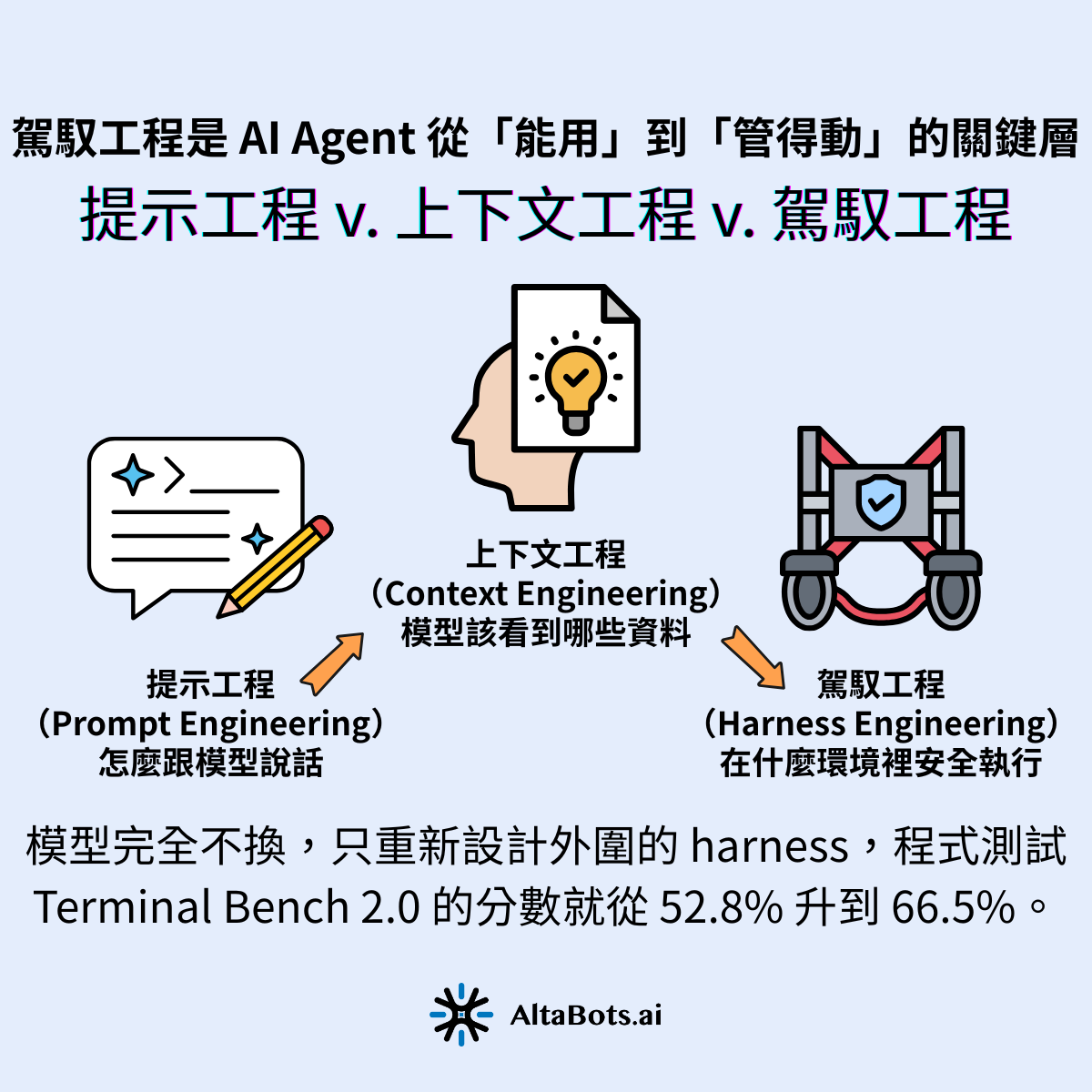
How do prompt engineering, context engineering and harness engineering differ?
The three layers stack; they do not replace each other. Without the top layer, nothing makes it into daily use.
Prompt engineering, context engineering and harness engineering are three stages in the development of AI applications. They deal with "how to ask", "which data the model sees" and "which environment it runs in safely". The three stack on top of each other and none can be dropped. Many people assume a new term means the old one has been retired, but these three layers are built one on top of another; if the first two are not done well, the third cannot stand.
Prompt engineering: asking the question clearly
Prompt engineering is about "how to talk to the model". In the era of a single input box, how well a model performed depended almost entirely on how clearly you stated what you needed: role settings, examples and output formats are all skills built up in this stage. Most of this layer is now built into tools and templates, but its spirit has not gone away. For practical techniques, see our overview of 2026 AI prompt engineering trends (in Chinese).
Context engineering: feeding the right background data
Context engineering deals with "which data the model should see". Once tasks get complex, asking well is not enough. At the right moment and in the right format, knowledge bases, history and live state must be fed into the model's working memory. RAG, memory and document chunking all belong to this layer, which addresses accuracy and hallucination. For a full breakdown of this layer, see our context engineering guide (in Chinese).
Why does harness engineering exist as a separate layer?
Once the model is smart enough and the context is sufficient, a new question comes up: letting an Agent decide the next step in a loop, call tools and handle errors on its own, without damaging data or systems. That layer is harness engineering. In short, everything outside the model counts as the harness: system prompts, tools, permissions, interception mechanisms and memory. The industry condenses this relationship into one formula: Agent = Model + Harness. The term "harness engineering" comes from an article by HashiCorp co-founder Mitchell Hashimoto in February 2026, in which he boiled the core principle down to one sentence: every time an Agent makes a mistake, engineer a fix into its environment so that the same mistake does not happen again [1]. Frontline teams have also systematized this practice in their own ways: Anthropic published a harness design for long-running tasks as early as late 2025 [3], and OpenAI delivered a hands-on report in early 2026 on building a million-line codebase with Codex [2].
How much does this layer matter? LangChain ran an experiment: with the model unchanged (GPT-5.2-Codex throughout) and only the surrounding harness redesigned, its score on the coding benchmark Terminal Bench 2.0 rose from 52.8% to 66.5%, moving from outside the top 30 into the top 5 [4]. The same model jumped a generation through environment design alone. The implication is simple: when an Agent performs poorly, the model is often not the problem. The system around it was not well designed.
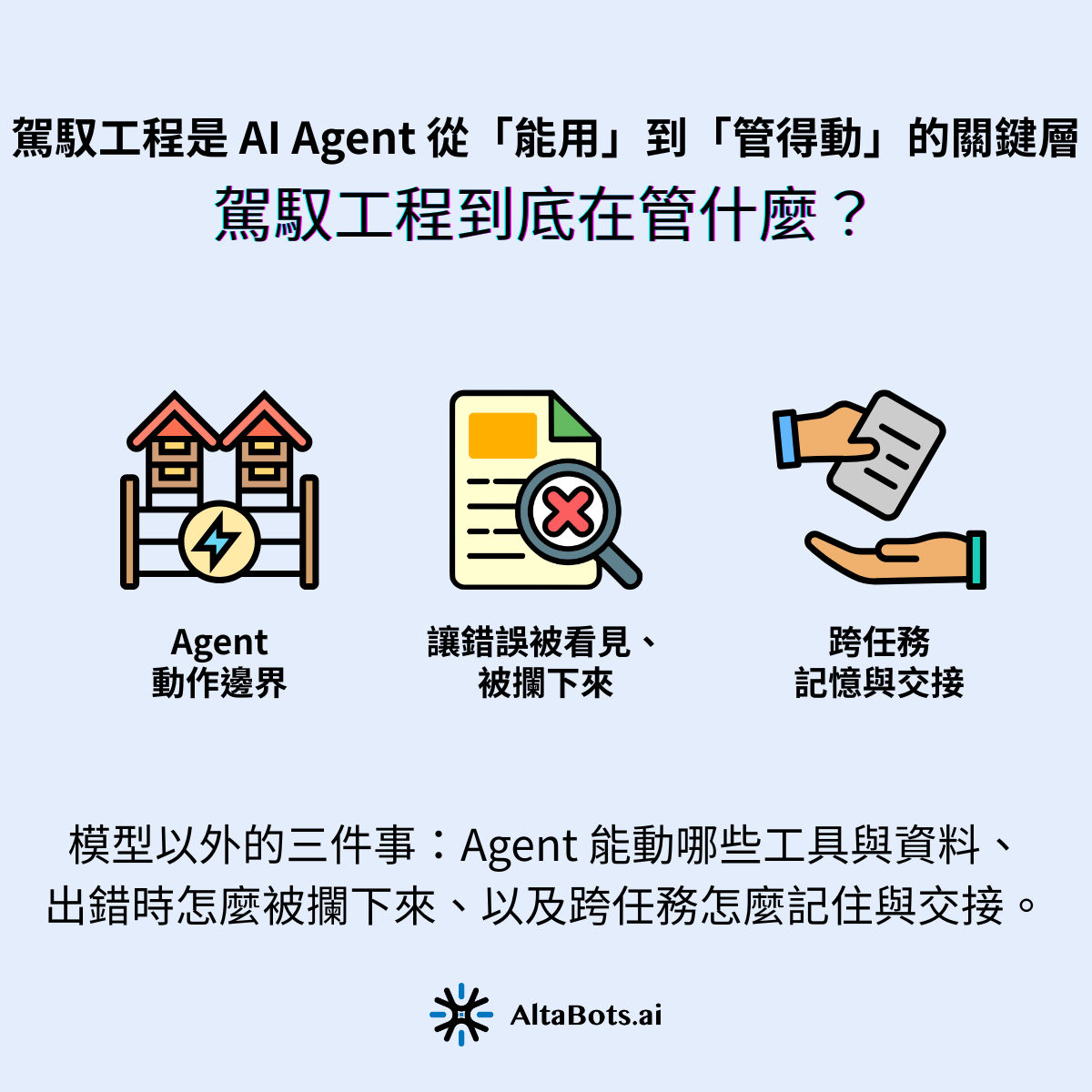
What does harness engineering actually manage?
It manages three things: action boundaries, error interception and memory handoff.
Harness engineering manages three things outside the model: which tools and data an Agent can touch, how errors get caught, and how work is remembered and handed over across tasks. These three decide whether an Agent can run reliably when nobody is watching. Below, each one is translated into scenarios a company will actually meet.
What can an Agent touch, and what can't it?
The first thing is to draw the boundary of an Agent's actions. Connecting to the same database with read-only access or with permission to modify and delete carries very different risk. Harness engineering breaks tools into finer parts, separating those that are read-only from those that change state, and adds a human confirmation step (human-in-the-loop) for high-risk actions: small things run automatically, but before anything touches production data or goes out to external parties, a person must approve. Without this layer, the typical situation is an Agent carrying out an action nobody authorized, and by the time it is noticed, production data has already been changed.
When something goes wrong, can you trace it and stop it?
The second thing is making errors visible and stopping them. The most common flaw in Agents is declaring a task finished after writing the result without actually checking that it is correct. Anthropic's research on long-running tasks recorded this behavior: models often mark work as complete before fully verifying it, announcing it done too early [3]. Harness engineering closes this gap with two mechanisms. One is a verification gate (hook) before completion: it runs preset tests or checks and, if they fail, sends the work back with the error message. The other is observability afterwards: every action and every tool call is logged, so when something breaks you can find which step failed. Without this layer, you only learn after the fact that an Agent gave wrong information, and you cannot trace which step caused it. This is also why error analysis should continue after an Agent goes live; for how to do it, see our guide to Agent error analysis and evals (in Chinese).
When someone else takes over, does it become a black box?
The third thing is memory and handoff across tasks. A model starts from a blank page every time. If what it did in the previous round and why it decided that way were not written down, the next round starts over. Harness engineering turns these into explicit assets: rules and decisions go into versioned documents (anything not written there effectively does not exist for the Agent), long conversations use compression so memory does not overflow, and handover relies on documents rather than on one person's head. Without this layer, you get the most troublesome situation of all: once the person who built the workflow leaves, the whole automation becomes a black box that nobody understands.
What separates "usable" from "governable"?
Getting it built is only the start. Keeping it manageable is what puts it into daily use.
"Usable" means the tool runs and produces output. "Governable" means errors can be stopped, workflows can be changed, scale can grow, and the work can be handed over when people leave. For most companies, AI automation gets stuck not on whether it is usable but on whether it can be governed.
Back to the companies mentioned at the start. They built automations with tools such as n8n, the workflows really do run, and people really do use them. By any usual measure that should count as success. But the reasons they came back to us had nothing to do with "whether it is usable". They were management problems that surfaced after some time in use.
The most common pain points in self-built automation of this kind are these. Once there are many workflows, they become hard to trace, and changing one node may or may not affect others. When something fails there is no good alerting, so it often takes someone noticing a wrong result and then manually going through the steps one by one. Accounts, keys and permissions used for integrations are scattered around, with no unified control. And the most practical one: the person who built it was usually an employee who happened to know the tool, and once that person leaves, nobody is confident maintaining the whole workflow.
Put side by side, these all point to the same thing: the tool made AI "usable", but nobody designed the layer that makes it "governable". Usable means the task runs. Governable means errors can be stopped, workflows can be changed, more can be added when you expand, and a change of owner does not bring it down. The gap between the two is exactly where harness engineering fits. It is also why treating AI as a tool and treating AI as a deliverable result lead to completely different paths. We cover that distinction in more detail in AI tool or AI result (in Chinese) .
So whether you are the engineer who builds it or the decision maker who signs off on adoption, the real question is the same: besides running, can this AI automation be governed? If the answer is no, rather than building a few more workflows, it is better to have specialists design governance in from the start.
How does AltaBots.ai design "manageable" in?
We do not hand you tools to build with on your own. Consultants design governance in.
This is the positioning of AltaBots.ai: an enterprise AI Agent platform, from decision to production, with consultants working alongside you throughout. It addresses the next question after "usable": how to design "governable" into the workflow from the first step.
Most no-code tools on the market give you the ability to "build it yourself", and can get a workflow running. But the governance covered in the sections above, meaning permission boundaries, error interception and handover documents, mostly has to be added by you. AltaBots.ai takes the opposite approach. Instead of handing over a set of tools for you to handle on your own, consultants work alongside you and design governance in from the first step.
"From decision to production" is not a slogan. It is a process with people alongside you. In the decision stage, consultants first work with you to clarify whether a workflow should go to AI at all, which part to start with, and which actions are risky enough to require human sign-off. In the build stage, permissions are split into read-only and writable, confirmation gates are set for high-risk actions, and verification and logging are built into the workflow. At go-live, rules and decisions are written into versioned handover documents, so a later change of owner does not turn the workflow into a black box.
This reflects Data-DI's consistent approach: data drives the scenarios, and AI delivers the results. What you want has never been "whether AI has been set up". It is whether it can finish the job reliably and stay manageable. Harness engineering is the technical core of this, and consultants working alongside you are what puts it into daily use.
Should a company build it itself, or have consultants design governance in?
Low-risk work can be built in-house. Once production data is involved, governance should be designed.
The rule of thumb is simple. The lower the risk, the more internal the process and the smaller the cost of error, the better suited it is to building it yourself. Once production data, external interaction, or errors that directly hurt customers and revenue are involved, treat governance as a day-one matter and hand it to people who know how to design it.
Building it yourself is usually enough in these cases:
- A purely internal, low-risk small tool, such as automatically turning a few documents into a summary.
- A mistake at worst means running it again, with no impact on production data or outbound messages.
- The person using it is the person who built it, and no handover is needed in the near term.
We recommend designing governance in from the start in these cases:
- The Agent will touch production databases, payments or customer data, or interact with outside parties on the company's behalf.
- The process spans departments or will scale, and someone else will maintain it later.
- A mistake cannot be fixed by running it again; it affects customer trust or revenue.
The difference is not "whether you can build it". You can probably build both kinds. The difference is whether, on the day something goes wrong, you have a designed mechanism that can stop it, trace it and fix it. The closer you get to production operations, the less this should be left to fix afterwards.
If you are not sure which side your workflow falls on, the quickest way is to take inventory first: sort the workflows you want to hand to AI by risk and scope of impact, and you will see which ones you can safely build yourself and which need governance designed in.
Conclusion: usable is the start; manageable is what puts it into daily use
Now that AI has reached the Agent stage, whether it is usable is no longer the point. What sets companies apart is whether it can be managed. Prompt engineering lets you say things clearly, context engineering lets the model see the right data, and harness engineering decides whether it can finish the job safely and under control when nobody is watching. Without this layer, AI stays a demo that "can be built" and never makes it into production operations.
Back to the companies at the start: they built it, they use it, and in the end they got stuck at "can't manage it". They did nothing wrong. "Usable" and "governable" are simply two different things, and the layer between them needs someone to design it on purpose. The closer you are to production operations and the more it touches customers and revenue, the less this should wait until something goes wrong.
If you already have an AI workflow that runs but leaves you uneasy, or you are evaluating whether to put an AI Agent into production, the first step is not to rush to expand. Check first whether it can be managed. You are welcome to talk with AltaBots.ai: together we can take inventory of your workflow risks, see where governance needs to be added, and turn "usable" into something that is really in daily use. Book an AI Agent adoption consultation.
Book an AI Agent adoption consultation
References

[1] Mitchell Hashimoto, "My AI Adoption Journey," 2026.
https://mitchellh.com/writing/my-ai-adoption-journey
[2] OpenAI, "Harness engineering: leveraging Codex in an agent-first world," 2026.
https://openai.com/index/harness-engineering/
[3] Anthropic, "Effective harnesses for long-running agents," 2025.
https://www.anthropic.com/engineering/effective-harnesses-for-long-running-agents
[4] LangChain, "Improving Deep Agents with Harness Engineering," 2026.
https://www.langchain.com/blog/improving-deep-agents-with-harness-engineering
Further reading: Martin Fowler / Birgitta Böckeler (Thoughtworks), "Harness Engineering."
https://martinfowler.com/articles/harness-engineering.html
FAQ
FAQs about this article
What is harness engineering?

Harness engineering is the systems work of designing tool permissions, error interception, memory and process control around an AI Agent, so a model moves from "it runs" to "it can be managed and put into daily use". After prompt engineering and context engineering, it is the layer that decides whether an enterprise AI Agent really goes into production.
How does harness engineering differ from prompt engineering and context engineering?
Prompt engineering addresses "how to ask", context engineering addresses "which data the model sees", and harness engineering addresses "which environment the Agent runs in, safely and under control". The three stack on top of each other and do not replace one another. Once the first two are done well, harness engineering decides whether AI can actually go into a production process.
What happens without harness engineering?
The most common outcome is "built, but can't be managed": the Agent runs, but errors cannot be stopped or traced, permissions have no boundaries and touch data they should not, and once the builder leaves the workflow becomes a black box. Usable does not mean governable, and this layer is what is missing.
Do small and mid-sized companies need harness engineering?
It depends on the risk of the workflow. For small tools that are purely internal, low-risk and can simply be rerun after a mistake, building it yourself is usually enough. But whenever an Agent will touch production data, interact with outside parties, or later needs to scale and be handed over, governance needs to be designed in, regardless of company size.
Should we build it ourselves or work with consultants?
The deciding factors are risk and scope of impact. Low-risk internal workflows suit a do-it-yourself approach. Once production data, customer interaction or revenue is involved, we recommend having consultants design governance into the workflow from the start rather than patching it after something goes wrong. AltaBots.ai works this way: consultants work alongside you from decision to production, building "governable" in from the beginning.
More articles


訂閱我們的電子報
每月 8 日定期發送最新趨勢與實用資訊!



