

What is UCP? 2026 spec update and e-commerce brand guide
UCP is Google's open standard for AI-driven checkout. In March 2026 it added a multi-item cart, a live product catalog and identity linking. This article compares UCP with OpenAI's ACP and gives Taiwan e-commerce brands a five-step preparation plan.


What is UCP? The latest 2026 spec, how it differs from ACP, and 5 preparation steps for Taiwan e-commerce brands
Key point: UCP has moved from experiment to checkout infrastructure that is running, and what you should do now is get your data ready.
UCP (Universal Commerce Protocol) is an open standard Google announced in January 2026 that lets AI agents complete purchases on behalf of consumers directly in Google AI Mode and Gemini, without sending them to the merchant's website [1]. Its full name is Universal Commerce Protocol, not Unified Commerce Platform. The key point: after Google's two major updates in March and May 2026, UCP has moved from the "experimental stage" to "checkout infrastructure ready for production". For Taiwan e-commerce brand owners, AI is no longer only ad traffic or customer service replies. It is becoming a new entry point for sales.
This article covers three things you actually need: what UCP really changed (including the latest May developments), how it differs from OpenAI's ACP, and five things you can prepare now without writing code.
Why should Taiwan e-commerce brand owners look at UCP now?
Key point: the cart abandonment problem unsolved for ten years is still here, and AI has opened a new battleground for sales.
The reason is simple: you face two pressures at once. The traditional cart abandonment rate has stayed at about 70% for years. Baymard's latest average, compiled from 50 studies, is 70.22%, and the figure has barely moved in ten years and was even higher in 2019 [2], which shows this is an old problem unsolved for a decade. At the same time, new AI shopping entry points are taking over the key moment of "deciding what to buy": eMarketer estimates that in 2026 AI platforms will contribute 1.5% of US e-commerce retail sales, about US$20.57 billion, nearly four times the 2025 figure [3]; Salesforce also points out that in the 2025 holiday season 20% of global orders were already influenced by AI and agents [4]. McKinsey further estimates that by 2030, agentic commerce will reshape US$3 trillion to 5 trillion of global retail spending [5].
In other words, the abandoned carts lost in the past have not been recovered, and now the new battleground of "completing a purchase inside the AI interface" has opened. This is exactly the problem UCP wants to solve. You can think of UCP as "a common commerce language that AI can understand and execute safely": when product data, checkout flow and return policy are all described with the same standard, an AI agent can take the user all the way to purchase without leaving the conversation window. If you want to start with the abandonment stage, we have another article you can refer to: 5 Automation Approaches for Shopify Cart Recovery for Cross-Border Sellers.
How do UCP and agentic commerce relate?
Key point: agentic commerce is the goal, and UCP is the common language that lets it work across platforms.
Agentic commerce means AI does not only answer questions but also completes a series of tasks on behalf of the user: filtering products, confirming conditions, executing the purchase and handling after-sales. UCP is the infrastructure that lets this work across platforms. It defines a common language between AI agents, merchant systems and payment services, so that agents can access product information, start checkout and handle after-sales without custom integration for each store [1].
UCP was formally announced by Google on January 11, 2026 at the National Retail Federation (NRF) conference in the US. It was developed together with Shopify, Etsy, Wayfair, Target and Walmart, and endorsed by more than 20 international retail and payment companies, including Adyen, American Express, Best Buy, Mastercard, Stripe, The Home Depot, Visa and Zalando [1]. Notably, UCP is designed to be compatible with the Agent Payments Protocol (AP2), Agent2Agent (A2A) and the Model Context Protocol (MCP) [6]. This means it is not starting from scratch but building on existing standards. This lineup also shows that UCP is not a spec Google launched on its own, but an industry standard that large companies have taken part in shaping.
The three major UCP updates of march 2026: cart, catalog and identity linking
Key point: UCP has gone from "buy one item only" to "the whole shopping flow".
When first launched in January 2026, UCP supported checkout for a single product only. On March 19, 2026, Google added three capabilities that moved it from a single-item experiment to a complete shopping flow [7]:
- Multi-item cart (Cart): previously only one product could be handled at a time. Now AI can add several items to the cart at once (for example "mouse + keyboard + mouse pad") and check out together. For a brand, this means higher order value and add-on rate, and AI shopping guidance closer to a human salesperson.
- Live product catalog (Catalog): merchants can sync prices, inventory and product variants to AI in real time, avoiding the case where AI recommends a product and it turns out to be out of stock or wrongly priced. For a brand, this means fewer wrong recommendations and customer service disputes, and more trust.
- Identity linking (Identity Linking): through identity linking, users in an AI interface can connect to the merchant's member system, so member prices, reward points and exclusive offers take effect instantly within the AI conversation. For a brand, this means connecting AI conversations with member management and raising repeat purchase rates.
Also launched was a "simplified Merchant Center setup process". Previously, integration required a technical team to handle multiple APIs and well-known endpoints, and Google has now built the whole setup into the Merchant Center back end [7]. For small and mid-sized e-commerce businesses, the barrier to entry drops noticeably.
The latest UCP developments of may 2026: universal cart and the global expansion timeline
Key point: another major update in May turned the expansion markets from "someday" into Canada, Australia and the UK by name.
If you looked at UCP three months ago, update your understanding with this section. At Google Marketing Live on May 20, 2026, Google launched another batch of UCP capabilities [8]:
- Universal Cart: a smart cart that works across retailers and across Search, Gemini and Maps. When consumers are ready to check out, they can finish in a few steps with Google Pay, or move the items to the merchant's website to check out. The first retail partners include Nike, Sephora, Target, Ulta Beauty, Walmart and Wayfair, as well as Shopify merchants such as Fenty and Steve Madden.
- A clear global expansion timeline: UCP checkout will expand first to Canada and Australia, then to the UK. This differs from the vague early-year statement that "global expansion plans will continue to roll out". The markets have now been named, and Taiwan brands can set their own preparation pace accordingly.
- Moving beyond retail into new categories: Google announced it is extending UCP to hotel booking and food delivery, so that in the future people can book a hotel directly in AI Mode or order delivery within a conversation in Google Maps.
- Merchant Center "AI performance insights" tool: merchants can see how their brand performs in AI interfaces and compare their "share of voice" with similar brands. In other words, how much your products are recommended by AI can now be measured.
What should brand owners care about? Do not rush to pick a side: both protocols share the same data foundation
Key point: UCP and ACP are not an either-or choice, and with the data foundation in place you can connect to both.
The market often described Google UCP and OpenAI ACP as "a showdown between two camps", but by mid-2026 the industry consensus has shifted to "the two protocols serve different entry points and need to be used together", comparable to supporting both Google Ads and Meta Ads at the same time.
First, a development most people have not caught up with: OpenAI's Instant Checkout launched in September 2025 with single products, in the US, with Etsy. "Buy it in ChatGPT", launched on February 16, 2026, extended it to all Plus, Pro and free users in the US, and released the Agentic Commerce Protocol (ACP) behind it as a formal open standard. It is open to the millions of Shopify merchants, with payments provided by Stripe and a fee of about 4% charged to the merchant on completed transactions, and PayPal has also joined [9].
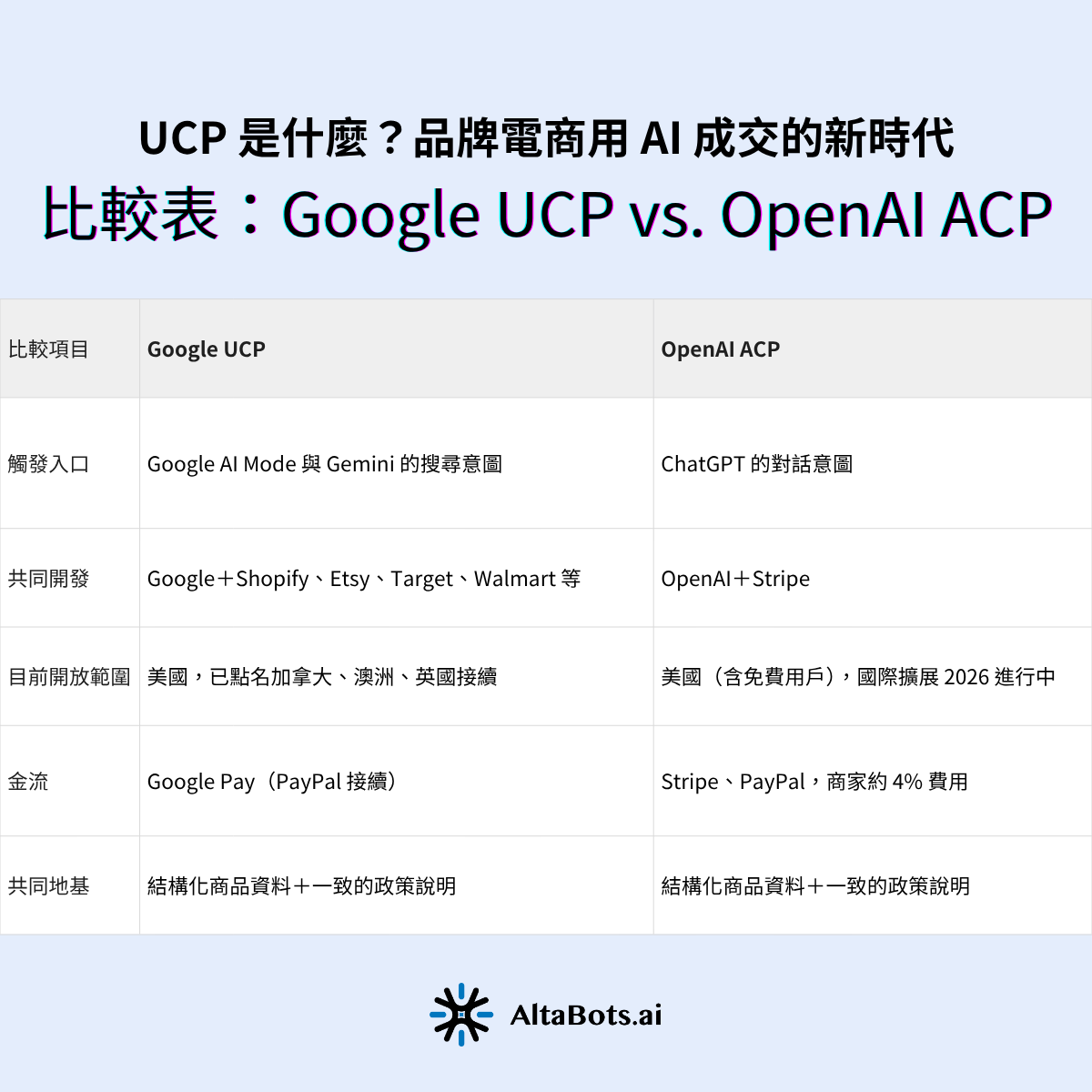
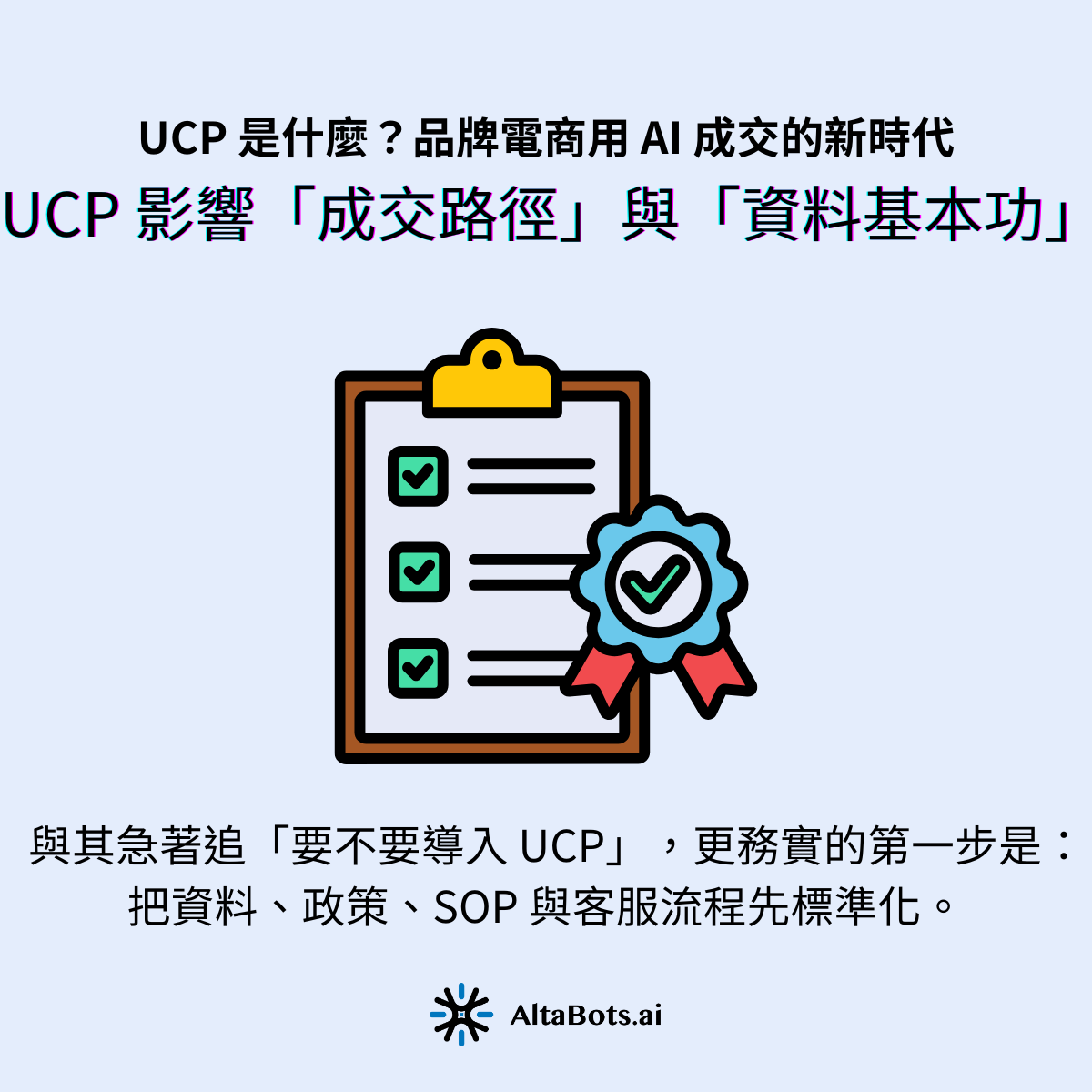
The practical approach: both protocols are built on the same foundation of "structured product data plus consistent policy descriptions". Get this layer right, and whichever of UCP or ACP opens in Taiwan first, you can connect faster. So the work now is not to pick a side but to get your data fundamentals to the point where "both can connect".
Taiwan e-commerce brand owners cannot use UCP Yet. do they need to prepare?
Key point: you cannot use it yet, but the decision window is only 6 to 12 months.
The checkout features of both UCP and ACP are currently open only to US merchants. Even if a Taiwan brand wanted to connect, there was no official channel as of mid-2026 [1][9]. But this does not mean you can wait until "the day it opens", for three reasons.
First, global expansion is only a matter of time, and the timeline is already concrete. In May Google named Canada, Australia and the UK as the next wave [8]. Shopify is a UCP co-developer with millions of merchants worldwide, and Taiwan's Shopify sellers can usually follow within a few months of a spec being released.
Second, cross-border e-commerce is already affected. If you sell to the US market through Shopify or Etsy, your products in theory already have a chance of being purchased through ChatGPT's Instant Checkout, provided that your return policy and shipping information are complete and structured on the US back end. In the cross-border e-commerce cases we have advised, we found that "return policy consistent across languages" alone affects the AI recommendation ranking of cross-border orders.
Third, the "data foundation" is also immediately useful in the domestic market. Google AI Overview launched in Taiwan in October 2024 and has supported Traditional Chinese since May 2025, and AI Mode has supported Traditional Chinese since October 2025 [10]. This means your product information and policies are already being read and compared on Google's AI interfaces in Taiwan, even though they cannot yet trigger checkout directly. Putting them in a format "AI can understand" improves your current AI recommendation performance even before UCP opens in Taiwan.
There is an easily overlooked shift here: in the age of AI summaries, "ranking on the first page" no longer means someone clicks through. When consumers ask "how do I handle returns for this product?", AI often finishes the answer on the search page itself, and users do not need to click at all. For a brand, instead of only competing on ranking, it matters more to make your product and policy content "clear enough in structure to be cited by AI". If cited, the brand at least still appears in the answer; if absent, it disappears completely.
5 things brand owners can do now (no coding needed)
Key point: whichever protocol opens in Taiwan first, you will use all five.
If you treat UCP and agentic commerce as a "future channel change", the fundamentals most worth investing in now are the ones common to every protocol. For further approaches, see our Industry Trends Article Series.
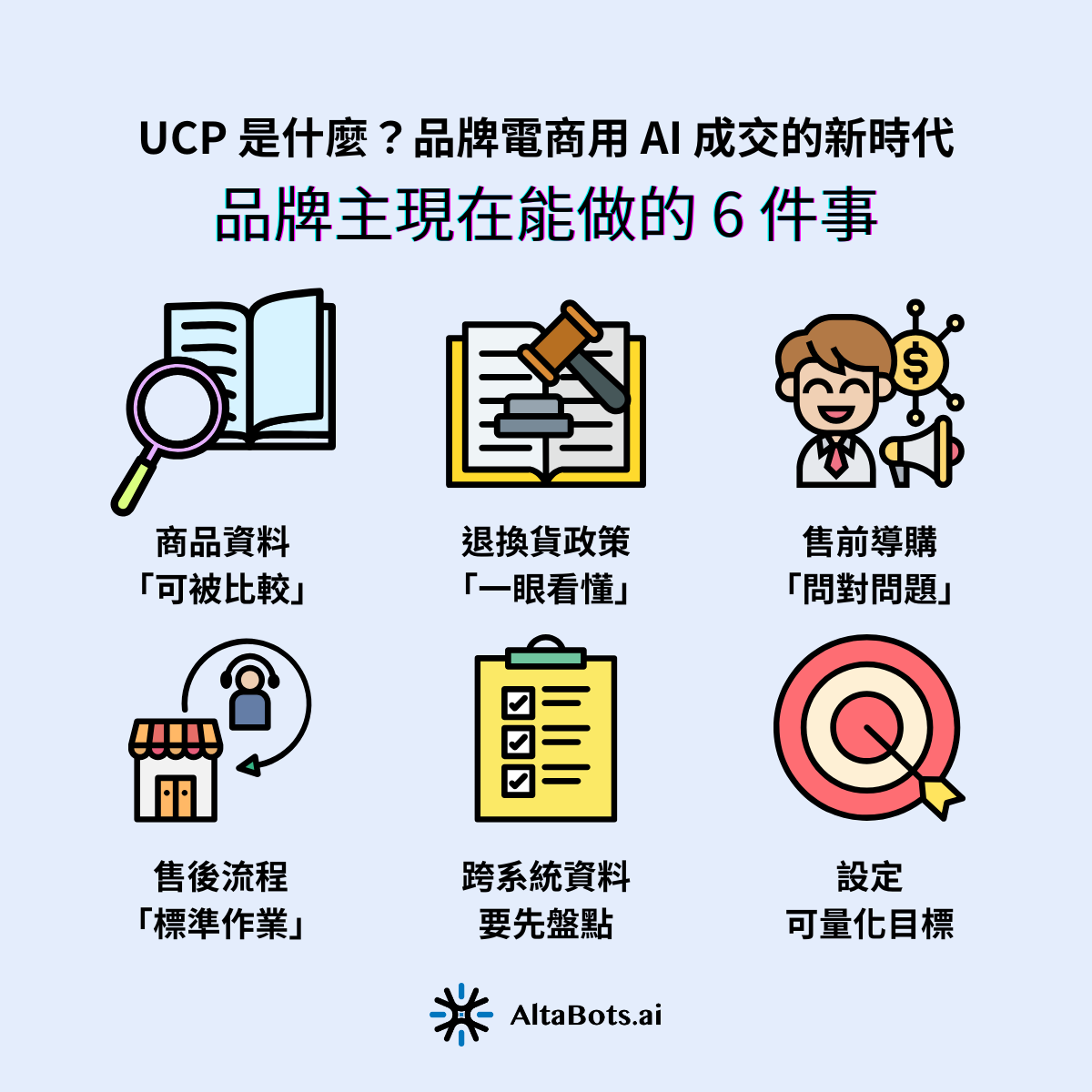
- Make product data "comparable by AI": clear specifications (size, material, capacity, use cases; the more specific the better), complete variants (color, size, style), and prices and inventory updated in real time. This is already a hard requirement in UCP's Catalog specification.
- Make shipping and return policies "clear at a glance": state delivery timelines, shipping fee thresholds and delivery areas clearly; do not bury return conditions, refund times and restrictions on special categories at the bottom of the terms; keep your own website, Merchant Center and third-party platforms consistent across all three.
- Make pre-sales guidance "ask the right questions": turn guidance from "throwing a pile of products" into "clarifying the need first": purpose, budget, preferences and constraints. If your website can also handle customers this way, AI is more likely to list you as a priority candidate that is "complete in information and suitable to recommend".
- Make after-sales processes "standard operating procedures": order status, address changes, cancellations, returns and exchanges, invoices and warranty. The more clearly they can be written as SOPs, the better suited they are to having AI help route and automate them.
- Take inventory of cross-system data first, without rushing to integrate: at the least, know which system holds products, orders and customer service records. In the future, AI needing data and not finding it is the easiest trap to fall into now. To connect omnichannel data in one go, see our 5-Step Guide to Omnichannel Integration (OMO).
How does AltaBots.ai help turn your SOPs into a format AI can read?
Key point: what gets stuck is usually not technology but data scattered everywhere and SOPs that were never written down.
UCP is a standard and an ecosystem trend. Where brands really get stuck is often data scattered across different people, SOPs that were never written down and cross-department collaboration that is jammed, so even when AI arrives it does not know how to answer.
A common scenario: a consumer asks ChatGPT or Gemini "how do I handle returns for this product?", and the AI pulls the return policy from your website. But if your return policy is scattered across "customer service FAQ", "the bottom of the product page" and "member terms", with inconsistent versions, the answer the AI picks up will be incomplete or contradictory.
AltaBots.ai is an enterprise no-code AI Agent platform that can consolidate this kind of "SOPs, policies and knowledge scattered in many places" into a structured format AI can read in real time. But the point of difference is not the "No Code" tool feature. It is that consultants work alongside you early on to take inventory of the data and design the process, which is usually what small and mid-sized e-commerce businesses lack most. When UCP opens in Taiwan in the future, or when you want to connect to ChatGPT's Instant Checkout, the AI interface will get consistent, credible, explainable answers. To see how the platform works, read How Enterprises Build AI Agents with No Code.
Next step: a free 30-minute AI checkout readiness assessment
Key point: first clarify how many steps you are from being "able to connect to UCP or ACP".
Every e-commerce brand's AI checkout readiness is different: some are stuck on return policies that differ across platforms, some on product specifications that are too vague, and some on after-sales SOPs not yet structured. If you want to clarify how many steps you are short, Data-DI offers a free 30-minute AI checkout readiness assessment, where consultants review the completeness of your product data, the consistency of your policies and how structured your customer service processes are, and give refinement suggestions you can act on immediately for your actual situation. You do not need to prepare data in advance; just give us your URL and the tools you currently use.
Book a free 30-minute assessment and get your "AI checkout readiness" done early.
References

[1] Google. (2026). A new generation of open standards and AI tools for agentic commerce (in Chinese). Google Blog.
https://blog.google/products/ads-commerce/agentic-commerce-ai-tools-protocol-retailers-platforms/
[2] Baymard Institute. (2026). Cart Abandonment Rate Statistics.
https://baymard.com/lists/cart-abandonment-rate
[3] eMarketer. (2026). FAQ on Agentic Commerce: How Brands Should Act Now.
https://www.emarketer.com/content/faq-on-agentic-commerce-how-brands-should-act-now-compete-ai-driven-landscape
[4] Salesforce. (2026). State of Marketing 2026 (share of AI orders in the 2025 holiday season).
https://www.salesforce.com/news/
[5] McKinsey & Company. (2025). The Agentic Commerce Opportunity.
https://www.mckinsey.com/industries/retail/our-insights
[6] Google for Developers. (2026). Universal Commerce Protocol (UCP) Overview.
https://developers.google.com/merchant/ucp
[7] Google. (2026). AI shopping gets simpler with Universal Commerce Protocol updates (March 19).
https://blog.google/products-and-platforms/products/shopping/ucp-updates/
[8] Google. (2026). New UCP features and AI tools (Google Marketing Live, May 20) (in Chinese).
https://blog.google/products-and-platforms/products/shopping/shopping-updates-google-marketing-live/
[9] OpenAI. (2026). Buy it in ChatGPT: Instant Checkout and the Agentic Commerce Protocol.
https://openai.com/index/buy-it-in-chatgpt/
[10] Google. (2025). Google Search officially launches AI Mode in Traditional Chinese in Taiwan (October 8) (in Chinese).
https://blog.google/intl/zh-tw/products/explore-get-answers/ai-mode-zhtw/
FAQ
FAQs about this article
Put simply, what problem is UCP (Universal Commerce Protocol) solving?

UCP is an open standard developed by Google with more than 20 international retail and payment companies, letting AI agents talk to all merchants in one common language and removing the break where, after AI recommends a product, the user must jump back to a website to check out. Think of it as the USB-C of commerce.
How do UCP and Agentic Commerce relate?
Agentic commerce is the goal: AI does more than answer questions. It can filter products, confirm conditions, complete the purchase and handle after-sales on the user's behalf. UCP is the common language that makes this work across platforms. It defines how AI agents, merchant systems and payment services communicate, so an agent does not need a custom integration for every store.
Is UCP an either-or choice with OpenAI's ACP, or should they be used together?
Both are open standards for AI-driven sales, and the difference is the entry point: UCP captures search intent in Google AI Mode and Gemini, and ACP captures conversation intent in ChatGPT. The point is not to pick a side but to first put product data and policies into a structured, consistent format so you can connect to both in the future.
What important new capabilities did UCP add in March 2026?
In March 2026 it added three capabilities: a multi-item cart, a live product catalog and identity linking. In May it launched Universal Cart across Search, Gemini and Maps, named Canada, Australia and the UK for expansion, and extended to hotel booking and food delivery.
Taiwan e-commerce brand owners cannot use UCP yet. Do they need to prepare now?
Yes. UCP and ACP are currently open only to US merchants, but the global expansion timeline already names Canada, Australia and the UK, and cross-border sellers are already affected. Putting product data and policies into an AI-readable format is immediately useful for current Google AI recommendations too.
More articles


訂閱我們的電子報
每月 8 日定期發送最新趨勢與實用資訊!



