

Shopify cart abandonment: 5 recovery methods and 2026 data | Alta.DI
The 2026 average Shopify cart abandonment rate is 70.22%. Using Baymard data, we break down four causes and compare five recovery methods, such as recovery emails and AI customer service, by conversion rate and cost for cross-border brands.


On Monday morning you open your Shopify back office. Yesterday there were 48 abandoned carts and only 3 completed orders. You spent 20,000 on ads, 80 people reached the checkout page, and 6 of them paid... You are not sure whether to fix the checkout page first, send recovery emails first, or find out why so many people are leaving.
This is the daily reality for Shopify sellers worldwide, and it does not mean your store is broken. The good news: of the roughly 70% of carts that are abandoned, 10–20% can be recovered, provided you know what to fix first, which methods to use, and in what order. This article breaks the abandoned cart problem into four questions: whether your abandonment rate is normal, why shoppers leave, which recovery methods give the strongest return for the cost, and how to keep those methods from working against each other.
What is a normal Shopify cart abandonment rate? The 2026 industry benchmark
The 2026 global average e-commerce cart abandonment rate is 70.22%. Of every 10 people who put an item in their cart, only 3 reach payment. Baymard Institute arrived at this figure by aggregating 50 independent studies, and it is the widely accepted industry benchmark [1].
Two points deserve attention from cross-border sellers.
First, the mobile abandonment rate is as high as 73–78%, compared with 62–68% on desktop [2]. For DTC brands that drive traffic from Meta, TikTok, and IG, most visitors arrive in a high-abandonment environment from the start, so recovery strategies cannot be designed for desktop alone.
Second, because Shopify has improved its checkout experience over a long period, its average abandonment rate is about 67–70%, roughly 2–3 percentage points below the industry average [3]. If you use Shopify and your abandonment rate is still above 75%, the problem usually lies in shipping cost transparency, the checkout flow, trust signals, or customer service response speed rather than in the platform itself.
Over the past decade the abandonment rate has stayed around 70%. Checkout technology has kept improving, yet the figure has not fallen noticeably [1]. Abandonment will not disappear, but the 10–20% that can be recovered is real revenue. Your goal is to win those shoppers back, not to push abandonment to zero.
Why is the Shopify abandonment rate so high? Four overlooked causes
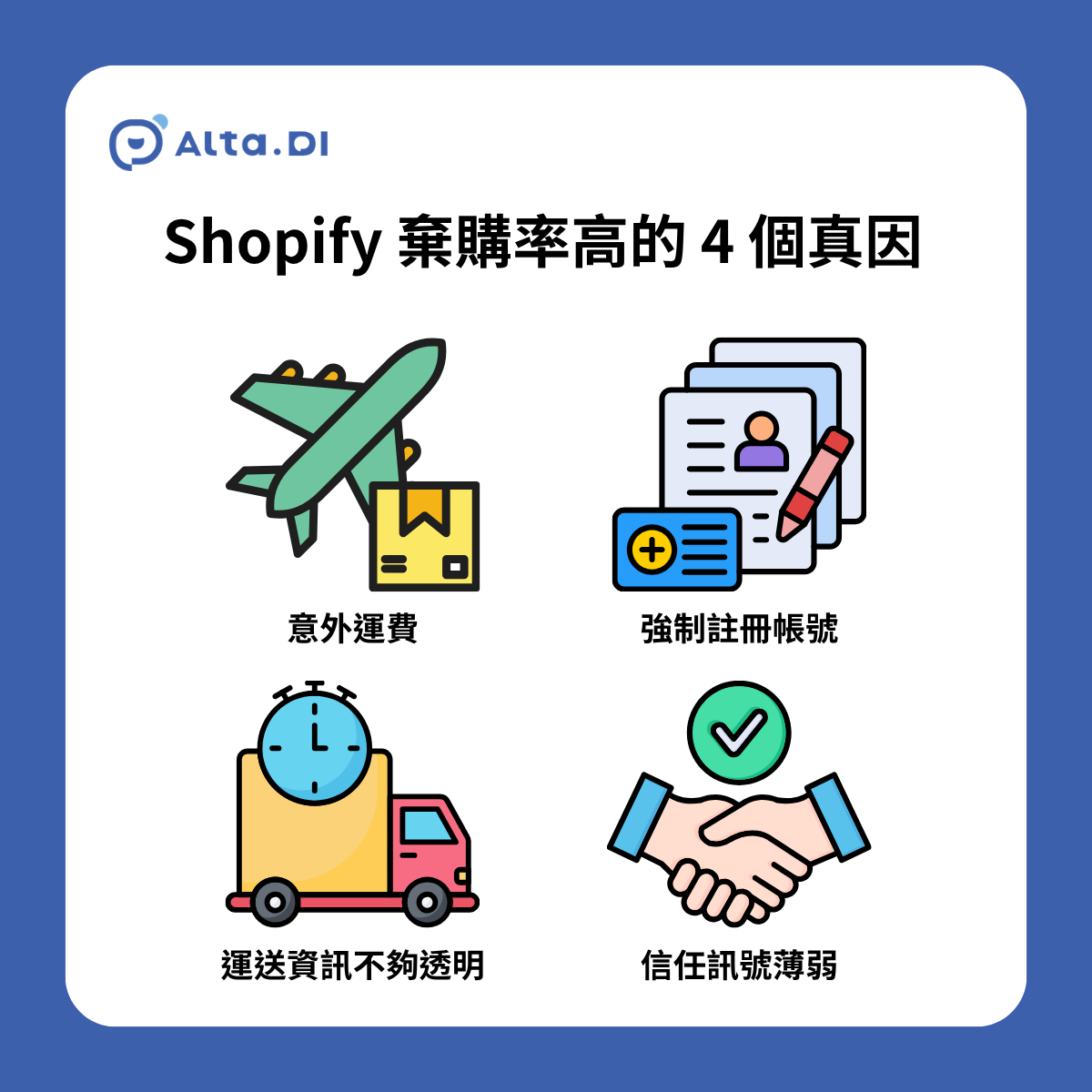
Shoppers abandon checkout for reasons far more complex than "too expensive." It is the result of four structural problems acting at the same time.
Unexpected costs are the broadest cause of abandonment.
When shoppers reach the checkout page and discover that shipping, tax, or fees raise the total price, 40% of them leave immediately [1]. Cross-border DTC brands run into this easily. For example, a product page shows US$30, but the checkout page adds US$12 in international shipping and US$8 in tax, and the price suddenly rises by 67%. Rather than pushing shipping costs down, it is more effective to disclose shipping information on the product page or in the cart, which removes the psychological gap of finding out only at checkout.
Forced account registration makes 18% of shoppers give up [1].
International buyers are more cautious about leaving personal data on an unfamiliar site. Shopify supports Guest Checkout natively, but many sellers turn it off to collect member data. That trades the abandonment rate for a contact list, which usually does not pay off.
Unclear delivery information makes 20% of shoppers leave [1].
"Truly slow" and "unclear when it will arrive" are often confused. If a cross-border brand writes only a vague range such as "7–14 business days," shoppers assume the worst case. Stating "US 5–7 days, Europe 7–10 days, shipping refunded if late" can instead reduce abandonment.
The fourth cause is weak trust signals.
To European and American shoppers, your site may be the first Asian brand they have heard of. There is no local reputation to refer to, and they have no way of judging whether the return process is reliable. Concrete ways to reinforce trust include SSL badges, familiar payment options such as Shop Pay or PayPal, real customer reviews, a complete and clear returns and exchanges policy, and a customer service channel that can answer questions immediately.
If time and resources are limited, start with two things: shipping cost disclosure and guest checkout. One is a product page copy change and the other is a back-office setting, so both cost little to change, yet they cover the two largest shares among the causes of abandonment. After front-end prevention is done, move on to the post-abandonment recovery strategies in the next section.
How do you choose among five abandoned cart recovery methods?
Recovery emails, SMS and WhatsApp reminders, checkout popups, AI customer service intervention, and ad retargeting: the conversion rates of these five methods range from 3% to 17%, and combining them performs 2–3 times better than a single channel [3][4]. When choosing, look at when each method can act, what it costs, and which shoppers it reaches, rather than ranking by conversion rate.
You do not need all five methods. Based on your current resources, pick two or three and get them running first.
The other three methods each have their own use cases. SMS and WhatsApp reminders go straight to the consumer's phone, but they require phone numbers to be collected in advance and commercial messaging rules differ by country, so they suit brands that have already built an SMS list. An exit-intent popup appears with a free shipping or small discount offer as a shopper is about to close the page. Its conversion rate is about 3–5% and it has a low setup threshold, but showing it too often irritates visitors, so we recommend triggering it at most once per visitor within 24 hours. Ad retargeting uses Meta or Google to serve dynamic product ads to shoppers who abandoned carts, and ROAS is usually better than for cold-traffic ads, provided your abandonment pixel has accumulated enough audience data.
Below, we look at the two methods most worth prioritizing.
Abandoned cart email sequence: the entry-level method with the highest ROI
An abandoned cart email sequence automatically sends 2–3 reminder emails on a timeline after a shopper abandons checkout. In 2026, sellers who perform well average a recovery rate of 10–15%. Abandoned cart emails have an open rate of 50.5%, more than double that of typical marketing emails, and each recipient generates US$3.65 in recovered orders on average [4].
We suggest a three-step timeline. Send the first email within 1 hour of abandonment, when the shopper still remembers what they looked at and purchase intent remains. Send the second after 24 hours, adding social proof or product reviews. Send the third after 72 hours, paired with a small discount as a final push. A three-step sequence recovers about 65% more than a single email [3].
Cross-border brands should keep three things in mind when running abandoned cart emails. Send times follow the buyer's time zone, not the seller's, and an email that arrives at 3 a.m. US Pacific time sees its open rate drop by half. The language should match the product page; an English site should write in English. Abandoned cart emails with AI-generated dynamic subject lines and product recommendations convert at 8.17%, about double the 4.1% of standard template emails [4].
The biggest limitation of abandoned cart emails is that iOS privacy policies and Gmail's tabbed inbox keep pushing reach down. This is why front-end prevention gets more attention than after-the-fact recovery in 2026, but abandoned cart emails remain the entry-level method whose ROI is easiest to measure. If your abandoned cart email open rate is below 40%, first check whether the subject line includes the product name and a specific amount. These two elements usually affect open rates more than the size of the discount.
Real-time AI customer service intervention: the only method that reaches shoppers before they abandon
Real-time AI customer service intervention is a recovery mechanism in which, when a shopper lingers too long on the checkout page or repeatedly views the cart, an AI Bot starts a conversation, answers questions, or recommends alternatives. In 2026, the recovery rate for intervention before abandonment is 6–10% [4]. Beyond answering automatically, the key value of AI customer service is reaching the shopper within the 60 seconds before abandonment, a moment email and SMS cannot reach.
For AI customer service to really influence checkout decisions, cross-border brands need to handle three practical problems at the same time. First, buyers may move back and forth between the Shopify site, Messenger, IG DMs, and TikTok Shop messages. If customer service data is scattered across five tools, there is no way to tell whether "this person is the one who asked about sizing a moment ago." Second, cross-border customers come from different countries, so the AI must be able to respond in multiple languages such as English, Japanese, Spanish, and Traditional Chinese, with conversation ability that handles actual business tasks. Third, AI customer service must be able to look up the shopper's cart contents and past orders in real time. Otherwise it can only answer FAQs and cannot really move a shopper to checkout.
Together, these three conditions explain why a ticketing system or a single-channel marketing tool on its own has trouble making a real difference in the 60 seconds before abandonment.
How do cross-border brands do it? Two cases
The two brands take different approaches, but the logic behind them is the same: consolidate customer data into one profile first, then talk about automation.
Canadian lighting brand Nanoleaf names each product, so its recovery emails say "Isabella is still waiting for you" instead of "You forgot to check out." Using storytelling, it raised its recovery rate to 30%, far above the industry average of 10–15% [8]. This strategy works because their site behavior data is integrated with the email system, so they know who viewed which product and for how long.
Anker rebuilt 16 cross-border standalone sites in three months on Shopify Plus. Each market uses its local language, local currency, and local payment methods (Shop Pay in the US, Klarna in Europe, Konbini in Japan), which removes at the source the cause of abandonment where shoppers are scared off at checkout by an unfamiliar currency and extra fees [10]. The two cases differ in scale and resources, but the logic is the same: first reduce the friction points that make shoppers hesitate during checkout, then use automated flows to win back those who have left.
The point of these cases is a more basic question than which tool to choose: do your Shopify order data, email tool, customer service system, and ad platform still run separately, or can they recognize the same customer? A typical symptom of scattered data is that ads keep chasing a customer who just bought, or emails keep nagging a customer that customer service just calmed down. Most email automation tools and ticketing systems integrate data only from their own channels. To make all automation decisions based on one customer profile, you need another layer of omnichannel data integration.
How does Alta.DI help Shopify sellers recover abandoned carts?
Our logic for abandoned cart recovery differs from most tools. Most email automation or ticketing systems look at data from only one channel at a time. Alta.DI first brings in order and product data from store platforms (Shopify, Shopline, WooCommerce, TikTok Shop) and also integrates messaging channels such as Messenger, IG, WhatsApp, LINE, and LiveChat, so every interaction is attributed to the same customer profile.
With this integration layer, abandoned cart recovery goes beyond sending an email. The Alta.DI back office includes built-in marketing automation templates such as "Abandoned Cart Recall" and "Abandoned Checkout Discount," which run automatically once you set the trigger conditions, so you do not have to build flows from scratch. Behavior data such as which products a shopper viewed on your standalone store, how long they stayed, and what is in the cart is fed into the AI conversation context automatically through our behavioral context technology. When the Bot steps in, it can talk directly about "the item you just viewed is now discounted," rather than sending a generic canned greeting.
On-site, Alta.DI uses popups and Bot bubbles to intercept shoppers at the moment they hesitate. Off-site, it reaches people who have already left through email, WhatsApp, SMS, and LINE. Once a shopper has been reassured or has completed a purchase on one channel, pushes on other channels pause automatically, so situations such as "customer service just replied and the ads are still nagging" do not occur.
For cross-border DTC brands that run a Shopify standalone store and several social channels, you do not have to buy an email tool, a customer service system, and marketing automation separately and connect them yourself. One tool can cover the full process from intercepting shoppers before abandonment to winning them back afterward.
Want to know where your Shopify abandonment funnel is stuck?
Every cross-border brand's abandonment problem is different. Some are stuck on shipping cost transparency, some on customer service response speed, and some on multi-channel data that cannot be integrated. If you want to pin down where your abandonment funnel is actually stuck, Data-DI offers a free 30-minute cross-border e-commerce diagnostic, in which a consultant reviews your current abandonment flow, existing tools, and the changes you can make right away. You do not need to prepare data beforehand; just give us your site URL and the tools you currently use.
References

[1] Baymard Institute. (2026.03). 49 Cart Abandonment Rate Statistics: Aggregated from 50 Studies. Baymard Institute.
https://baymard.com/lists/cart-abandonment-rate
[2] Dynamic Yield. (2025.01). Ecommerce Benchmarks: Mobile vs Desktop Abandonment Rates. Dynamic Yield Resources.
https://www.dynamicyield.com/benchmarks/
[3] Shopify. (2026.01). Abandoned Cart Emails: Examples, Best Practices & Recovery Strategies. Shopify Blog.
https://www.shopify.com/blog/abandoned-cart-emails
[4] Klaviyo. (2026.01). Abandoned Cart Email Performance Benchmarks 2026. Klaviyo Marketing Resources.
https://www.klaviyo.com/blog/abandoned-cart-benchmarks
[8] Rejoiner. (2024.01). How Nanoleaf Recovers 30% of Abandoned Carts with Storytelling Emails. Rejoiner Resources.
https://www.rejoiner.com/resources/nanoleaf-abandoned-cart-email-case-study
[10] Shopify. (2024.01). How Anker Replatforms 16 Cross-border Ecommerce Sites in Three Months on Shopify Plus. Shopify Plus Case Studies.
https://www.shopify.com/case-studies/anker
FAQ
FAQs about this article
How is the Shopify cart abandonment rate calculated?

The abandonment rate is (number of people who created a cart minus number who completed checkout) divided by the number who created a cart, multiplied by 100%. You can see your actual figure in the Shopify admin under Analytics reports and compare it with the industry average of 70.22%.
When should abandoned cart emails be sent to be most effective?
A three-step sequence works best: the first email within 1 hour of abandonment, the second after 24 hours, and the third after 72 hours. A three-step sequence recovers about 65% more than a single email. The first email converts best, but the accumulated recovery value of the last two is usually larger.
Is cross-border cart recovery done the same way as domestic recovery?
No. Cross-border recovery requires extra work on time zone alignment, multilingual copy, shipping cost transparency, and cross-platform payment integration. Open rates for abandoned cart emails that land in the middle of the buyer's night drop by half, and recovery copy produced by machine translation converts noticeably lower than localized versions.
Which channels can automatically recover Shopify abandoned carts?
There are five main ones: abandoned cart email sequences, SMS and WhatsApp reminders, checkout page popups, real-time AI customer service intervention, and ad retargeting. Combining them performs 2 to 3 times better than a single channel, and we suggest starting with abandoned cart emails and AI customer service.
What should you do first in abandoned cart recovery?
Start with front-end prevention: disclose shipping costs on product pages and turn on guest checkout. These two changes cost the least to make and affect the most shoppers. After that, build the abandoned cart email sequence and the AI customer service intervention flow.
More articles


訂閱我們的電子報
每月 8 日定期發送最新趨勢與實用資訊!



