

Multilingual AI customer service for cross-border e-commerce | Alta.DI
Orders come from around the world, but support is a few people in Taiwan? Using time zones, language and repeat questions, this article shows how Alta.DI covers 24-hour support with human-AI collaboration and translation, and what to check when choosing.


According to Gartner, conversational AI alone will save contact centers worldwide about US$80 billion in labor costs in 2026 [1]. For cross-border e-commerce, the question is no longer whether to adopt it, but how fast AI can pick up the order messages that nobody answers late at night and early in the morning.
Almost every cross-border brand has the same problem: orders come from around the world, but customer service is a handful of people in Taiwan. A Japanese customer ordering late at night, a European buyer checking out at dawn, a shopper who can only ask questions in Korean: every message that does not get an instant reply can be a lost order. The answer is not hiring a whole row of night-shift staff. It is letting AI take most routine questions first, so people can focus on the conversations worth their time. This article breaks down three real challenges in cross-border customer service and shows how Alta.DI uses human-AI collaboration and RAG to let a small team handle global orders.
Why can Taiwan's cross-border e-commerce customer service never catch up?
Cross-border customer service usually overloads in three places. These are the patterns we see most often after working with a number of cross-border brands.
First, the market. According to 2026 statistics from the Future Distribution Institute (未來流通研究所), in 2025 the total volume of small imported cross-border e-commerce parcels in Taiwan grew 11.4% year over year to more than 65 million, and import value grew 14.7% to NT$75.2 billion, both record highs [2]. Taiwanese consumers already treat cross-border shopping as routine, and the market willing to order from overseas keeps growing. The problem is that orders grow while profit does not, because the customer service team gives out first.
Time zones: your customers are awake, your agents are asleep
Japanese shoppers peak between 9 p.m. and 1 a.m. Taiwan time, and European and American buyers do not become active until late at night in Taiwan. Keeping people on call around the clock lets labor costs eat the margin, while leaving messages unanswered costs even more. According to Zendesk's 2026 customer experience trends report, 74% of consumers expect brands to offer round-the-clock support, and 85% of customer service leaders say that customers start considering leaving if their issue is not resolved at first contact [3]. Miss that response window and the urge to buy fades, and the order goes with it.
Language: every extra market adds a layer of communication cost
When a business spans Japan, Korea, Southeast Asia, Europe and the US, each additional language adds another layer of cost. Many brands outsource translation or hire multilingual staff, but human translation is slow, hard to do in real time, and different translators make it hard to keep a consistent brand voice. More troublesome still, cross-border service needs more than correct words. Terms such as return policy, customs duties and shipment tracking call for "translators who know the product", not "translators who know the language".
Repeat questions: the few questions that eat most of the team's time
This is the biggest drain on the team. Low-value, highly repetitive questions such as "Where is my parcel?", "How do I send a return?" and "Why won't my discount code work?" take up most of the agents' time and leave none for the VIP customers who actually buy again. A Gartner study published in 2025 predicts that as Agentic AI matures, by 2029 AI will autonomously resolve about 80% of common customer service issues without human intervention [4]. In other words, brands that start building an AI customer service structure now are securing a structural advantage early. And while the team is busy with repeat questions all day, high-value pre-sales inquiries and complaint handling can only wait in line.

How Alta.DI supports 24-hour global customer service
Alta.DI combines autonomous AI agents, RAG (Retrieval-Augmented Generation) and multilingual translation so that customer service can run 24 hours a day. The aim is not to replace people with AI, but to use human-AI collaboration so that AI serves as the front-line filter and clears the two barriers of time zone and language first.
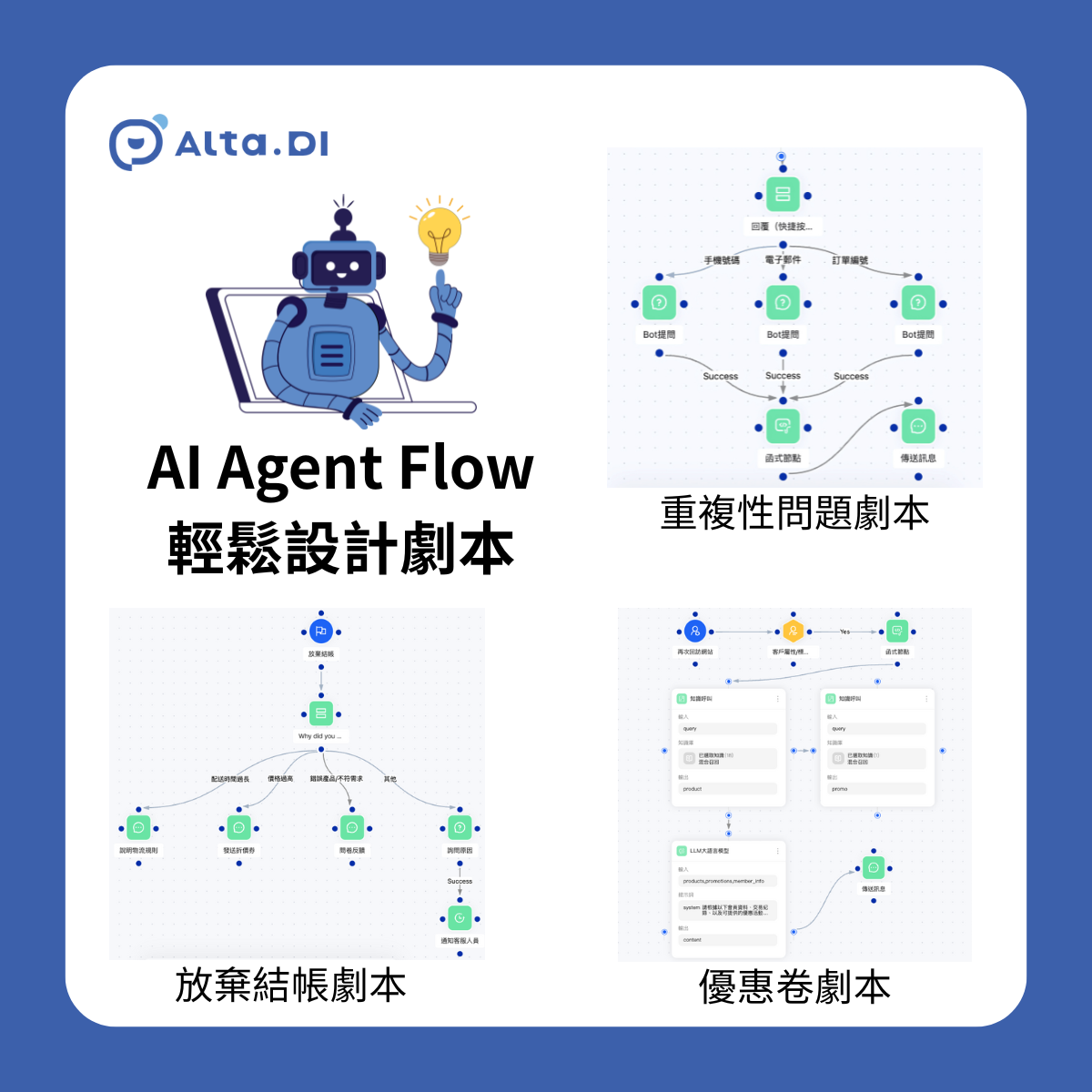
AI agent and human collaboration: AI holds the front line, people take high-value conversations
Human-AI collaborative customer service is a hybrid service structure in which AI handles routine questions and people focus on high-value conversations, with clear roles and smooth handover between the two. Its value lies in accurate routing.
Take the payment company Klarna as an example. It once said publicly that its AI customer service handled a monthly volume equal to hundreds of full-time staff, which sparked discussion in the industry. Later, it found that AI alone handles routine questions very efficiently, but customer satisfaction dropped on complex complaints and high-value pre-sales inquiries. In the end, Klarna brought human agents back to focus on high-value interactions.
This turn matches Alta.DI's approach: good automation is built on human-AI collaboration. The system identifies conversation intent automatically, and when it meets complex emotions or high-potential sales opportunities, it hands over smoothly to the human team, so the efficiency of AI and the warmth of people each go where they belong.
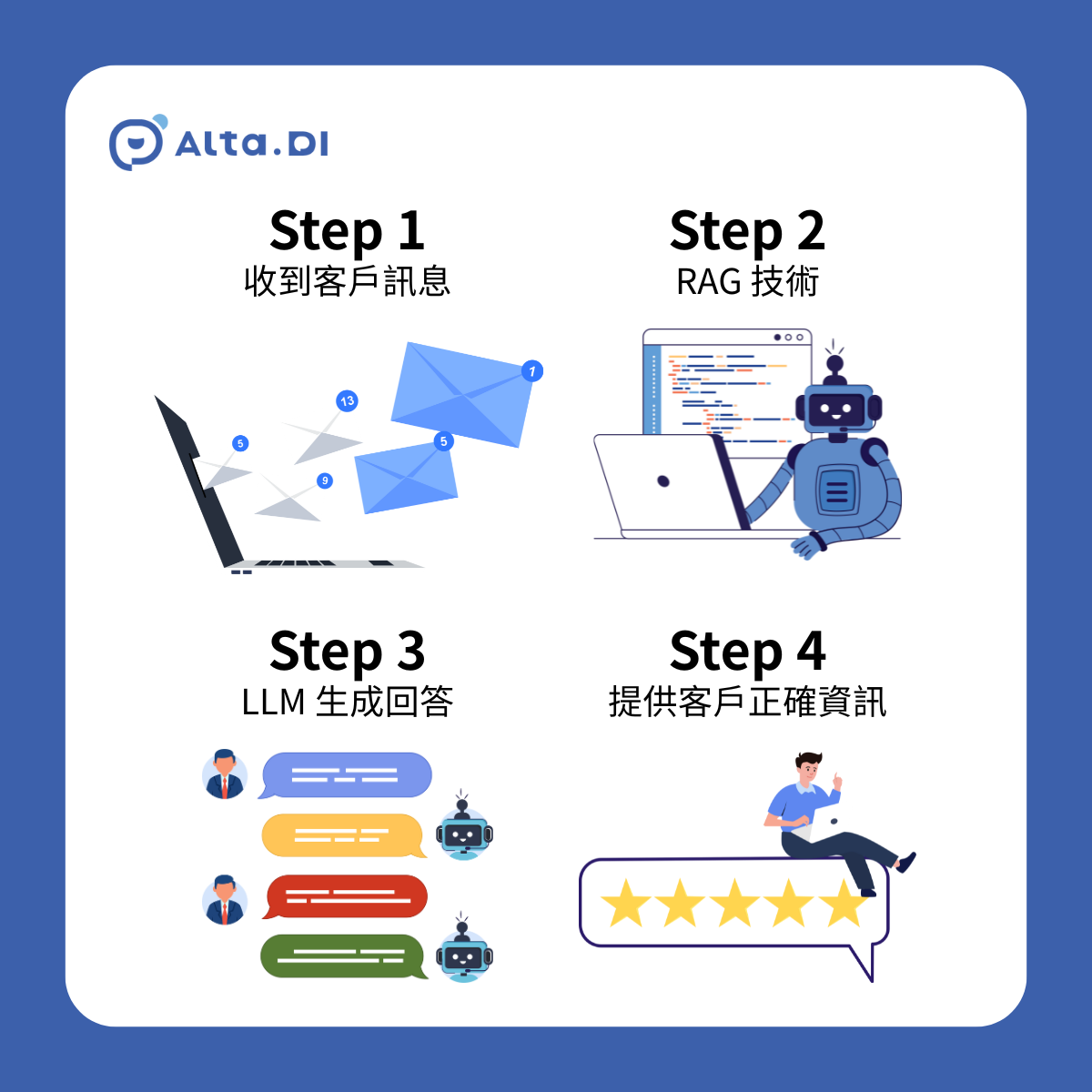
RAG: make AI answer only from your knowledge base, no empty promises
RAG (Retrieval-Augmented Generation) is a technical architecture in which AI answers only from a company's own knowledge base. Its purpose is to eliminate AI hallucinations and make sure every reply follows the brand's return policy and service rules, which suits cross-border service where accuracy matters most.
Traditional chatbots tend to make wrong promises, while an AI with RAG understands context and gives correct answers. When a customer asks about the return period, the system pulls the answer straight from the policy documents you uploaded instead of making one up. This is the most important basis of trust in cross-border service.
When the brand's own knowledge base is complete enough, the AI can answer accurately like a senior employee and block a large share of tickets for the team. The more complete the knowledge base, the higher the share of tickets the AI intercepts, and the more high-value issues the team can handle. For technical details, see RAG and Knowledge Base Use Cases.
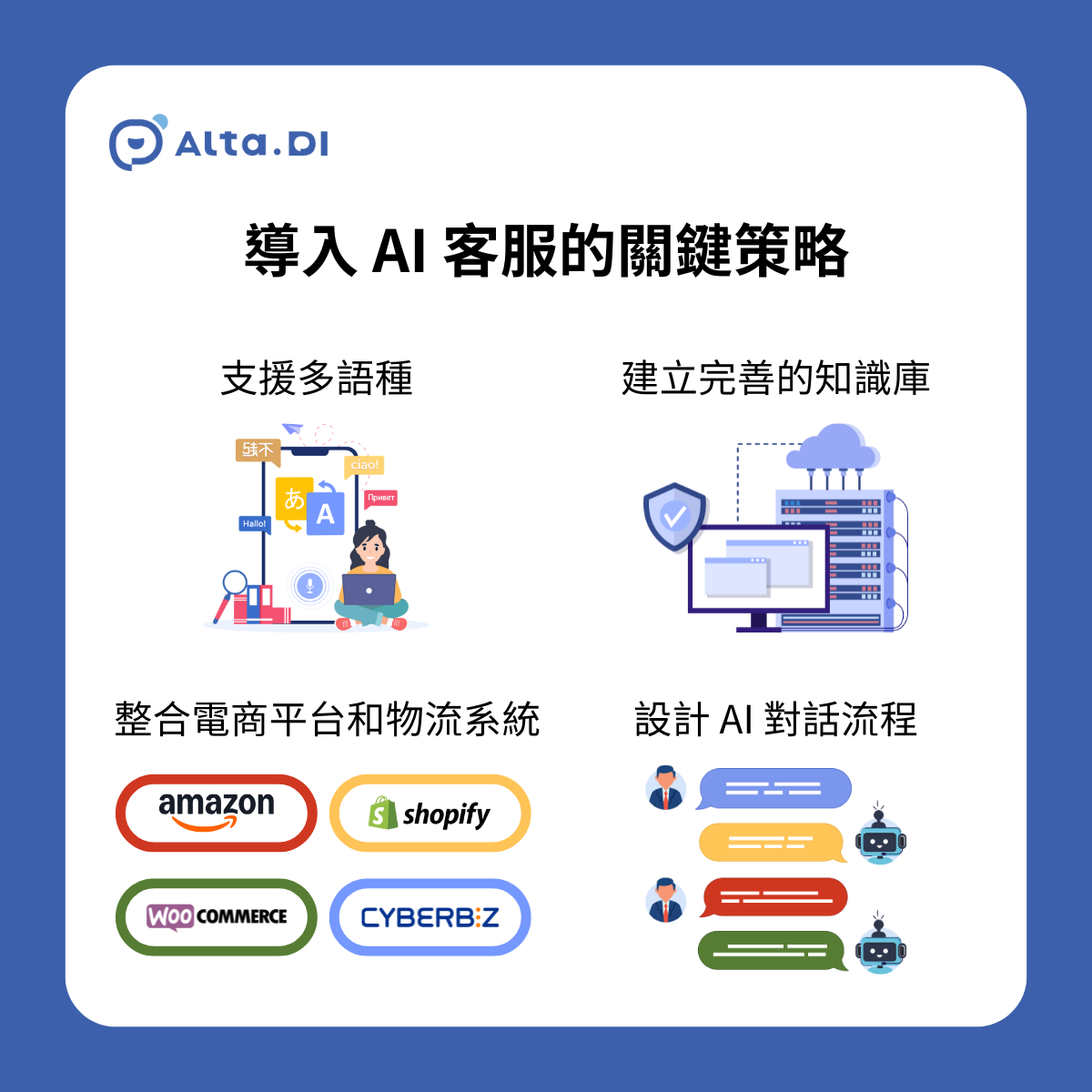
Multilingual support: one team in Taiwan, orders from around the world
The Alta.DI platform has built-in live translation in more than 50 languages, so a single-language customer service team in Taiwan can still take order inquiries from many countries while keeping a consistent brand voice and e-commerce terminology.
When a Japanese customer asks about customs duties in Japanese, the system translates it into Chinese in real time so the Taiwan agent can understand it, or replies directly in natural Japanese that reflects local regulations. This is not word-for-word translation but context-aware semantic translation that matches cross-border e-commerce vocabulary, keeping the brand voice consistent across languages and building a sense of professional trust with overseas consumers. For cross-border sellers targeting the two high-traffic markets of Japan and Korea, this is often the line between keeping and losing a customer.

Omnichannel integration: one back office for conversations worldwide
Omnichannel integration is a customer service architecture that manages multiple messaging channels such as LINE, WhatsApp, the website and email in a single interface. It saves the time spent switching windows and suits e-commerce brands whose customers span several countries and use different messaging habits.
Messaging apps differ widely across overseas markets. Taiwan and Japan favor LINE, Southeast Asia prefers WhatsApp, and Europe and the US are used to email and live chat on websites. Making agents switch manually between platforms to reply not only makes messages easy to miss, it also slows response time.
According to Zendesk's 2026 customer experience trends report, 74% of consumers expect brands to provide round-the-clock support, and 76% say they are more willing to choose a brand if they can mix text, images and video in the same conversation thread [3]. Omnichannel integration is not only a technical issue but an experience design that decides whether overseas consumers stay.
With Alta.DI, your team logs in to a single back office to receive and reply to messages from everywhere. Beyond consolidating conversations, the system also tracks each customer's full history across channels, so consumers do not need to explain their problem again. This consistent, smooth service experience is the key to raising repeat purchase rates overseas
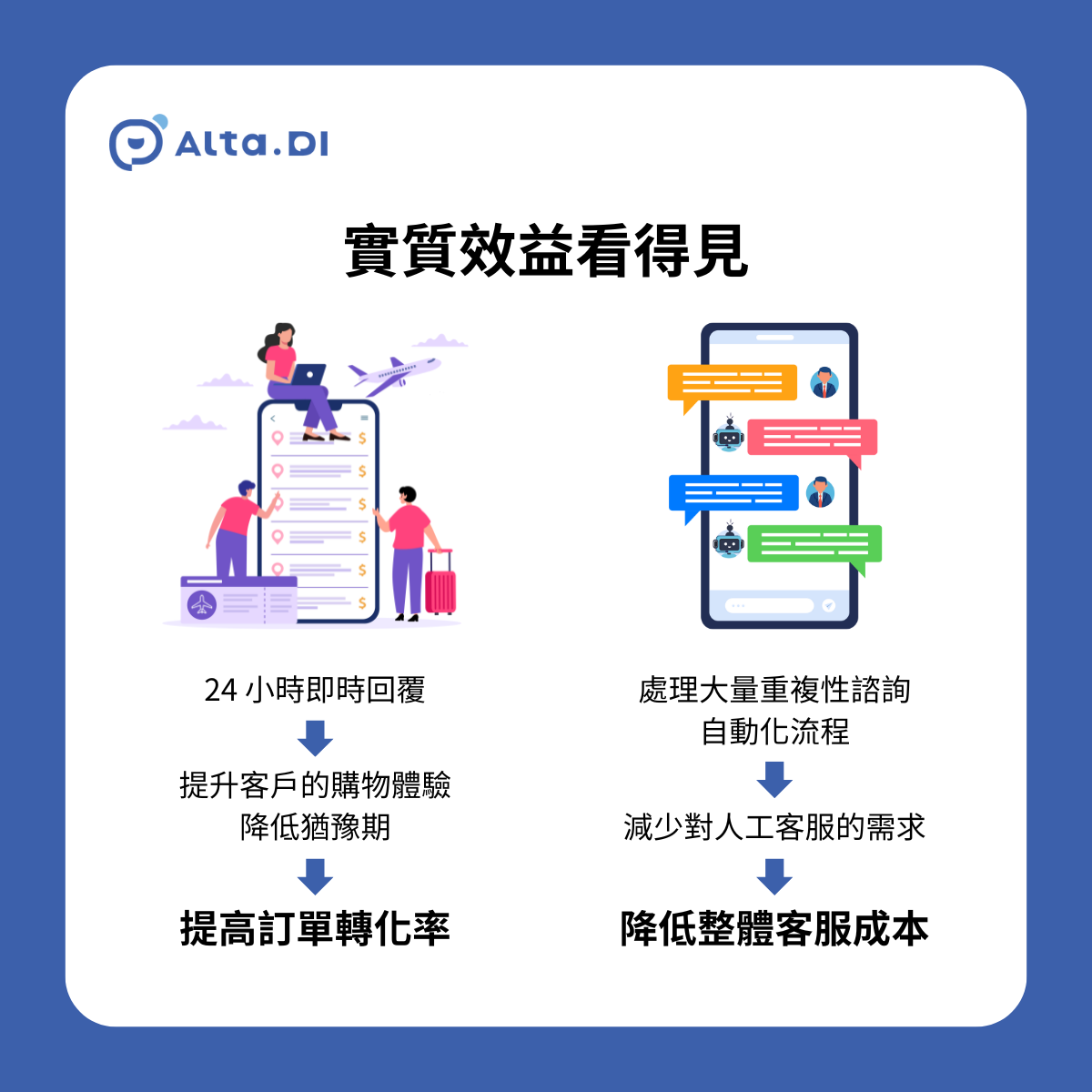
How should cross-border brands choose AI customer service? Look at results, and at these three things
When a cross-border e-commerce business chooses AI customer service, what matters is not how many features are listed, but whether it can handle your most practical scenarios: across time zones, languages and platforms, and still answer accurately. The following uses the real differences between Alta.DI and traditional human customer service to bring out three evaluation points.
Gartner's research predicts that by 2029 Agentic AI will autonomously resolve about 80% of common customer service issues and bring overall operating costs down by about 30% [4]. The meaning is direct: brands that build an AI customer service structure now are preparing for the scaled automation ahead.
But this does not mean the answer is to "hand everything to AI". The Klarna example has already shown that relying on AI alone for volume loses customers in complex situations. What to do instead is free up the existing team: when AI intercepts most routine tasks, your agents can proactively look after VIP customers, handle complex complaints and even do upselling. In the cases we have worked on, after the team had time to focus on high-value interactions, costs fell and revenue grew too. For detailed figures, see our Case Study: How an E-commerce Business Raised Repeat Purchases by 30%.
So when a cross-border brand in Taiwan chooses AI customer service, these three things are worth more attention than a feature list:
First, whether it is tied to a single channel. Many solutions tie pricing and capability to the LINE ecosystem. Once your customers are on WhatsApp, Messenger or email, or span time zones and languages, a solution built around one channel shows its limits. Alta.DI is positioned as channel-agnostic, with all channels and all data: wherever your customers are, customer service is there.
Second, whether multilingual support can truly be put into daily use. Whether it understands cross-border terms such as "refund period", "customs declaration" and "shipment tracking number" instead of translating them literally decides how much overseas customers trust you.
Third, what happens when it cannot answer a question. Does it make up an answer, or hand over to a person automatically? This directly affects whether the brand loses trust over a single wrong promise. For a fuller comparison of different architectures, see our AI Customer Service Selection Guide.
Spend your team's time where it counts
Competition in cross-border e-commerce is not only about front-end marketing but also about the service experience behind it. With orders arriving around the clock worldwide, the old methods of manual shift scheduling and outsourced translation cannot keep up with the pace of growth. Using Alta.DI so that AI agents handle cross-language translation and most routine inquiries, while the human team focuses on deeper interactions and winning back complaints, is a more cost-effective choice for cross-border brands in 2026.
Stop letting your team spend time on repetitive copy and paste. To get customer service out of overload and handle global orders with ease, you can book an Alta.DI consultation, or first read the Alta.DI AI customer service product page to learn the features. We will assess the most suitable adoption path based on your service volume and language needs.
References

[1] Gartner. (2022). Gartner Predicts Conversational AI Will Reduce Contact Center Agent Labor Costs by $80 Billion in 2026. Gartner Newsroom.
https://www.gartner.com/en/newsroom/press-releases/2022-08-31-gartner-predicts-conversational-ai-will-reduce-contac
[2] Future Distribution Institute (未來流通研究所). (2026). Key Data Analysis of Taiwan's Cross-Border E-commerce Imports and Exports (in Chinese).
https://www.mirai.com.tw/analysis-of-key-data-trends-in-taiwans-cross-border-e-commerce/
[3] Zendesk. (2025). Contextual Intelligence Becomes the New Standard for Exceptional Customer Experience in 2026. PR Newswire.
https://www.prnewswire.com/news-releases/contextual-intelligence-becomes-the-new-standard-for-exceptional-customer-experience-in-2026-302617972.html
[4] Gartner. (2025). Gartner Predicts Agentic AI Will Autonomously Resolve 80% of Common Customer Service Issues Without Human Intervention by 2029. Gartner Newsroom.
https://www.gartner.com/en/newsroom/press-releases/2025-03-05-gartner-predicts-agentic-ai-will-autonomously-resolve-80-percent-of-common-customer-service-issues-without-human-intervention-by-2029
FAQ
FAQs about this article
Which Taiwan-based AI customer service with multilingual support suits cross-border e-commerce?

Check three things: whether it is tied to a single channel, whether its multilingual support understands cross-border terms, and whether it hands over to a person automatically when it cannot answer. Alta.DI is channel-agnostic with all channels and all data, which suits brands whose customers span several countries.
How long does it take a cross-border e-commerce business to adopt AI customer service, and roughly what does it cost?
From signing to going live usually takes about 2 to 6 weeks, depending on how complete the knowledge base is. Pricing is a monthly subscription with no large IT build. We suggest booking a consultation to get a quote based on your actual service volume and language needs.
Can LINE, WhatsApp and website customer service be integrated in one back office?
Yes. Alta.DI omnichannel integration brings mainstream channels such as LINE, WhatsApp, website live chat and email into a single back office, and agents can see the same customer's cross-channel conversation history in one interface.
Can cross-border AI translation handle Japanese and Korean accurately?
Yes. The Alta.DI platform has built-in live translation in more than 50 languages and handles cross-border terms such as "refund period" and "customs declaration" instead of translating them literally. Japanese and Korean, the two high-traffic languages, are especially common.
What data do I need to prepare for a RAG knowledge base? Is it difficult?
No IT background is needed; you can work through a graphical interface. The core material includes return policies, shipping fees and logistics descriptions, FAQs and product specifications. The more complete the data, the higher the share of tickets the AI intercepts.
More articles


訂閱我們的電子報
每月 8 日定期發送最新趨勢與實用資訊!



