

Win back orders with AI customer service: 3 playbooks | Alta.DI
Traffic without repeat purchases is often a customer service problem: agents cannot see order data. This article covers three AI automation playbooks (abandoned cart, post-delivery check-in, dormant customers) and how Alta.DI helps turn one-time buyers into returning customers.


Ecommerce brands often have traffic but few repeat purchases. The cause is usually not the product: customer service cannot see order data and waits for the customer to speak first. When conversation channels such as LINE, Instagram and TikTok are connected to order data in the store back end, AI customer service can reach out at three moments (abandoned cart, delivery, dormant customer) and turn one-time buyers into returning ones.
In 2026, customer acquisition cost (CAC) keeps climbing, and the period when buying traffic with ads paid off is over. Brands on Shopify, WooCommerce or other store platforms tend to get stuck in the same place: visitors arrive, but most browse and leave, or buy once and never return.
The role that gets underestimated is customer service. When it only handles complaints reactively, it is a cost center. Once it can see a customer's purchase history and reach out at the right moment, it works like a salesperson who creates revenue. From our experience helping ecommerce clients adopt it, using AI customer service for proactive outreach and lifting repeat purchases among existing customers by around 30% is not unusual.
Below are the three automation playbooks our clients use most and find most effective, and how to turn conversations into orders with Alta.DI.
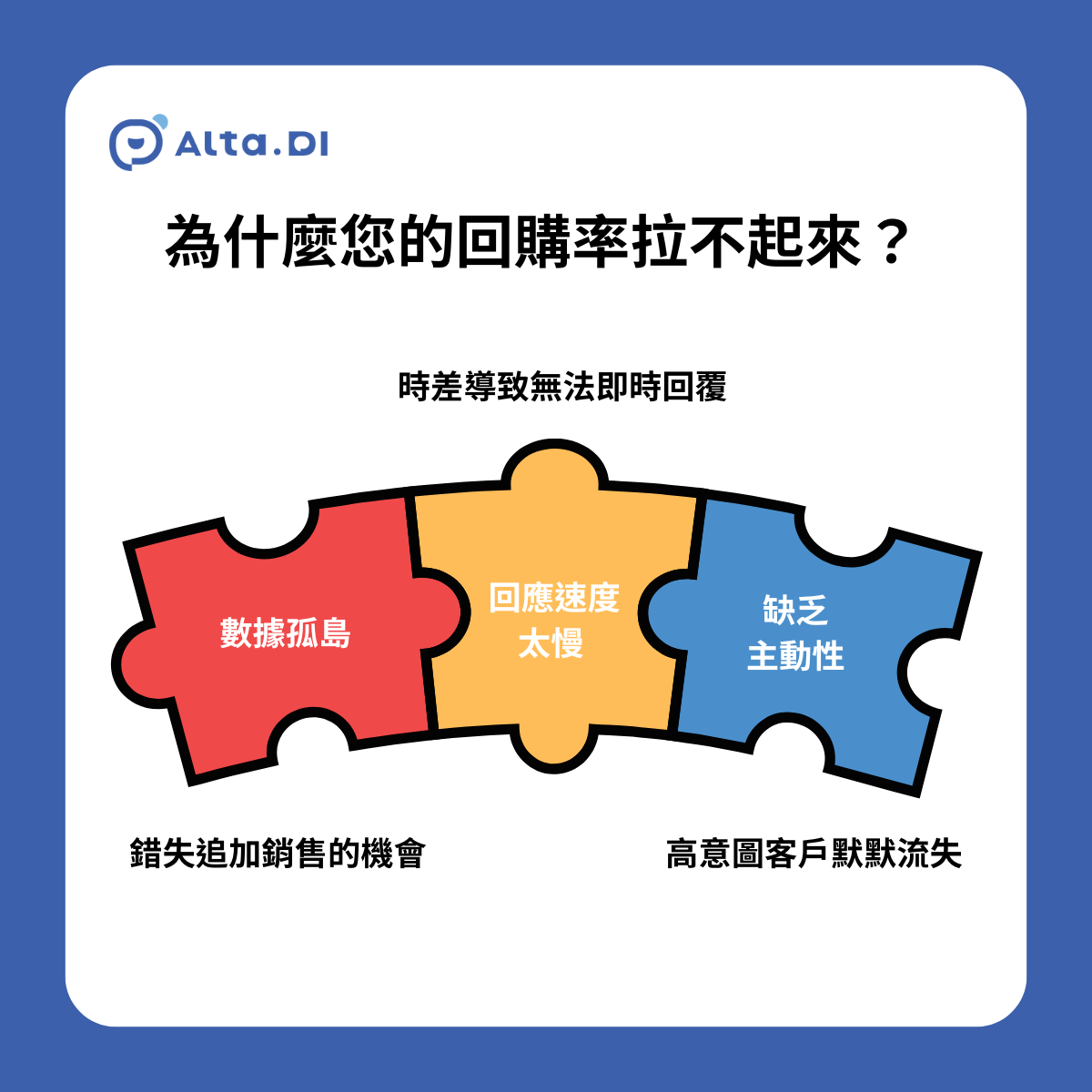
Why traffic doesn't turn into repeat purchases: three hidden causes
A low repeat purchase rate is usually not a sign of weak marketing. It comes from three structural problems hidden in daily operations: customer service cannot see orders, replies are too slow, and the team only waits for customers to ask. Once these three are clear, you can see which part AI needs to cover.
- Data silos:Your order data sits in the Shopify or WooCommerce back end, while customers message you on LINE or Instagram. When replying, your agents do not know what the person bought or how long it has been since the last purchase, so they send canned answers and up-sell opportunities slip away. This is not a minor issue: according to the Zendesk 2026 CX Trends report (more than 11,000 consumers and CX leaders across 22 countries), 74% of consumers are frustrated by having to repeat their situation, and 67% expect brands to serve them based on past interactions [3].
- Slow response time:This is especially costly for cross-border sellers. Time zones make real-time replies difficult, which affects store ranking and pushes hard-won visitors toward faster competitors. The cost of slow replies is higher than it looks: the same Zendesk report found that 85% of CX leaders believe a single unresolved issue is enough to lose a customer, and 88% of consumers expect faster replies than a year ago [3].
- Lack of proactivity:Traditional customer service sits and waits for questions to arrive. But the best sales moments often come when a customer adds an item to the cart and then does not check out. Without automation to pick this up, these high-intent customers leave quietly.
Too many customer messages to answer each day? How Alta.DI's multichannel integration works
Multichannel integration means bringing the conversations your customers have on different platforms into one back end, and letting AI read order data from the store back end to interpret them together. Agents no longer switch between ten windows, and they are not limited to formulaic replies because they do not know who the customer is.
To solve the three problems above, you do not need more agents. You need a system that understands requests and connects conversations with order data. Alta.DI splits this into two independent lines that meet in the back end:
- Where your customers send messages (messaging channels):LINE, Facebook Messenger, Instagram, WhatsApp, TikTok and website live chat (LiveChat) all flow into one workbench, while Amazon and Email have separate settings areas. Cross-border sellers can also connect messaging channels commonly used in overseas markets as needed. Wherever a customer starts a conversation, customer service is there to respond.
- Where your order and product data live (store platform integration):Alta.DI can connect to Shopify, Shopline/Shoplazza, WooCommerce/WordPress and TikTok Shop, bringing order status and product data into the conversation.
Once the two lines meet in the back end, when a customer asks a question on TikTok, the AI already knows what they bought on your website last week and which segment they belong to, and replies in the most suitable tone. This is the technical basis for turning customer service from a cost center into a profit center. To integrate online and offline channels more fully, see our5-step guide to omnichannel integration.
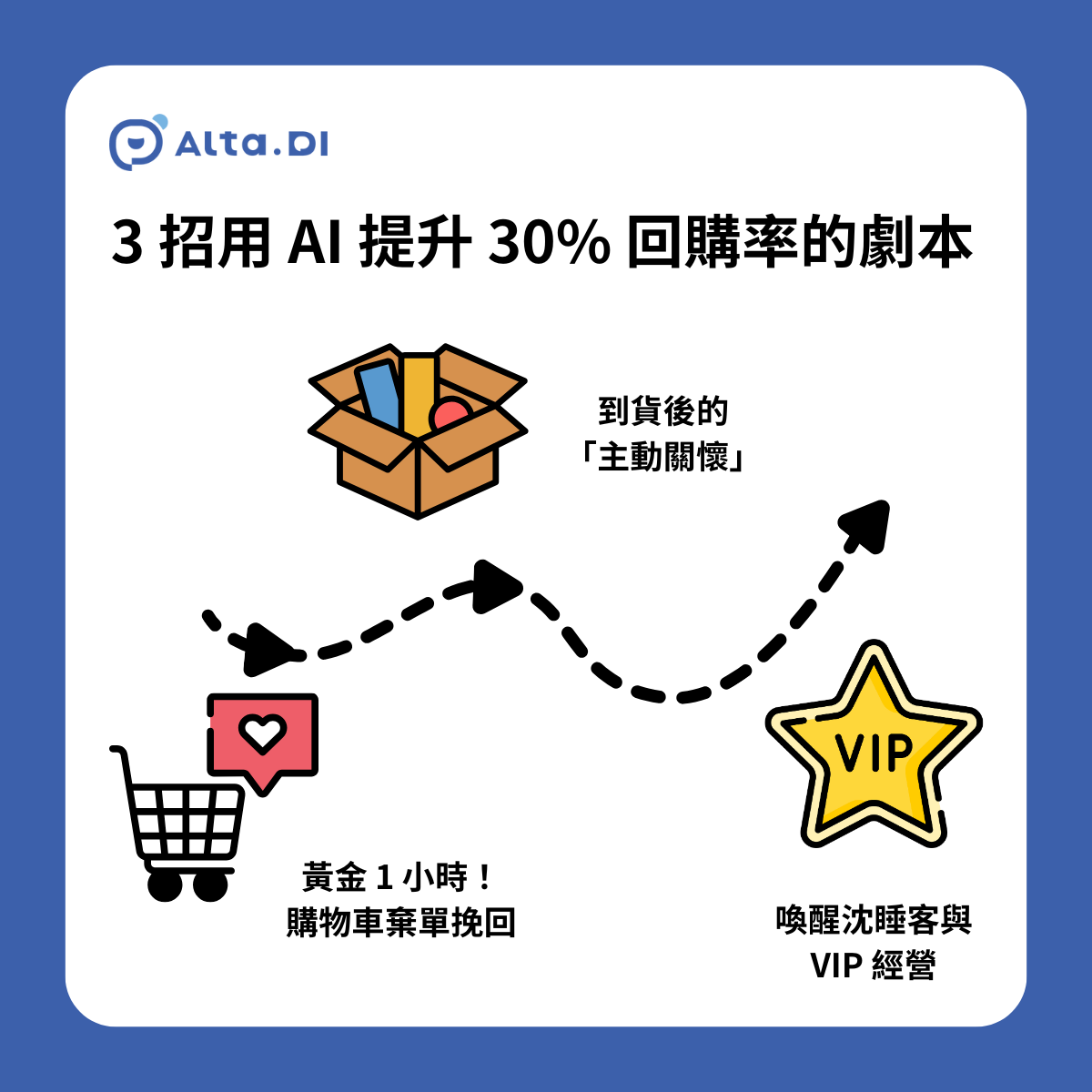
3 automation playbooks for raising repeat purchases with AI
An automation playbook is a preset flow: when a given situation happens, the system automatically does a given task. The three below have the highest return and are the easiest to start with, one each for abandoned cart, delivery and dormant customer.
Playbook 1: The golden hour, recovering abandoned carts
This flow has the highest return. According to Baymard Institute's 2025 data compiled from more than 49 studies, the global average cart abandonment rate is about 70%, which means 7 out of every 10 people who add an item to the cart do not check out [1].
The trigger: a customer adds an item to the cart on your online store and does not complete checkout within 60 minutes. When the system detects this event, it sends a reminder through the customer's most-used messaging app (for example, LINE). The tone does not need to push; a gentle nudge is enough:
"Hi [customer name]! It looks like [product name] was left in your cart. Stock moves quickly, so we'll hold it for you for 24 hours. If you're still deciding, here is a 5% discount code just for you [SAVE5]. Tap here to check out."
Compared with traditional email, which has low open rates, messaging app notifications are much more likely to be seen, and recovery rates rise with them. If you mainly run Shopify, we have another article that goes further:5 abandoned-cart automations for cross-border sellers.
Playbook 2: A proactive check-in 3 days after delivery
Many sellers stop talking to customers once an order ships, which is a wasted opportunity. Days 3 to 7 after delivery are when customer satisfaction is highest and customers are most willing to listen, which makes it the right time to build loyalty.
The trigger: 3 days after the delivery status changes to "delivered", the system sends a check-in message and attaches a short how-to video related to the product (for example, a TikTok link).
"Hello! Your [skincare product] should have arrived. Many customers say this technique works even better with it, so here is a 30-second video [video link]. If you have any questions about using it, just reply here. The AI assistant is available 24 hours a day."
This can substantially reduce returns caused by customers not knowing how to use a product, and by giving value first it builds trust and prepares the ground for the next purchase. Traffic from short videos often breaks down at the handoff to purchase, and this article is worth a read:3 handoff breakpoints where short-video traffic fails to convert.
Playbook 3: Waking up dormant customers and managing VIPs
Keeping existing customers costs far less than acquiring new ones. According to a frequently cited estimate from Bain & Company, quoted by Harvard Business Review, acquiring a new customer costs roughly 5 to 25 times as much as retaining an existing one, depending on the industry. Dormant customers are the first group worth winning back. The math is simple: HBR, citing Bain's research, also notes that a 5% increase in customer retention can raise profits by 25% to 95% [2].
The trigger: a customer whose last purchase was more than 90 days ago and whose lifetime value (LTV) is above average. The AI picks out these high-value dormant customers automatically and, based on their past preferences, recommends "related new products" or "returning-customer offers".
"Long time no see! We remember you liked our [Series A]. The new [Series B] just launched this week, and many longtime customers have already pre-ordered. This is your private VIP sale, visible only through this link."
Cross-border ecommerce: opportunities on Amazon and TikTok
Cross-border sellers struggle most with two things: Amazon's strict reply deadlines and TikTok's flood of private messages. Both are where AI working together with people helps most. For the full approach, readCross-border ecommerce customer service without the burnout.
Amazon's strict response windows:
Amazon requires sellers to reply to messages within 24 hours, weekends included. Alta.DI's AI is on call 24 hours a day and handles common queries such as "Has my order arrived?". It supports real-time translation in more than 50 languages, so a Taiwan-based team can handle global business steadily and protect account health.
This matches market expectations: the Zendesk 2026 CX Trends report shows that as AI becomes common, 74% of consumers already treat 24-hour service as a baseline [3].
TikTok's flood of private messages:
TikTok brings large volumes of traffic, but private messages fill up with repetitive questions such as "How much?" and "Is it in stock?". Alta.DI filters these out first and routes only high-value customers with real purchase intent (for example, those asking about wholesale or partnerships) to human agents, so your social media staff can spend their effort where it counts.
AI does not replace people; it frees up their time
Adopting Alta.DI is not about having a bot replace your customer service team. It hands the 80% of repetitive, routine work to automation so the team can focus on the 20% of interactions that need a human touch, such as complex complaints and key VIP relationships. Analysts see the same direction: Gartner predicts that by 2029, agentic AI will autonomously resolve 80% of common customer service issues and reduce operating costs by 30% [4]. Handing repetitive tasks to AI and keeping people on high-value interactions is the first step in that trend.
Unlike many tools tied to a single messaging app, Alta.DI does not lock you into one channel. Whether a customer writes on LINE, TikTok or Amazon, the data is visible and usable in the same back end. When your customer service system connects smoothly to the store back end and responds in real time on each channel, growth in repeat purchases follows naturally.
What to do next
Want to know which AI playbook fits your ecommerce situation? Do not let traffic slip away. Book a free Alta.DI implementation assessment, and based on your current store platform and customer service setup, we will map out the quickest first step.
Book an implementation assessment
References

[1] Baymard Institute. (2025). Cart Abandonment Rate (49 studies, average 70.19%). Baymard Institute.
https://baymard.com/lists/cart-abandonment-rate
[2] Harvard Business Review. (2014). The Value of Keeping the Right Customers (citing Bain & Company / Fred Reichheld). HBR.
https://hbr.org/2014/10/the-value-of-keeping-the-right-customers
[3] Zendesk. (2026). Customer Experience Trends Report 2026 (22 countries, 11,297 respondents). Zendesk.
https://cxtrends.zendesk.com/
Consumer data press release:https://www.zendesk.com/newsroom/articles/ai-ushers-in-era-of-contextual-intelligence-redefining-customer-experience-in-2026/
[4] Gartner. (2025). Gartner Predicts Agentic AI Will Autonomously Resolve 80% of Common Customer Service Issues Without Human Intervention by 2029. Gartner Newsroom.
https://www.gartner.com/en/newsroom/press-releases/2025-03-05-gartner-predicts-agentic-ai-will-autonomously-resolve-80-percent-of-common-customer-service-issues-without-human-intervention-by-20290
FAQ
FAQs about this article
We have traffic but few orders. Can AI customer service help?

Yes. Traffic that does not convert often means customer service cannot see order data and can only reply reactively. Once conversation channels are connected to the store back end, AI can reach out at three moments (abandoned cart, delivery, dormant customer) to turn browsers into buyers.
Our daily customer messages are too many to answer. Is there an AI customer service system you recommend?
Alta.DI brings LINE, Instagram, TikTok and other channels into one back end. AI handles repetitive questions automatically, filters out low-value inquiries and routes only high-intent customers to human agents, so the team can focus on the conversations that need a human touch however large the volume.
How does AI recover orders left in the shopping cart?
The most effective approach is the golden-hour recall. When the system detects that a customer added an item to the cart and has not checked out after 60 minutes, it automatically sends a LINE reminder with a time-limited discount code. Messaging apps recover noticeably more carts than email, which has low open rates.
Which AI customer service options in Taiwan connect to ecommerce order data?
Start by checking whether it connects to your store platform. Alta.DI can connect to Shopify, Shopline, WooCommerce and TikTok Shop, bringing order and product data into the conversation so AI can reply based on purchase history instead of canned answers.
Is AI customer service suitable for products with many technical questions, such as 3C electronics?
Yes. AI first handles the large volume of repetitive spec and order queries, then passes complex technical questions to a human agent, and can attach short how-to videos to lower the barrier to understanding. With this division of work, the team can save its time for technical complaints that need judgment.
More articles


訂閱我們的電子報
每月 8 日定期發送最新趨勢與實用資訊!



