

Short video traffic not converting? 3 handoff gaps | Alta.DI
Short videos go viral but orders do not follow? The cause is the handoff path, not the content. This article breaks down three handoff gaps and gives e-commerce brands a 5-step checklist. Start a free trial of Alta.DI to see it in practice.


Short video is now the mainstream form of social video in Taiwan (92% of users watch it), but viral traffic does not mean order growth. Many e-commerce and brand operators find high view counts and lively comments but very few orders. The problem is not the video content but the "handoff gap" after the video. This article breaks down the 3 most common gaps in converting short video into orders, and gives e-commerce brand owners handoff design steps they can put into practice right away.
Short video traffic not turning into orders? The problem is not the content but the "handoff gaps"
In short: traffic is up but there are no orders. This article is not about how to shoot videos, but about what happens after you shoot.
A short video handoff gap is a key point, between a consumer finishing a short video and actually completing a purchase, where poor path design cools their intent. It commonly appears in three places: a vague CTA, slow replies to direct messages, and cross-platform data that cannot be integrated.
If you run an e-commerce brand in fast-moving consumer goods, apparel or lifestyle, you have probably spent the last six months doing the same thing: putting resources into short videos, posting on TikTok and Instagram Reels, and working with KOLs. In its 2025 Taiwan Video Viewing Behavior Survey, MIC (the Market Intelligence & Consulting Institute of the Institute for Information Industry) found that as many as 92% of social video users watch vertical short videos [1]. That share almost means "if you use social media, you watch short videos."
But here is the catch. The same survey also shows that although 44% of viewers form an impression of a new person or brand because of short videos, in the end only about two in ten actually follow that person's or work's fan page [1]. In other words, from "being struck by it" to "willing to act further," more than half of the attention is lost, and from "following" to "actually ordering" there is another layer of loss.
Among the fast-moving consumer goods and apparel brand owners we have spoken with recently, almost every one asks the same question: "The video numbers are clearly good, so why hasn't revenue moved?" The answer rarely lies in the video itself. The problem is usually after the video: the viewer was struck by it, but you did not design a handoff path for "where to go next."
This article does not teach you how to shoot short videos (there are already too many such tutorials). It deals with something else:When the traffic really comes in, is your handoff process ready?
Next we break down the 3 most common handoff gaps and the design approach for each. After reading, you should be able to check your current process against them and find the hole to fill first.
3 handoff gaps that stall short video orders: which one are you?
In short: find your own gap first, then decide which hole to fill first.
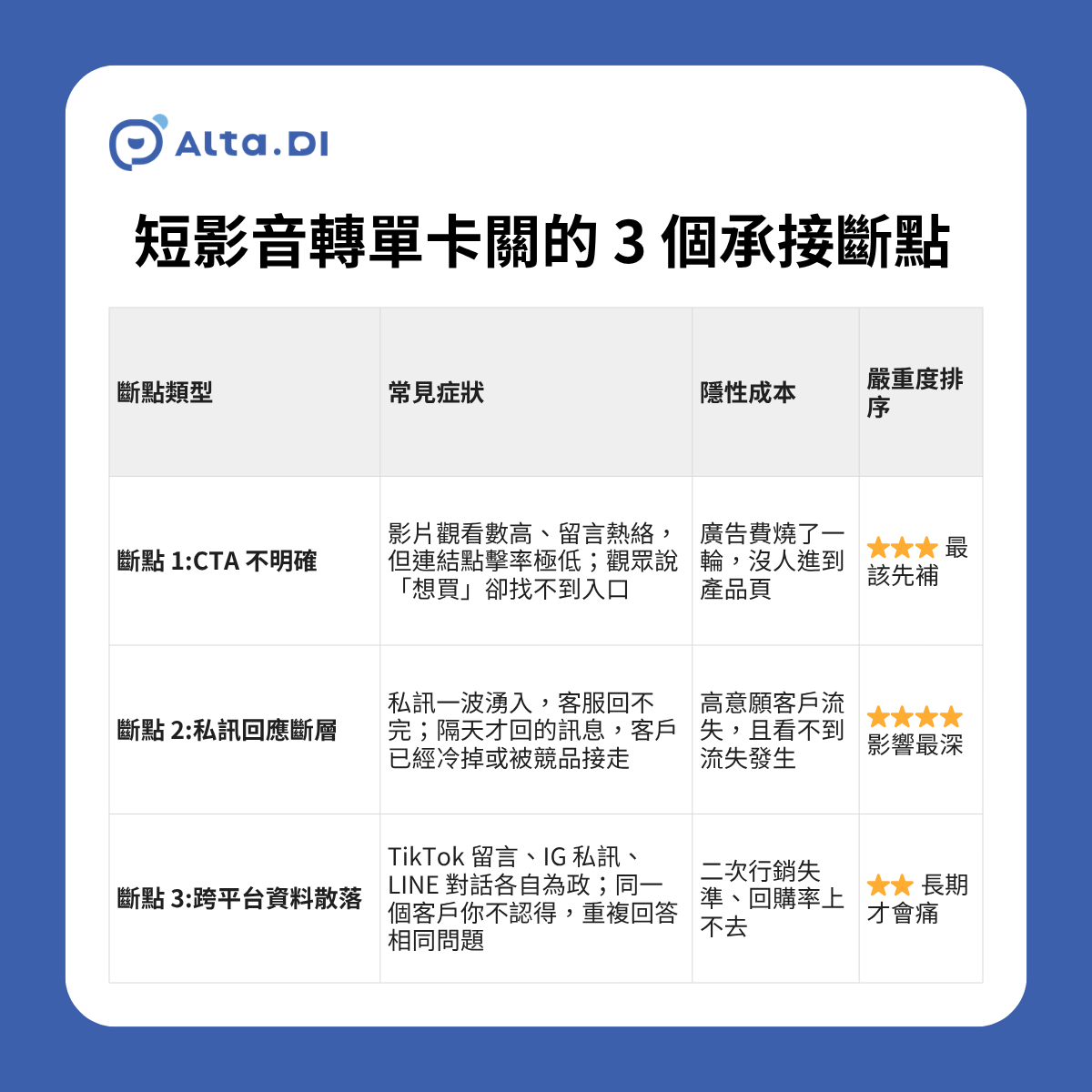
The 3 short video handoff gaps are: an unclear CTA (viewers do not know where to go next), a gap in direct message replies (messages pour in but customer service cannot keep up), and scattered cross-platform data (TikTok, IG and LINE conversations cannot be integrated). Most brands are not stuck on only one but on all three, though there is an order of priority.
We have looked at the handoff processes of dozens of e-commerce and brand operators and noticed something interesting:When most e-commerce brand owners diagnose their own problem, they put all the causes down to "the video isn't good enough" or "the algorithm isn't accurate". Neither of these is the real bottleneck. The real bottleneck is that after the viewer was struck by the video, something went wrong in the handoff path.
The table below is a tool for finding your own gap. Read the "common symptoms" in each row and see which one looks most like your situation.
Why fill them in this order?
- Gap 1 is an "entry problem": if you have not even designed where viewers should go, no amount of AI customer service afterward will help. This is the layer that can be changed within 24 hours and shows results fastest.
- Gap 2 is a "handoff problem": once the entry is designed and traffic really comes in, the speed of direct message replies becomes the next bottleneck. An apparel brand we have coached received 800+ direct messages within 24 hours after one viral video, and the customer service team took a full three days to work through them, by which time nearly all the early high-intent customers had gone cold. This layer is a loss that "hurts but cannot be seen".
- Gap 3 is a "long-term problem": conversation data scattered across platforms does not affect any single order right now, but keeps hurting the brand's ability to run remarketing and its repurchase rate. When you want to run precise remarketing, you find the data you need is not in your hands.
You may ask: "If I have all three, should I fix them all at once?"
Not recommended.The order matters. A common result of fixing all three at once is money spent, tools bought, team resistance, and a process that never gets running. First pin down the CTA path for gap 1 (fastest), then add the AI real-time handoff for gap 2 (most noticeable), and finally do the data integration for gap 3 (deepest).
The next three sections break down the design approach for each gap. You can pick the one that hurts most and jump straight to that section.
Fixing gap 1: change the CTA from "learn more" to a "specific next step"
In short: 90% of handoff gaps come from this layer, and it can be fixed within 24 hours.
A CTA is the call to action at the end of a short video that guides the viewer to the next step. Vague wording (learn more, click the link) converts very poorly, while a specific commitment (message us for the size chart, comment to get the discount code) works. The trap Taiwan e-commerce brand owners most often fall into on TikTok and IG Reels is applying the same CTA line to every video, whether the video is a tutorial, an unboxing or a promotion.
The problem is not "having no CTA" but a CTA that is not tied to the video's content.
Why are the words "learn more" useless?
Because viewers have no idea what will happen when they tap. See the product? Read an article? See an event page? Add on LINE? A vague CTA is the same as no CTA: the viewer has to decide within three seconds, and chooses not to tap.
More specifically, the core of a CTA is not "telling viewers what you want them to do" but "telling viewers what they will get". These are two completely different design logics.
CTA wording comparison: change the "action" to a "commitment"

Note the three shared features in the right column:(1) a specific verb; (2) a specific time (within 3 minutes / next week); (3) a specific return (get the size chart / discount code / product).With all three elements in place, the CTA works.
TikTok vs Instagram Reels: CTA placement has to differ
The CTA path design logic is completely different on the two platforms. A CTA template that works across platforms does not exist, and this is the mistake most e-commerce brand owners make first.
TikTok CTA placement priority:
- Spoken line in the video (viewers should know what they will get within the first 3 seconds)
- First 50 characters of the video description (the CTA should still be visible after truncation)
- The "website link" on the profile and a pinned latest post
- A comment pinned by you in the comments area (a link or a lead-in line placed directly)
TikTok viewers stay briefly and are unwilling to click through to other pages, so the CTA is best "completed inside the video", and viewers should not be pushed to tap elsewhere.
Instagram Reels CTA placement priority:
- First line of the video description (to avoid being hidden behind "... more")
- Product tags on Reels (a must for e-commerce)
- Publish to Stories at the same time, with a Q&A sticker or link sticker
- Link in bio on the profile and Highlights
Instagram viewers are more willing to explore across pages, so the CTA can "hand off across several points", with the video description, Stories and the Bio link working together in three layers.
What you can do in week one: rewrite the CTAs on all your old videos
This needs no tool budget and does not have to wait for the next video. Open your top 10 videos from the past 3 months and rewrite each vague CTA into a specific one.This is usually the step in handoff improvement that shows results fastest and has the highest return on investment. Many brands only changed the CTA description and saw link click rates rise 2-3 times that same week.
But once the CTA is fixed, the next question surfaces right away: when viewers really do message you, can your customer service keep up? That is what gap 2 is about.
Fixing gap 2: move direct message handoff from "manual scheduling" to "AI real-time replies"
In short: on the night your video goes viral, your customer service is asleep. You cannot see this loss, but it is very real.
A direct message reply gap is a handoff gap in which, after a brand posts a short video, direct messages from viewers arrive faster than human customer service can handle, so high-intent customers drift away while waiting. The most common scene for Taiwan e-commerce brands: at 9 p.m. a video starts going viral and messages surge in, customer service has gone home, and replies only begin at 10 a.m. the next day. In that 13-hour gap, most high-intent customers have already been picked up by competitors or have simply lost the urge to buy.
The trouble with this gap is that you cannot see it happening.
Why is direct message reply speed the core of handoff?
Viewers' intent after a short video is strongly time-sensitive. Right as they finish the video, their memory of the brand is sharpest and their desire to buy is highest; after 1 hour, 3 hours or 1 day, that intent fades quickly. In the cases we have coached, the close rate for messages answered within 30 minutes is clearly higher than for those answered only after 24 hours. This is not marketing talk; it is the natural pattern of short-term human memory and emotional decay.
But small and mid-sized e-commerce brands find it hard to build a 24-hour live customer service team. Here the AI customer service platform does not "replace customer service"; it catches customers first during the hours before customer service starts and during peak hours when customer service cannot keep up.
The cost calculation from the e-commerce brand owner's view: hiring people vs using AI
This decision ends up on the boss's desk. Below is a rough comparison table to use as a reference in internal discussion.
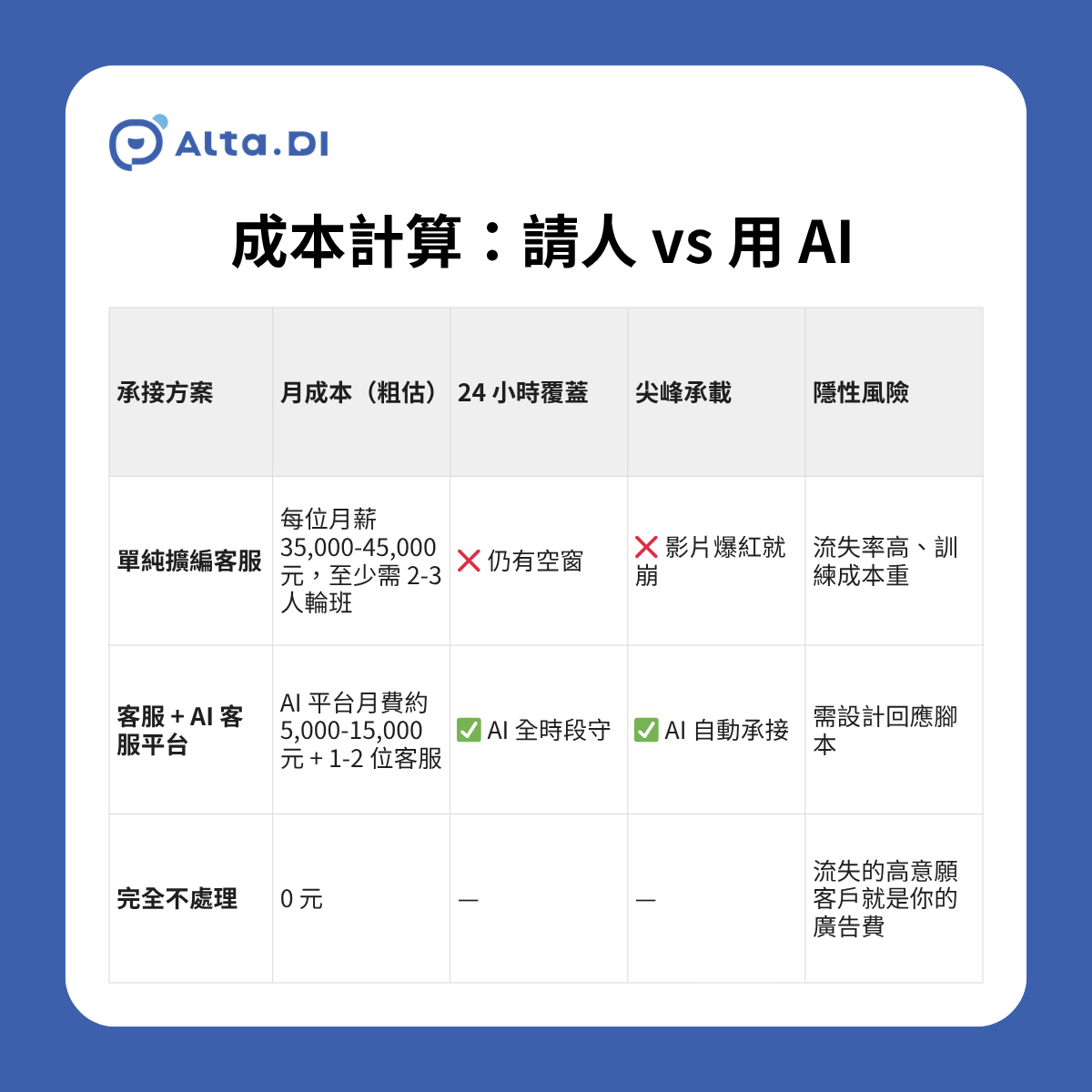
The third row is the real problem. Most brands do not realize that for a message not answered right then, the ad spend for that order has already been spent. You paid to buy the traffic, then let the customer go on the last mile. For the decision framework on building your own AI customer service vs buying a platform, we have a separate full comparison you can refer to.
Two roles for AI customer service in the handoff process
Not every direct message needs AI to take over immediately. In practice, an AI customer service platform plays two clear roles in the short video handoff path:
Role 1: gatekeeper (responds within the first 30 seconds)
Whatever time the message arrives and whether or not customer service is on duty, the AI gives the customer a clear response right away. This response does not have to solve the problem, but it must do three things:
- Confirm receipt (so the customer does not feel the brand is cold)
- Set expectations ("a human agent will take over within X time")
- Collect key information (video source, product interest, type of need)
This 30-second response alone cuts the drop-off rate considerably.
Role 2: router (assigns automatically by complexity)
Simple questions the AI answers directly (size, price, shipping method, return policy); complex ones (custom requests, price negotiation, special situations) are assigned automatically to the right human agent. This layer lets the customer service team focus on the conversations that "really need a person," instead of being buried in repeated questions.
After an apparel brand we coached adopted this process, the number of conversations handled per agent rose substantially, and the close rate of early high-intent customers returned to a healthy level. This is not AI replacing people; it is AI putting people back on what they should be doing.
The design focus of Alta.DI at this layer is "catching every channel": whether the customer comes in from a TikTok comment, an IG message, LINE or the website, they land in the same AI handoff interface, get replies from the same script, and accumulate in the same customer profile. This leads to the next gap, scattered data.
Fixing gap 3: connect TikTok, IG and LINE conversation data into one chain
In short: the loss you cannot see today will show up the day you want to run repurchase marketing.
Scattered cross-platform data means that a brand's conversation records, behavior data and purchase preferences from interactions on TikTok, Instagram, LINE, its website and other channels sit in different platform back ends and cannot be integrated into a single customer profile. The long-term result is customer service answering the same thing twice, inaccurate remarketing and a repurchase rate that will not rise. This gap does not hurt right away, but on the day you want precise remarketing or a push on repurchase, it blocks all progress.
Why is this gap the easiest to overlook?
Because it "does not hurt right now".
Gap 1 is ad click rates that will not go up, which hurts right away. Gap 2 is messages that cannot be answered and customers who go cold, which shows up in this month's revenue. Gap 3 is different: your customer service still answers messages every day, orders still come in, and revenue looks fine.
Until one day the marketing manager says in a meeting: "We want to run a campaign for returning customers," "We want a pre-order for loyal fans for the new product launch," "We want precisely segmented EDM." Only then do you find that the data you need is not in your hands.
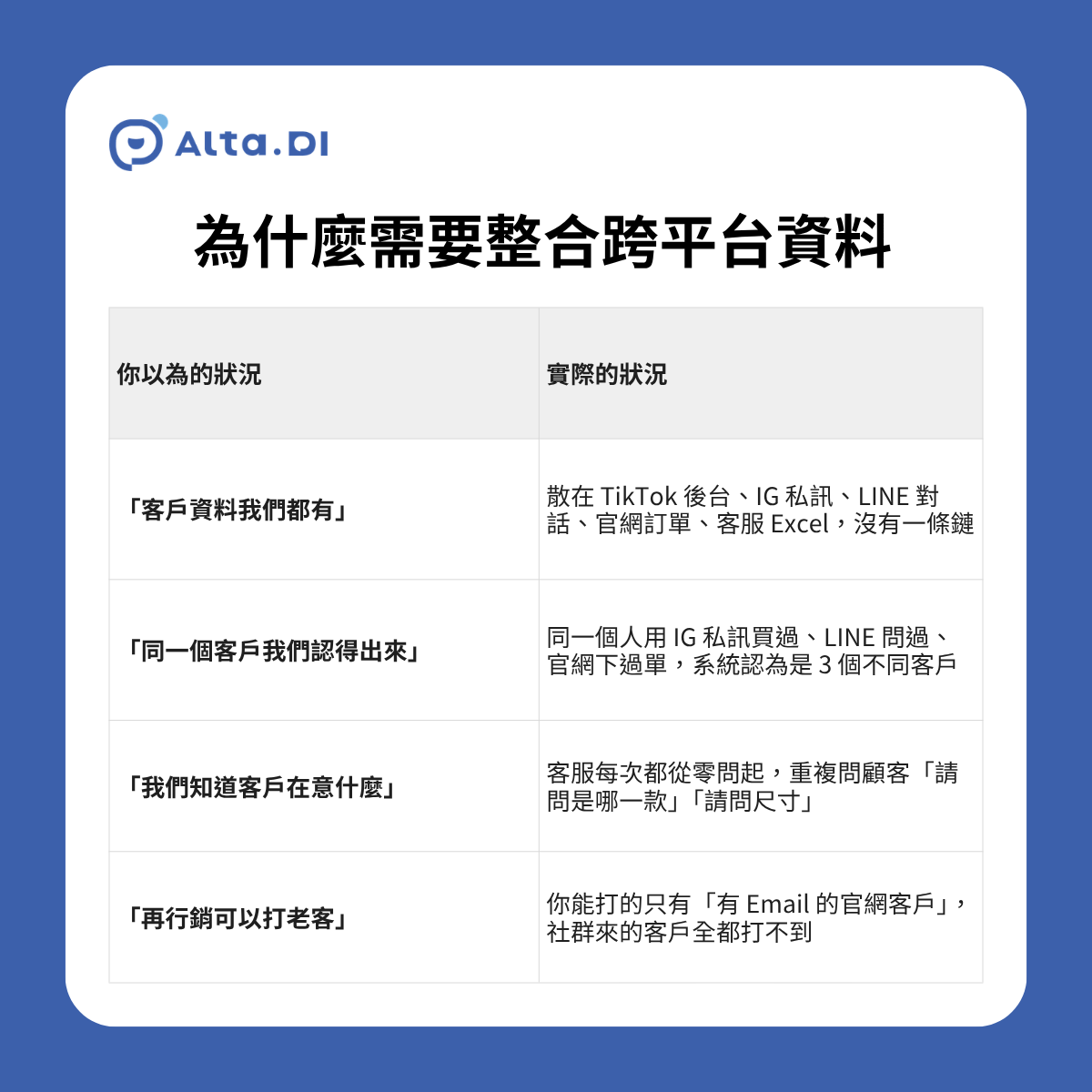
How full-channel integration works in practice
Integration is not as simple as "pouring all the data into one database." The core of integration is to make conversations and behavior from different entry points link into one customer profile, so customer service sees the same page and marketing reaches the same person. In practice it goes through three layers:
- Layer 1: unified conversation interface. TikTok comments, IG messages, LINE conversations and website customer service all come into one interface for replies. Customer service does not have to switch between five tabs, and customers are not treated as different people because they crossed platforms.
- Layer 2: customer identity linking. The same customer who asked on an IG message, then added on LINE, and finally ordered on the website must be recognized in the system as "the same person." This requires the platform to support cross-channel identification logic, such as matching phone numbers, matching emails or automatic tag association.
- Layer 3: behavior and tag accumulation. Tags produced by each interaction (what products they asked about, whether they claimed a discount code, which video they watched, which items they saved) accumulate automatically in the customer profile. The next time they come, both customer service and the AI "recognize them", and the precision and speed of replies pull clearly ahead.
For detailed implementation steps across channels, see our5-step guide to omnichannel integration (OMO).
Why does this matter especially for e-commerce brand owners?
Because this layer directly decides whether ad spend ROI can accumulate across periods.
If, every time an ad campaign ends, the customer data it brought ends with it and cannot be picked up again, then every campaign is buying traffic from scratch. But if these customers are fully caught and linked into profiles, in the next campaign you can directly target precise segments such as "visited last time but did not buy" or "bought A last time but did not repurchase." Only then does ad spend ROI evolve from "single-campaign return" to "customer lifetime value (LTV)."
Alta.DI's core positioning is "a channel-agnostic AI customer service platform: all channels, all data". This is not a marketing slogan; it is designed for the real problem of the short video era, that wherever traffic comes from, customers scatter. When your customers are spread across TikTok, IG and LINE, tying customer service to a single channel (for example, connecting only to LINE) means giving up more than half of your customer data by choice.
Next, the design approach for these three gaps is organized into a 5-step checklist you can check against your own process right away.
A handoff process that really converts: a 5-step checklist
In short: the fixes for the three gaps above, compressed into one checklist you can use today.
The 5 key steps of a short video handoff process are: make the CTA specific, catch direct messages in real time, unify the interface across channels, link customer identities, and accumulate behavior tags. Each step maps to a specific fix for the three gaps above, and you can check from top to bottom which piece your current handoff path is missing.
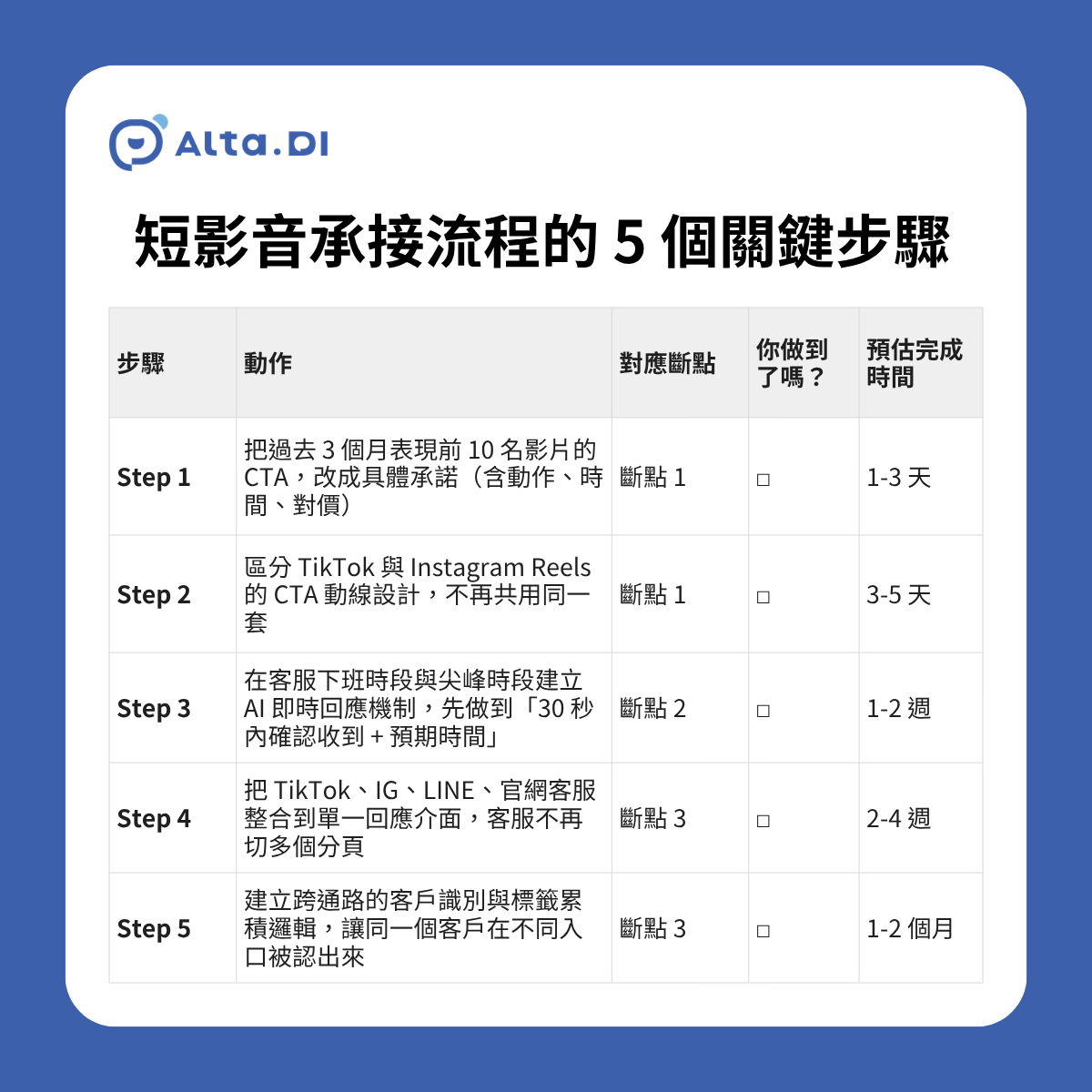
How to decide which step to do first?
If you have done none of the three, we suggest following the order in the table. The first 2 steps can be changed within this week, your own team can carry them out, and no tool budget is needed. From Step 3, you need to evaluate an AI customer service platform, and Steps 4-5 need a platform that supports cross-channel integration.
A caution: many brands jump straight to Steps 4-5 (buying tools) without getting Steps 1-2 right. That produces the awkward situation of "the tools are in place but the traffic itself cannot be caught". If the CTA is not designed well, even the strongest AI customer service is only catching viewers who "do not know what to do." The order matters.
What will you see after the 5 steps?
Revenue will not double overnight, but you will start to see things that you could not see before:
- How many direct messages and orders each video actually brings (before, perhaps only view counts; now a complete funnel)
- Which CTA wording converts best (before, by gut feeling; now with a comparison group)
- Which time periods lose the most customers (before, no idea there was loss; now the holes can be filled)
- The complete journey of the same customer across channels (before, only single points; now a chain)
-
This "visibility" is itself the starting point for all later decisions about improvement. A problem you cannot see cannot be solved, but a problem you can see is only a matter of time.
For the fast-moving consumer goods and apparel brands we have coached, starting from the first gap and running the whole process through this checklist took about 6-8 weeks on average. After finishing, what most brands find looking back is not "a revenue explosion" but "the short video ad spend finally starts to build up value": with the same budget, each extra month adds thickness to the customer database and improves the precision of the next campaign. This is where the real value of short video handoff lies.
Conclusion: short video is not a content problem but a path problem
The era of short video is no longer about "whether to do it" but about "how to catch viewers after you do it". In Taiwan, 92% of social video users watch short videos, and 44% form an impression of a brand because of short videos [1]. The viewers' attention is already there; the question is whether your handoff path is ready.
If you run an e-commerce brand in fast-moving consumer goods, apparel or lifestyle, this article gives you only "a starting point for finding your place". The actual gap is in a different place for each brand: some are stuck on the CTA, some on direct message handoff, some on data integration.
We offer a 7-day free trial of Alta.DI: we connect one channel for you, and you look at 7 days of conversation data. You do not need to prepare data first or produce an evaluation report first. During the trial you will see what real-time conversation replies, the direct message handoff process and customer data accumulation look like in practice.
This trial suits e-commerce brands that are seriously treating short video as a long-term channel. If your scale is still at the starting stage, we suggest beginning with this article's 5-step checklist to check yourself, then evaluating tools once traffic is steady.
Short video traffic will keep growing. The question is not whether there is enough traffic, but whether the handoff path can keep up.
Try Alta.DI, the channel-agnostic AI customer service platform, and start from the first gap.
References

[1] Market Intelligence & Consulting Institute (MIC), Institute for Information Industry. (2025). Taiwan Video Viewing Behavior Survey: Vertical Short Videos Have Become a Marketing Tool (in Chinese).https://mic.iii.org.tw/news.aspx?id=716
FAQ
FAQs about this article
What is wrong when short video traffic is high but actual orders are few?

The problem is usually not the video itself but the "handoff gap." The three most common places: the CTA is too vague (viewers do not know where to go next), direct message replies are too slow (high-intent customers go cold), and cross-platform data is scattered (remarketing cannot reach them). Checking yourself against these three lets you quickly find the hole to fill first.
Can the CTA design for TikTok and Instagram Reels be shared?
We do not recommend sharing it. TikTok viewers stay briefly and are unwilling to click through, so the CTA should be completed inside the video (spoken line + first 50 characters of the description + pinned comment); Instagram Reels viewers are more willing to go across pages, so the CTA can hand off across several points (first line of the description + product tag + Stories + Bio link). Applying the same CTA to both platforms lowers conversion on both.
If direct messages pour in and I cannot answer them all, do I have to buy an AI customer service platform?
Not necessarily right away, but first set up a basic mechanism of "confirm receipt within 30 seconds + expected reply time." Small and mid-sized brands can first use each platform's auto-reply feature as the first line, and evaluate an AI customer service platform once traffic is steady. The real cost is not the tool fee but the high-intent customers you already paid ad spend for and failed to catch.
How long does it take to integrate TikTok, IG and LINE customer service into one interface?
Depending on the platforms chosen and the complexity of existing systems, most small and mid-sized e-commerce brands need about 2-4 weeks to complete basic integration. We suggest starting with the "unified customer service reply interface," then moving to "customer identity linking," and finally "behavior tag accumulation." Trying to integrate everything at once makes it easier to get stuck.
Will revenue double right away once all 5 steps are done?
It will not double right away, but you will start to see what you could not see before: how many orders each video actually brings, which CTA wording converts best, which time periods lose the most customers, and the complete journey of the same customer across channels. This data is itself the starting point for all later decisions about improvement. The value of handoff improvement is that ad spend starts to build up value, not a single-campaign return.
More articles


訂閱我們的電子報
每月 8 日定期發送最新趨勢與實用資訊!



