

Vibe coding demo stuck? A guide to 7 governance capabilities
Building a demo with vibe coding is easy; launching and maintaining it is the challenge. This article sets out 7 governance capabilities and a three-phase roadmap to turn AI generation speed into sustainable delivery, with a 10-question procurement checklist.


Continued from the previous article: AI Lab Vibe Coding
This article focuses on the product trends from Q4 2025 to Q1 2026, starting from "vibe coding culture". Why can everyone build a demo quickly, yet get stuck when it comes to real launch and scale? What you need to add is not more prompt tricks but the governance capability that keeps speed controllable, quality verifiable and responsibility traceable.
The conclusion first: in 2026, vibe coding is about "controlled speed"
You built something that runs in one evening with vibe coding. You showed it to your manager, and the reaction was good. Then what?
To launch it properly, you find there are no tests, no version control, and no one knows who is responsible for which piece of code. To keep iterating, you find the specification has changed but the AI still generates as before, fixing A breaks B, and you fall into an endless debugging loop. To hand it to someone else to maintain, you find there is no documentation at all, and the whole project lives only in your conversation history with the AI.
This is not an individual problem but a structural challenge of vibe coding culture.
The market has reached a divide. In the demo era anyone can do it, and the maintenance era decides whether what you built is a product or a toy. The next step is to add the governance capability that lets speed keep delivering.
1. why does vibe coding culture make demos so fast?
What makes the "exploration phase" so efficient is a combination of three things: get it running first (aim for the feel of a product, not completeness); use language instead of syntax (spend time describing intent, not reading documentation); humans judge, AI produces (people own direction and trade-offs, AI generates in volume). This combination suits new feature prototypes, landing pages, internal tools and simple automation especially well. As long as the goal is "validate an idea quickly", vibe coding is almost irreplaceable.
But this combination carries a built-in cost: it pushes the questions of "quality and responsibility" to later. The faster you go, the higher the cost of going back to add tests, fix bugs and refactor can become. DX's Q4 2025 research [1] points out that once AI tools become widespread among developers, the gap shifts from "whether you use AI" to "whether your processes and culture can turn AI into stable delivery capability". SlashData's Q1 2026 developer trends survey [2] observes something similar: the gap in technical maturity is shifting from tool choice to process integration. In other words, the next step for vibe coding is not generating better but governing better.
2. enterprise pushback in 2026: speed is not enough, you must also carry the responsibility
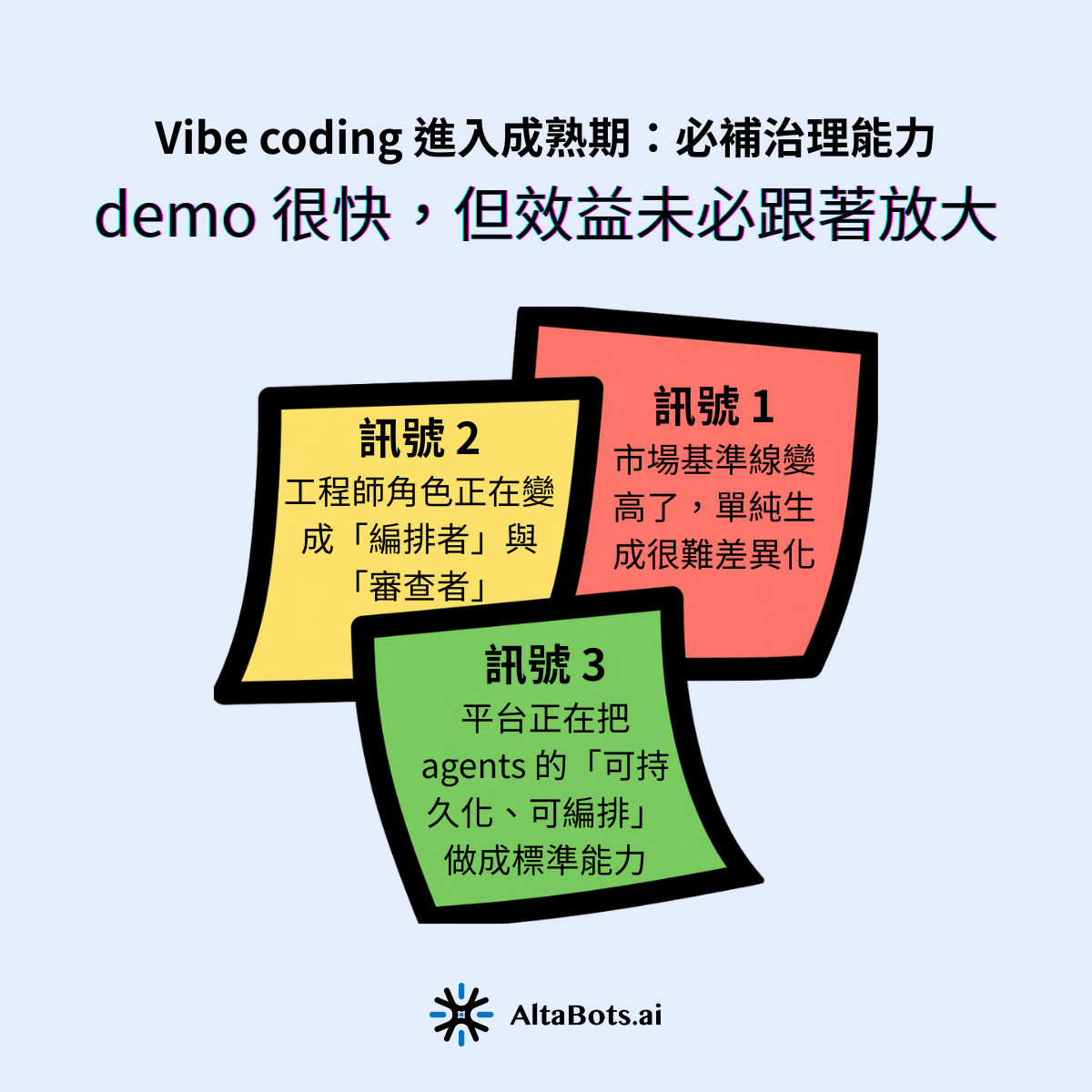
The speed advantage of vibe coding was accepted by the market in 2025, but in 2026 clear signs of pushback have appeared on the enterprise side. They are not against AI-assisted development; they are against adoption that has "only speed and no governance".
The first signal comes from the spread of shadow AI.
A Lenovo "Work Reborn Research Series 2026" survey [10] (January to February 2026, more than 6,000 full-time employees in 12 countries) shows that more than 70% of employees use AI tools every week, with up to a third of that use happening outside IT oversight. A Freshworks survey [11] of IT leaders at mid-sized companies in the same period found that 79% believe employees using unapproved AI tools really did raise productivity, yet 86% admit that at least once in the past year there was a negative incident involving unapproved AI. This means one thing: people are building faster and faster, but the organization remains hazy about "what was built, who is responsible and how well it works". If your organization faces a similar situation, this article analyzes the causes of shadow AI, how it spreads and how companies should respond。
The second signal is the emergence of the concept of "cognitive debt".
Enterprise automation company Appian put forward the term in a 2026 analysis [12]: AI can make software look like it runs, but when no one truly understands what it is doing, every change accumulates hidden risk. Appian's Senior Vice President of Engineering, Galal, stated plainly that governance is not a brake on AI adoption but the condition that keeps it running:
"Every step has to be intercepted, tested and evaluated."
The third signal is that the market's demand for "maintainability" is spreading from individual developers to enterprise procurement.
Opsima's analysis of industrial IT [5] and Charter Global's independent research [6] both point out that vibe coding tools themselves do not provide the security, compliance, governance and maintainability that enterprises require, and once an enterprise control layer is added, the speed advantage often shrinks sharply. This makes "enterprise-grade governance capability" itself the core of product differentiation, rather than a checklist for after-the-fact repair.
3. from demo to maintainable product: 7 governance capabilities you must add
The core gap between a demo and a maintainable product is not technical ability but governance capability [7]: turning requirements into specifications, outputs into something acceptable, actions into something auditable, and iteration into something sustainable. The seven governance capabilities below can serve as a roadmap checklist for vibe coding products. The more completely you do them, the better you turn "speed" into "sustainable delivery".
Governance 1: Requirements governance (turn a prompt into a specification)
Requirements governance means turning a vague natural-language prompt into a structured, verifiable specification, covering goals, users, inputs, outputs and constraints, so that every generation has clear criteria for success and failure.
A demo prompt is usually "build me a...", but a maintainable product needs: a requirements template (goal, user, input, output, constraints), acceptance criteria (what counts as success and what counts as failure) and a not-to-do list (which scenarios must be refused or handed to a human).
How to productize it: turn common requirements into reusable task templates, rather than leaving prompts in individuals' heads.
Governance 2: Context governance (data sources, versions and changes)
Context governance means making sure the data sources, specification versions and change records behind AI generation are all traceable, avoiding the hidden drift of "the specification changed but the AI still generates as before". The most common source of going back to fix bugs in vibe coding is exactly this: the specification changed, the API changed, the documentation was updated, but the AI still generates as before. To be maintainable, you need: a data source list (which documents are authoritative), version control (which specification version each generation used) and a change log (who changed what and when it took effect).
Governance 3: Tool and permission governance (what it can and cannot do)
Tool and permission governance means that when an AI Agent can call external tools, create PRs and trigger deployments, you clearly define each tool's access boundary and apply the principle of least privilege, so actions can be audited and scaled.
Once vibe coding enters the Agentic AI stage, the AI does not only "write code". It may also create PRs, call CI, read and write files or trigger deployments. To lower integration cost and improve maintainability, more standardized tool-connection specifications have appeared in the market. For example, the Model Context Protocol (MCP) [8] provides a specification for describing how a model or Agent connects to tools and context, and major platforms (including Microsoft Foundry [4]) have gradually added native support, so it can serve as a reference when designing integration and governance. If you are evaluating how to design Agent tool connections, this article offers a complete architecture and practical reading of MCP。
Governance 4: Quality governance (test sets, static checks, reproducibility)
Quality governance means building a reproducible, verifiable quality mechanism, including a test set of key scenarios (Golden Set), static checks and type validation, so that every change can be measured objectively rather than judged by feel.
A demo that appears to run does not mean it can be maintained. Maintainability needs reproducibility and acceptance: a test set (key scenarios to run on every change), static checks (lint, type checks, SAST) and reproducible setup (the same input gives the same output, or at least the variance is controlled).
Governance 5: Security governance (dependencies, supply chain and sensitive information)
Security governance means proactively scanning AI-generated code for dependency risks, sensitive information leaks and supply chain vulnerabilities, rather than finding them passively after launch. AI-generated code can introduce unknown dependencies or insecure patterns. A maintainable product should at least be able to: scan for secrets (to keep API keys out of the repo), run dependency risk checks (package vulnerabilities, licenses) and build an SBOM or at least a dependency list. Opsima's industrial IT analysis [5] also points out that every time an AI-generated build enters production without passing a full governance pipeline, it is a potential liability gap.
Governance 6: Process governance (PR review and accountability)
Process governance means setting clear labeling rules, review checklists and a division of responsibility for AI-involved code, so that "the AI wrote it" is no longer a vague excuse but a traceable delivery record. Vibe coding culture easily blurs responsibility into "the AI wrote it", but after launch responsibility must be clear: AI output labeling rules (which commits or PRs involved AI), a review checklist (security, boundaries and tests must be checked) and a division of responsibility (who can merge, who can deploy, who can roll back).
Governance 7: Observability governance (the feedback loop after launch)
Observability governance means building post-launch error classification, trend tracking and an iteration cadence, so that "knowing when something is wrong, locating it and fixing it" becomes a sustainable capability, rather than learning about problems only when customer service or users tell you. The core of maintainability is active observation, not passive reporting. You need: error classification (generation errors, specification misunderstandings, tool failures, insufficient permissions), trend tracking (which type of error is rising, whether drift appears) and an iteration cadence (adjust templates, specifications or tool strategy weekly).
4. product roadmap recommendation: lay out three phases clearly so you do not run into a mess
Treating governance capabilities as a roadmap avoids the two most common traps: spending too much time on governance during exploration (over-engineering), or discovering in the maintenance phase that governance gaps have piled up into technical debt (locking the barn door after the horse has gone). We recommend advancing through three phases in order, rather than putting all 7 governance capabilities in place at once.
Phase 1: Make it work (exploration phase)
The focus is generation, scaffolding and rapid iteration. The goal of this phase is to validate an idea, not to build a maintainable system. The minimum governance bar: a requirements template (Governance 1) and secrets scanning (Governance 5). The former keeps the AI's generation direction from drifting, and the latter prevents sensitive information from accidentally entering the repository during exploration.
Phase 2: Get it live (delivery phase)
The focus is testing, permissions, review, version control and rollback capability. Governance investment in this phase has the highest return. Filling in quality governance (Governance 4), tool and permission governance (Governance 3) and process governance (Governance 6) here lets the demos built in the exploration phase actually be delivered, rather than rewritten before launch. Anthropic's 2026 Agentic Coding trends report [3] also points out that the focus of developer work is shifting from simply writing code to earlier-stage activities such as task orchestration, review and tool integration, which is exactly the core of delivery-phase governance.
Anthropic's study of 400,000 Claude Code sessions, published in June of the same year [13], further confirms this direction: success depends on how deeply the user understands the problem, not on coding ability itself. In other words, governance and professional judgment are not replaced by the speed of AI generation. They are what decides whether AI output can go live.
Phase 3: Keep it running (maintenance phase)
The focus is observation, error classification, governance cadence and organizational adoption. In this phase, build observability governance (Governance 7) and context governance (Governance 2) into the daily workflow, rather than relying on people to remember. Microsoft's discussion of AI coding agents and DSLs [9] makes the same point: to make outputs maintainable and verifiable, constraints and rules must be put "into language", rather than generating completely freely.
The ordering logic of the three phases is: first make speed feasible, then make delivery controllable, finally make maintenance sustainable. Skipping any phase and jumping to the next costs more later.
5. procurement advice for companies and teams: use these 10 questions to judge whether a tool can be maintained
The most common mistake when companies evaluate vibe coding tools is testing only "generation speed". Generation speed only decides whether you can build a demo, while the 10 questions below decide whether you can truly maintain it. Bringing this list into a procurement evaluation quickly separates "tools that can only make prototypes" from "platforms that can support core business".
- Is there version control and a change log? When the specification changes or the API is updated, can the AI know? Without version control, every generation is a gamble.
- Can requirements be fixed into templates and acceptance criteria? If you must describe the requirement again every time, the tool suits only personal use, not team delivery.
- Are there test sets and quality gates? Can you set "these scenarios must pass before moving on"? Without quality gates, going live is gambling.
- Does the AI scan for secrets and dependency risks? Generated code easily brings API keys or insecure packages into the repository. Without this check, security risk will erupt at the least expected moment.
- Can AI output be labeled and traced? When something goes wrong, can you tell which code the AI generated and which specification version it used? Without traceability, responsibility is always a messy account.
- Does PR review have a standardized checklist? Traditional code review assumes the author understands every line. AI-generated code cannot carry the same assumption, and there must be a review mechanism specific to AI output.
- Are tool calls least-privilege and auditable? Can the Agent access systems it should not touch? Every tool call should be recorded, rather than executed as a black box.
- Can you roll back after an error? Is the rollback process clear? Fast generation must be matched by fast restoration. A tool without a clear rollback mechanism is a time bomb in production.
- Is there observation and error classification after launch? Can you proactively learn what went wrong and which type of error is rising? If you only learn of incidents when users report them, your observability is zero.
- Is there a consultant or consultant-led support mechanism to help embed the tool in your processes? Whether a tool you bought can actually be used is often not a technical problem but a process and organization problem. Whether someone works alongside you to embed the tool in your existing delivery rhythm decides whether adoption succeeds.
You do not need a "yes" to all 10 questions before buying, but if you cannot answer the first 5, the tool is most likely suitable only for a PoC and not for supporting core business.
6. conclusion: the next step for vibe coding is turning freedom into control
Vibe coding made creation speed surge, but speed itself is not a moat. In 2026, with the market baseline already very high and everyone able to build a demo in one evening, the real differentiation is often not generating better but delivering and maintaining better.
To go from a demo to a maintainable product, you need to fill in governance capabilities systematically: turn requirements into specifications (Governance 1), context into something traceable (Governance 2), tool actions into something auditable (Governance 3), quality into something verifiable (Governance 4), security risk into something scannable (Governance 5), accountability into something labeled (Governance 6) and post-launch errors into something observable (Governance 7). You do not need to add all 7 at once, but they must arrive step by step in the rhythm of Phase 1-2-3. Otherwise, the faster you go, the heavier the technical debt later.
A practical starting point: whether you choose a vibe coding tool or an enterprise-grade Agent adoption, the most important thing is to pick one high-frequency, low-risk scenario first, build a test set, a handoff-to-human mechanism and an iteration cadence, and expand to more critical processes once it runs smoothly. Do not use your most important business scenario for the first experiment. For more on AI Agent development governance and adoption practice, browse the AI Lab Technology Trends series。
Further reading: if you find the risks of vibe coding too high after evaluating
If vibe coding still leaves you stuck on quality control, accountability and controllability, another route is to make PoC, governance and measurement more systematic, especially when the scenario involves customer data or core business processes, or when the team lacks the ability to maintain it. To find out whether your scenario suits enterprise-grade AI Agent adoption, consider booking an adoption assessment for AltaBots.ai。
References

[1] DX.(2025.11). AI-assisted engineering: Q4 impact report. DX Blog.
https://getdx.com/blog/ai-assisted-engineering-q4-impact-report/
[2] SlashData.(2026.03). 14 software developer trends & insights youneed to know in Q1 2026. SlashData.
https://www.slashdata.co/post/14-software-developer-trends-insights-you-need-to-know-in-q1-2026
[3] Anthropic.(2026.01). 2026 Agentic Coding Trends Report.Anthropic.
https://resources.anthropic.com/2026-agentic-coding-trends-report
[4] Microsoft DevBlogs.(2026.03). What’s new in Microsoft Foundry:Dec 2025 & Jan 2026. Microsoft Foundry Blog.
https://devblogs.microsoft.com/foundry/whats-new-in-microsoft-foundry-dec-2025-jan-2026/
[5] Opsima.(2026.04). Vibe Coding for Enterprise: Industrial IT Guide.Opsima Blog.
https://opsima.com/blog/industry-insights/vibe-coding-for-enterprise/
[6] Charter Global.(2026.05). Can Vibe Coding Produce Production-Grade Software? Charter Global.
https://www.charterglobal.com/can-vibe-coding-produce-production-grade-software/
[7] Vybe.(2026.03). Enterprise Vibe Coding: Why Governance Is theReal Product. Vybe Blog.
https://www.vybe.build/blog/enterprise-vibe-coding-governance
[8] Model Context Protocol.(2025.11). MCP Specification(2025-11-25).
https://modelcontextprotocol.io/specification/2025-11-25
[9] Microsoft DevBlogs.(2025.12). AI coding agents and domain-specific languages. All Things Azure Blog.
https://devblogs.microsoft.com/all-things-azure/ai-coding-agents-domain-specific-languages/
[10] Lenovo.(2026.04). 70% of Enterprise AI is Uncontrolled, DrivingHidden Risk, Cost and Slower ROI(Work Reborn Research Series2026). Lenovo StoryHub.
https://news.lenovo.com/pressroom/press-releases/70-enterprise-ai-uncontrolled-driving-hidden-risk-cost-slower-roi/
[11] Freshworks.(2026.04). Shadow AI Survey Results. FreshworksThe Works.
https://www.freshworks.com/theworks/employee-experience/shadow-ai-survey-results/
[12] Appian.(2026.04). Vibe Coding Governance / Cognitive Debt.Appian Blog.
https://www.appian.com/blog/2026/vibe-coding-governance
[13] Anthropic / Hitzig et al.(2026.06). Agentic Coding and PersistentReturns to Expertise. Anthropic Research.
https://www.anthropic.com/research/claude-code-expertise
FAQ
FAQs about this article
What is vibe coding, and how is it different from ordinary AI-assisted development?

Vibe coding means describing intent in natural language and letting AI generate runnable code directly, aiming for the feel of a product quickly. Compared with traditional AI-assisted development, it puts more weight on speed and exploration, but has relatively little of the maintenance basics such as tests, version control and documentation.
Why is a vibe coding demo hard to launch directly?
At the demo stage the goal is "it runs", but launching requires test sets, version control, accountability and error handling. Vibe coding pushes this structural work to later, so gaps turn out to be too large only before launch, and the repair cost ends up higher.
Do all 7 governance capabilities need to be built at once?
No. We recommend moving through three phases: in exploration, build a requirements template and sensitive-information scanning first; in delivery, add quality and process governance; in maintenance, build observability and feedback. Following the order avoids both over-engineering and fixing things only after the damage is done.
What should companies watch most when buying a vibe coding tool?
Maintainability matters more than generation speed. Specifically, first confirm whether the tool supports version control, requirements templates, test thresholds, security scanning and output traceability. A tool that cannot answer these five is most likely suitable only for prototypes.
What is cognitive debt, and why is it related to vibe coding?
Cognitive debt means AI-generated code appears to run, but no one truly understands what it does, and every change accumulates hidden risk. The fast generation of vibe coding tends to speed up the build-up of cognitive debt, which is why governance capability becomes critical.
More articles


訂閱我們的電子報
每月 8 日定期發送最新趨勢與實用資訊!



