

How to evaluate MCP adoption: a 2026 platform and security guide
How should enterprises evaluate MCP adoption in 2026? This article covers three platform selection criteria, five security risks in priority order, and a dual-track IT and OT rollout for Taiwan, with a free 30-minute assessment.


MCP (Model Context Protocol) is an open protocol that lets AI models access enterprise data and tools under a common set of rules. Anthropic introduced it in late 2024, and in December 2025 it was donated to the Linux Foundation, which formed the Agentic AI Foundation (AAIF)[1]. Previously, each added model or data source could mean another set of integration code. MCP consolidates those connections into one shared interface, so existing ERP, CRM and knowledge-base systems do not have to be reintegrated for every AI model.
If you are an enterprise IT manager or lead digital transformation, knowing the definition of MCP is not enough to decide on a purchase. You also need to answer four questions:whether 2026 is the right time to start, which scenario to pick first, how to verify that a vendor is genuinely compatible, and which governance work still stays with your company. When we help Taiwan enterprises evaluate AI agent adoption, the sticking point is usually that these four judgments lack a shared standard. This article turns the specification, ecosystem figures and cases into criteria you can check one by one, and it spells out where MCP's responsibility ends.
As of 2026, MCP SDKs are downloaded 110 million times a month[2], and Anthropic counts more than 10,000 active public MCP Servers[3]. Gartner also predicts that 40% of enterprise applications will include task-specific AI agents by the end of 2026[4]. These figures are enough to put MCP on an enterprise's formal evaluation list, but not enough to show that every company should adopt it now. Whether to start still depends on data readiness, permission ownership and a first scenario that can be verified.
What is MCP, and why is it called the USB-C of the AI era?
MCP standardizes how systems connect; permissions, processes and governance responsibility are still set by the enterprise.
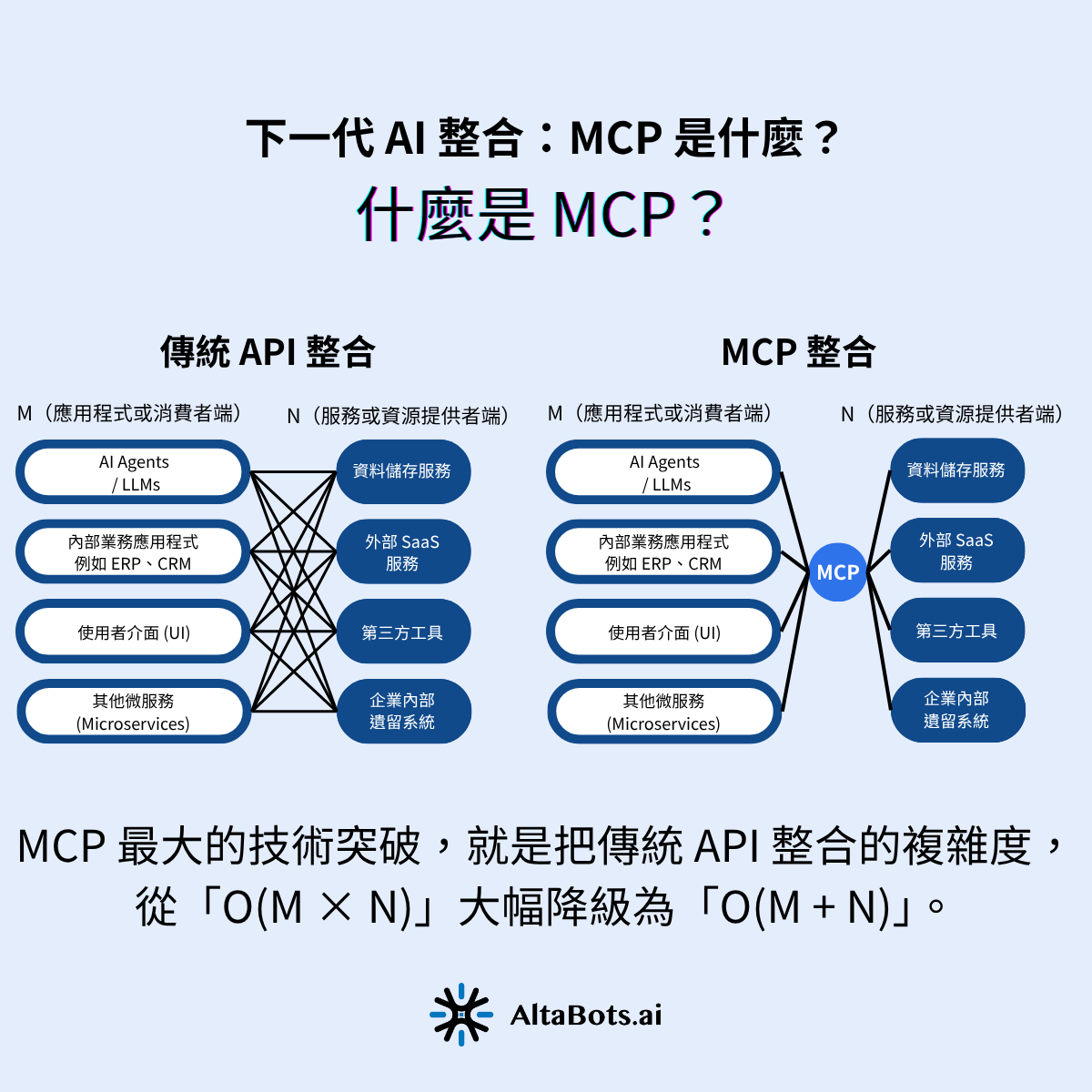
MCP (Model Context Protocol) lets AI applications access external data and tools under one set of rules. Previously, developers had to write integration code separately for each model (Claude, GPT, Gemini) and each data source (Google Drive, Slack, SQL, an enterprise CRM). MCP plays a role similar to USB-C by providing a shared interface specification. This holds only if the Host, Client and Server support the same version and capabilities, and permissions, data formats and operating procedures have been configured. "Supports MCP" should not be read as "connect it and it works."
MCP is often explained as turning "M × N" into "M + N." Suppose 5 AI models need to connect to 10 internal systems. The traditional approach might need 50 connections; with MCP, the count can in theory drop to 15 (5 models each implement it once, and 10 systems each implement it once). This is an estimate for understanding the architecture, not a guarantee of effort. Permissions, data formats, existing processes and protocol versions still affect the actual cost.
MCP is also not an AI agent platform, let alone a security product. It defines how systems exchange requests and results. Who may make calls, which data can be read and which actions require human confirmation remain the responsibility of the platform the enterprise chooses and its governance design. If this boundary is not made clear first, procurement can easily mistake "protocol compatibility" for "enterprise governance capability."
Who proposed MCP? Anthropic released it as open source in November 2024, with native support built into Claude Desktop. In December 2025 it was donated to the AAIF under the Linux Foundation, so it is now governed by a neutral organization[1]. That shift in who proposed it and who governs it now is a precondition for writing it into an enterprise's long-term technology roadmap.
The point of the scale figures is to judge whether MCP has enough of an ecosystem for enterprises to evaluate. Monthly downloads of the MCP Python and TypeScript SDKs rose from about 97 million in late 2025 to the 110 million announced at the Dev Summit in April 2026[2][3]. Mainstream frameworks such as OpenAI's Agent SDK and LangChain have adopted MCP, and Google, Microsoft and AWS have also announced support. For buyers, this means MCP can serve as a checkpoint for cross-platform interoperability. It does not guarantee the same depth of implementation across vendors, so versions, capabilities and governance methods still need to be verified one by one.
Why is 2026 the key year for enterprise MCP adoption? Three signals
Evaluate on whether governance is neutral, whether the ecosystem is usable, and whether comparable enterprises have moved from trials to production use, rather than on market buzz.
We regard 2026 as the point when MCP can enter formal evaluation, for three reasons: governance has moved to a neutral organization, the public ecosystem has reached a certain scale, and some enterprises have moved from trials to wider use. These three signals answer whether MCP is worth the time to validate. They do not ask enterprises to adopt it because their peers have.
Signal 1: Governance has moved to a neutral organization, lowering the risk of single-vendor lock-in
In December 2025, Anthropic formally donated MCP to the Linux Foundation, where it joined Block's goose and OpenAI's AGENTS.md to form the Agentic AI Foundation (AAIF)[1]. Founding and platinum members include AWS, Anthropic, Block, Bloomberg, Cloudflare, Google, Microsoft and OpenAI, which covers many of the major AI vendors.
For enterprise IT procurement, neutral governance lowers the risk of the protocol being controlled by a single AI vendor, so MCP can be included in long-term technology evaluations. Platform implementations, data formats and permission design can still create switching costs, however, and an open protocol does not mean zero vendor lock-in.
Signal 2: The ecosystem has passed the threshold for enterprise adoption
As of 2026, Anthropic counts more than 10,000 active public MCP Servers[3], not including private Servers that run inside enterprises. Finance, manufacturing and customer service already have implementation cases to refer to. A 2026 BCG survey shows that about one-third of respondent companies are expanding their use of agentic AI[7]. Gartner also predicts that by the end of 2026, 40% of enterprise applications will include task-specific AI agents, an 8-fold increase from less than 5% in 2025[4].
Signal 3: Some enterprises have moved from trials to production use
A 2026 McKinsey survey shows differences by company size. Among respondents at companies with annual revenue above US$500 million, 40% say they are scaling agentic AI within the organization, compared with 22% at smaller companies[6]. This result cannot directly represent adoption across Taiwan's industries, but it does show that some enterprises have moved from trials to wider use. When evaluating, there is no need to chase what peers are doing. Start by confirming measurable business needs, data conditions and governance responsibility.
Gartner also predicts that by the end of 2027, more than 40% of agentic AI projects may be canceled because of runaway costs, unclear business value or inadequate risk controls[5]. Ecosystem scale can therefore only support starting an evaluation; it cannot replace adoption conditions. Whether the first scenario maps to a clear process, has usable data and has an owner does more than market buzz to decide whether a project can continue.
How does MCP work? The three roles of Host, Client and Server explained
These three roles determine where data comes from, who can make calls, and at which layer permissions and auditing belong.
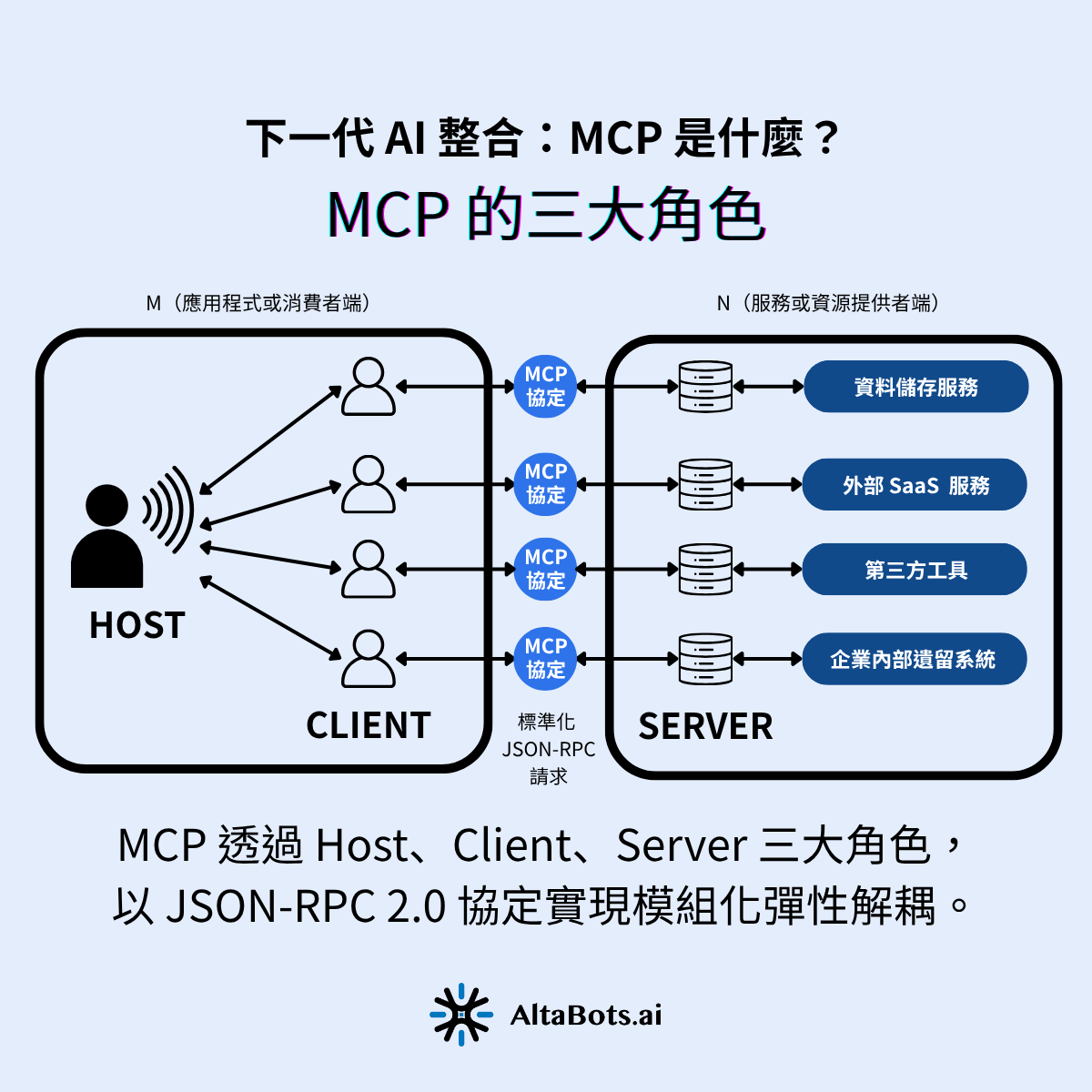
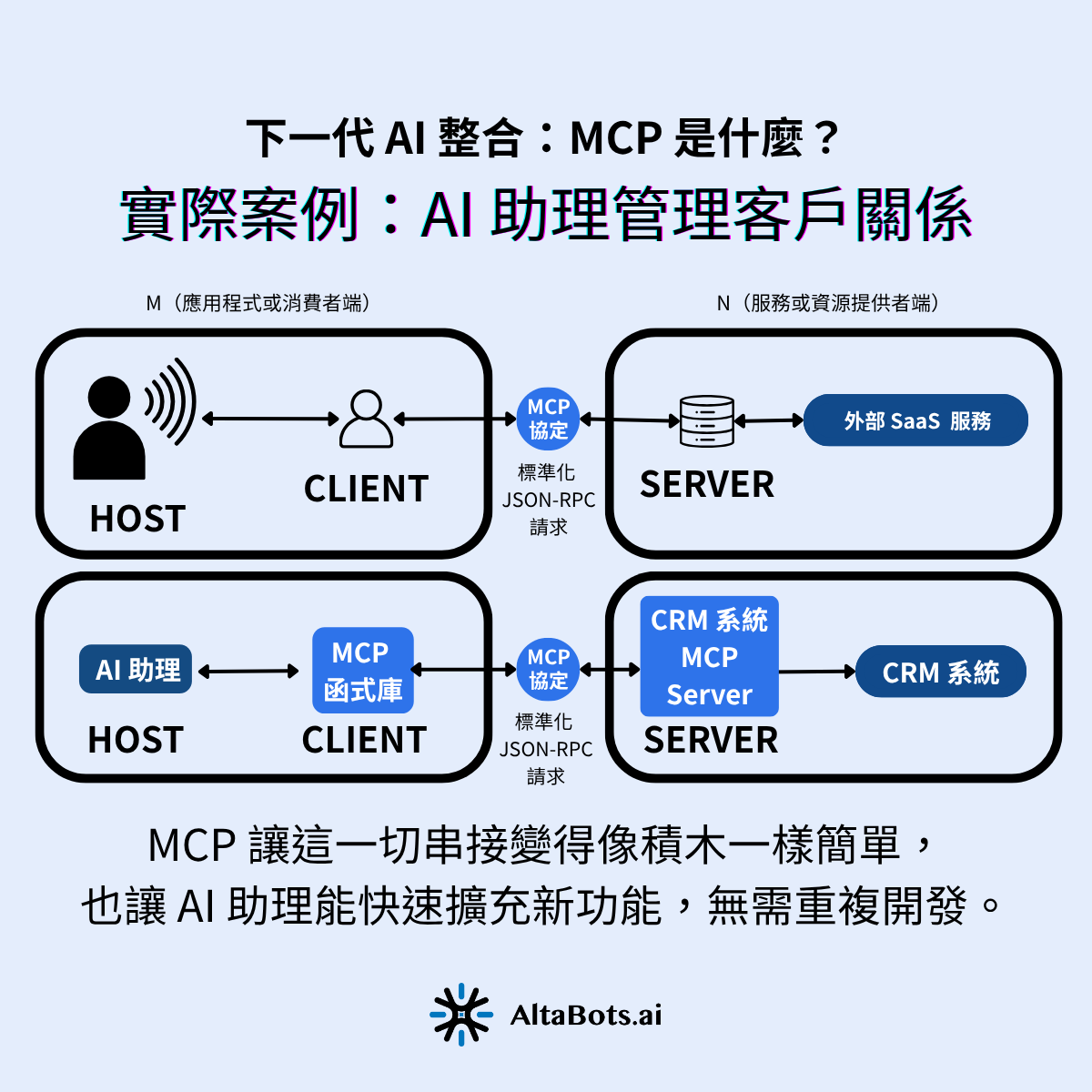
MCP uses three roles, Host, Client and Server, to separate the AI application, the protocol connection and the enterprise systems, and it communicates using the JSON-RPC 2.0 message format[14]. Readers do not need to memorize every technical detail, but should know that adopting MCP does not complete permission responsibilities automatically: the Host decides how users issue tasks, the Client handles the protocol connection, and the Server accesses enterprise data and operating capabilities.
For procurement and architecture evaluation, the three roles can be distinguished as follows:
- Host (entry point): Handles the user experience, task orchestration and security policy. It corresponds to the AI application or agent platform the enterprise chooses (such as AltaBots.ai, Cursor or Claude Desktop).
- Client (protocol connection): Sits inside the Host and converts instructions into standard JSON-RPC requests sent to the Server. It usually comes with the Host and does not need to be purchased separately.
- Server (system adapter layer): Provides tools, resources and prompts, and connects to APIs, databases or enterprise systems. Because the Server accesses real data and operating capabilities, permissions, allowlists and auditing must be set explicitly at this layer.
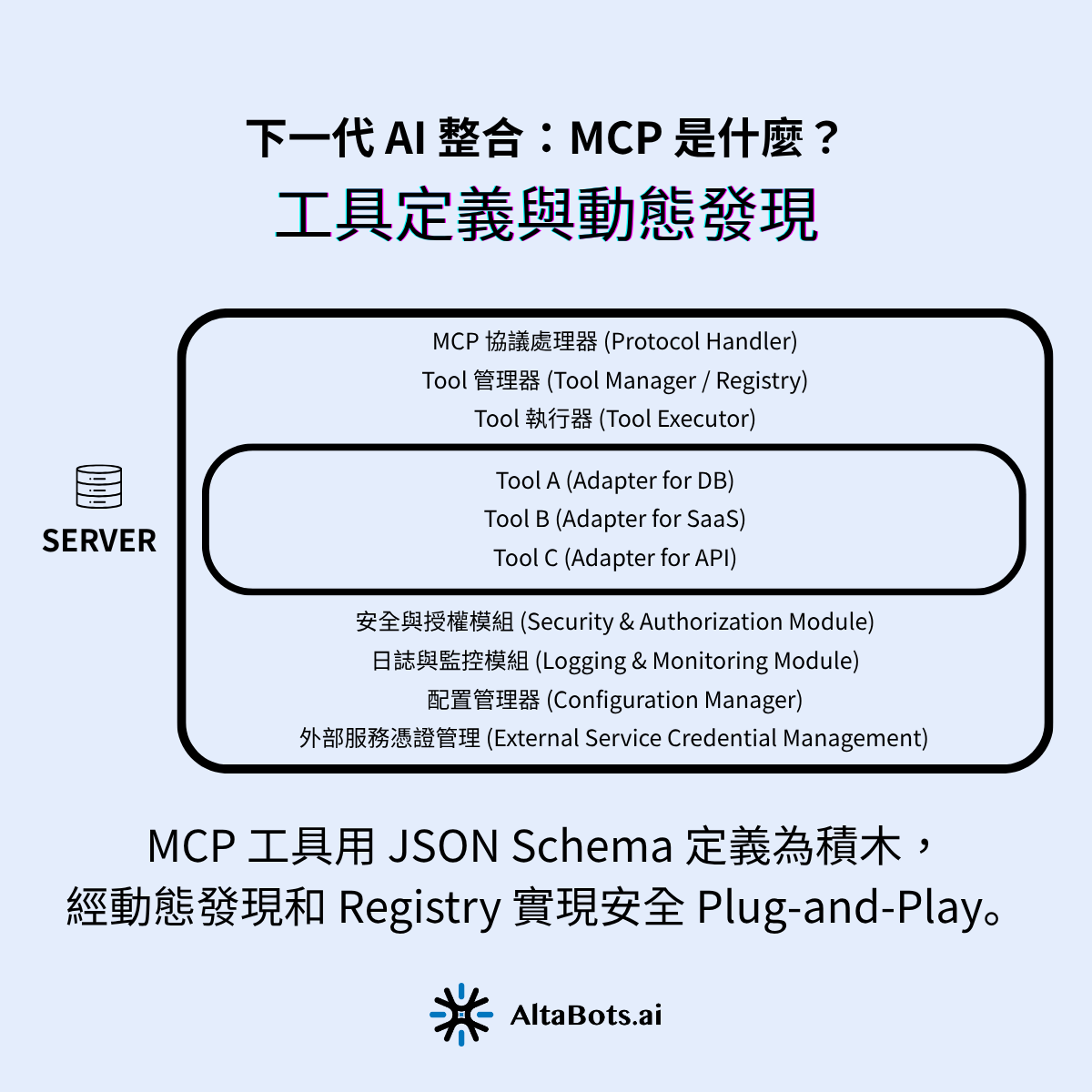
Take an AI assistant looking up customer data as an example. The user asks to retrieve a customer's interactions over the past three months, and the Host determines that external data is needed. The Client finds a CRM query tool in the list of available tools and sends a request to the Server in standard JSON-RPC format, and the Server then calls the Salesforce API to retrieve the data. Enterprises need to check more than whether the data came back: they also need to check whether the Server verifies user permissions, records the operation, and applies governance policies through an API Gateway.
The MCP tool list can change as the Server is updated, so an AI agent does not need all its capabilities hard-coded in its program. This design makes it easy to add tools, and it also means an unapproved tool could enter the callable list. The security section below explains how enterprises can restrict this.
How does MCP connect to existing ERP and CRM systems?
MCP adds a shared interface on top of existing ERP or CRM systems, while the original systems continue to own the data and business processes.
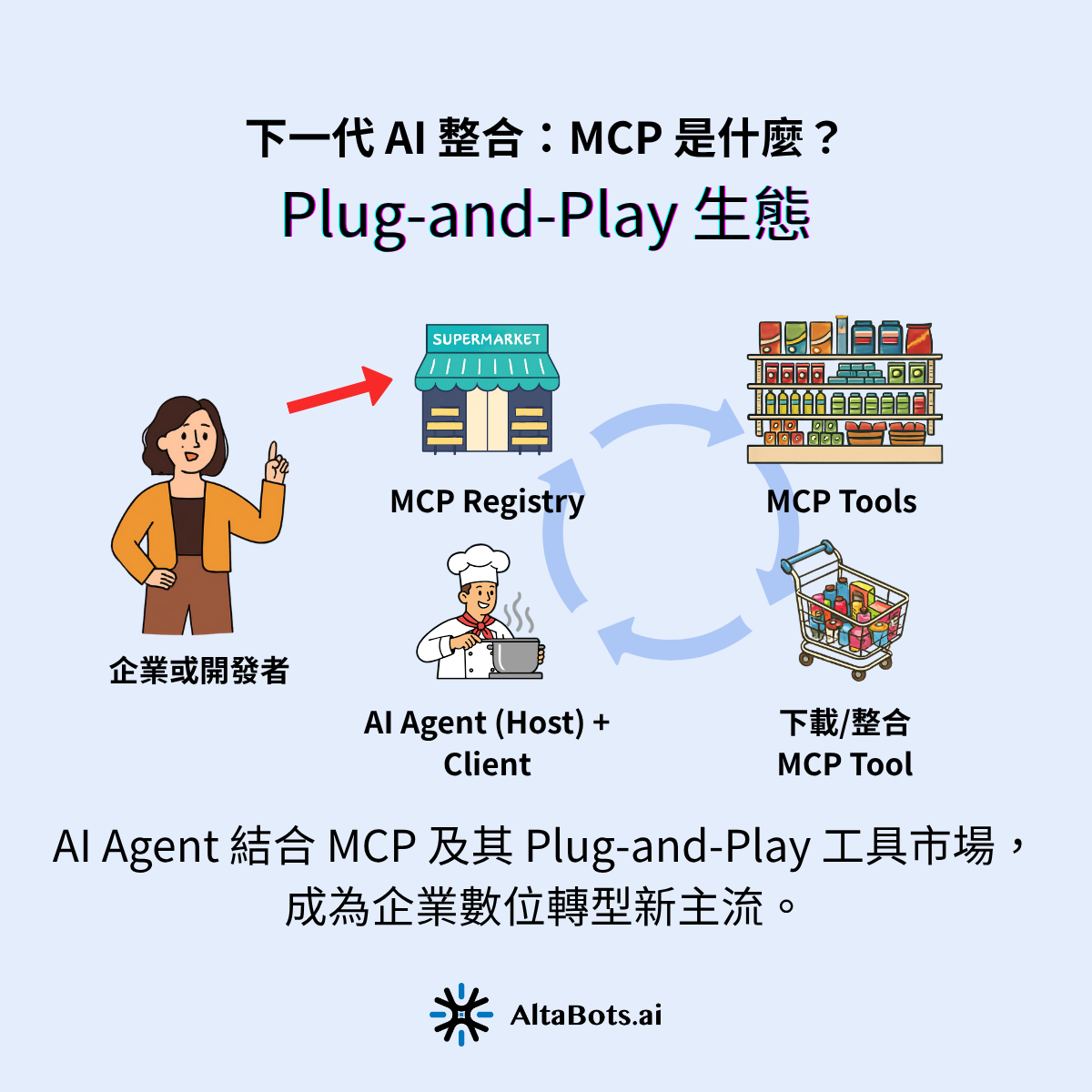
MCP does not require you to replace your existing ERP, CRM or databases. Instead, each system gets an MCP Server as an adapter layer that turns functions such as querying orders, reading customer data and writing tickets into a standard JSON-RPC interface. Once that is done, Clients that support the same MCP version and capabilities can call them under the protocol. Permissions, data formats and the level of support on each platform still need to be verified individually.
In practice, you can start by separating them by system: one Server for ERP (reading inventory, orders and financial data), one for CRM (customer 360 and interaction records), and one for the internal knowledge base. With this split, the enterprise can set permissions and auditing one by one, for example opening financial data as read-only and allowing writes only in the ticketing system. The order of adoption is also easier to control, because not every system has to be opened at once.
Three key criteria for evaluating an MCP solution
Procurement should check three things: whether the protocol is truly compatible, whether operations can be governed, and whether the adoption method can be verified.
When a vendor says it "supports MCP," that may mean only that it can connect, or it may include version management, permissions and auditing. Enterprise buyers should verify three layers: how far the protocol implementation goes, whether there is a Gateway governance layer, and whether the vendor can clearly state who is responsible for needs assessment, scenario selection, testing and going live.
Enterprises can connect MCP Servers themselves or choose an AI agent platform that already integrates them. Both routes work; the difference is how much version verification, permission design and operations work the enterprise is willing to take on itself. The three criteria below can serve as a first-round checklist for ruling out solutions that offer only a connection demo and cannot explain governance and operations responsibilities.
Criterion 1: Does it natively support MCP? (Avoiding "false compatibility")
First ask the vendor which MCP version, which SDKs and which transport methods the platform supports, and how it migrates when the specification is updated. The 2026-07-28 specification changed initialization, session identification, routing and authorization, and moved Tasks into an extension[14]. Systems that depend on the old session identification method may need changes. Buyers do not need to memorize the specification item by item, but the vendor must be able to point to the affected components, the migration method and the test results. Agent identity is still on the later roadmap, so at this stage protocol compatibility cannot be described as having solved every identity verification need[15].
"Whether it natively supports MCP or an equivalent standard protocol layer" should therefore be an evaluation item, so that you keep the option of changing models, platforms or backend systems later[8].
Criterion 2: Does it have enterprise-grade Gateway governance?
The integration efficiency MCP brings can be put to use only with matching governance infrastructure. In practice, check at least four things:
- Identity integration: Can it connect to your existing SSO (Azure Entra ID, Okta) so that the AI agent inherits user permissions rather than creating a parallel account system?
- Delegated authentication (OAuth 2.1 OBO): When an agent acts on a user's behalf, is the authorization chain complete and auditable?
- Tiered permissions and step-up verification: Reading data can use a standard token, but executing a payment transaction must trigger step-up verification.
- Immutable audit trail: Every tool call must be fully recorded so it can be traced afterward.
In April 2026, Cloudflare published an enterprise MCP reference architecture that combines remote MCP Servers, Access (SSO and MFA), MCP Server Portals, AI Gateway, and a Gateway that detects "shadow MCP"[11]. These capabilities map to the permission and data governance layer in 5 key risks to know before adopting an AI agent. If a vendor cannot explain how it handles identity, permission policy, auditing and unapproved Servers, it does not yet have the governance conditions that enterprise use requires.
Criterion 3: Do evaluation, pilot and production use follow the same method?
Connecting to an MCP Server is only a technical validation. The enterprise then still has to decide the first scenario, data ownership, human confirmation points, the fallback process when execution goes wrong, and how to coexist with existing systems. This work requires a clear adoption method; a software feature list cannot cover it.
Gartner notes that more than 40% of agentic AI projects may be canceled by the end of 2027, mainly because of runaway costs, unclear business value and insufficient risk controls[5]. When evaluating vendors, ask more specific questions: who inventories data and processes, what metrics validate the pilot, when permissions and auditing will be completed, and what conditions trigger a stop. Data-DI's role is to help enterprises put these decisions into a single adoption plan, beyond delivering a piece of software.
How is MCP different from A2A, and where did ACP go?
MCP governs how agents use tools; A2A governs how agents collaborate with each other. The two are often used together in multi-agent architectures.
MCP and A2A handle different layers of connection: MCP standardizes communication between an AI model or agent and tools, and A2A standardizes collaboration between agents. ACP, proposed by the IBM BeeAI team, originally also handled communication between agents, but it has been merged into A2A under the Linux Foundation. The ACP team stopped independent development, and existing users should move to A2A following the migration documentation[9]. When evaluating a new architecture in 2026, ACP therefore does not need to be treated as a third parallel option, and a multi-agent system may still use both MCP and A2A.
The division of labor between the two current protocols, and the status of ACP:
Suppose you are building a multi-agent system to handle e-commerce orders. An inventory agent, a supplier communication agent and a shipping agent each use MCP to connect to the ERP, the supplier system and the shipping API, and then use A2A to exchange task progress. MCP handles the connection between agents and tools, and A2A handles collaboration between agents. If a vendor covers only one of the two layers and cannot explain how the other interoperates, you may have to integrate again when you expand later. For more on multi-agent design, see our article What is multi-agent AI? Enterprise architecture and 3 cases.
What security risks does MCP bring? The five top threats of 2026 and the order to address them
Address first the risks that could give an agent unauthorized tools or permissions, then expand what it is allowed to execute.
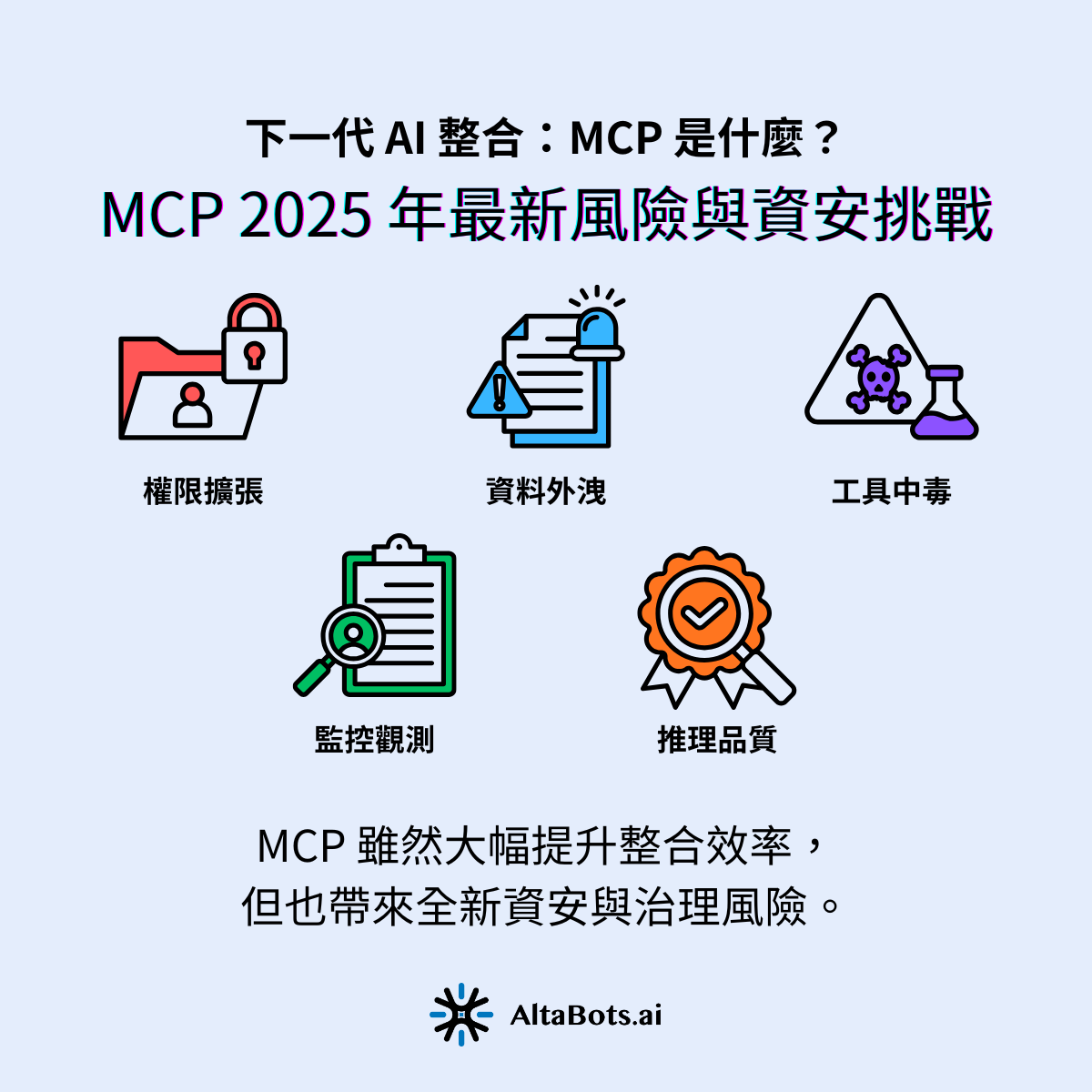
MCP allows tools to be discovered and called dynamically, which also adds entry points for permission misuse. Enterprises should first address dynamic tool injection and the Confused Deputy problem: the former can let unapproved tools into the list, and the latter can let an agent use a legitimate identity to carry out operations beyond what was intended. The remaining risks can be handled in stages according to the number of tools and operating permissions. The agenda of the April 2026 MCP Dev Summit also made security a main theme[2].
The five risks, in priority order:
- Priority 1: Dynamic tool injection and permission expansion: MCP supports dynamic tool discovery. Without a properly configured allowlist, an AI agent may gain unapproved high-risk capabilities, such as deleting data or executing payment transactions. In the first stage, complete the tool allowlist, version pinning and change notifications, and use an API Gateway to centrally review tool registration and calls.
- Priority 2: Confused Deputy and sensitive data leakage: If MCP Server permissions are poorly designed, an AI agent may be induced to perform operations beyond the user's permissions, and prompt injection can also cause data leakage indirectly. Enterprises need to carry the user's identity through, verify the scope of each authorization, and record a traceable log of operations.
- Priority 3: Tool poisoning and description contamination: Attackers may embed malicious instructions in tool descriptions or parameters to induce an agent to carry out unauthorized operations. Enterprises need to inspect tool descriptions and inputs and outputs, and when tool content changes significantly, have a person confirm before it is opened up.
- Priority 4: Insufficient permission control and observability: MCP provides an authorization foundation, but per-tool and per-resource policies and centralized auditing still depend on the implementation. As Servers multiply, apply the principle of least privilege and centralized logging and monitoring, so that exception rules are not scattered across systems.
- Priority 5: Context window bloat and degraded reasoning quality: When all tool definitions are loaded into the LLM context, more tools take up more tokens and affect tool selection. RAG-MCP first retrieves the tool definitions relevant to the current task and then loads them into the model, which can reduce unnecessary context usage[12].
What is RAG-MCP, and why do you need it once there are many tools?
As the number of tools grows, first find the tools relevant to the task, then load only the necessary definitions into the model.
RAG-MCP is an architecture that applies retrieval-augmented generation (RAG) to tool selection. Instead of stuffing all MCP tool definitions into the LLM's context at once, it first uses retrieval to find the few tools most relevant to the current task and then loads those[12]. When the number of tools grows from a handful to hundreds, this is the key technique for avoiding a token explosion and slower reasoning.
The same approach appears at the Gateway layer. In a Code Mode case published by Cloudflare, with 4 internal MCP Servers and 52 tools in total, tool definitions took about 9,400 tokens. After switching to 2 portal tools, they took about 600 tokens, a 94% reduction[11]. This is a result from Cloudflare's own environment and cannot be applied directly to other enterprises, but it can be used to check whether a platform supports progressive tool discovery. To learn more about retrieval and reranking, see our article What is RAG? Retrieval, reranking and answer checks.
Another governance issue in 2026 is shadow MCP: like shadow IT in earlier years, employees or departments connect unapproved MCP Servers on their own, creating blind spots for auditing and security. As enterprises expand MCP use, detecting and bringing unapproved Servers under management must be on the governance checklist.
To handle these risks, you can choose a governance method according to how hard recovery is and when intervention is possible. Risks that change slowly and can be traced back call for audit-based governance. Risks that change quickly but can still be intervened in call for monitoring-based governance. Operations that are hard to reverse and have major impact require behavior boundaries to be set at the design stage. Of the five MCP risks, the first two should be handled in the first adoption phase, and the last three can be added in stages according to the scale of use.
Implementation path for Taiwan enterprises adopting MCP: IT and OT in parallel
First limit the actions an agent can execute, then choose the first scenario according to the data conditions on the IT and OT sides.
Taiwan enterprises do not need to connect MCP to every system at once. A more controllable method is to first classify by the actions an agent can execute into Level 1, 2 and 3, and then divide use cases into IT and OT tracks[8]. The IT track handles work with existing data and processes, and the OT track handles equipment and on-site knowledge. The two tracks have different validation cycles and should not use the same short-term ROI standard.
Step 1: Use Levels 1, 2 and 3 to control risk exposure
We recommend expanding in the order L1, L2, L3 rather than pursuing fully automated, maximum-permission operation from the start:
Step 2: Run the IT and OT tracks at the same time, with different scenarios
- IT track: Aims to improve decision quality and speed of response. Typical scenarios include automatic triage in AI customer service, consolidating customer intelligence before a sales visit, and real-time detection of anomalies in financial reports. These scenarios have complete data and ROI that is easy to quantify, so they suit validating first-wave results in a 30-day POC (proof of concept).
- OT track: Aims to make factory tacit knowledge preservable and usable. A typical scenario is turning senior technicians' equipment tuning know-how and quality-control anomaly judgment logic into tools an agent can call. This kind of work may not prove its value through hours saved in the first quarter, so evaluate it with knowledge coverage, lookup time and consistency of anomaly handling instead.
In March 2026, Pinterest publicly described its production MCP environment. Areas such as Presto, Spark and Airflow each have a dedicated Server, managed through a central registry, with human confirmation set for sensitive operations. The article records about 66,000 calls a month and 844 active users, and, based on estimates from tool owners, calculates savings of about 7,000 engineering hours a month[10]. These figures are Pinterest's internal estimates and cannot be used directly as a benefit target for other enterprises. What the case offers as reference is how dedicated Servers, central management and human confirmation work together.
Step 3: Align with the timeline of Taiwan's AI governance law
Taiwan's Artificial Intelligence Basic Act was promulgated and took effect on January 14, 2026[13]. Article 18 requires the government to complete adjustments to related laws and administrative measures within two years of taking effect, and Article 16 requires competent authorities to help industries draw up guidelines and codes of conduct[13]. This is not a general two-year grace period for enterprises. When evaluating MCP, enterprises should still handle data, permissions and auditing according to current personal data, information security and industry regulations.
In practice, the governance framework and MCP scenario pilots should run in parallel. A 2026 McKinsey survey shows that among respondents at companies with annual revenue above US$500 million, 40% say they are scaling agentic AI within the organization, compared with 22% at smaller companies[6]. If data inventory, permission tiers and audit mechanisms are put off, existing processes and Servers may need to be reworked.
Conclusion: MCP is worth evaluating now, so start with a scenario you can verify
The next step is to pick a scenario that can be verified, can be stopped and has controllable permissions.
By 2026, MCP has a neutral governing organization, more than 10,000 public Servers[3] and enterprise production cases. A BCG survey also shows that about one-third of respondent companies are expanding their use of agentic AI[7]. These conditions support starting a formal evaluation, but adoption should still begin with a scenario that is measurable, reversible and clear in its permission scope.
For enterprise IT managers and decision-makers, the key actions for the second half of 2026 are as follows:
- Procurement evaluation: Confirm item by item the protocol version and capabilities, the Gateway governance method, and how the vendor completes needs assessment, pilot validation and production rollout. Do not rely only on a feature label saying "supports MCP."
- Pilot planning: Start with a Level 1 advisory agent and choose an IT-track scenario with complete data and easily quantified ROI as the first POC (such as AI customer service triage or sales intelligence consolidation). If no first-wave results appear within 30 days, adjust or stop immediately.
- Governance setup: Run data inventory, permission tiers, audit mechanisms and scenario pilots in parallel, to avoid redesigning permission and audit processes after go-live.
- Regulatory alignment: Build internal governance according to current personal data, information security and industry regulations. The two-year period in the Artificial Intelligence Basic Act is the timeline for the government to adjust laws and administrative measures, not a grace period for enterprises[13].
If you are planning enterprise MCP adoption but cannot yet decide the first scenario, verify a vendor's compatibility or assign governance responsibilities, Data-DI offers a free 30-minute AI agent adoption assessment. Consultants first learn about your current IT architecture and the work you want to improve, then work with you to decide which scenarios can be validated first, what data you need to prepare, and which permission and audit conditions are indispensable in the first phase. You do not need finished documents beforehand; bring your current situation and questions.
→ Book a consultant-led AltaBots.ai adoption assessment
References

[1] Linux Foundation. (2025.12). Linux Foundation Announces the Formation of the Agentic AI Foundation (AAIF), Anchored by New Project Contributions Including Model Context Protocol (MCP), goose and AGENTS.md.
https://www.linuxfoundation.org/press/linux-foundation-announces-the-formation-of-the-agentic-ai-foundation
[2] Agentic AI Foundation. (2026.04). MCP Is Now Enterprise Infrastructure: Everything That Happened at MCP Dev Summit North America 2026.
https://aaif.io/blog/mcp-is-now-enterprise-infrastructure-everything-that-happened-at-mcp-dev-summit-north-america-2026/
[3] Anthropic. (2025.12). Donating the Model Context Protocol and Establishing the Agentic AI Foundation.
https://www.anthropic.com/news/donating-the-model-context-protocol-and-establishing-of-the-agentic-ai-foundation
[4] Gartner. (2025.08). Gartner Predicts 40% of Enterprise Apps Will Feature Task-Specific AI Agents by 2026, Up from Less Than 5% in 2025. Gartner Newsroom.
https://www.gartner.com/en/newsroom/press-releases/2025-08-26-gartner-predicts-40-percent-of-enterprise-apps-will-feature-task-specific-ai-agents-by-2026-up-from-less-than-5-percent-in-2025
[5] Gartner. (2025.06). Gartner Predicts Over 40% of Agentic AI Projects Will Be Canceled by End of 2027. Gartner Newsroom.
https://www.gartner.com/en/newsroom/press-releases/2025-06-25-gartner-predicts-over-40-percent-of-agentic-ai-projects-will-be-canceled-by-end-of-2027
[6] McKinsey & Company. (2026.08). The State of AI.
https://www.mckinsey.com/capabilities/quantumblack/our-insights/the-state-of-ai
[7] BCG. (2026.02). The $200 Billion Agentic AI Opportunity for Tech Service Providers.
https://www.bcg.com/publications/2026/the-200-billion-dollar-ai-opportunity-in-tech-services
[8] Pei Youheng. (2026.02). From the MCP protocol to security governance: a CIO's 2026 practical roadmap (in Chinese). CIO Taiwan.
https://www.cio.com.tw/106747/
[9] IBM Research. (2026.11). Agent Communication Protocol (ACP; date accessed).
https://research.ibm.com/projects/agent-communication-protocol
[10] Pinterest Engineering. (2026.03). Building an MCP Ecosystem at Pinterest.
https://medium.com/pinterest-engineering/building-an-mcp-ecosystem-at-pinterest-d881eb4c16f1
[11] Cloudflare. (2026.04). Scaling MCP Adoption: Our Reference Architecture for Simpler, Safer and Cheaper Enterprise Deployments of MCP.
https://blog.cloudflare.com/enterprise-mcp/
[12] arXiv. (2025.05). RAG-MCP: Mitigating Prompt Bloat in LLM Tool Selection via Retrieval-Augmented Generation.
https://arxiv.org/html/2505.03275v1
[13] National Science and Technology Council. (2026.01). Artificial Intelligence Basic Act (in Chinese).
https://law.nstc.gov.tw/LawContent.aspx?id=GL000592&kw=%E4%BA%BA%E5%B7%A5%E6%99%BA%E6%85%A7&media=print
[14] Model Context Protocol. (2026.07). The 2026-07-28 Specification.
https://blog.modelcontextprotocol.io/posts/2026-07-28/
[15] Model Context Protocol. (2026.08). The New MCP Roadmap.
https://blog.modelcontextprotocol.io/posts/mcp-roadmap/
FAQ
FAQs about this article
Who proposed MCP, and when?

Anthropic proposed MCP as open source in November 2024 and supported it in Claude Desktop. In December 2025 it was donated to the Agentic AI Foundation (AAIF) under the Linux Foundation and is now governed by a neutral organization. Enterprises can include it in cross-platform evaluations without depending on a single vendor.
How do you choose an MCP platform? Which criteria matter?
Check three things: the MCP versions and capabilities supported, how identity, permissions and auditing are handled, and how the vendor verifies the first scenario and handles version migration. Different solutions can take on the three responsibilities, but each should be confirmed item by item before purchase, so that being able to connect is not mistaken for being ready for production use.
How does MCP connect to existing ERP and CRM systems?
You do not need to replace existing systems. Instead, add an MCP Server to each system as an adapter layer. Clients that support the same MCP version and capabilities can call it under the protocol. Permissions, data formats, auditing methods and the level of support on each platform still need to be verified item by item.
Which MCP security risks should be handled first?
Handle first the risks that could give an agent unapproved tools or permissions beyond the user's authorization. In the first stage, complete the tool allowlist, version pinning, identity and authorization checks, and operation logs. As the number of tools and the executable scope grow, add centralized monitoring and exception management.
Where should Taiwan enterprises start with MCP?
Start with a Level 1 scenario that has a clear permission scope and results that can be checked. The IT track can pick customer service triage or intelligence consolidation, and the OT track can begin with equipment and on-site knowledge. The two-year period in the Artificial Intelligence Basic Act is the timeline for the government to adjust laws and administrative measures, not a grace period for enterprises.
More articles


訂閱我們的電子報
每月 8 日定期發送最新趨勢與實用資訊!



