

What is an SLA? 2026 customer service FRT benchmarks | Alta.DI
What is an SLA? A one-sentence definition of the service level agreement, 2026 customer service FRT benchmarks by channel, reasonable SLA attainment ranges, and a realistic path to hitting targets after adopting AI. Book a free Data-DI SLA health check.


Key takeaway: first understand what an SLA is, then use the 2026 FRT benchmarks by channel and three-dimension attainment rates to turn it from a contract clause into a lever for customer retention.
An SLA (Service Level Agreement) is a written standard of commitment on service speed and quality. In customer service, it is the concrete numbers for "how fast we respond, how fast we resolve," and in 2026 it is an operating lever that decides whether customers stay. If you are wondering "what exactly is an SLA," "how many minutes should customer service first response time (FRT) be," or "why didn't attainment improve after adopting AI customer service," this article gives you the definition, a 2026 FRT benchmark table by channel, and the adjustment path Data-DI's clients have actually followed.
The Zendesk CX Trends 2026 report finds that 63% of customers rank "speed of response" as the top factor in a support experience, ahead of speed of resolution (57%) and channel availability (49%) [1]. SLAs moving from contract commitments to retention levers is now the consensus in 2026 customer service management.
What is an SLA? Full name, definition and common types of service level agreements
A one-sentence definition first, then the difference between IT and customer service SLAs.
SLA stands for Service Level Agreement. It is a measurable commitment by a service provider on service levels, covering metrics such as speed, quality and availability, and it applies wherever a clear service standard is needed: IT operations, cloud services, software supply and customer service. Put simply, an SLA writes "how good a service I will provide" as numbers that can be checked, rather than a verbal assurance.
SLAs have most often appeared in IT and cloud procurement contracts, with commitments such as "99.9% system availability." But the same logic measures different things in different settings, and they fall into three common types:

If you searched "what is an SLA," you are probably about to set a service standard or trying to understand the term in a contract. Of the three types, the one most directly tied to revenue and most often used by managers to run their teams is the customer service SLA. It measures not machines but how customers actually feel in every conversation. The FRT, attainment rates and AI involvement discussed below all focus on the customer service SLA.
Why did the customer service SLA move from contract clause to retention lever in 2026?
The metrics have not changed, but the angle should shift from risk control to growth.
A customer service SLA is the standard of service speed and quality a company commits to its customers. Common metrics include first response time, average response time, resolution time and SLA attainment rate. It suits B2B and B2C companies that want to manage their service teams with data and improve retention. The most important change in 2026 is that it is no longer just a contract document between a service provider and enterprise customers; it is an operating lever that directly affects whether customers stay.
Research shows that companies replying to email within one hour reach a 71% customer retention rate, which drops to 48% when replies take more than 24 hours. That 23-percentage-point retention gap comes entirely from response speed [2]. The same research finds that 88% of customers expect companies to reply faster than they did a year ago, and 53% say "waiting too long" is the biggest frustration when dealing with a company [1].
For managers, this change is practical. You used to look at an SLA as "did the contract get breached." Now you look at it as "will the customer come back." The metrics are the same, but the management mindset shifts from risk control to a growth lever.
What are the 2026 FRT benchmarks by channel?
40 seconds for Live Chat, 4 hours for Email: this is the 2026 top-performer line, not the average line.
First response time (FRT) is the time from a customer sending a message to the first substantive reply from service. The 2026 top-performer benchmarks by channel are within 40 seconds for Live Chat, within 1 hour for social messaging and within 4 hours for Email [2]. This is where the international service teams cited above are today, and most companies in Taiwan still lag by 2-3 orders of magnitude.

A note: the Email industry average is 7-10 hours, but 46% of customers expect a reply within 4 hours [2]. That gap is your opportunity in setting an SLA. Bringing Email FRT from 24 hours down to within 4 hours, based on the retention data cited above, leaves room to improve retention by 20 percentage points or more.
Practical advice for Taiwan: do not adopt a top-performer line such as 40 seconds directly as an internal KPI, as it will overwhelm the team. First look at where your own median sits. The median reflects the "typical customer's real experience" better than the average, because a few extreme delays pull the average up sharply [3]. Set the first-stage target 30-50% better than the median, review every three months, and tighten it then.
Why doesn't SLA attainment rise after adopting AI customer service?
The AI picks up the conversation but not the workflow, and that is what holds attainment back.
When SLA attainment does not improve after AI customer service goes live, the main cause is usually not that the AI is inaccurate, but that "the conversation was caught and the workflow was not." After the AI's first reply there is no clear handoff rule, so FRT looks good while resolution time gets worse. In the clients we have worked with, three situations come up most often:
- First, the AI replies fast and the human picks up slowly.The AI sends its first reply within 5 seconds, but when a person needs to take over, the agent does not see the notification for a long time, and overall FRT (including human takeover) ends up higher than before adoption. The fix is to set the AI-to-human handoff as its own SLA timer, instead of only watching the number from "customer sends message to the AI's first reply."
- Second, the AI absorbs the easy questions and leaves the hard ones piling up for people.On the surface the AI handles 60% of conversations, but all of that 60% are easy questions solvable within 30 seconds, while the remaining 40% are all highly complex, and the handling time per person actually goes up. The fix is to split the SLA into two lines, "easy-question FRT" and "complex-question FRT," so averages do not mislead you.
- Third, channels are not integrated, and each SLA stands alone.LINE, the website and Email each have their own SLA, but a customer who asks on LINE and then follows up by Email means the same case is counted twice as overdue. The fix is to use one all-channel platform to unify the SLA view, which is one of the problems the all-channel design of Alta.DI, a channel-agnostic platform, is built to solve. To see how multiple channels converge into one consistent service level, refer to our5-Step Guide to Omnichannel Integration (OMO).
Consider Klarna's 2024 data from deploying an OpenAI-based customer service assistant: in its first month of global rollout it handled 2.3 million conversations, and average resolution time fell from 11 minutes to under 2 minutes [4]. But behind that figure was a human-AI handoff process designed in advance; it did not happen automatically just by connecting the AI.
What SLA attainment rate counts as good? Which reports should managers watch in 2026?
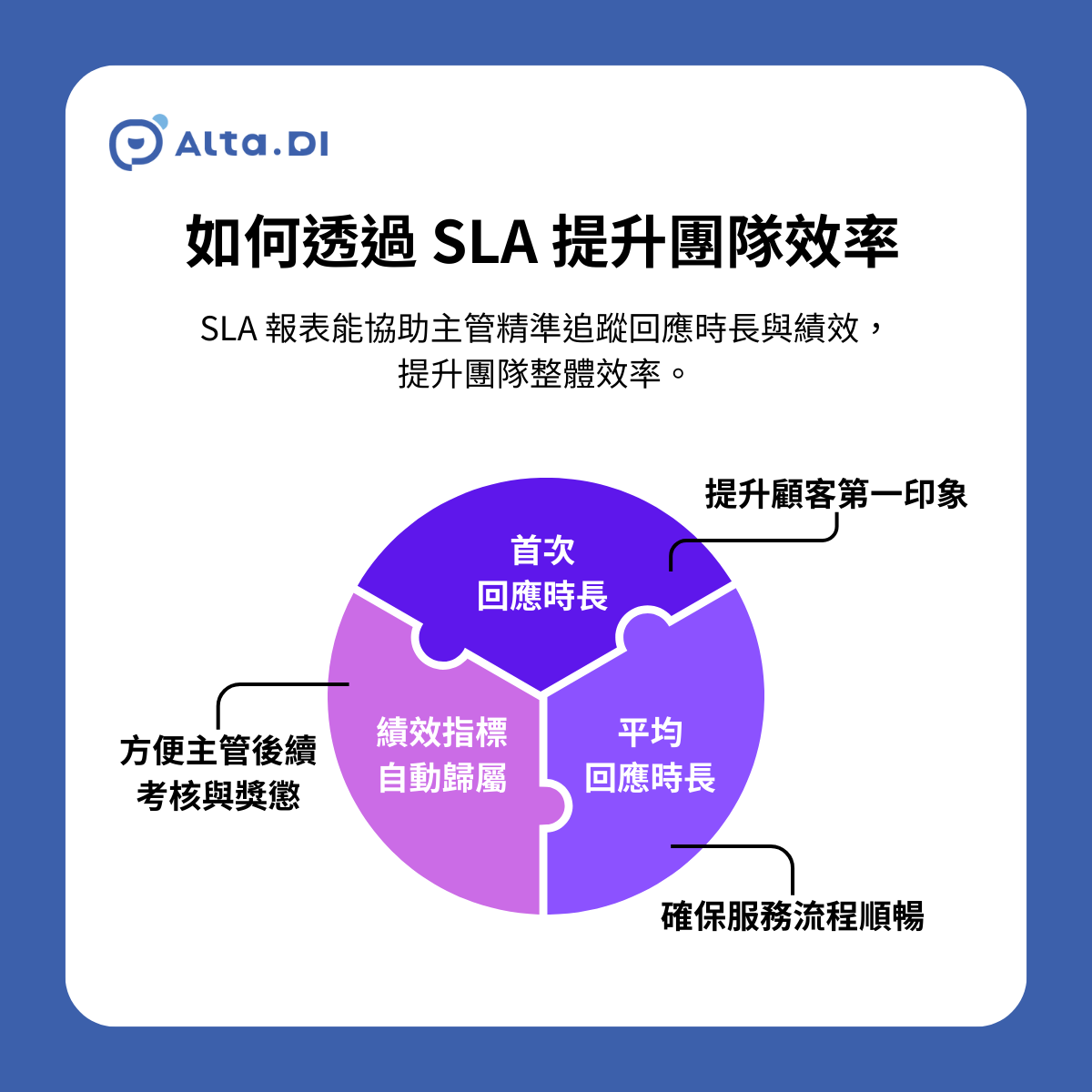
Do not look only at the overall attainment rate. Break it down by channel, time of day and conversation type.
SLA attainment rate is the share of conversations that a service team responds to or resolves within the agreed time. In 2026 a good benchmark varies widely by channel: for easy questions on Live Chat, attainment should be 90% or higher; for complex questions on Email, 80% is excellent; and 75% across all channels is good. But looking only at the total misses the real problems, so break it down in three dimensions.
- The first dimension: by channel.Reasonable attainment rates differ between Live Chat and Email. Viewed together, synchronous channels pull the number up and asynchronous channels pull it down, hiding the real bottleneck.
- The second dimension: by time of day.For most teams, SLA performance drops noticeably on weekdays from 14:00 to 17:00 and on Monday mornings. This usually means scheduling needs adjusting, not that the team as a whole lacks capability.
- The third dimension: by conversation type.Reasonable SLAs for complaints, refunds, technical issues and general inquiries can differ by 3-5 times. We suggest a first response within 1 hour for complaints, and technical issues can be relaxed to a first response within 4 hours. Mixing them together lets the average hide the risk of complaint escalation.
In its practice helping clients manage service performance, Data-DI often observes that once managers start reading attainment reports through the three-dimension breakdown, they usually find within the first week that a particular time slot or conversation type is the main source of SLA misses, which a dashboard showing only the total cannot reveal. Whether a reporting platform supports this kind of multi-dimension breakdown is the capability to check first when selecting one. For a practical comparison, seeHow AI Reports Catch Gaps in the Customer Service Process.
How does the Alta.DI platform help managers set and track SLAs?
Not one more dashboard, but no more piecing numbers together from three places.
Alta.DI is an AI-driven customer engagement platform. Its SLA management covers flexible rule settings, real-time countdown reminders, sortable views and cross-channel attainment reports, and it suits service teams that need to manage service levels across LINE, the website, Email and other channels in one place. Once you know the 2026 benchmarks and the three-dimension breakdown, the next practical question is usually: "Can our current tools support this way of managing?"
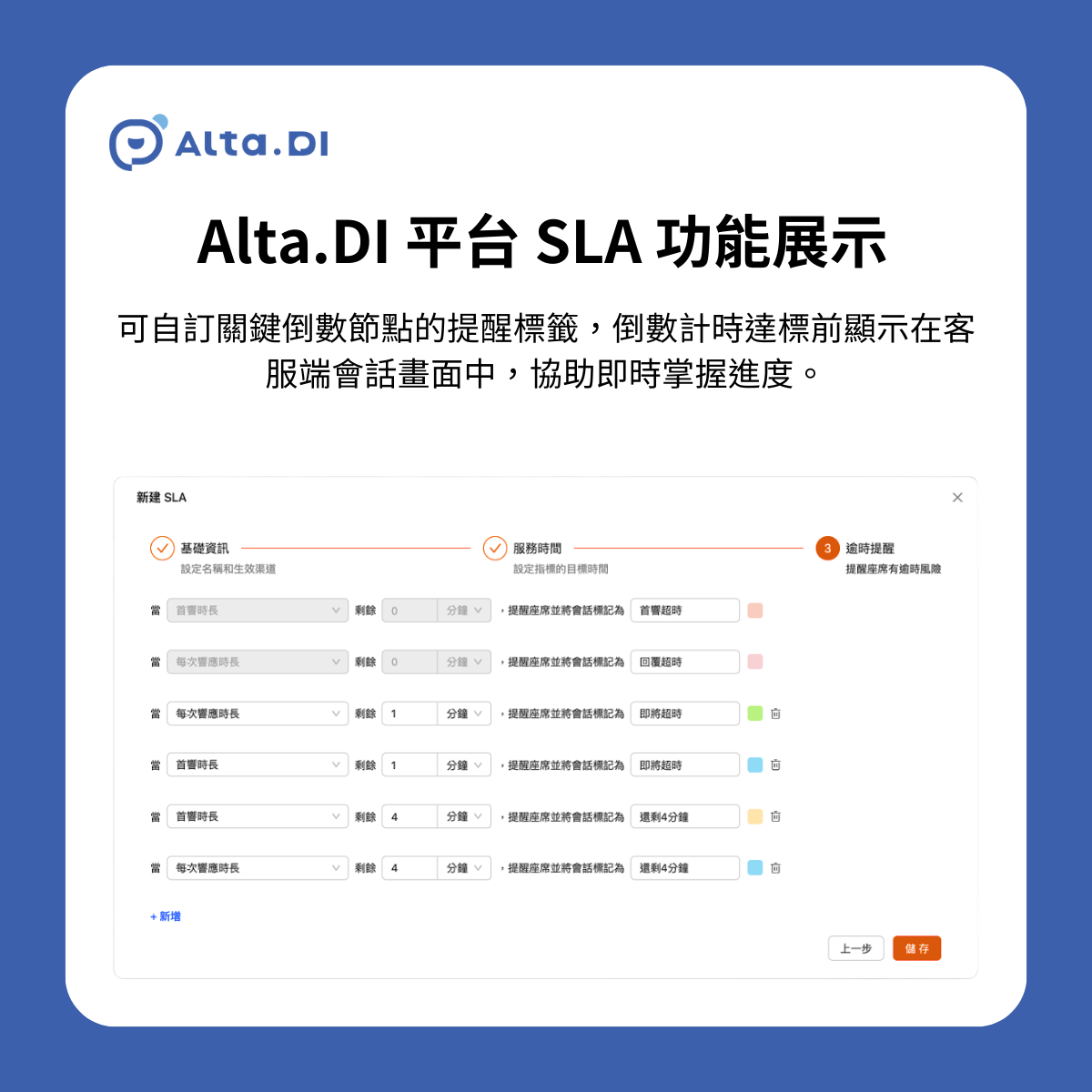
If your service manager currently copies numbers from three channel back ends into Excel and calculates attainment by hand, automating just that saves half a day every week and lets the manager spend that time on decisions that actually improve the process. The most direct difference for managers: before, it took a week to pull data from each channel back end and calculate attainment in Excel; now the report is generated automatically, and the manager's real time goes to "deciding what to change next week based on this report."
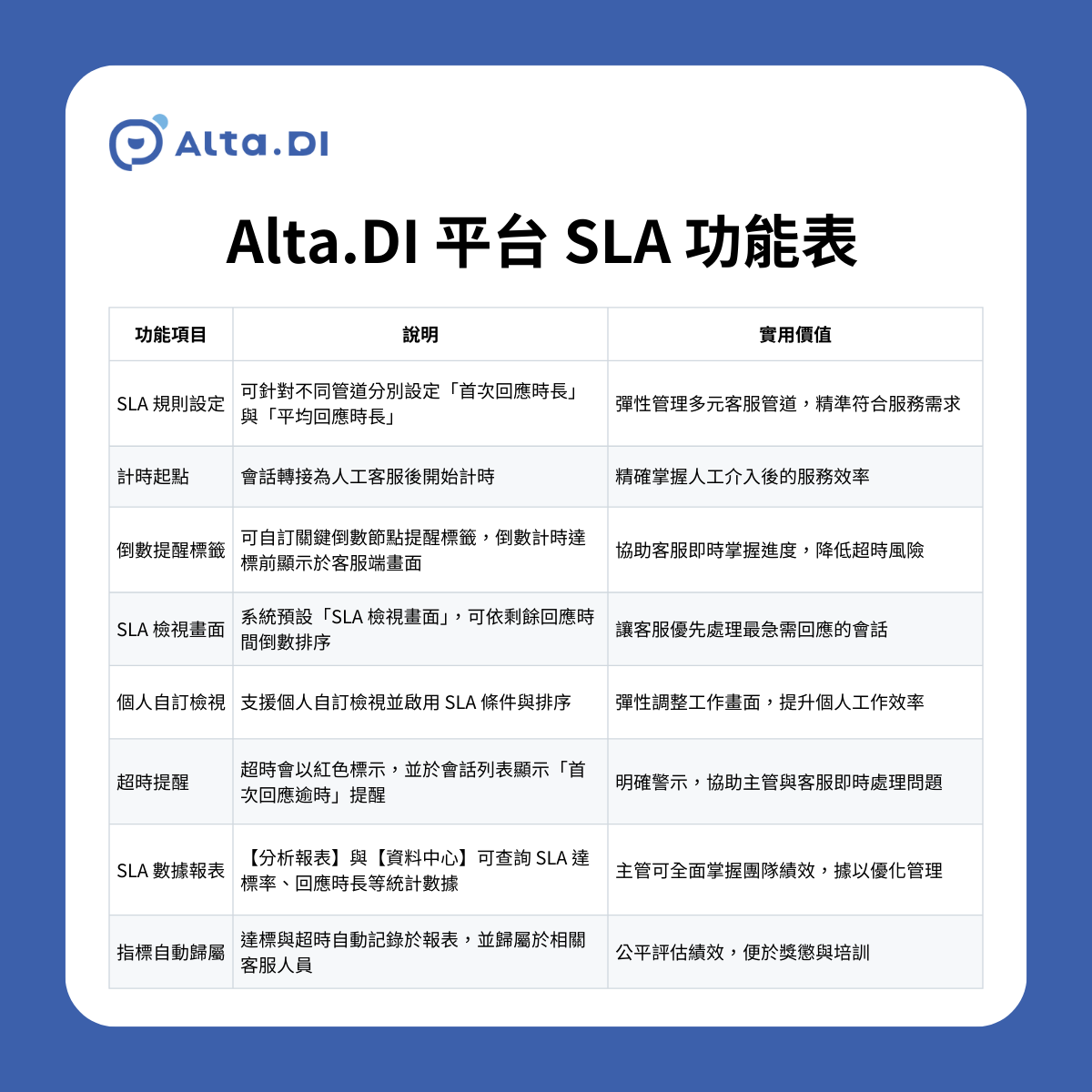
This is also something Data-DI consultants working alongside you will help design, from SLA strategy through platform deployment, rather than handing you a tool to figure out afterward. For more feature details, see Alta.DI AI Features Explained, or go directly to the Alta.DI customer engagement platform.
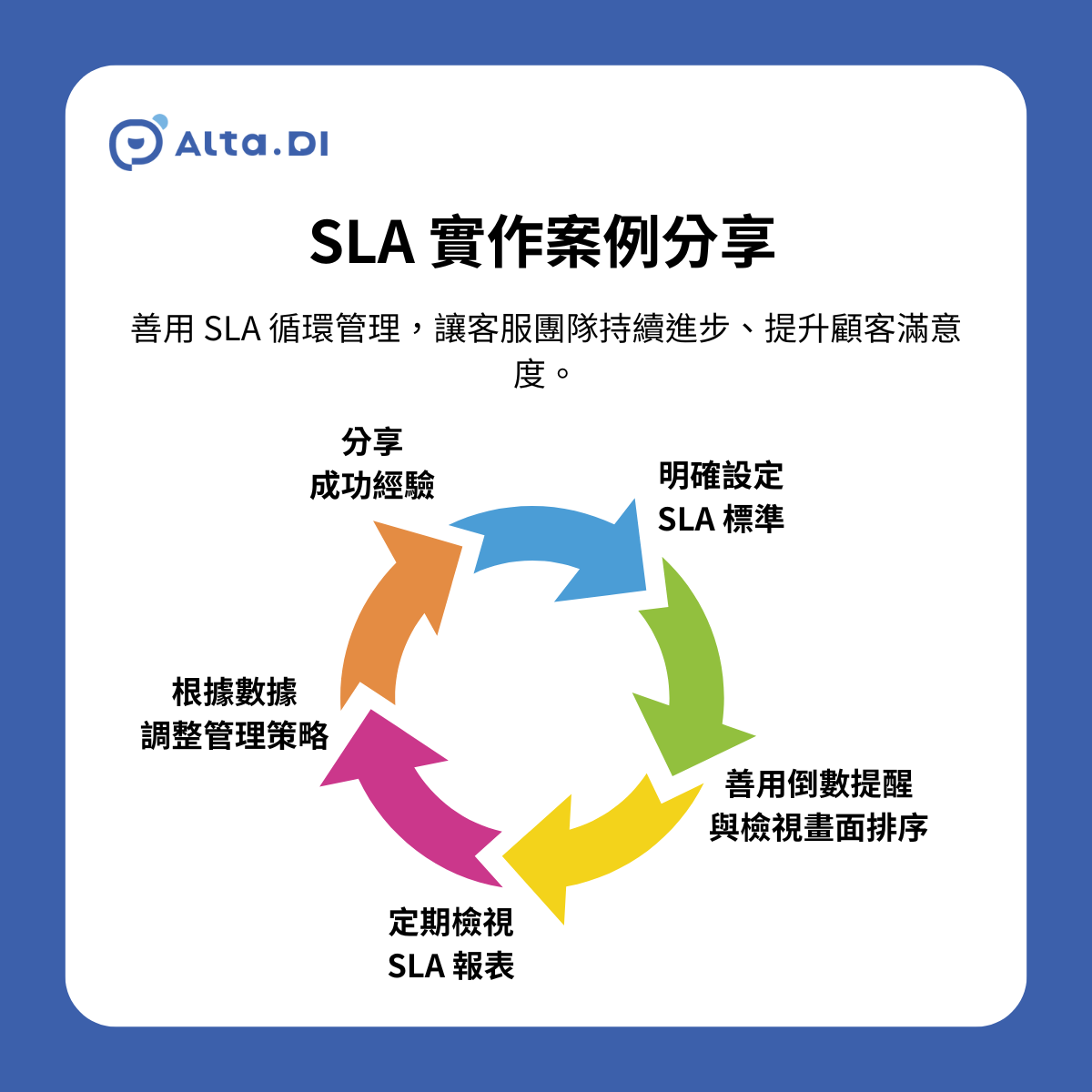
An SLA management path from new manager to senior leader
Start with the median, then split by dimension, then bring in AI, in three-month cycles.
A mature SLA management path breaks into three stages, one cycle every three months: in the first stage, capture the current median and set a first target; in the second, break attainment down by channel and conversation type; in the third, bring in AI to take over easy questions and reallocate staff to complex ones. The clients we have worked with, from new managers to senior leaders, have almost all followed this path.
- Month 1, set the baseline. Calculate the FRT median (not the average) from the past 3 months of historical data and set the first internal SLA target. Setting it 30-50% better than the median is enough; do not jump straight to the international top-performer line.
- Month 2, break it down by dimension. Split attainment by channel, time of day and conversation type to find the biggest point of loss. Most teams find the problem concentrated in 1-2 time slots or 1-2 conversation types, and that is where putting in effort works best.
- Month 3, build countdown reminders and sorting. Agents get reminded before a case goes overdue, and managers can see on the dashboard "X cases about to time out right now," shifting from after-the-fact review to intervention beforehand.
- From Month 4, evaluate AI involvement. Hand easy questions to the AI and free up staff for complex ones; when you adopt, remember the three sticking points mentioned earlier and design the human-AI handoff SLA in advance. Freshworks 2025 benchmark data shows that small businesses using an AI Copilot improved FRT by 41.56% on average and cut resolution time by 36.39% [5]. But that result came with process design; it does not happen automatically just by installing AI.
- After Month 5, review regularly and benchmark internally. Compare each month's attainment change against the previous month, and at the quarterly review look at SLA results together with customer retention, NPS and other metrics. That is when an SLA truly evolves from a contract clause into a retention scorecard.
Conclusion: turn the SLA from a report number into a retention lever
Understand the definition first, then start from the current median and evolve gradually in three-month cycles.
In 2026 the customer service SLA is no longer just a contract clause but an operating lever that directly affects customer retention. The point is not to apply the international top-performer line all at once and overwhelm the team, but to first understand what an SLA is and which metrics to measure, then break results down by channel, time of day and conversation type, and evolve in three-month cycles: capture the current median, split by dimension to find the bottleneck, then bring in AI to handle easy questions and reallocate staff.
If you are redesigning your team's SLA standards, or want to understand why current attainment will not rise, Data-DI offers a free 30-minute customer service SLA health check. A consultant reviews your FRT distribution, the attainment gaps across channels and suggested points for AI involvement, and proposes a first-stage target you can act on in your actual situation. You do not need to prepare data in advance; just tell us which service platform you use now and what you want to improve,book a free customer service SLA health check.
References

[1] Zendesk. (2026). Zendesk CX Trends 2026: AI-powered customer service report. Zendesk Research.
https://www.zendesk.com/blog/first-reply-time/
[2] Lorikeet. (2026). First Response Time Benchmarks: How Fast Should Your Team Be in 2026? Lorikeet CX.
https://www.lorikeetcx.ai/articles/first-response-time-benchmark-customer-service
[3] Zendesk Support. (2026). Measuring customer satisfaction with the Zendesk Benchmark. Zendesk Help Center.
https://support.zendesk.com/hc/en-us/articles/4408886231066
[4] Crescendo AI. (2026). 5 Proven AI Tools for Improving First Response Time. Crescendo Blog. (Compiles Klarna's global deployment data from Feb 2024)
https://www.crescendo.ai/blog/ai-tools-for-improving-first-response-time
[5] Freshworks. (2025). Freshworks CX Benchmark Report 2025: Freddy AI Copilot performance metrics. Freshworks. (Secondary compilation via Crescendo 2026)
https://www.crescendo.ai/blog/ai-tools-for-improving-first-response-time
FAQ
FAQs about this article
What is an SLA, and what does it stand for?

SLA stands for Service Level Agreement, a measurable commitment by a service provider on speed and quality. It commonly falls into three types: IT/cloud SLAs, software vendor SLAs and customer service SLAs. A customer service SLA measures first response time, resolution time and attainment rate.
What is a reasonable FRT target for customer service in 2026?
It varies widely by channel. Top-performer benchmarks are 40 seconds for Live Chat, within 1 hour for social messaging and within 4 hours for Email. For Taiwan teams, we suggest setting the first target 30-50% better than the current FRT median, then tightening after three months, rather than applying the international top-performer line all at once and overwhelming the team.
What SLA attainment rate counts as good?
It varies widely by channel and conversation type: for easy questions on Live Chat, attainment should be 90% or higher; for complex questions on Email, 80% is excellent; and 75% across all channels is good. We suggest reading it after breaking it down by channel, time of day and conversation type, so that averages do not mislead you.
Why hasn't SLA attainment risen after adopting AI customer service?
Three situations are common: the AI replies fast but the human picks up slowly, the AI absorbs the easy questions and leaves hard ones piling up for people, and multi-channel SLAs stand alone and get counted twice. The fixes are to set the human-AI handoff as its own SLA timer, split the SLA into easy-question and complex-question lines, and unify the SLA view with an all-channel platform.
How do Alta.DI's SLA features differ from other customer service platforms?
Alta.DI supports SLA rules set separately by channel, conversation type and priority level, and provides multi-dimension reports that break down attainment automatically, so managers do not have to consolidate multi-channel data by hand. Data-DI also offers consultants who work alongside you, from SLA strategy design through platform deployment, rather than only providing a tool for the team to figure out alone.
More articles


訂閱我們的電子報
每月 8 日定期發送最新趨勢與實用資訊!



