

Competitor price monitoring with an AI agent: JS jealousness case
Should competitor price monitoring rely on in-house crawlers, an off-the-shelf comparison tool or an AI Agent? Using a real five-channel case from JS Jealousness, this article covers the rollout, before/after results and five self-check points. Welcome to talk with a consultant.


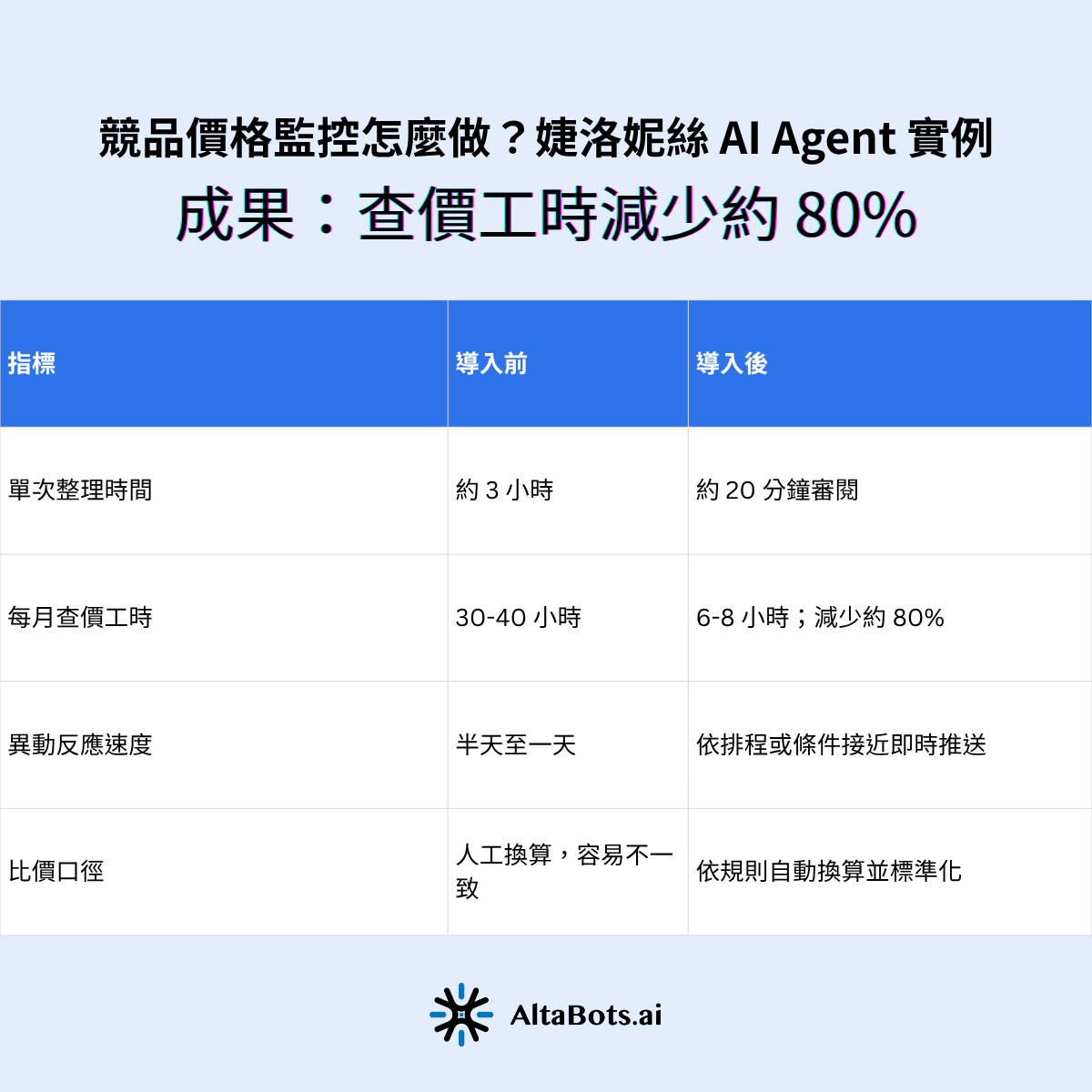
Competitor price monitoring is when a brand regularly tracks the selling prices, promotions and gift bundles of rivals in the same category across e-commerce channels, converts them to one comparison basis, and uses the result for its own pricing and campaign decisions. The skincare brand JS Jealousness worked with Data-DI to build a competitor price monitoring Agent on AltaBots.ai, bringing together price, promotion and bundle information from five major e-commerce channels. After adoption, the monthly routine price-checking effort fell from 30-40 hours to 6-8 hours, a reduction of about 80%. A single compilation dropped from about 3 hours to about 20 minutes, and the team only reviews the highlights. The time saved is close to one working week.
Results at a glance
- Competitor prices, promotions and bundle information are collected and organized automatically across five major e-commerce channels
- Monthly routine price-checking effort fell from 30-40 hours to 6-8 hours, a reduction of about 80%
- A single compilation went from about 3 hours to about 20 minutes of review
- Major price or campaign changes can be pushed proactively, cutting reaction time from half a day to a full day down to near real time
This matters in 2026 because consumers no longer decide in a single channel. A 2025 survey by Kantar Taiwan shows that 93% of respondents had shopped on an e-commerce platform in the past year, and 67% of them use more than one platform at the same time, going back and forth to compare specifications, prices and reviews [1]. Cross-channel price comparison is now the norm. A brand that knows only its own prices is deciding with half the information.
About the company in this case
JS Jealousness is a Taiwanese skincare brand with many years of local experience. Its brand promise is the "zero-burden skincare expert," centered on skin type and aimed at an effective, low-burden skincare experience. Triple-acid renewal, ceramide repair and retinol-type anti-aging are among its main product lines, backed by long-term investment in clinical evidence and formulation research.
The brand's channel coverage is quite complete: momo, Shopee, PChome, Yahoo Shopping Mall and the brand's official online store, plus a membership and points system run through its own app. All mainstream channels are covered. That is also why this case is worth studying. JS Jealousness faced an advanced problem, the kind of operational bottleneck you hit only after channels are fully built out and membership has taken off, which brands just starting out do not yet meet.
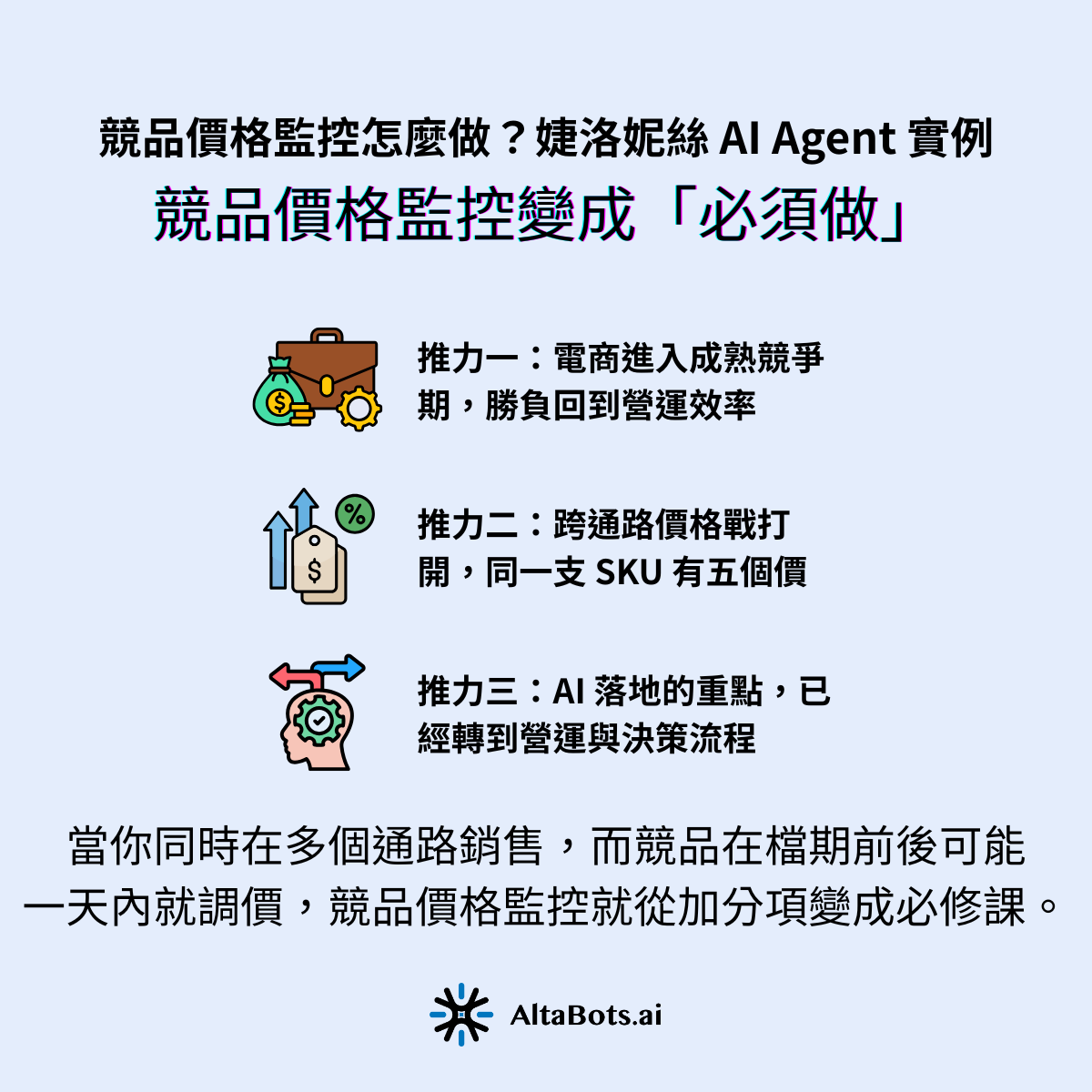
What is competitor price monitoring? Why did it go from "easiest to do" to "must do" in 2026?
Competitor price monitoring means a brand regularly tracks competitors' selling prices, promotions, gift bundles and discount rates across sales channels, and organizes them into intelligence that can be compared directly. This has existed for a long time. It used to be filed under routine chores to do "when there is time." Three reasons have come together to make it a must-do in 2026.
Driver 1: E-commerce has entered a mature, competitive phase, and winning comes down to operating efficiency
According to the Department of Statistics, Ministry of Economic Affairs, Taiwan's retail online sales reached NT$671.6 billion in 2025, up 2.8% year on year, about 13.9% of total retail sales, and 14.8% in the fourth quarter [2]. The market is still growing, but not at the pace of the pandemic years. The reading from the Market Intelligence & Consulting Institute (MIC) is that Taiwan e-commerce has moved from a high-growth phase into a mature, competitive phase, where growth no longer comes from traffic dividends but from deeper membership economics, online-offline integration and better operating efficiency [2].
The same data also points to a signal directly relevant to beauty brands: the drug and cosmetics retail sector, helped by high repurchase rates and member stickiness, has been an important growth engine of online sales in recent years [2]. The category is still growing. But every competitor is watching the same group of repeat buyers, so price and campaign competition gets closer.
Driver 2: Cross-channel price wars have opened up, and the same SKU has five prices
Taiwan's e-commerce channel structure has clearly diverged. According to combined data from TEJ and Mordor Intelligence, by B2C revenue momo accounts for about 33.3% and Shopee about 28.5%, PChome and Yahoo Shopping Mall together about 20%, and Coupang has quickly raised its profile with low prices and cross-border direct shipping: its Taiwan revenue in the second quarter of 2025 reached US$1.2 billion, up more than threefold year on year, and 42.8% of South Korean SMEs' exports to Taiwan were beauty products [3].
For brands, every platform has a different commission, shipping subsidy, campaign rhythm and member reward rule, so the same SKU can have five different final prices across five channels. Pricing is no longer something one spreadsheet can handle.
Driver 3: The focus of putting AI into daily use has moved to operations and decision workflows
Tu Chia-Hsing, chairman of the Taiwan e-commerce and startup association TeSA, notes that one key to e-commerce competition in 2026 is whether AI is actually put into practice in demand forecasting, inventory management, dynamic pricing, customer service efficiency and operational decision support, helping companies improve their fundamentals and lower operating costs [2]. Using AI to generate posts and images is no longer a differentiator. What gets tested is the operational work that must be done every day, hurts to do and affects margin when finished.
The dividing line between "easiest to do" and "must do"
To tell which side your brand is on, you only need to look at one thing:When you sell across several channels at once, and competitors may change prices within a single day around campaign periods, competitor price monitoring goes from a nice-to-have to a must-do. Without this intelligence, pricing is blind adjustment inside an information gap. If a rival cut prices last night and you still sell at last week's price today, the gap shows up directly in conversion rate and the day's revenue.

On the ground: five back ends, three hours a round, and the market may have changed by the time the data is done
Before adopting an AI Agent, JS Jealousness's competitor checks were handled by one colleague, covering five channels: momo, Shopee, PChome, Yahoo Shopping Mall and the brand website. She had to go through dozens of brand series and hundreds of SKUs one by one, putting list price, promotion price, bundled items and discount rate into Excel for the pricing and campaign meetings. The same colleague also supported brand and marketing planning. This work was weighing on planning hours.
Bottleneck 1: Prices on different platforms cannot be compared directly
The same product may appear with a bundle price, member price, shipping subsidy, points deduction and gift bundles all at once. Comparing only the listed price easily leads to wrong conclusions. The team also had to convert by hand to cost per unit (ml), total cost including shipping and the actual discount rate after the bundle.
Take a situation e-commerce teams deal with every day. A competitor lists a higher price than yours on one channel, but bundles a sizable set of trial samples, and after stacking a member discount and a shipping subsidy, its actual final price turns out to be lower than yours. This reversal cannot be seen from the listed price. It appears only once the comparison basis is unified. Without first defining a consistent comparison baseline, a brand gets only five price lists in different formats, not intelligence that directly supports decisions.
Bottleneck 2: Compilation cannot keep up with competitor changes
One full round takes about 3 hours, yet competitors may change prices again within a day around campaign periods. By the time the spreadsheet is done, the decision maker may be looking at the market as it was half a day ago. Every pricing judgment rests on old data. Over time, this erodes the team's confidence in its own price band.
Bottleneck 3: Planning staff are tied up in repetitive data work
30-40 hours a month is close to a working week. The person responsible has to open pages, copy numbers, convert prices and tidy formats over and over, and the work that actually needs analysis and creativity gets pushed back. This is a double loss for the brand: the labor cost on one side, and the strategic value this person could have created on the other.
What separates the four ways to monitor competitor prices across platforms?
There are four practical ways to set up cross-channel competitor price monitoring: pure manual checking, in-house crawlers, general-purpose price comparison tools, and an AI Agent with consultants working alongside you. The table below compares them on five dimensions. What matters is not how many features each has, but what it means for decisions in e-commerce operations.
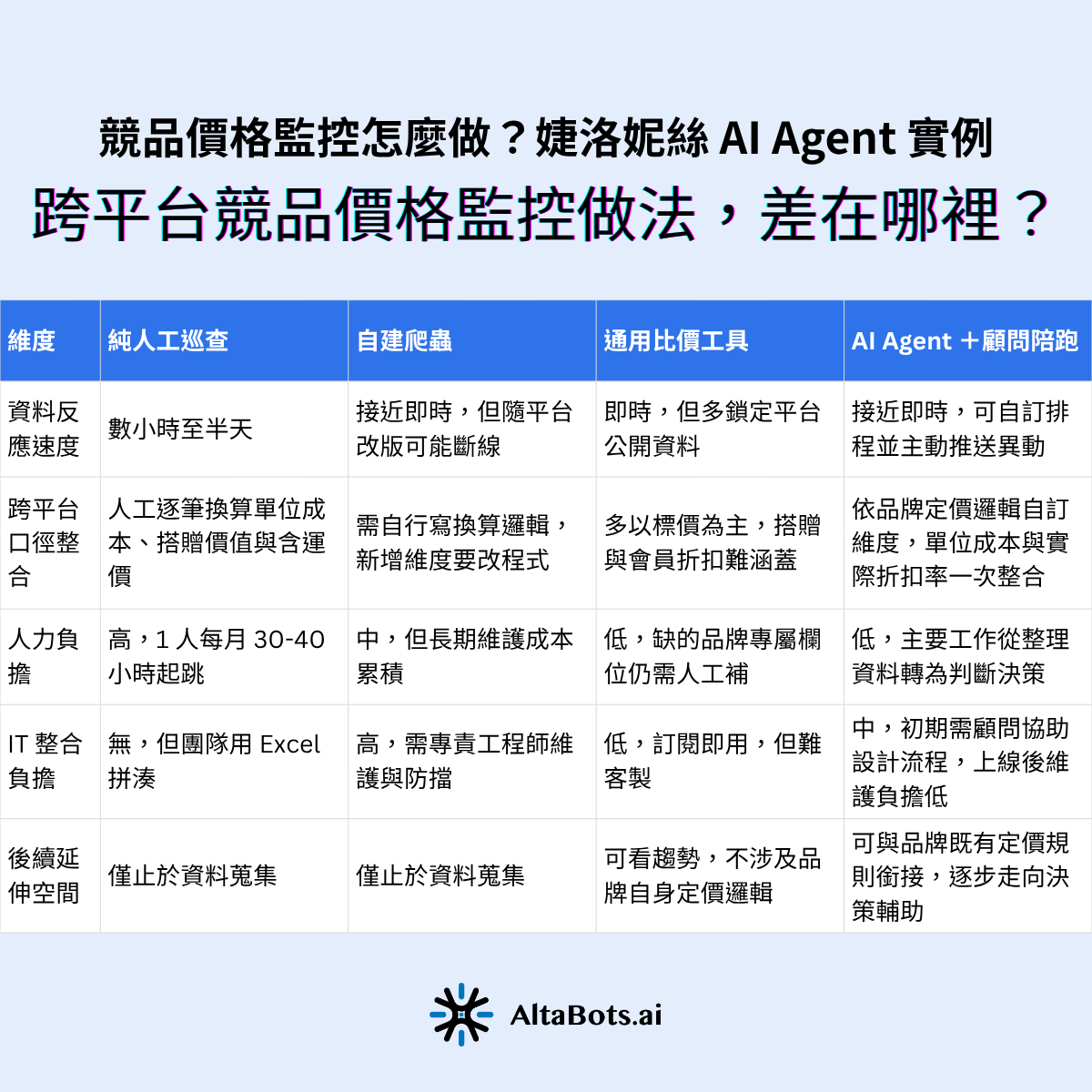
The difference is not the number of features. For the first three, the difference is the degree of automation; for the fourth, it is the role. No matter how automated the first three methods are, their output is still a price table that "awaits manual interpretation." The fourth route builds the brand's own comparison basis into the workflow, so what reaches people is already an organized summary of changes with the key points marked. This is also the distinction we discussed in The Difference Between Copilot and Autopilot: when a company buys AI, is it buying a tool, or a result?
The JS Jealousness team was choosing between the third and fourth routes. They had already tried crawlers on their own and had evaluated general-purpose tools, and in the end chose the fourth.
The solution: define the monitoring logic first, then let the agent run it
The project's order was to think through what to monitor first and only then start building. Data-DI consultants first went through the competitor list, brand series, key SKUs and platform priorities with JS Jealousness's e-commerce lead, and defined clearly which changes need an immediate notice and which can go into the routine summary.
This up-front inventory may look like it lengthens the build, but it greatly reduces noise later. The team must first confirm the items to monitor, how products map across platforms, the update frequency, the notification thresholds and who is responsible when data is missing or a page is redesigned. Otherwise, automation only produces more data you cannot act on, faster.
Once the monitoring logic was confirmed, the Agent ran the following tasks on a schedule:
- Collect competitors' list prices, promotion prices, bundles, discounts and comparable fields from the five major e-commerce channels.
- Convert cost per unit, price including shipping and actual discount rate according to the rules the brand defined.
- Organize changes into a summary sent daily or at a set frequency to the relevant decision makers.
- Push an alert proactively when there is a large price cut or an important campaign change, without waiting for someone to open a report.
The colleague's work therefore shifted from "opening five back ends every day to copy prices" to "reviewing the change summary the Agent prepares and making judgments on the important changes."
Three things this project got right
- Define what is worth monitoring first: Without first settling the competitors, SKUs, conversion basis and notification thresholds, no amount of collected data will produce anything more than another table that is hard to read.
- Keep data sources that already work: The new system handles integration, conversion and notification, and does not rebuild all the infrastructure just for the adoption.
- Keep people in the decision seat: The Agent provides consistent, timely input, while price and promotion strategy is still decided by the managers who understand margin, inventory and brand positioning.
A note for IT leads: integration does not mean tearing everything down
Before adopting a new platform, the first question IT usually asks is the same: will our existing systems be torn down? The tools and data flows a brand has built up in e-commerce operations were often assembled slowly over a year or two. Most teams will not start over for one new capability. In this project, AltaBots.ai plays the role of the integration and judgment hub, and does not require the company to switch to a specific data source or a specific model provider.
- Data sources can be mixed: Competitor data can come from the platform's web extraction capability, from the company's existing crawler services or third-party price comparison APIs, or from regular file imports (PDF, Word, Excel and other formats are supported). When a crawler is blocked, you can switch sources and the monitoring flow does not have to stop.
- Not tied to a single model provider: The platform supports multiple large language models, and a company's self-hosted LLM Router can also be integrated by agreement, so you can switch according to data sensitivity, cost and performance needs.
- Deployment is your choice: You can use cloud SaaS, or private deployment where security requirements call for it.
- Existing processes can stay: Before adoption, JS Jealousness had built a basic crawler and compilation process of its own. These were not retired but connected in as one of the raw data sources.
- The run leaves a record: Every step of the Agent's node log is traceable, so when something goes wrong you can see which part did not run. It is not a black box.
Taken together, these conditions decide whether IT gives its approval in the internal evaluation.
Results: about 80% less price-checking effort, and people back to higher-value work
Three things improved clearly: price-checking efficiency, reaction speed to changes and consistency of the comparison basis. As a result, the e-commerce planner can put more time into analysis and decisions.
"After adopting the competitor price monitoring Agent, we saved not only about 80% of the monthly routine price-checking effort. More importantly, the team can grasp market changes faster and put its time into pricing, marketing and growth decisions. For a business owner, the value of AI is not to replace people but to free the team from repetitive data compilation so it can use its expertise where more judgment is needed." — Hung Chia-Yi | General Manager
The time saved was not used to cut headcount. It went into campaign-transition analysis, member communication, promotion bundle design and deeper competitor research. Soft intelligence that could never fit into the schedule before, such as rivals' new-product rhythm, social media reputation and shifts in brand messaging, now gets seen. AI takes over data preparation that follows clear rules and repeats often, while people keep the decisions that need business context and accountability.
Next stage: from monitoring to pricing recommendations
JS Jealousness has already completed cross-platform monitoring, data conversion and summaries through the Agent. In the next stage, the brand plans to have AI combine its own product data with competitor price information to provide reference recommendations for pricing strategy, and to bring in historical pricing, margin constraints and inventory conditions to organize options for promotion bundles or reasonable price ranges. This direction is still in planning, and the final pricing decision stays with the managers. More retail and e-commerce adoption scenarios are collected in our Overview of Case Articles.
Which brands are a good fit? 5 self-check points
Whether adoption is worthwhile does not depend on company size. What really decides it is channel complexity and how fast competitors change. JS Jealousness is a mid-sized brand with fully built-out channels and a working membership program. Brands that are not as large can use the five questions below to find their own position first.
1. How many e-commerce channels do you sell on today?
- 1-2 channels: pure manual work or a basic SOP can still cope.
- 3 or more: inconsistent comparison bases across platforms have already appeared, and you can start evaluating automation.
- 4 or more, plus your own website or app: you have reached the tipping point JS Jealousness was at when it adopted.
2. Does how often competitors change prices match your compilation cycle?
- Competitors change prices only weekly: weekly manual checks are still workable.
- Competitors may change prices within a day around campaign periods while your compilation cycle is half a day or more: the risk of decisions resting on old data has already surfaced.
3. How many hours a month does your team spend on checking?
- Under 10 hours: it can wait. Improve the SOP first.
- 20-40 hours: you have reached the stage that needs attention.
- Over 40 hours: that is a person's core capacity lost every month, and the return on adoption is clear.
4. Does your brand have pricing logic that can be turned into rules?
For example, the normal price range of each SKU, the usual discount depth for campaigns, the offer rules by membership tier and how you have responded to past competitor price cuts. If these exist only in the heads of senior staff and are not documented, the consultants will help organize them during the consulting phase. That documentation is itself a brand asset.
5. How strongly does IT need "integration without tearing down"?
- You have existing crawlers, tools or APIs you want to keep: choose a flexible integration approach.
- Starting from scratch with no legacy: any approach can be evaluated.
If three of the five questions land on "reached the tipping point / needs attention / needs to be turned into rules / want to keep existing systems," this case is relevant to you. If you are still comparing different partners, How to Choose an AI Agent Consultant: 5 Practical Delivery Checkpointslists checkpoints you can use for comparison.
Next step: take stock of your most time-consuming monitoring process
If your team also copies prices, converts them and tracks promotions across several channels, you can start by taking stock of four things: the competitor list, data sources, monthly hours and notification needs. After the inventory, you will usually find that what is stuck is not that the tools are not good enough. It is that nobody has yet defined clearly which changes deserve a notification.
Data-DI's approach starts from the decision side: we first work through the monitoring logic with you, then decide whether to keep your existing tools, strengthen the data flow or build a full Agent.
Talk with a Data-DI consultantand bring us your current situation, and we will think it through with you. To learn about the platform's capabilities first, see AltaBots.ai Enterprise AI Agent Platform.
References

[1] Kantar Taiwan. (2025). Survey of online platform usage behavior in Taiwan (in Chinese). Kantar Taiwan.
https://kantar.com.tw/News_detail.php?nid=333
[2] Department of Statistics, Ministry of Economic Affairs; Market Intelligence & Consulting Institute (MIC); Taiwan e-commerce and startup association (TeSA). (2026). From high-speed growth to structural upgrade: key turning points in Taiwan's e-commerce industry, 2025-2026 (in Chinese). Economic Daily News.
https://money.udn.com/money/story/11799/9292104
[3] Tenten. (2025). Coupang's market ambitions: challenging momo, the subsidy war as the key battle shaping Taiwan's B2C/D2C market (in Chinese). Tenten AI.
https://tenten.co/learning/coupang-taiwan-market-share/
The case material in this article comes from Data-DI client adoption results (JS Jealousness has authorized public disclosure). Brand and product line information refers to the JS Jealousness official website.
FAQ
FAQs about this article
How long does it take to build a competitor price monitoring Agent, and how should costs be estimated?

The process has three stages: defining the monitoring logic, building the Agent and tuning after launch. Defining the monitoring logic affects final quality the most and is usually the stage that takes longest to discuss. There is no one-size-fits-all quote; cost varies with the number of channels, the number of SKUs, the degree of customization and whether consultants working alongside you are included. A more practical approach is to calculate the hours you spend on checking each month first, then compare that number with the adoption cost.
If a competitor redesigns its e-commerce page, will the Agent capture the wrong data or fail to capture?
A page redesign does affect extraction results. This is the most common maintenance point in this kind of project, and responsibility should be agreed on during the build stage. What needs handling is not only remapping fields technically, but also who is responsible for spotting a gap, how quickly it gets fixed and whether data from the period before the fix should be flagged. If none of this is agreed in advance, the problem is usually not that the system broke but that nobody knows they should take over.
How often should monitoring run? Is once a day enough?
The frequency depends on how fast competitors change prices, and there is no standard answer. If competitors may change prices within a single day around campaign periods, once a day is the minimum; for categories with stable channels, a weekly summary takes less effort. Also, frequency and notification threshold are two different things that are easily mixed up. Collecting often does not mean interrupting often: data can update every day, but only changes beyond a set size trigger an alert, and the rest goes into the routine summary.
How much effort is needed to maintain it after launch?
Day-to-day maintenance is mostly review. In this case, 6 to 8 hours a month are kept after adoption to read the change summary and decide whether to follow up. What is easier to underestimate is the early stage: defining the monitoring logic needs people who know the category and the pricing, and what they contribute is judgment, not hours. This part cannot be outsourced to the system.
Can we start if we have not yet organized our competitor and SKU lists?
Yes. The competitor list, brand series and key SKUs are usually organized together during the inventory stage with consultants working alongside you, so you do not need them ready in advance. Conversely, if this information exists only in the experience of a few senior colleagues, writing it down has value in itself: whether or not you end up adopting automation, the inventory results are an asset you keep.
More articles


訂閱我們的電子報
每月 8 日定期發送最新趨勢與實用資訊!



