

AI agent customer service vs. chatbots: adoption guide | Alta.DI
Customer asks, issue resolved? How AI Agent customer service differs from chatbots, how RAG guardrails reduce hallucination risk, real-world 75% deflection data, and a three-phase 90-day rollout. Book a free diagnosis.


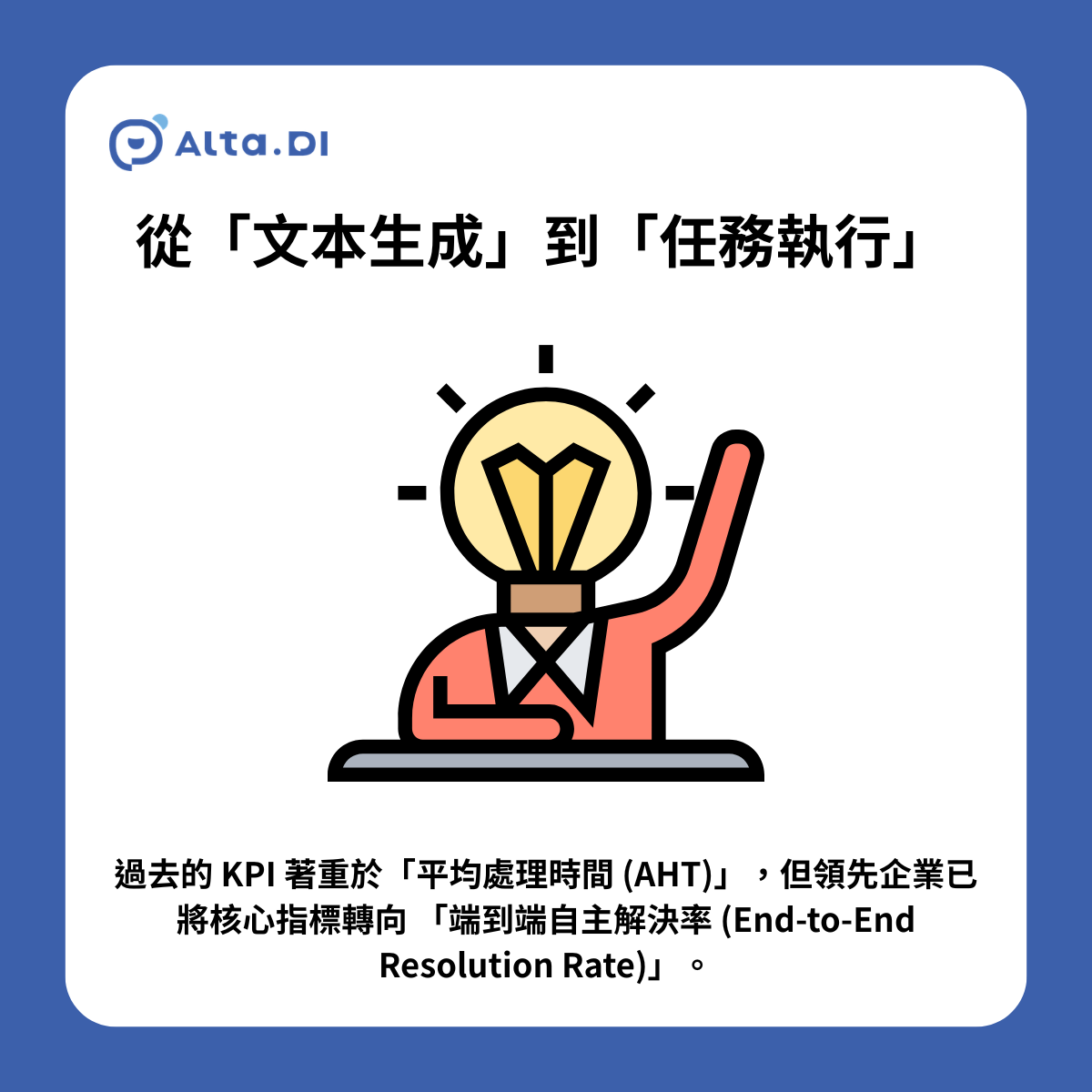
AI Agent customer service is a new generation of AI customer service systems that can complete tasks on their own: it does not just answer questions, but also calls back-end data such as orders and shipments, and runs inquiries and after-sales processes to completion within the conversation. It suits service teams with high message volumes and scattered channels. Gartner predicts that by 2029, agentic AI (AI with the autonomous execution capability of an Autonomous Agent) will autonomously resolve 80% of common customer service issues without human intervention and cut operating costs by 30% [1].
You may recognize this situation: you open the monthly report and repeat questions make up seventy percent of volume, yet a person still handles every one by hand. Or a big sale has just ended, the service team worked until dawn and orders still slipped through, and a customer who asked on LINE has to explain everything again the next day on FB. When you then search for "AI customer service," every vendor calls itself an AI Agent, yet some deployments still leave customers with off-topic answers. The difference comes down to one line: is it a chatbot that only "answers," or an AI Agent that can "get the job done"?
This article uses one comparison table, real-world data and a 90-day adoption path to help you align your thinking and budget before you evaluate vendors.
What is AI agent customer service, and how does it differ from a traditional chatbot?
One table shows the differences, so you have a baseline for judgment before evaluating vendors.
AI Agent customer service is a service system built around a large language model (LLM) that understands meaning and carries out multi-step tasks on its own; the industry also calls it an Autonomous Agent. A traditional chatbot relies on keyword matching and pre-written decision-tree scripts. The gap between them is not response speed but whether the task gets finished.
Most companies are disappointed with AI customer service because they apply the old keyword decision-tree mindset to a new tool. When a customer asks, "The jacket I bought yesterday doesn't fit, and I'm traveling abroad next week. Can I still exchange it?", a scripted bot can only match the word "exchange" and send a link to the return policy. An AI Agent can break the sentence into three actions, "look up the order, check inventory, start an expedited exchange," and carry them out in order.
Why can an AI agent get the job done? Three key technical differences
Intent understanding, context memory and tool calling: miss any one and it falls back to a canned-response bot.
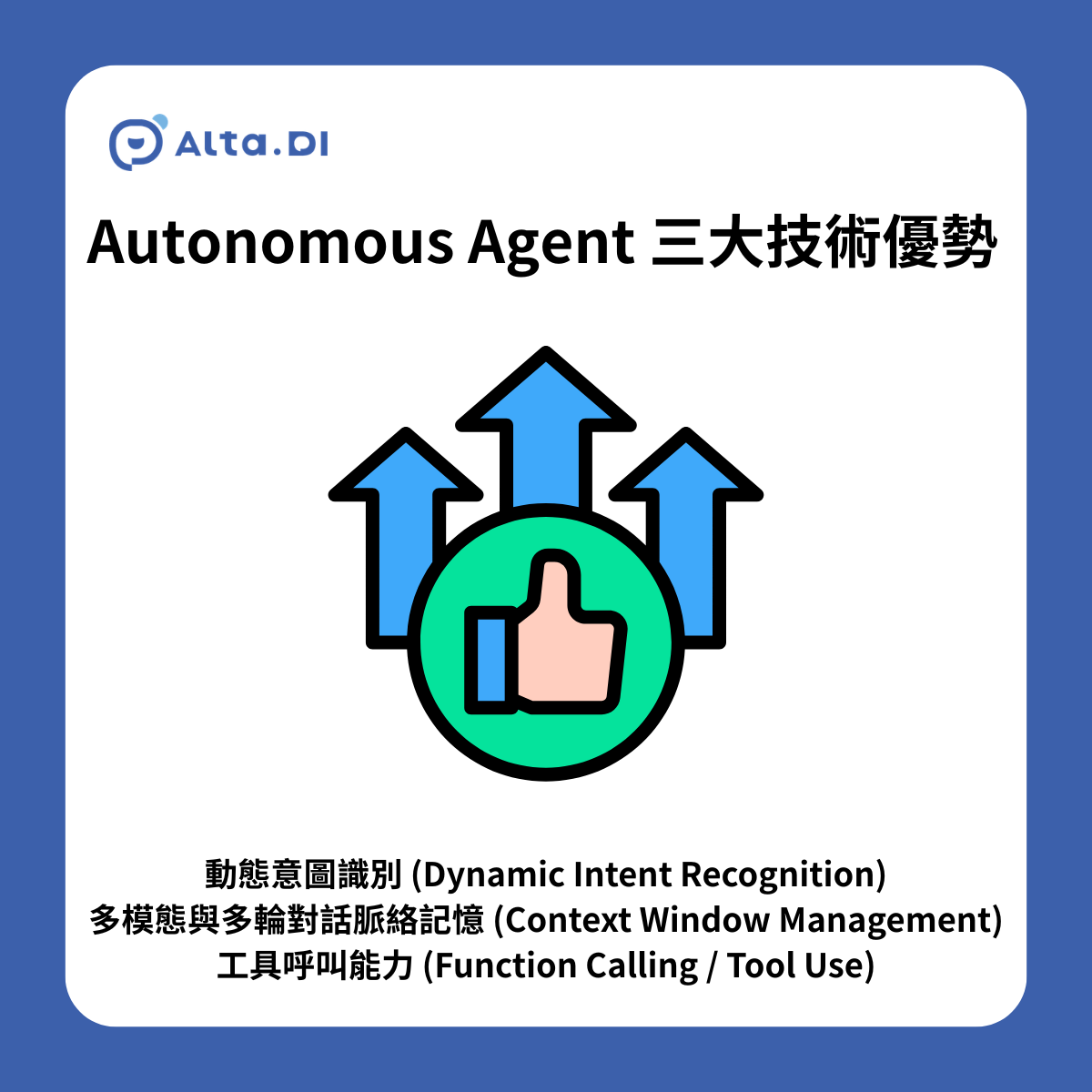
An AI Agent can execute tasks because of three technical capabilities working together: dynamic intent understanding, cross-channel context memory, and tool calling (Function Calling). If any one is missing, the system degrades into a canned-response bot with a new interface.
Dynamic intent understanding: An AI Agent does not rely on preset scripts; it uses an LLM to understand the meaning of the whole sentence. When a customer packs three requests into one long message, it can identify each, put them in order and handle them, which keyword matching cannot do.
Cross-channel context memory: When a customer asked a question in the morning through the website LiveChat and follows up in the afternoon on LINE, the AI still remembers the earlier exchange. When a handoff to a person is needed, the system passes along the conversation summary and customer background, so the customer never has to repeat the story. This experience depends on all channels feeding into one back end and mapping to one customer identity.
Tool calling: This is the dividing line between "answering" and "executing." In an e-commerce scenario, when a customer asks "Where is my package?", the AI can connect to the e-commerce platform's order data through OpenAPI and reply with the delivery status directly in the chat, so the customer does not even need to look up the order number. Note that such connections mainly rely on the platform's existing integrations. Connecting to a company's in-house system counts as custom work, so evaluate feasibility with a consultant first, and be wary of claims that "any system can be connected directly."
Will AI customer service make things up? Reducing hallucination risk with RAG and guardrails
Retrieve first, then answer; hand off to a person when it cannot answer. Hallucination can be managed by process.
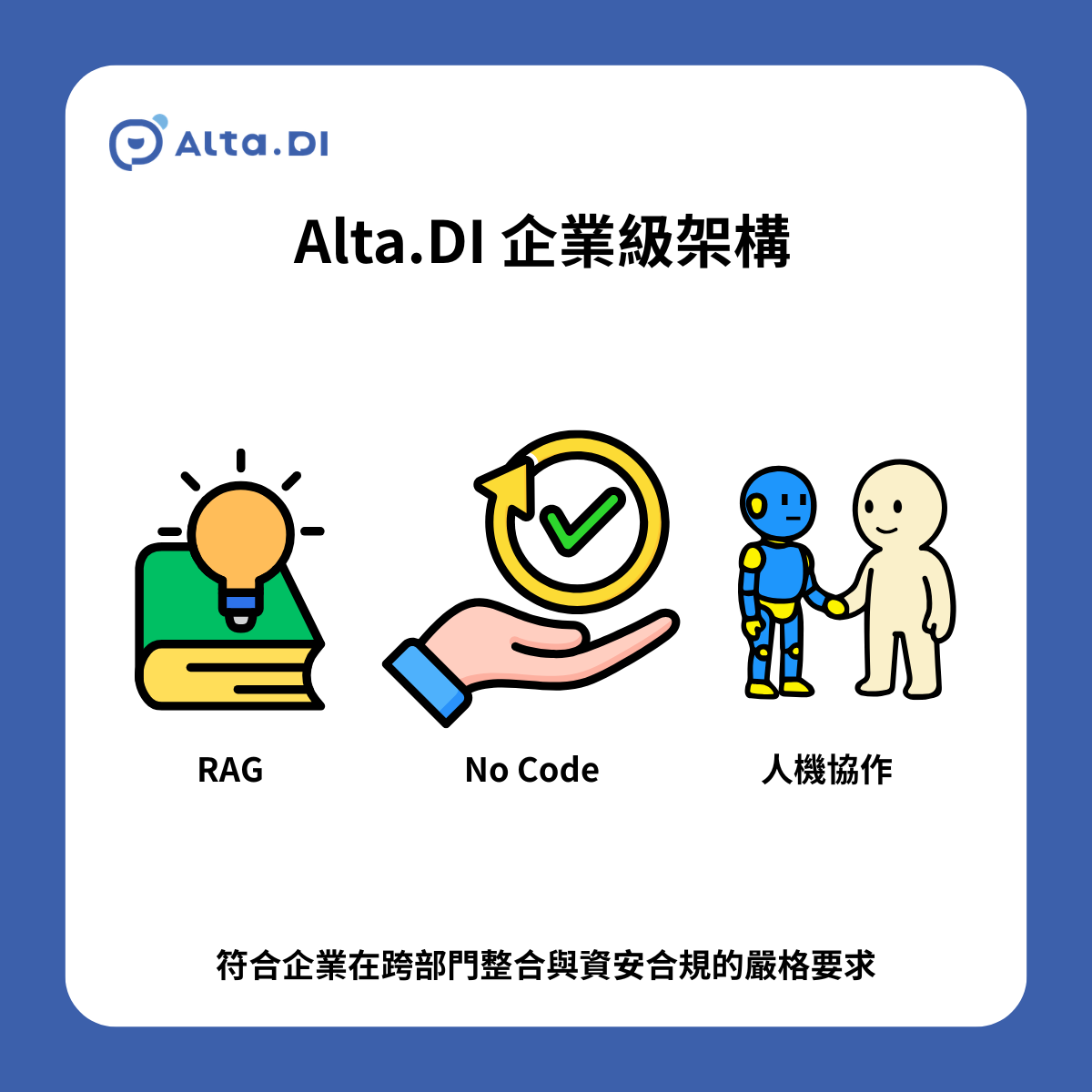
An AI hallucination is when a model invents an answer because it has nothing to base one on. In customer service, the biggest risk is promising refunds or warranty terms by mistake. The mainstream approach today is RAG (retrieval-augmented generation) combined with response guardrails, so that the AI answers from the company's knowledge base as far as possible and the chance of inaccurate replies drops sharply.
RAG works in the order "retrieve first, then generate": the system turns documents such as product specifications and return policies into a searchable knowledge base, and when a customer asks a question, the AI must first find the relevant material before composing an answer from it. What the knowledge base does not say, it has no material to improvise on, which lowers compliance risk at the source.
Guardrails are the second safeguard beyond RAG. Take the approach of the Alta.DI AI customer service platform as an example: when the AI cannot find knowledge, it replies with the wording you define and hands off to a person instead of making something up. When a customer gives an answer a thumbs-down, it can trigger a preset remedial action. The whole process of how the AI generated an answer can be traced visually with Tracing, so you can check node by node which knowledge bases it called and which tools it triggered, and pinpoint the cause when an answer is wrong. Before going live, you can also upload historical customer complaints in batch to the evaluation platform for automatic testing and scoring, verifying accuracy before opening it to customers.
How much can AI agent customer service save? Two sets of real-world data
A 75% deflection rate. Judge the benefit by resolution rate, not just speed.
The core metric for evaluating AI customer service benefit has shifted from "average handling time" to "AI autonomous resolution rate": the share of cases the AI can handle from start to finish without a person stepping in. The data below comes from actual Alta.DI deployments.
Logistics and freight consolidation company: Thousands of inquiries arrive every day, about seventy percent of them repeated package status and shipping fee questions, and each one had to be looked up across systems by a person. After adoption, the deflection rate for routine questions reached 75% and overall response speed improved by 45%, so human agents could focus on claims and exception cases. For the full process, see a logistics freight consolidation company's real-world record of adopting AI customer service.
If you want to estimate how much staff time you could save before adopting, start by checking what share of daily inquiries are repeat lookups. The higher that number, the more an AI Agent can take over. Actual results vary by industry, number of channels and knowledge base quality, so we suggest asking a consultant directly about an evaluation method that fits your situation.
How can you tell a real AI agent from a "re-skinned bot"?
Gartner has named agent washing. Use three questions to see through it during a demo.
Agent washing is Gartner's name for a market problem: vendors rename an existing chatbot or process automation tool and call it an AI Agent. Gartner estimates that among thousands of vendors claiming to offer agentic AI, only about 130 have substantive capabilities, and predicts that over 40% of agentic AI projects will be canceled by the end of 2027 because of escalating costs, unclear business value or inadequate risk controls [2].
The market is noisy, but the way to see through it is simple. During a demo, ask three questions directly:
- "Can it look up my order data directly within the conversation?" A system that can only answer and cannot execute is a re-skin.
- "What happens when it cannot answer?" If the vendor cannot describe a guardrail mechanism, or the demo shows the system making things up, rule it out.
- "Can I see the AI's decision process at every step?" If they cannot explain how tracing works, you will be left guessing at a black box when problems arise later.
If you are still working out what level of automation you need, read AI Customer Service Selection Guide: How to Choose Among FAQ, Flow and AI Bot Typesfirst. Use its scenario comparisons to confirm your required level, and the demo will go more efficiently.
What does the three-phase, 90-day path to AI agent customer service look like?
Organizing data in the first 30 days matters more to success than rushing into demos.
The three-phase 90-day plan is a framework for putting AI into daily use that breaks adoption risk into smaller pieces: take stock of data first, run a small-scope pilot next, then go live in hybrid mode. The three main reasons Gartner gives for project cancellations are cost, value and risk, and each can be caught in one of these three phases.
- Days 1-30: Data inventory and knowledge base organization. List the top ten most frequent inquiries and confirm that SOPs, FAQs and product documents are consistent in version and clearly structured. RAG answer quality depends on knowledge base quality; if this step is not done well, even the most expensive system will not answer accurately.
- Days 31-60: Small-scope pilot and system integration. Pick one or two high-frequency processes with no security concerns (for example, order status lookup), connect them to the system, and stress-test with tricky edge-case questions in a test environment to confirm the guardrails actually hold.
- Days 61-90: Hybrid launch and metric reset. Have the AI draft replies first and let a person review them before sending; once stable, switch to automatic replies. At the same time, change the team's KPIs from "cases handled" to "AI resolution rate" and "satisfaction with complex case handling," so that the way work is measured keeps up with the tool.
Taking Alta.DI's standard adoption timeline as an example, with consultants working alongside you, knowledge base setup, AI training, testing and go-live can be completed in about 5 weeks. The remaining time is left for the company's internal data preparation and process adjustment, because in practice what holds adoption up is usually the data, not the system.
Conclusion: from "can answer" to "can execute," the gap opens at the system you choose
Customer service competition has reached the level of resolution rate: customers no longer want a link to a policy page. They want the matter settled once they have asked. Every company gets stuck at a different point: some have a knowledge base scattered across departments, some have too many channels with data that does not connect, and some cannot tell whether their current bot is just a re-skin.
Alta.DI is a channel-agnostic AI customer service platform: all channels, all data, and we are wherever your customers are. During adoption, consultants work alongside you from data inventory to go-live, rather than handing you a system to figure out on your own. If you want to clarify where to start, Data-DI offers a free 30-minute AI customer service diagnosis: a consultant reviews your current inquiry structure, channel setup and knowledge base, and points out where results can show up fastest. You do not need to prepare any materials in advance, justbook a free 30-minute diagnosis. For more industry case breakdowns, browse the Alta.DI series of AI customer service articles.
References

[1] Gartner (2025.03). Gartner Predicts Agentic AI Will Autonomously Resolve 80% of Common Customer Service Issues Without Human Intervention by 2029. Gartner Newsroom.
https://www.gartner.com/en/newsroom/press-releases/2025-03-05-gartner-predicts-agentic-ai-will-autonomously-resolve-80-percent-of-common-customer-service-issues-without-human-intervention-by-20290
[2] Gartner (2025.06). Gartner Predicts Over 40% of Agentic AI Projects Will Be Canceled by End of 2027. Gartner Newsroom.
https://www.gartner.com/en/newsroom/press-releases/2025-06-25-gartner-predicts-over-40-percent-of-agentic-ai-projects-will-be-canceled-by-end-of-2027
FAQ
FAQs about this article
What is AI Agent customer service?

AI Agent customer service is a new generation of AI customer service system that can complete tasks on its own. It does not just answer questions; it also calls back-end data such as orders and shipments and runs inquiries and after-sales processes within the conversation. It suits companies with high message volumes and scattered channels.
How does AI Agent customer service differ from a traditional chatbot?
A traditional chatbot relies on keyword matching and preset scripts, and stalls on anything outside the script. An AI Agent uses a large language model to understand meaning, remembers conversation context across channels, and calls systems on its own to complete tasks, rather than just returning canned answers.
Will AI customer service make things up?
There is a hallucination risk, and the fix is RAG plus guardrails: the AI retrieves from the company knowledge base before answering, and when it finds nothing it replies with the wording you define and hands off to a person instead of inventing an answer, so sensitive replies such as return policies have a source to check.
How should I estimate the cost of adopting AI Agent customer service?
Most offerings are cloud subscriptions. For Alta.DI, the Growth plan starts at NT$9,980 per month and includes an automation bot and monthly AI credits, which is lower than the cost of hiring one more service agent. Estimate the plan tier from your monthly message volume and number of channels.
How long does it take to adopt AI Agent customer service?
Taking Alta.DI's timeline as an example, with consultants working alongside you, knowledge base setup, AI training, testing and go-live take about 5 weeks. With a three-phase 90-day plan, finishing the data inventory in the first 30 days makes answer accuracy noticeably steadier after launch.
More articles


訂閱我們的電子報
每月 8 日定期發送最新趨勢與實用資訊!



