

Logistics AI customer service: 3 steps to cut costs 30% | Alta.DI
Peak-season tracking inquiries and temporary staffing costs hit parcel consolidators every year. This guide covers logistics AI customer service adoption in 2026, with Gartner and III data and a real case that cut costs 30%.


At peak season, let AI take the 80% of inquiries that repeat
Logistics AI customer service is an automated system with natural language understanding. It replies around the clock to shipment status queries and freight estimates, and suits consolidation and logistics companies facing surging inquiries and costly temporary staff at peak season. After adoption, a consolidation team can free its people from repetitive messages and focus on the complex cases that need judgment.
Every e-commerce peak season, such as Double 11 and Black Friday, the LINE Official Accounts of consolidation companies are often flooded overnight with tracking messages. Front-line staff scramble, reply times stretch, and complaints follow.
Alta.DI is a channel-agnostic AI customer service platform. It brings conversations from LINE, the website and email into one place and answers common questions automatically with AI. What it gives you is every channel in and every piece of data kept, without locking you into a single channel, so a logistics team can go live in as little as two weeks.
Why should logistics companies adopt AI customer service in 2026?
Order volume is growing faster than headcount can handle
The fundamental reason logistics companies need AI customer service in 2026 is that order volume is growing far beyond what staff can handle, and about 80% of peak-season inquiries are repetitive questions that can be automated. This is not a question of "whether" but a race of "how fast it goes into use".
A 2026 Gartner survey shows that as many as 91% of customer service leaders are under pressure from senior management to adopt AI in 2026 [1]. The aim goes beyond cost savings and speaks directly to customer satisfaction. Gartner also expects conversational AI to bring global companies a considerable reduction in customer service labor costs [1].
The trend is just as clear in Taiwan. The "E-commerce Market Trends and Consumer Survey" published in 2026 by the Market Intelligence & Consulting Institute (MIC) of the Institute for Information Industry (III) names "AI" and "logistics" as the two keys to upgrading the competitiveness of Taiwan's e-commerce operators, and finds that 75% of consumers prefer convenience-store pickup for delivery [4]. According to the Department of Statistics, Ministry of Economic Affairs, Taiwan's retail online sales reached NT$671.6 billion in 2025, and the fourth quarter alone, driven by Double 11, Black Friday and Double 12, rose to NT$192.7 billion [5]. Behind every order is a potential tracking inquiry.
For consolidation companies where every minute counts, these figures map directly onto peak-season staffing gaps. Whoever hands repetitive questions to a system earlier can keep staff for the complex cases that need judgment, protecting profit and keeping customers through the peak.
How do traditional and AI customer service differ? One table shows the division of labor
The difference is not "who replaces whom" but "who is responsible for what"
The most important gap between traditional and AI customer service is response speed and scalability. AI can handle hundreds of tracking queries in parallel within seconds, while human agents are limited by headcount and shift schedules. At peak season, human service inevitably hits a waiting bottleneck, while the quality of AI replies does not fall as message volume rises.
This is a division of labor, not a replacement. AI handles frequent, standardized tracking questions, and people focus on situations that need contextual judgment, such as lost parcels and claim negotiations.

Case breakdown: how one consolidation company cut costs 30% with AI customer service
Eighty percent of inquiries are tracking, which is exactly where AI is strongest
A cross-border logistics consolidation company adopted Alta.DI and reduced overall customer service cost by 30% and raised customer satisfaction to 95%. The key was letting AI intercept the vast majority of repetitive tracking inquiries and freeing staff for complex cases.
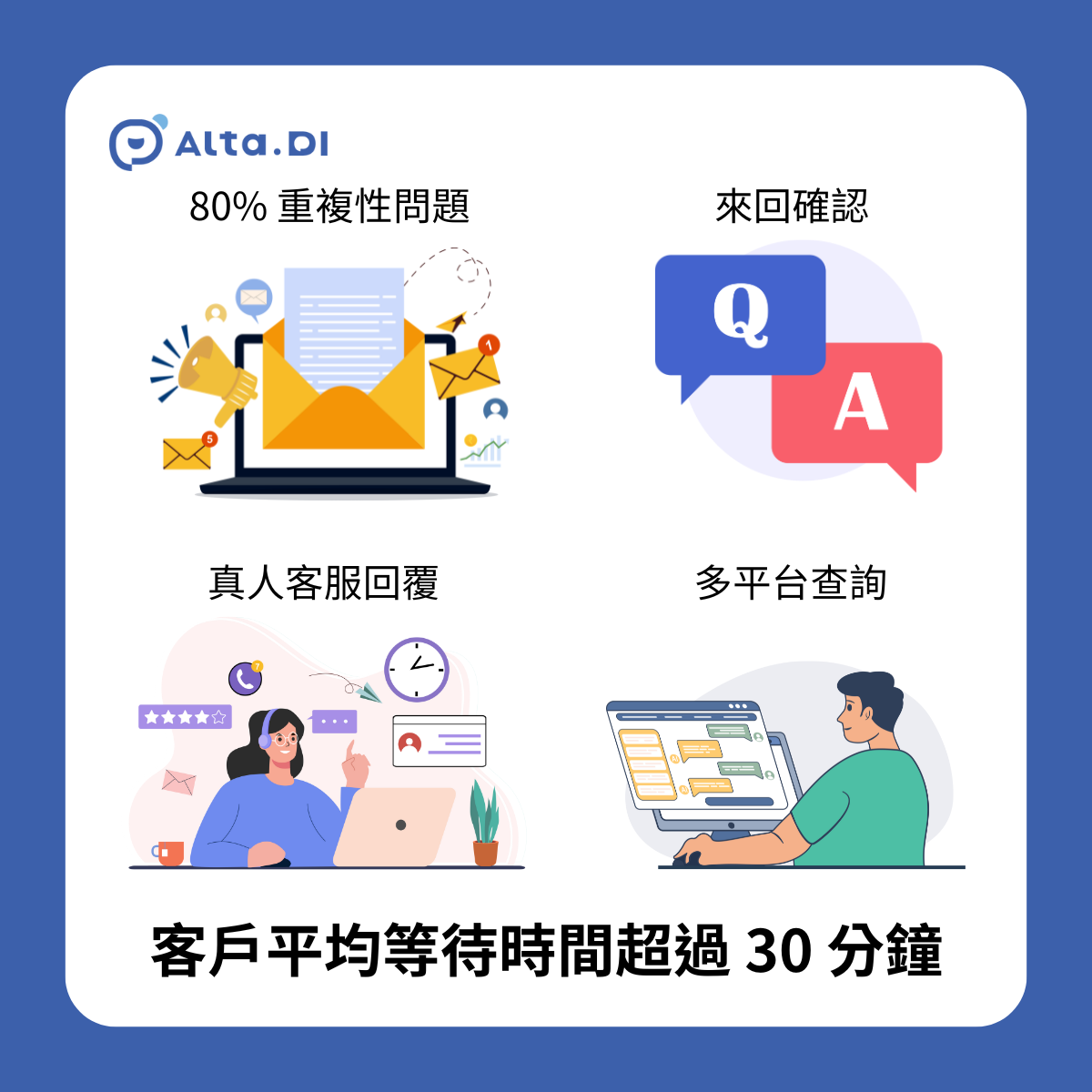
Pain point: message overload at peak season and serious customer loss
Based on our hands-on consulting experience, this consolidation company handled a large volume of cross-channel inquiries every day, and as many as 80% of them were about parcel progress and freight estimates. This ratio is not a one-off. Salesforce notes that "Where is my order?" (WISMO) is among the highest-frequency, lowest-value customer inquiries in e-commerce and logistics, spanning every channel including email, phone, live chat and social media [6]. Decagon's industry benchmarks also show that WISMO normally makes up 25% to 40% of e-commerce customer service volume and climbs above 50% at peak season [7]. Because the consolidation business depends heavily on shipment tracking by nature, a figure of 80% is reasonable, even on the high side.
To cope with the workload, the company had to hire temporary staff at peak season, but training took long and service quality was uneven. The average customer wait exceeded 30 minutes, which led to frequent complaints and even a wave of order cancellations.
Turning point: what changed after adopting Alta.DI
After evaluation, the company chose Alta.DI because no engineers were needed, it could quickly integrate with the existing LINE Official Account, and RAG technology ensured accurate tracking and freight information. After go-live, the system intercepted the vast majority of repetitive tracking queries, and full-time staff could focus on complex problems such as lost parcels.
Gartner's latest research is a reminder: AI is a tool for reallocating staff, not an all-purpose substitute. Gartner even predicts that half of the companies that cut customer service headcount because of AI will rehire by 2027 [2]. This consolidation company's approach is consistent with that: no layoffs, but a change of role for existing staff, focused on high-value interactions that need empathy and judgment. When a question falls outside the knowledge base, Alta.DI automatically summarizes the conversation and hands it to a person, so service is not interrupted.
Customers keep asking about delivery status. Which AI that connects to logistics data should you choose?
Whether it can connect to your live shipment status is the dividing line for this kind of AI
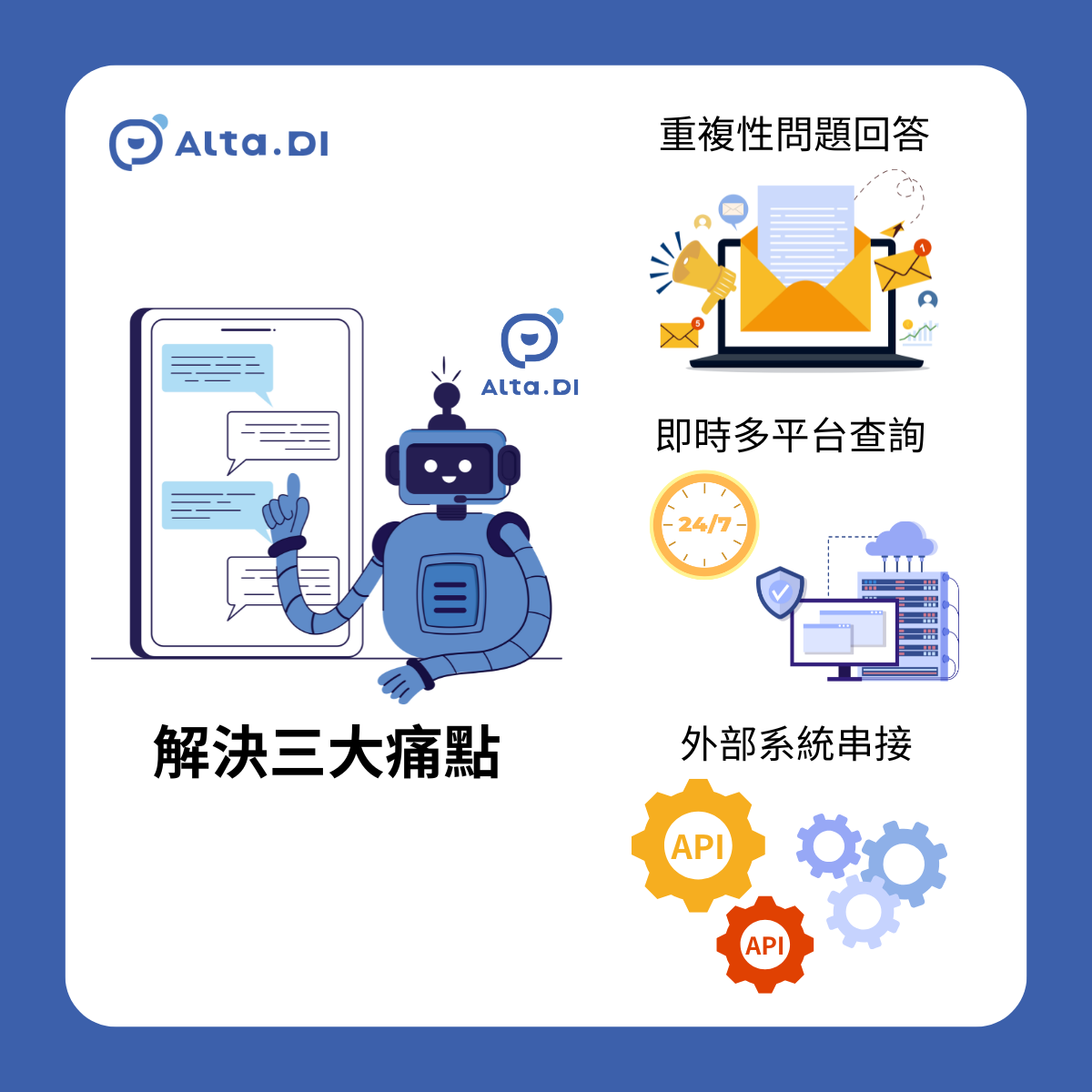
For an AI customer service that connects to logistics data, the key is a combination of three capabilities: knowledge accuracy, cross-channel integration and no-code integration, above all whether it can connect to your live shipment status data. A bot that answers tracking questions with canned replies is the one that gets it wrong at the most critical moment, when something is off. Below we take apart Alta.DI's three core modules.
1. Knowledge base and RAG: ending AI's made-up answers
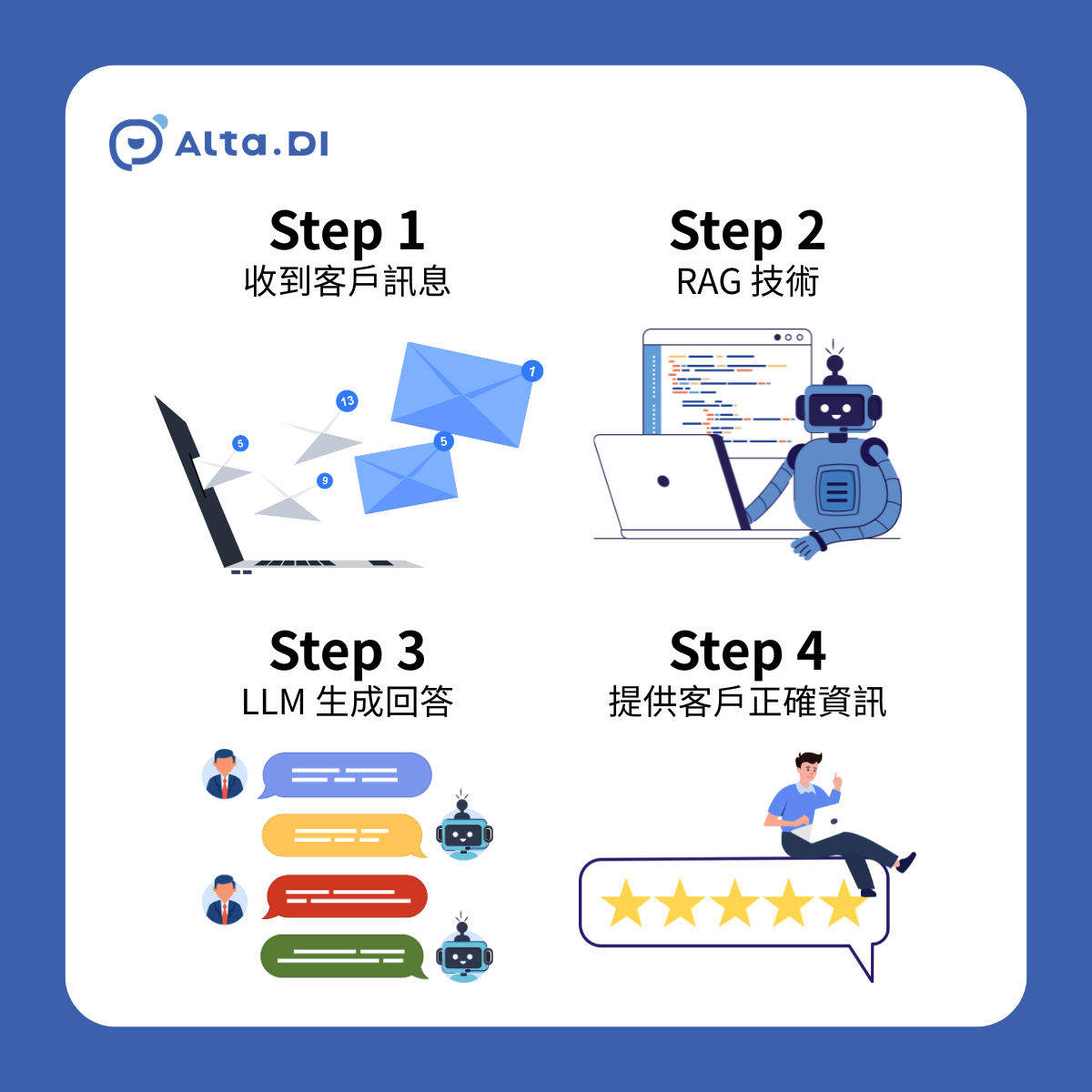
What the logistics industry fears most is a system giving a wrong freight quote or warehouse address. Alta.DI uses RAG (Retrieval-Augmented Generation) technology so the system answers only from the PDF or Excel files a company uploads. Sea and air freight rules, tariff policy and prohibited item lists are all output according to the documents you provide, which effectively prevents AI from producing wrong information. Questions not covered are automatically transferred to a person, forming a complete safety mechanism.
This matters because the success of AI customer service often depends not on the model itself but on whether the underlying data is current and clean. If answers come from an outdated or poorly maintained knowledge base, AI will give wrong information at the moment it is needed most (delays, missing items, customs holds) and instead erode customer trust. To learn more about this technology, see our RAG and knowledge base use cases (in Chinese).
2. Omnichannel integration: LINE, website and email managed in one place
Consolidation customers write in from scattered sources: some send LINE messages, some email, some leave messages on the website. Alta.DI supports single-platform management of LINE, Messenger, Instagram and email, so staff can see the full conversation history in one interface. Built-in real-time translation in more than 50 languages lets a Taiwan consolidation team serve overseas customers from Southeast Asia, Europe and the US without hiring extra multilingual staff. Compared with options that tie you to a single channel, Alta.DI's omnichannel design keeps the sources of inquiries and customer data in your hands (further reading: 5-step guide to omnichannel integration (in Chinese)).

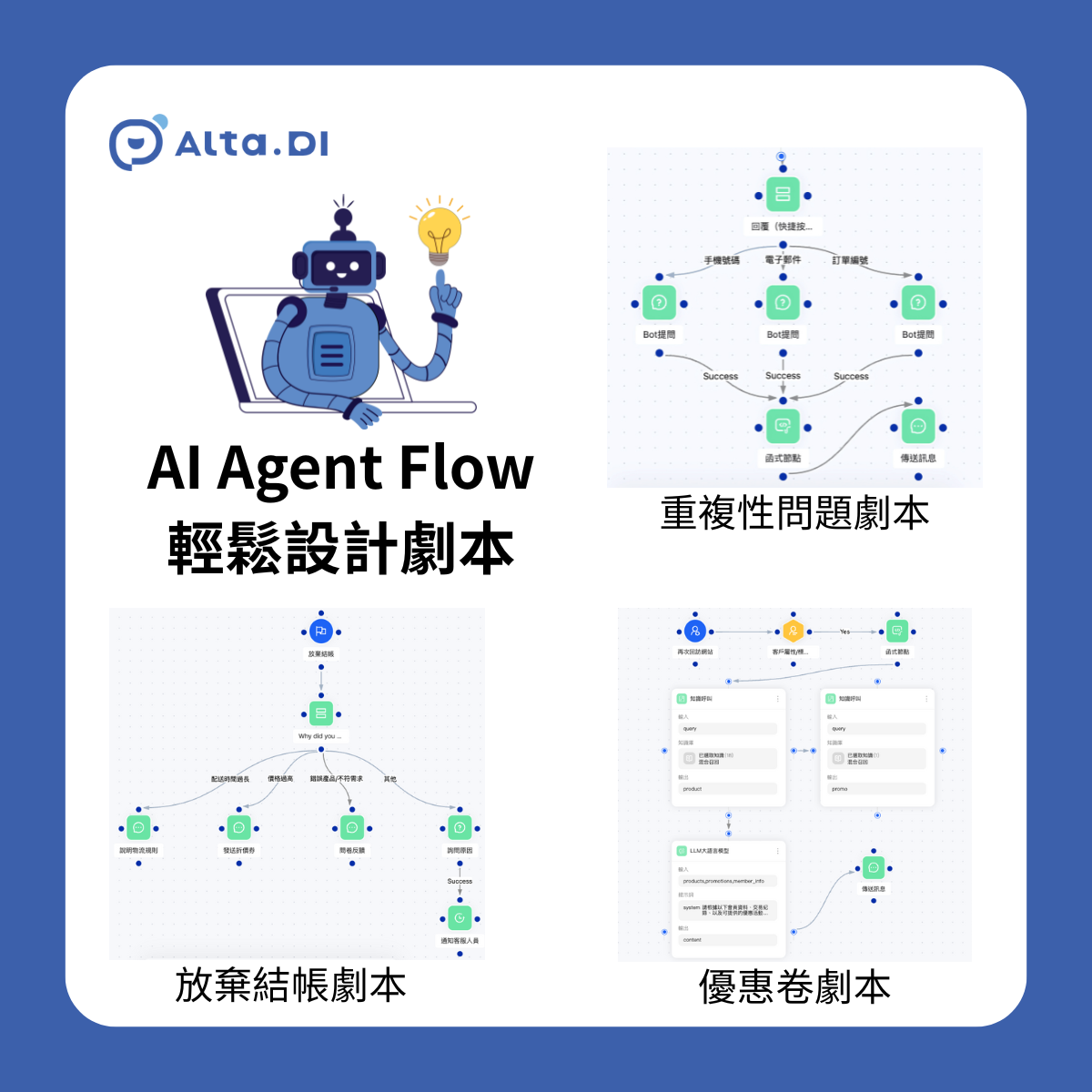
3. No-code workflow orchestration and ERP integration: go live without engineers
Operations staff can complete setup by intuitive drag-and-drop, with no coding. The platform supports one-click connection to major e-commerce platforms and syncs order status with the logistics ERP, so AI customer service can reply with real shipment status instead of canned replies. When the system judges a question too complex, it automatically organizes a conversation summary and hands it to a person, so the service experience is not interrupted. This is the difference between an AI that connects to logistics data and a bot that only chats.
Hands-on guide: connect a LINE customer service bot in 3 steps, live in as little as two weeks
No large IT project: the system can take over tracking in two weeks
Adopting logistics AI customer service in a consolidation business does not require a large IT project. With a standardized process, the system can be live on your LINE Official Account in as little as two weeks.
Step 1: Build the consolidation knowledge base
Organize your existing FAQs, freight rate tables, prohibited item lists and warehouse receiving rules, and upload them to the Alta.DI back end. The system learns this content automatically, with no need to set up tedious keyword triggers by hand. We suggest preparing the "tracking process" and "freight estimate rules" documents first. These two account for the highest inquiry volume and show the most noticeable interception effect after go-live. For practical methods, see the guide to building an AI customer service knowledge base (in Chinese).
Step 2: connect the LINE official account and logistics API
Authorize your company's LINE Official Account to the Alta.DI platform and connect the logistics provider's API. Once you set the trigger conditions for tracking and freight estimates, the system can take over conversations automatically. Your existing rich menu and follower count are fully kept, with no need to change accounts or worry about losing existing customers.
Step 3: Test tone, set handoff thresholds, then go live
Set a dedicated reply tone (professional or friendly) and the conditions that trigger a handoff to a person, and run an internal rehearsal. After go-live, monitor answer accuracy in real time on the dashboard and keep improving the knowledge base based on the questions that actually come in. We suggest reviewing once a week in the first month after launch to keep AI reply quality stable (you can track results alongside the 5 key customer experience (CX) metrics (in Chinese) ).
Key takeaways
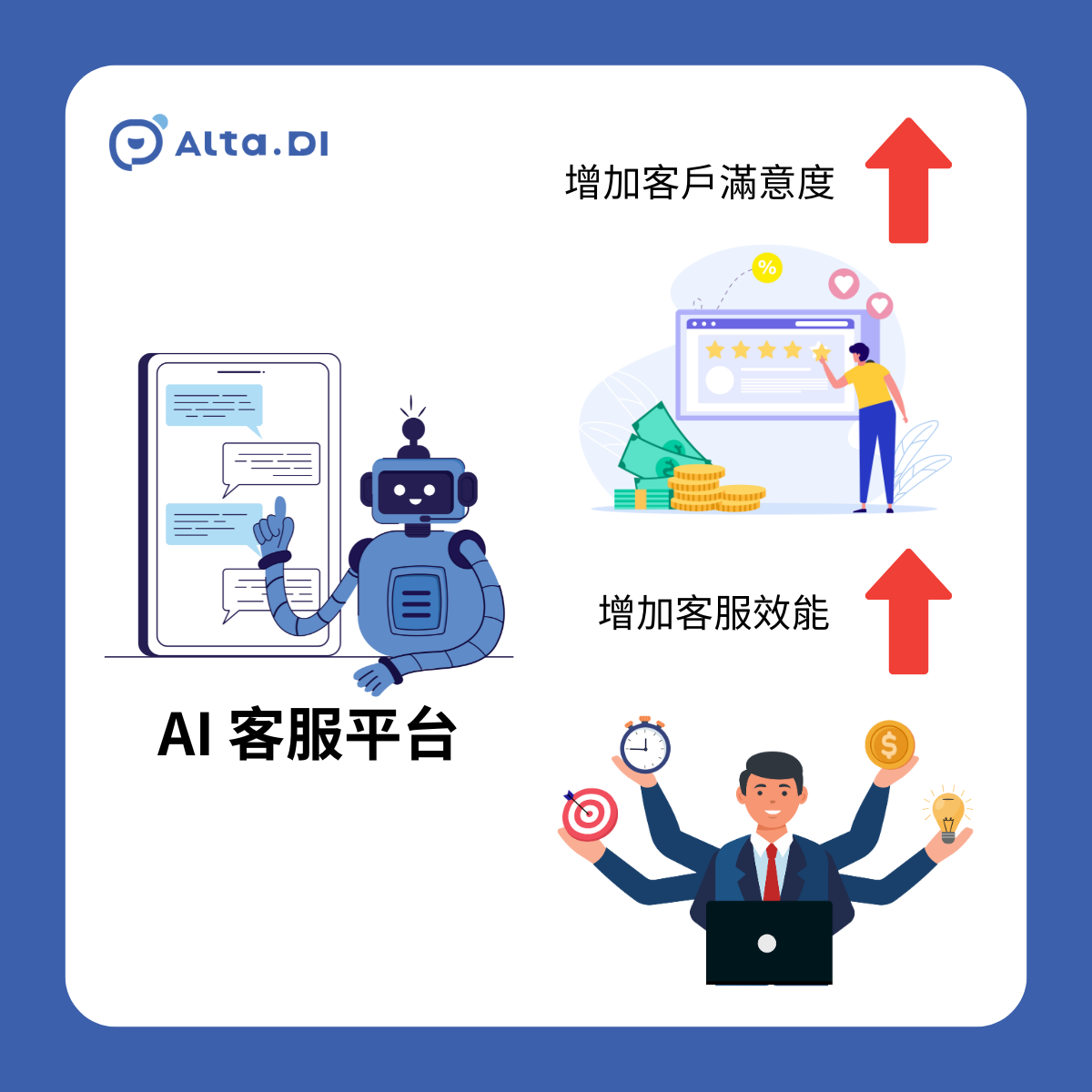
The core benefit of adopting logistics AI customer service is that consolidation companies no longer rely on adding staff at peak season. The system intercepts a high share of repetitive tracking inquiries so people can focus on the questions that really need judgment, and overall customer service cost can fall by 30%.
In 2026, 91% of enterprise customer service leaders face pressure from senior management to adopt AI, and in Taiwan, "AI" and "logistics" have been named by III's MIC as the two keys to upgrading e-commerce competitiveness. Completing the groundwork early is what builds an advantage before the next peak season arrives. The key to success is always one thing: finding the right division of labor between people and machines. AI handles high-frequency standard questions, and people focus on high-value interactions. No-code setup and accurate RAG technology greatly lower the barrier to adoption without lowering service quality.
Conclusion: turn the next Double 11 into a growth opportunity
You need not fear the staffing gap at peak season, and now is a good time to start on automation. Unlike offerings that only sell you a tool, Data-DI works alongside you from workflow design through to results: consultants first take inventory of your consolidation scenarios and design the knowledge base and handoff paths, and then Alta.DI is put into daily use. Ready to turn the next Double 11 into a growth opportunity for your consolidation business instead of a customer service meltdown? Book a conversation, and we will plan an adoption approach tailored to consolidation companies. If you are still deciding whether to adopt and how to choose, start with How to choose AI customer service: a selection guide (in Chinese).
References

[1] Gartner. (2026). Gartner Survey Finds 91% of Customer Service Leaders Under Pressure to Implement AI in 2026. Gartner Newsroom.
https://www.gartner.com/en/newsroom/press-releases/2026-02-18-gartner-survey-finds-ninety-one-percent-of-customer-service-leaders-under-pressure-to-implement-ai-in-2026
[2] Gartner. (2026). Gartner Predicts Half of Companies That Cut Customer Service Staff Due to AI Will Rehire by 2027. Gartner Newsroom.
https://www.gartner.com/en/newsroom/press-releases/2026-02-03-gartner-predicts-half-of-companies-that-cut-customer-service-staff-due-to-ai-will-rehire-by-2027
[3] Gartner. (2025). Gartner Predicts Agentic AI Will Autonomously Resolve 80% of Common Customer Service Issues Without Human Intervention by 2029. Gartner Newsroom.
https://www.gartner.com/en/newsroom/press-releases/2025-03-05-gartner-predicts-agentic-ai-will-autonomously-resolve-80-percent-of-common-customer-service-issues-without-human-intervention-by-20290
[4] Market Intelligence & Consulting Institute (MIC), Institute for Information Industry. (2026). 2026 E-commerce Consumer Survey: Consumers Want AI and Convenience-Store Pickup Most; Two Keys to Survival for Local Operators (in Chinese). Commercial Times.
https://www.ctee.com.tw/news/20260630701646-430503
[5] Department of Statistics, Ministry of Economic Affairs / Economic Daily News. (2026). From High-Speed Growth to Structural Upgrade: Key Turning Points for Taiwan's E-commerce Industry in 2025-2026 (in Chinese). Economic Daily News.
https://money.udn.com/money/story/5635/9290776
[6] Salesforce. (2026). WISMO: What It Is and How to Reduce 'Where Is My Order?' Calls. Salesforce Commerce.
https://www.salesforce.com/commerce/wismo/
[7] Decagon. (2026). What is WISMO (Where Is My Order)? Definition and AI Guide. Decagon Glossary.
https://decagon.ai/glossary/what-is-wismo-where-is-my-order
FAQ
FAQs about this article
What tracking questions can AI customer service handle automatically for consolidation companies?

AI customer service for consolidation companies can automatically answer repetitive questions such as parcel progress, freight estimates, prohibited item checks, warehouse receiving rules and consolidation schedules. Such questions usually make up more than 80% of a consolidation company's inquiry volume, and adoption can greatly ease peak-season pressure on staff.
Customers keep asking about delivery status. Which AI that connects to logistics data should you choose?
The key is to choose an AI that connects to your live shipment status data, not a chatbot that only gives canned replies. Alta.DI connects through ERP and logistics APIs so that tracking and freight replies match real shipment status and do not go wrong when something is off.
Roughly how much does it cost a logistics consolidation company to adopt AI customer service?
AI customer service for consolidation companies is mostly subscription-based, which avoids a large upfront development cost. Alta.DI uses usage-based pricing, so companies can reach enterprise-grade automation at a relatively low threshold. For actual cost, we suggest confirming the best-fit plan directly with a consultant.
How do you connect AI customer service to an existing LINE Official Account?
Alta.DI offers no-code integration, with no need to change your LINE Official Account or worry about losing followers, and your existing rich menu is fully kept. After authorization you only set trigger conditions, and the system takes over tracking and quote conversations automatically, going live in as little as two weeks.
Is AI customer service suitable for a small or mid-sized consolidation company short on peak-season staff?
Yes, especially for teams under peak-season staffing cost pressure. A subscription platform lets small and mid-sized companies get the same automated reply capability as large operators without building a technical team, and ride out the tracking peak steadily.
More articles


訂閱我們的電子報
每月 8 日定期發送最新趨勢與實用資訊!



