

DTC AI customer service for Gen Z: 3 myths, 1 framework | Alta.DI
Is your DTC brand's AI customer service missing Gen Z? Ada's 2026 research overturns the "Gen Z prefers AI" myth. This article covers 3 misconceptions, 3 diagnostic questions and 3 blind spots so brand owners can check their service fit. Book a free diagnostic.


Summary
Whether AI customer service fits a DTC brand depends not on how smart the AI is, but on whether the brand's service style matches the needs of the target customers' generation. Ada's 2026 global study of 2,000 people overturns a popular myth: Gen Z and Boomers have the same core expectations of AI customer service, and the gap shows up at the moment the AI fails. This article clears up three common misconceptions and gives brand owners a self-diagnosis framework, so you can see who your AI customer service is keeping and who it is driving away.

Your AI customer service may be driving away your core customers, while you think they love it
Key point: what makes customers abandon an order is not AI but misplaced AI
You open your Shopify back office and see two new one-star reviews from yesterday: "Asked three times and it still didn't understand" and "Couldn't get the bot to a real person, gave up." The instinctive reaction is "we need to upgrade the AI." But the problem is usually not that the AI is not smart enough. It is that the AI does not know your customers.
Whether AI customer service fits a DTC brand depends on whether the brand's service style matches the needs of the target customers' generation. Ada's 2026 global study of 2,000 people found that 57% of consumers would stop using a brand because its AI customer service could not hand them over to a human when needed [1]. There is no generational difference in this number. It is a shared floor across generations.
More surprising is another finding from the same Ada study: when you rank Gen Z's and Boomers' priorities for customer service, both generations put the same answer first:accurate and solves the problem, with empathy ranked last [1]. The two popular claims, "Gen Z wants to be understood" and "Boomers reject AI," both mislead DTC brand owners' service design decisions.
This article clears up three common misconceptions about Gen Z and AI customer service, gives you three diagnostic questions to identify your core customers' generation, and points out the generational blind spots DTC brands most often fall into when designing AI customer service. After reading, you will know who your AI customer service is keeping and who it is driving away, and how to correct it next.
Three misconceptions DTC brand owners hold about Gen Z and AI customer service
Key point: what you think is a preference may be your blind spot
Many DTC brand owners instinctively apply a kind of "generation logic" when setting AI customer service strategy: Gen Z likes AI, Boomers reject AI, so when targeting young customers, turn the AI up to the maximum. Ada's 2026 global study of 2,000 people shows this logic is off in three key ways, which directly hurt a brand's ability to retain customers through service [1]. Before you decide how open your AI customer service is and where the threshold to hand over to a human sits, look at these three common misconceptions.
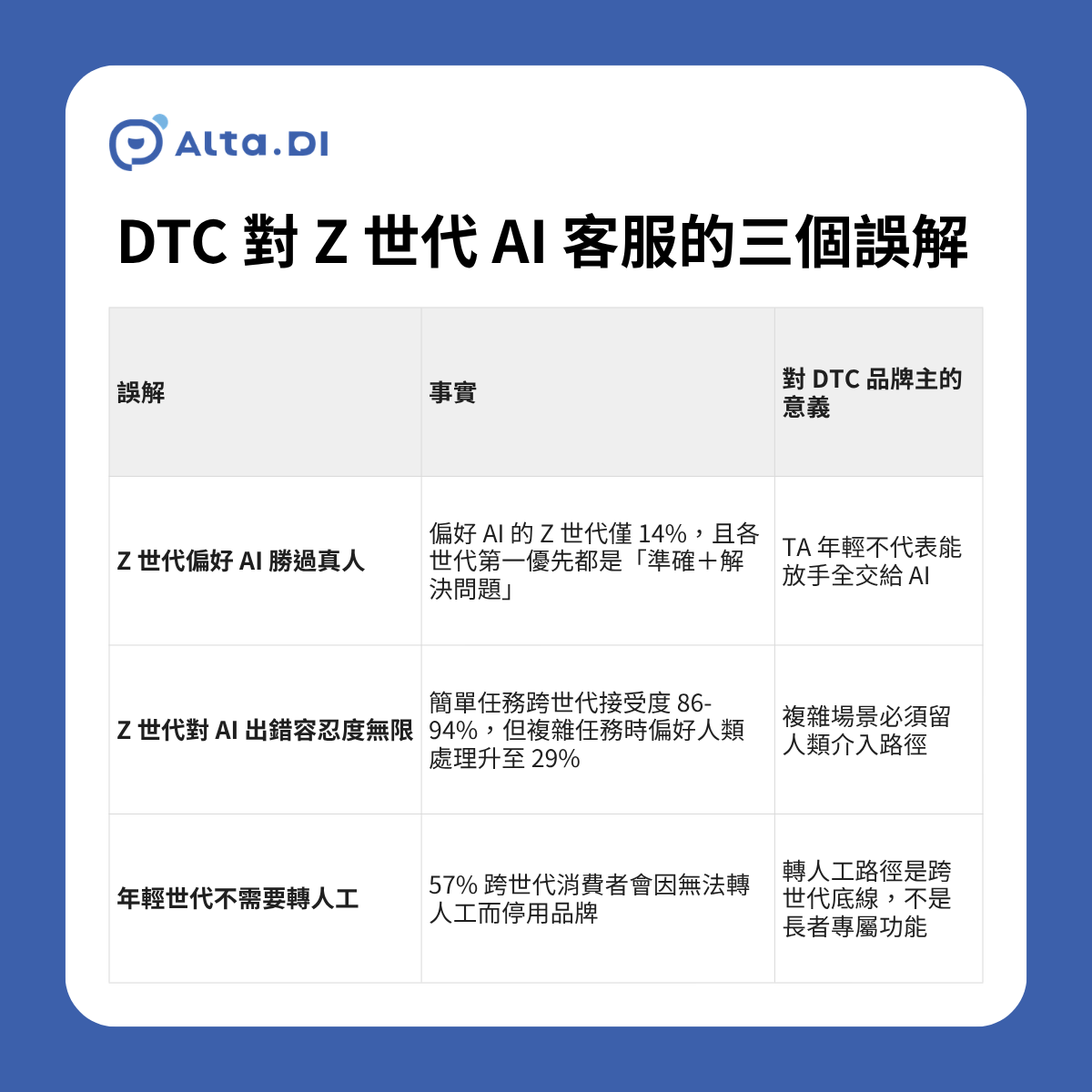
Misconception 1: Gen Z prefers AI customer service to humans
The fact: Gen Z consumers who prefer AI are a minority, and most still prefer a human. A SurveyMonkey survey from late 2025 shows that the share who "prefer interacting with AI over a human when speed and quality are equal" is 14% for Gen Z, 11% for millennials, 7% for Gen X and 4% for Boomers [2]. Gen Z is indeed higher than other generations, but 14% is still far below half.
More importantly, when Ada's 2026 study ranked "the most important attributes in customer service" for each generation, every generation put "accurate + solves the problem" first and empathy last [1]. This means customers do not want "AI or a human." They want to know "will you solve my problem." If you put the AI in a scenario it cannot handle (such as a complex return or exchange judgment), swapping in customers from any number of generations will not help.
What this means for DTC brand owners: do not treat "our target audience is Gen Z" as a reason to let AI take over all of customer service.
Misconception 2: Gen Z has a high tolerance for AI mistakes
The fact: high, but only up to a threshold. Ada's 2026 data shows that for simple and moderately complex tasks (order lookups, address changes, return status), AI acceptance across generations is between 86% and 94%, with a small gap [1]. But once a task is complex, the overall preference for "fully handled by AI" falls from 40% to 18%, while the preference for "fully handled by humans" rises from 13% to 29% [1].
This is where generational differences show up: millennials' AI acceptance for complex tasks is 41% and Boomers' is 32%. Gen Z and millennials do tolerate AI mistakes more, but the tolerance is not unlimited. When a DTC brand pushes AI past the edge of its ability (for example, letting AI handle a defect dispute on a high-priced item), even the most forgiving Gen Z will leave.
What this means for DTC brand owners: complex tasks must have a clear path for human involvement, and this holds for every generation.
Misconception 3: younger generations do not need a handoff-to-human option
The fact: 57% of consumers across generations say that "not being able to reach a human when needed" is the top reason they would stop using a brand's AI customer service [1]. This number has no generational difference. Gen Z, millennials, Gen X and Boomers all treat it as a floor.
The difference is who stays at the moment "the AI fails and the customer has to find a human on their own." The same Ada study shows that 17% of Gen Z and 20% of millennials would keep trying in this situation, but 25% of Boomers and 32% of postwar-generation consumers would leave right away [1].
For DTC brand owners, this means a brand with mostly young customers cannot assume "they will find their own way." The line in a one-star review, "Couldn't get the bot to a real person, gave up," is exactly the kind of sentence these 17% leave behind when they turn on you.
Quick comparison of the three misconceptions
Which generation mainly makes up your DTC brand's customers? Three self-diagnosis questions
Key point: take stock of your customers first, then design customer service
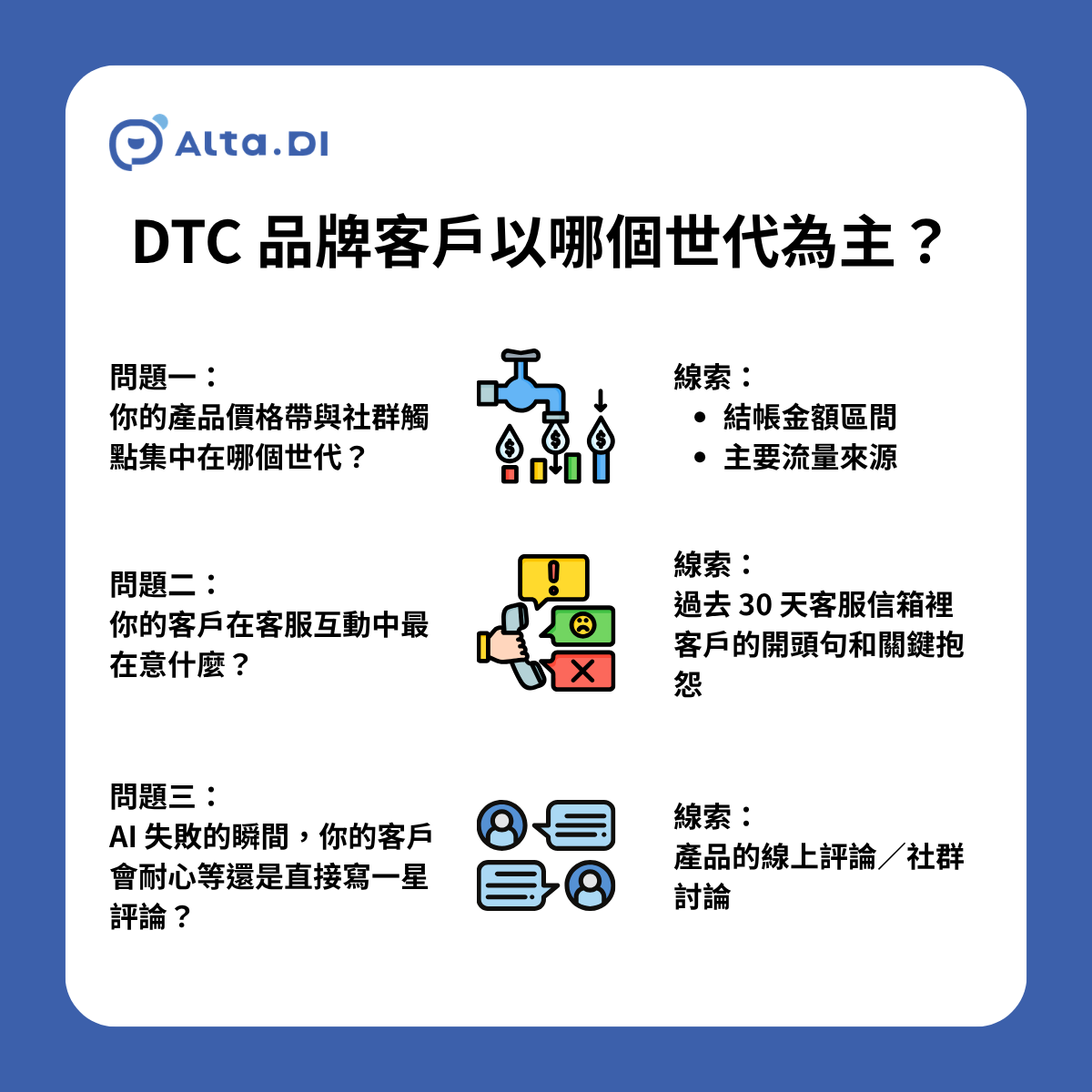
To design AI customer service that fits, the first question is not "how far do I open up the AI" but "who am I serving." Most DTC brand owners' picture of "my customers" is actually a mix of "the people I hope to attract" and "the demographics on the ad platform dashboard," and these two are often not the same group as the people who actually write to your service inbox. The three questions below need no market research budget. You can work out the answers from your existing Shopify back office and service records.
Question 1: which generation do your product price range and social touchpoints concentrate on?
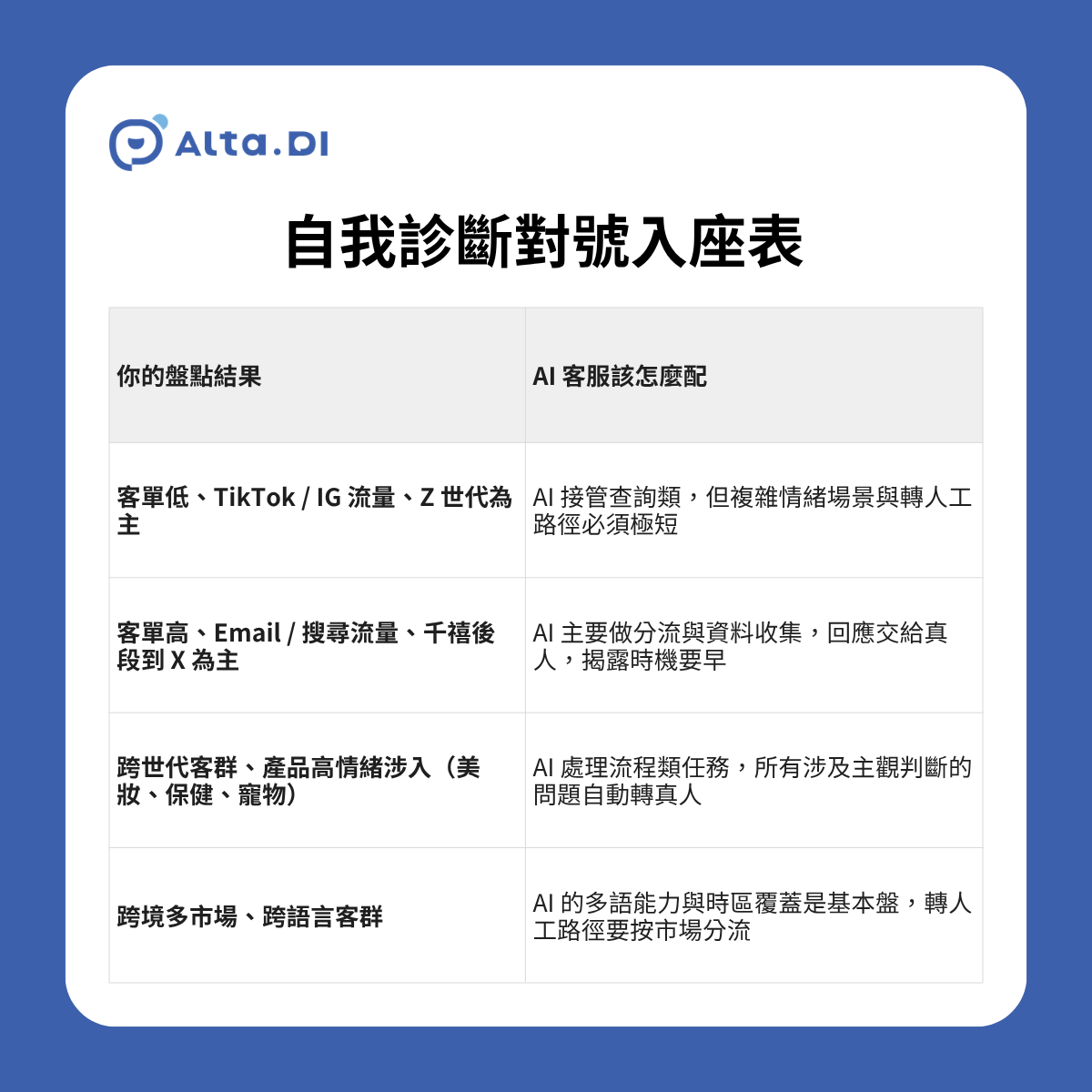
How to check: pull the last 90 days of Shopify orders into a table by "checkout amount range" and "main traffic source." For brands with an average order value of NT$500-2,000 and traffic mainly from TikTok and Instagram Reels, the core customers are likely Gen Z and younger millennials. For brands with an average order value above NT$3,000 and traffic mainly from Google search or email marketing, the core customers lean toward late millennials to Gen X.
Criterion: if one generation contributes more than 60% of your revenue, their service preferences should be the first priority in your AI customer service design. Do not average across generations. Serve that 60% first.
Question 2: what do your customers care about most in service interactions?
How to check: pull the opening lines and key complaints from customers in your service inbox over the last 30 days. There are three common patterns:
- "Where is my order?" "I want to change my address": speed and precision come first. AI can take over more than eighty percent of these.
- "The color looks very different from the photo. Can I return it?" "My skin had an allergic reaction after three days of use": the customer wants to be taken seriously, not brushed off with a canned reply. AI can do initial routing and data collection, but judgment and the reply must stay with humans.
- "I'm buying a gift. Which one suits an older relative better?": the customer wants expert advice. The AI's role here is to help gather requirements and compile options for a human to take over, not to give the answer directly.
If the second and third patterns make up a high share of your service inbox, setting the AI customer service KPI to "the more the AI resolves automatically, the better" will actually make the brand lose customers.
Question 3: when the AI fails, will your customers wait patiently or write a one-star review right away?
How to check: look at how many of your product's online reviews and social discussions are negative comments about "the service experience itself." If your brand's customers like to complain in public, designing this moment takes priority over any other service KPI you currently consider important.
Why this question matters most: Ada's 2026 study shows that 57% of consumers across generations would stop using a brand because "AI customer service could not hand them over to a human when needed" [1]. This 57% is not vague dissatisfaction. It is leaving outright, and the younger the customer, the better they are at turning that departure into a public review. How you design the moment the AI fails determines how much of your most public negative sentiment you will get.
Self-diagnosis matching table
The three generational blind spots DTC brands most often fall into when designing AI customer service
Key point: the right tool in the wrong scenario is worse than no tool
At the end of last year we spoke with a local DTC beauty brand whose main customers are women aged 18-28 and whose monthly revenue had stabilized at eight figures. The founder opened our discussion with: "I want to turn the AI customer service up to the maximum. Young customers all like this, and it happens to save us two service staff." Three months later when we spoke again, she said the brand's Google reviews had dropped by 0.4 stars, the monthly return rate had gone up, and the most painful part was that an IG story screenshot had been reshared 4,000 times on Threads. It showed their AI customer service replying with the same canned SOP three times to a customer who said "I had an allergic skin reaction and want to return it."
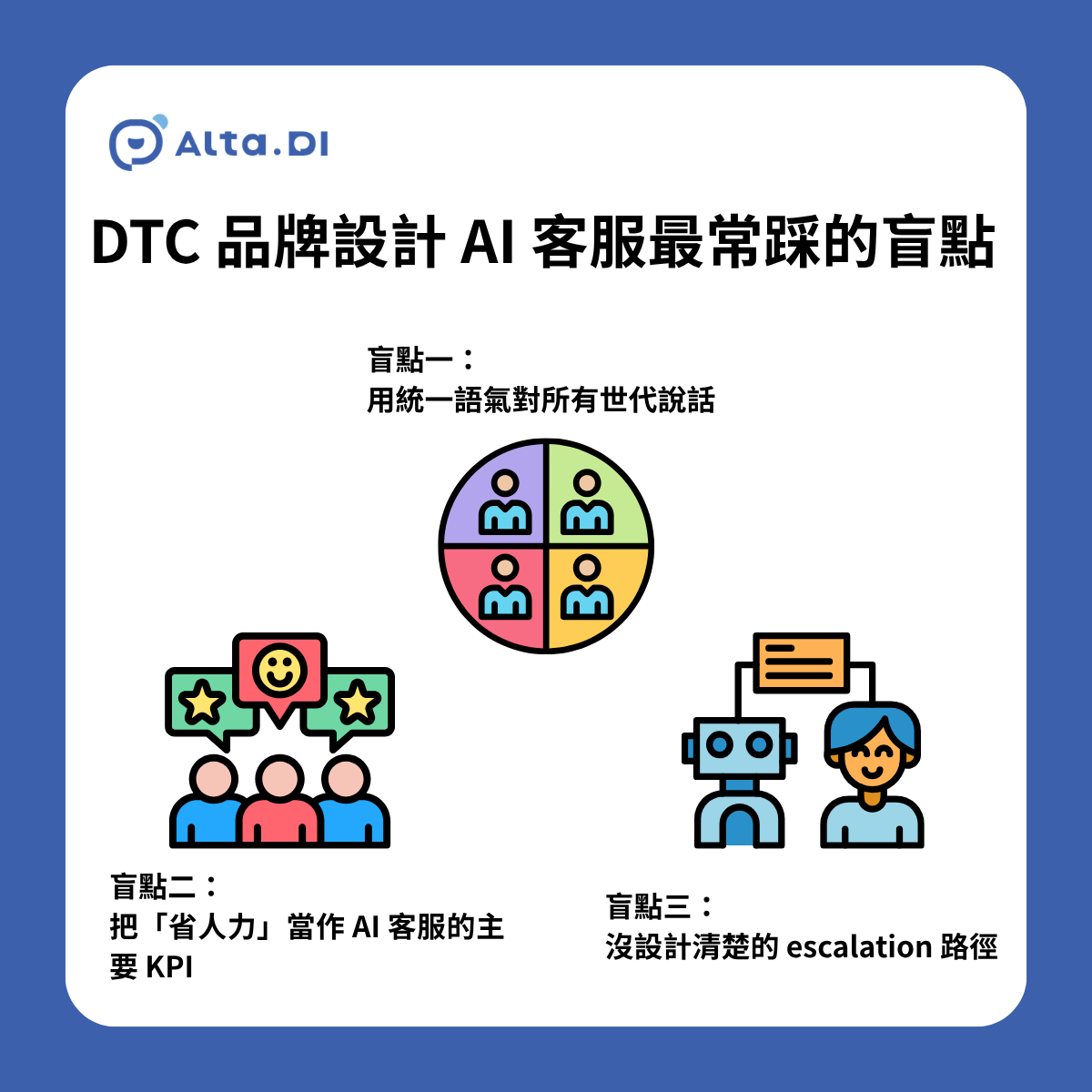
"I thought our audience is young so we could leave it to the AI" is the first brick DTC brand owners most often step on. From the DTC brands we have worked with, the three blind spots below appear most often, and they are also the signals by which brands most easily misjudge their customer base.
Blind spot 1: speaking to every generation in the same tone
Many brands set up one "brand voice" when AI customer service launches and apply it to every customer. But Ada's 2026 data points out that the timing of disclosure itself differs by generation: 54% of Boomers and 66% of the postwar generation prefer to be told clearly at the very start of the conversation that this is an AI, while among Gen Z 27% accept disclosure "shortly after the conversation begins" and 11% even feel "answering only if asked is fine" [1].
This means a brand with customers across generations has to branch even on the small act of "when to say I am an AI." Brands that never disclose (10% of all consumers' brands do this) or delay until a handoff to a human (13%) land exactly on the groups with the lowest tolerance [1].
How to fix it: the AI disclosure at the opening is not a yes-or-no choice but a design question of "when and in what tone." Brands with low order value and younger customers can fold the disclosure into the opening feature introduction. Brands with high order value and more mature customers should put the disclosure in the first sentence of the conversation.
Blind spot 2: treating "saving labor" as the main KPI of AI customer service
This is the hole the beauty DTC brand above fell into. Ada's 2026 data is clear: when consumers across generations rank "the most important attributes in customer service," accuracy and solving the problem come first and empathy last [1]. That does not mean customers do not need to be "taken seriously." It means customers do not need the AI to pretend to empathize. They want the problem actually dealt with, and when the AI cannot, a human takes over right away.
Brands that use "saving labor" as the KPI push the AI resolution rate up (from 60% to 80%, then to 95%), but each percentage point leaves more cases that should have gone to a human with the AI. The Salesforce 2026 State of Service report observed a key turn: after deploying AI customer service, the KPI that improved most was CSAT customer satisfactionand not service productivity or average handling time [3]. This tells DTC brand owners that AI customer service should chase "brand customer retention," not "lower costs."
How to fix it: change the KPI from "AI automatic resolution rate" to "customer satisfaction + first-contact resolution rate." The former encourages the AI to swallow cases, and the latter encourages the AI to let go cleanly when it cannot do the job.
Blind spot 3: no clearly designed escalation path
"Not being able to reach a human when needed" is the top reason 57% of consumers across generations stop using a brand's AI customer service [1]. Break that 57% down, and the first to leave are not Gen Z but Boomers and the postwar generation. Gen Z and millennials try a few more times (17% and 20% are willing to find a human on their own), but their "trying more" is not free, and the next step is mostly to screenshot the experience and post it on social media [1].
Three mistakes are common in practice: the handoff button is buried in a third-level menu, handoff works only during business hours while the AI runs 24 hours, and a handoff throws the customer back to the start of the conversation to be asked "What are you looking for?" again. All three designs treat "handoff to a human" as a patch for when the AI fails, not as part of the AI system.
How to fix it: treat handoff to a human as a main feature, not a backup. Every AI conversation should keep an entry point for "get a person now," and when handing over, the conversation context must pass in full to the human so customers do not have to say it again.
How to turn AI customer service from a "spec selection question" into a "brand positioning question"
Key point: the right question is "who do I serve," not "who has more features"
DTC brand owners choosing AI customer service most easily fall into the spec-comparison trap: comparing accuracy rates, number of languages and number of integrations, without returning to the question that matters most: does this AI customer service fit my brand's tone and my customers' generation? The inventory and blind spots in the previous three sections essentially repackage a selection question as a positioning question.
Two typical kinds of DTC brand need completely different AI customer service configurations:

From this table you can see that the real value of AI customer service is not a spec upgrade like "I'm 2% more accurate than competitors," but saving the brand owner the whole hassle of "figuring out each generation's preferences + configuring disclosure timing separately + designing handoff thresholds separately." When a brand goes cross-border and faces Gen Z in Europe and the US, millennials in Asia-Pacific and fast-fashion buyers in Southeast Asia at the same time, the value of "saving one hassle" multiplies tenfold.
This is also what Alta.DI works on: a channel-agnostic AI customer service platform with all channels and all data, and we are wherever your customers are. Whether a customer comes in from TikTok Shop, checks out from Shopify or asks about a return by Instagram DM, Alta.DI keeps these conversations and data in the same back office, so brand owners can configure service style according to customer generation traits and brand tone, instead of being pushed to change the brand by a tool's channel limits.
AI customer service platforms on the market fall roughly into two kinds. One puts its selling point on "tied to a single channel, deep specs, priced per channel." That may be enough for a brand on one platform serving one generation, but a DTC brand hits a wall the moment it goes cross-border. The other puts its selling point on "following the brand and following the customer": unified data, channel-agnostic and configurable tone. This is the direction DTC brand owners should evaluate seriously.
After understanding how AI customer service relates to generational fit, the next step is usually to go back and take stock of your existing service tools and where your data sits. If your customers are spread across several channels, returns and abandoned carts are scattered across different conversation records, or language versions get messier after going cross-border, these are specific scenarios Alta.DI was designed to solve. You can start your evaluation from 5 ways to automate Shopify abandoned cart recovery and how e-commerce brands use AI customer service to lift repeat purchases by 30% these two concrete scenarios.
Does your AI customer service fit? Start with an inventory
Back to that one-star review at the start: "Couldn't get the bot to a real person, gave up." What this line is really saying is not that the AI is not strong enough, but that the brand owner put the AI to work without understanding what customers want. The three misconceptions, three diagnostic questions and three blind spots in this article all point to the same thing: whether AI customer service fits a DTC brand is not a spec question but a positioning question.
Every DTC brand's generational inventory comes out differently: some are stuck with young customers but a mature service tone, some with completely different generational structures in each market after going cross-border, and some with an AI resolution rate KPI pushed so high that cases that should go to a human all stay with the AI. If you want to clarify how well your brand's AI customer service fits right now, Data-DI offers a 30-minute free DTC brand AI customer service fit diagnostic, in which a consultant goes through the generational blind spots your AI customer service is hitting, based on your order values, traffic structure and a sample of service records, and gives corrections for your actual situation. You do not need to prepare data in advance. Just give us your brand's website address and the customer service tools you use now, and we can start.
If you would like to see how Alta.DI approaches scenarios like these first, start with the Alta.DI article series to read how other DTC and e-commerce brand owners use it in practice.
References

[1] Ada Support and NewtonX. (2026). Agentic AI for Customer Service: What 2,000 Consumers Told Us. Ada Research. https://www.ada.cx/research/agentic-cx-in-2026/
[2] SurveyMonkey. (2026). Customer Service Statistics 2026: Humans vs AI Trends. SurveyMonkey Curiosity. https://www.surveymonkey.com/curiosity/customer-service-statistics/
[3] Salesforce. (2026). New Research: AI Service Agents Are Scaling and Delivering CSAT. Salesforce News. https://www.salesforce.com/news/stories/ai-service-agents-improve-customer-satisfaction/
Internal material
[—] Data-DI internal advisory cases
FAQ
FAQs about this article
Does Gen Z really prefer AI customer service to humans?

Not the majority, a minority. A SurveyMonkey survey from late 2025 shows only 14% of Gen Z prefer AI over a human, which is higher than other generations but far below half. Every generation's first priority in customer service is accuracy and solving the problem, not AI or human.
How can a DTC brand tell which generation its core customers are?
Pull the last 90 days of Shopify orders and cross-check average order value against traffic source. Low order value plus TikTok traffic is mostly Gen Z. High order value plus Google or email is mostly late millennials to Gen X. The generation contributing more than 60% of revenue is the one to serve first.
In which AI customer service situations does Gen Z abandon an order outright?
Two: complex emotional scenarios and a broken handoff path. AI acceptance across generations is 86-94% for simple tasks, but for complex tasks the preference for human handling rises to 29%. Add a handoff button that is hard to find, or being thrown back to the start of the conversation to repeat everything, and Gen Z mostly writes a one-star review right away.
What is the most common mistake DTC brands make when designing AI customer service?
Using the AI automatic resolution rate as the main KPI. Pushing the resolution rate from 60% to 95% forces cases that should go to a human to stay with the AI, which lowers CSAT, raises the return rate and increases negative social posts. Track customer satisfaction and first-contact resolution instead, and let the AI step aside when it cannot do the job.
How should AI customer service design the handoff path so it does not lose customers?
Treat handoff to a human as a main feature, not a backup. Keep an entry point for getting a person now in every AI conversation, and do not bury it in a third-level menu. After handoff, pass the conversation context to the human in full so customers do not have to repeat themselves. Ada's 2026 study shows 57% of consumers would stop using a brand that cannot hand them over to a human.
More articles


訂閱我們的電子報
每月 8 日定期發送最新趨勢與實用資訊!



