


Why does everyone at an ad agency work overtime during weekly and monthly reporting season?
Key point of this section: overtime is a production line problem, not a headcount problem
Ad agency AI report automation uses AI Agents to connect automatically to each ad platform and database, consolidate performance data and produce insight reports clients can understand. Its purpose is to free ad optimizers (OPs) and account managers (AMs) from the routine work of weekly and monthly reports, and it suits digital ad agencies that serve many clients at once and carry a heavy reporting load.
Walk into any B2B ad agency in the last week of the month and almost no one leaves on time. They take on many accounts but output quality cannot keep up, and when they want to expand they are stuck on "how many senior people we have". This is not one company's management problem but a structural bottleneck shared across the whole industry.
The key point: the root of reporting-season overtime is how the report production line is designed, not a shortage of hands. Adding more people and more overtime only runs the same inefficient line for longer. The real fix is to move the whole line onto an automated track. This echoes the shift highlighted in Sequoia Capital's March 2026 report "Services as Software": over the past year or two most AI applications have followed the "Copilot" route, which only lets people work a bit faster, while the real value lies in having the AI finish the job itself and hand the result to you [1]. For an agency, the plain-language version of this shift is: stop buying a tool that "helps OPs type faster", and look for a line that "produces the report by itself" (we break down the difference between these two models in the article How Copilot and Autopilot Differ , which covers it in full).
Next we break down three things: why you are stuck (where the capacity black hole really is), how to fix it (a three-step adoption framework), and how far a real case went (IMAG cut its monthly report from 3 days to 1 minute).
One key figure that shows the agency capacity black hole
Key point of this section: where the time goes decides how many clients you can take
An agency's capacity ceiling is usually not "whether there are enough hands" but "how much of senior people's time is eaten by report chores". Observations from a senior digital ad buyer at an agency show the problem well: an OP spends about 65% of the day on account checks, setup and optimization, 14% on client meetings and presentations, and 7% on internal reports. That adds up to 86%, leaving less than 15% of time for deep strategic thinking [2]. When weekly and monthly reporting season stacks on top, reports get squeezed into hours outside normal working time.
Following this timeline down sets off a whole chain of effects.
On the OP side They have to pull raw data from backends such as Meta, Google and LINE LAP, align definitions, run cross-analysis and draw charts, and only then get to writing insights. The result is that the preparation work often uses up their energy, and the insight section that is actually valuable gets rushed through.
On the AM side Once they get the report they cannot send it out directly. They must first translate CPC, CTR and ROAS into strategic language the client can understand: why CPM rose this month, which creative set should be replaced, whether budget should move to LINE. This "translation work" draws on the AM's industry experience, and a junior AM may need to reread the report for half a day before daring to hold the meeting.
On the company side Most critically, report quality is tightly tied to the OP's seniority, and it is hard for newcomers to produce insightful reports independently. So sales wins a new client, but managers hesitate to hand it to a new hire; a senior OP carries three or four big clients alone, stays overloaded for a long time, and the risk of losing talent rises with it. The capacity ceiling gets stuck on "the number of senior people", and the cost of expansion becomes training and poaching instead of systematically replicating capability.
To loosen this knot, what really needs fixing is not "making OPs and AMs work faster" but redesigning the whole report production process. This is also the industry consensus in 2026: McKinsey estimates that agentic AI could carry about two thirds of current marketing work, covering tasks from content generation and audience testing to media planning [3]; Gartner also predicts that by the end of 2026, 40% of enterprise applications will feature built-in task-specific AI agents [4]. In other words, agencies face a structural transformation, not just the multiple-choice question of "whether to buy one more tool".
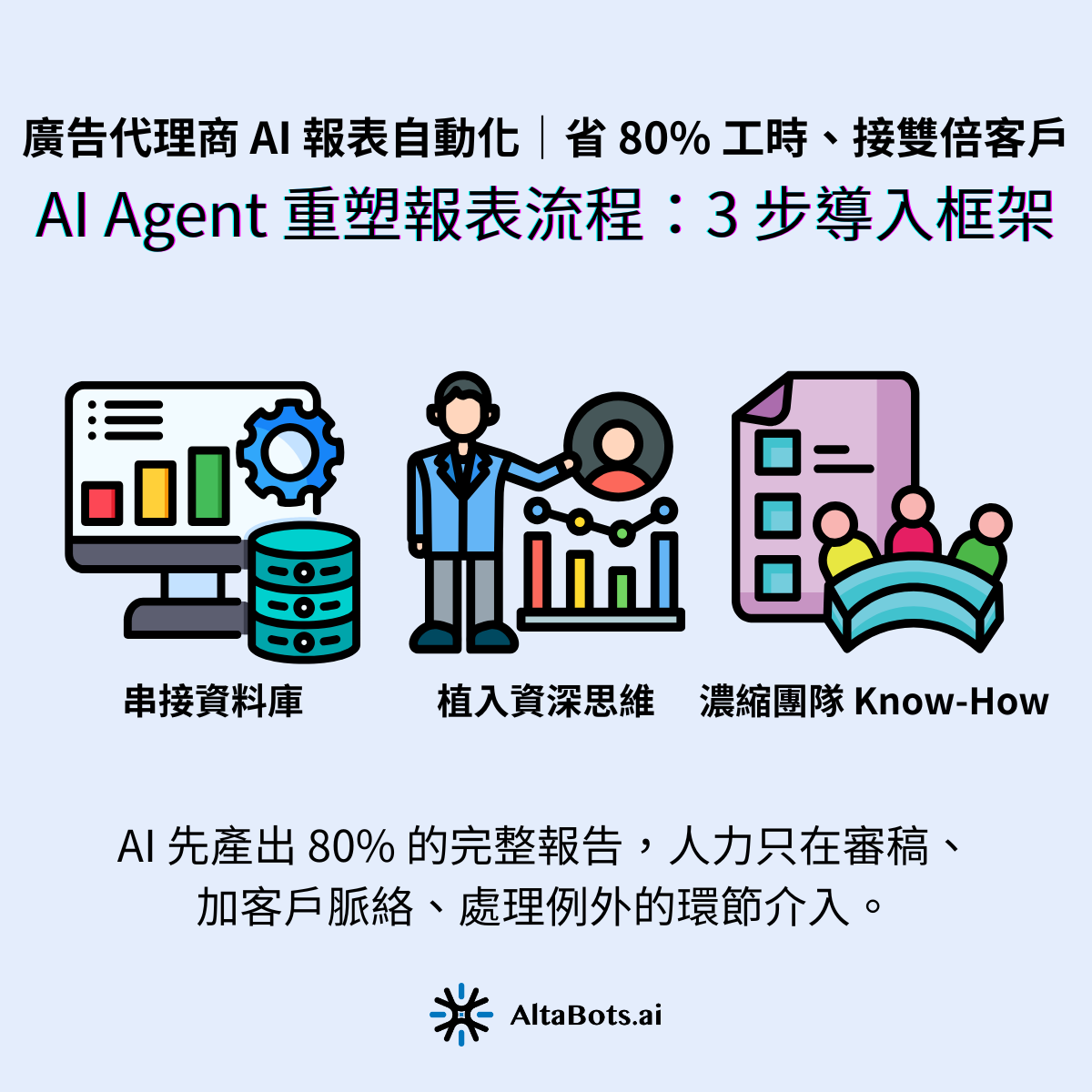
How do AI agents reshape the reporting process? A 3-step adoption framework
Key point of this section: not adding a tool, but changing the production line
Handing reports to an AI Agent is not plugging one more add-on into the existing process but redesigning the whole production process. McKinsey's observation is direct: the companies that get real results are those that "design processes around AI agents", rather than gluing agents onto old processes [5]. The three steps below move an agency's report production line from the manual track to the automated track.
Step 1: Connect the database so data flows in automatically
The first step is concrete: use APIs or data connectors to automatically sync data from Meta Ads Manager, Google Ads, the LINE Official Account backend, LINE LAP and GA4 into the company's central database (usually BigQuery or MSSQL).
The benefit of this step is not only saved time but also solving the long-standing problem of "different reports whose numbers do not match", since all later analysis runs on the same clean data. It is also the foundation of whether adoption succeeds: McKinsey found that about 80% of companies' obstacles to expanding agentic AI come from data quality and integration, not from models that are not strong enough [6]. The common obstacles are often administrative: the client's GA4 access has not been fully granted, or admin rights still sit under a departed colleague's account. The week before adoption is often spent on such details, so we recommend allowing time for them.
Step 2: Build in senior thinking by turning judgment logic into rules
Clean data is only the base. What makes AI more valuable than an ordinary BI dashboard is writing a senior OP's comparison logic into the Agent: this campaign period against the same period last year, this creative against other creatives on the same theme, this time slot against the same slot yesterday.
In practice, this means breaking the company's internally validated strategy into executable rules: which copy structure converts well, which type of creative pairs with which audience, which time slot has the lowest CPA. Once the rules are written in, when the AI produces a report it will proactively flag concrete recommendations such as "Creative set A's ROAS is 2.3 times the average, we recommend scaling its budget", rather than just throwing out a pile of numbers.
The most common obstacle in this step: a senior OP's judgment is mostly intuition rather than itemized rules. We recommend extracting it through "interviews backed by actual reports": first capture the 3-5 most-used judgment rules and put them live, then expand gradually.
Step 3: Distill team know-how so the AI becomes a colleague who never leaves
This is the step most agencies overlook, and it matters most for success. The tacit knowledge that OPs and AMs accumulate, such as what style a client prefers, how to read the busy and slow seasons of a given industry, which kinds of questions clients ask most often and how the standard answers go, mostly lives only in individual minds and resets to zero when the person leaves.
The fix is to build an internal knowledge input mechanism: OPs write their optimization logic into the Agent's knowledge base, AMs add client communication templates and common Q&A, and managers organize each industry's service standards into rules. As this accumulates, the AI grows from a reporting tool into a senior consultant on call around the clock, one that can be replicated to every new colleague.
This matches Sequoia Capital's moat logic: large models update every month, and what retains value is not the tool itself but the private data and internal processes the company accumulates, which large models cannot take away [1]. Settling team know-how into the AI is equivalent to building a moat for the agency that others cannot copy.
After all three steps, the way of working turns upside down. In the past, an OP worked for half a day and an AM digested it before the meeting. Now the AI first produces a report that is about 80% complete, and people step in only to review, add client context and handle exceptions. This is also the real meaning of the headline's "save 80% of working hours": not AI replacing people, but letting people spend their time on the 20% that most needs judgment.
Real case | how did IMAG cut its monthly report from 3 days to 1 minute?
Key point of this section: turn a senior analyst's judgment into a system that never leaves
IMAG is not itself an ad agency but a luxury LINE ecosystem service provider, yet the two face the same difficulty in essence: many clients, dense reporting, and analysis quality tightly tied to senior staff. This project, a collaboration between Data-DI and IMAG, is an example of going through the three-step framework above in full.
Background: an 86-person team, more than 50 luxury brands, stuck on report chores
IMAG Co., Ltd., founded four years ago, now has a team of 86. It is one of the few LINE ecosystem specialists worldwide with both "creative strategy planning" and "system and technology integration" engines, and has won both LINE's official creative partner and technology partner certifications across markets. Building on LINE Official Accounts, they developed modules for booking, content, shopping guidance, e-commerce and membership, so that brands can assemble the services they want like Lego bricks. They have served more than 50 brands worldwide, from top-tier luxury groups to international luxury giants, with markets across the UK, France, Italy and Spain.
As the service footprint grew, data processing became a heavy burden for the team. The first bottleneck was the report itself: an analyst took a full 3 days to produce one global operations monthly report, and after the report went out the real challenge began, because clients always had questions after reading it, from "what is the reason behind this figure" to "how is a certain metric defined", varied and highly repetitive. The business units could only keep going back to the analyst for more data, and the whole analysis team was tied down by report chores. The second bottleneck was thornier: clients are spread across many European countries and many have limited English, so they may not even understand a report written in English, which meant back-and-forth follow-ups and steadily rising communication costs. What CEO Henry wanted to solve was how to free the team from data chores and put their energy back into creating value for clients.
The solution: two steps, and why "just hand the data to AI" is not enough
IMAG chose to work with Data-DI, which focuses on putting data and AI into daily use, to build an "AI virtual analyst". Wallace Pao, Partner Manager at Data-DI, points out the key: to make AI genuinely useful, you cannot just hand it the data, and you must complete two steps.
The first step is to train the AI to understand the analysis logic of the luxury industry. Luxury data on LINE has its own way of thinking: how to track changes in friend count, what the block rate means, the standards for evaluating campaign performance, and behind each metric there is a specific analysis framework. Through in-depth interviews and repeated testing, the two sides turned the industry experience IMAG had accumulated into rules the AI could read. One concrete example: the store manager of a top-tier luxury jeweler had long observed that about 70% of customers who bought a bracelet would buy a ring within six months. This kind of insight, hidden in a senior analyst's head, was converted into an opportunity rule the AI can identify automatically. And different data needs different thinking: tracking friends is one logic and campaign operations is another, so Data-DI had to write the matching framework into every analysis process before the AI could produce professional insights like a real analyst. This is rule-building work, not something that yields answers by throwing the question at a general-purpose chatbot.
The second step is to embed the AI in the existing workflow. Data-DI added a chat box next to IMAG's original reporting system. After a report is produced, clients or the internal team can ask questions directly in natural language, such as "Why did the block rate suddenly rise this month?" or "Which campaigns had the highest engagement rate?", and the AI answers immediately, with no need to refer them to an analyst. The assistant supports four languages: Chinese, English, French and Spanish, so European clients can ask directly in their native language, and communication costs fall sharply.
Especially worth an agency's attention is IMAG's acceptance mechanism. They did not hand every judgment to the AI at once. They first positioned the AI as a "rookie data analyst", and once the team and clients accepted its performance, upgraded it to a "senior data analyst" and gave it more complex tasks. This gradual-trust design keeps adoption risk controllable and gives both the IT and business sides time to build confidence.
Results: 3 people cover 50+ brands, and the role shifts from making reports to optimizing the system
After adoption, results appeared quickly: a global operations monthly report that used to take 3 days now takes 1 minute with AI, and the various follow-up questions clients have after reading the report can also be put directly to the AI. Henry says that the data team now has only 3 people and can cover the analysis needs of more than 50 brands worldwide, and the team's role has shifted from "making reports and answering questions" to "managing the system and optimizing algorithms", putting their time back into planning new features and refining the analysis framework.
McKinsey's research points in the same direction: with proper design, two to five people can supervise an "agent factory" made up of 50 to 100 specialized AI agents [7]. IMAG, with a leaner team, reached this ratio earlier.
"The biggest challenge in adopting AI is defining the problem clearly. A company must first clarify its real pain point, and once the problem is clear, the technical solution follows naturally." (IMAG CEO Henry) [8]
For an ad agency, the three things IMAG achieved can transfer directly: report time largely recovered, know-how permanently kept in the company, and the same headcount taking on more clients. And this AI virtual analyst is built on Data-DI's enterprise AI Agent platform AltaBots.ai. The next section covers why this kind of project needs an enterprise-grade platform and not simply a general-purpose tool.
Why choose an enterprise AI agent instead of using ChatGPT directly?
Key point of this section: the difference is not whether you can use AI, but whether you can entrust it with your own data
By the evaluation stage, the question agencies ask most is: "Can't I just subscribe to ChatGPT Enterprise and let OPs paste reports in and ask?" For personal use this is entirely valid, but in an agency's daily operations it hits five unavoidable hurdles:
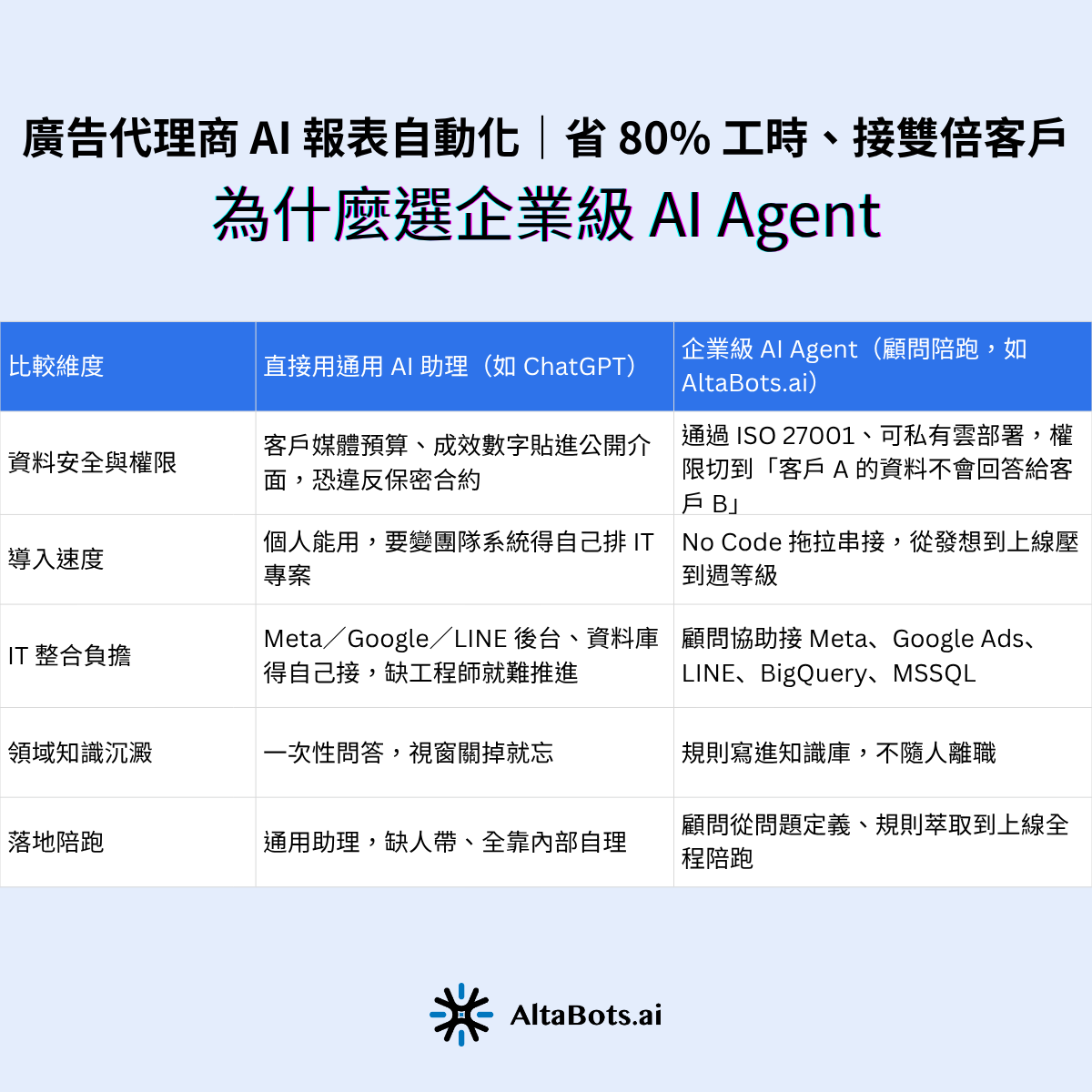
Once you set these five side by side, the difference is clear. AltaBots.ai is Data-DI's No Code enterprise AI Agent platform, but its real value is not in "no code needed" but in consulting that works alongside you: from clarifying the pain point and extracting senior OPs' judgment into rules, to connecting data sources and tuning it until it can go live, someone guides you throughout. This also echoes Henry's line "define the problem clearly": whether you can ask the right question and write the right rules in often matters more than the model itself.
At the platform level, AltaBots.ai supports switching among multiple models (Claude, GPT or Gemini, chosen by task, with the combination recommended by the consultant), and can be embedded in an iframe and in the LINE chat interface, so AMs can ask the AI directly inside the client's LINE Official Account without opening another system. This approach is consistent with what Data-DI did on Alta.DI in the 5-Step Guide to Omnichannel Integration : let AI appear where users already are, without forcing everyone to learn a new interface.
And this positioning does not depend on any particular tool. You may already be using the platforms' native auto-bidding (Google, Meta, LINE) or audience optimization platforms (such as Appier) to run ads. These do the job of "targeting more precisely". AltaBots.ai works on a different layer: it consolidates the data these tools produce into reports clients can understand, and settles it into your own analysis rules. That output is your own asset and does not belong to any media platform or group. In other words, it does not compete with your existing ad tools but fills in the "integration and accumulation" step.
Put simply, ChatGPT is a general-purpose assistant. What an agency needs is a dedicated analyst that can see your own data, remember your own rules and follow your own processes. For a closer look at the trade-offs between the two approaches, see Building Your Own AI Agent vs. Using ChatGPT Directly。
5 self-check questions before adoption
Key point of this section: take stock before buying tools, because getting the order wrong costs the most
Not every agency is ready for adoption "right now". Use these 5 questions to take stock of where you stand:
- Can your data sources be connected automatically? You have admin rights on the main ad platforms, clients have granted GA4 or CRM access, and the company has a central database. If all three are in place you can start straight away; if any is missing, build the foundation first.
- Are senior OPs and AMs willing to write down their know-how? This question has nothing to do with technology; it is about people. Managers must first make the senior staff's position clear: moving from "executor" to "rule-maker", and using KPIs or profit sharing to reward them for making tacit knowledge explicit.
- Is there a suitable case type for a pilot? Choose a case type that is "the most repetitive, moderate in scale, and has a senior OP internally who can label the correct answers", and run a 30-day PoC first to validate data stability, AI output quality and client acceptance.
- Can managers clearly define the "real pain point"? This is exactly what Henry stressed: define the problem clearly. Only when you can say what you want to solve can the technology connect; if the question is vague, even the strongest AI has nothing to work with.
- Does the company have a minimum data foundation? As Wallace Pao reminds us, AI is not magic from nothing; it makes what you already do faster and better. Only with a certain data foundation can AI add value.
After the 5 questions, you will land in one of three positions: "can adopt directly", "build the foundation first, then adopt" or "settle organizational consensus first, then adopt". Any of these is a good answer. The worst case is buying tools without taking stock.
A note for IT managers: before adoption, the technical side should confirm three things: (1) API authorization of data sources and permission governance (who can see which client's data); (2) deployment mode (public or private cloud, involving client confidentiality contracts and ISO 27001 requirements); (3) how to integrate with the existing reporting system (iframe embedding or API connection). In the early stage of adoption, Data-DI consultants help handle details such as API authorization and database connection, so teams without a technical background can also go live smoothly.
In practice, we recommend first running one round of a 30-Day PoC (Proof of Concept) on a single case type. Before you start, it is also worth reading 5 Major Risks to Know Before Adopting an AI Agent, to avoid the most common obstacles up front.
What to Do Next
Key point of this section: validate with small steps first, then decide whether to commit fully
Reporting-season overtime has been the norm in the agency industry for years, but that norm is being broken piece by piece by AI Agents. Agencies that systematize their report production line earlier can put the saved capacity where it matters more: taking on more clients, delivering deeper strategic services and giving more stable quality.
If you now understand "why you are stuck, how to fix it and how far it can go", here are three next steps, from light to deep:
- See more industry cases: browse Data-DI's enterprise automation cases to see how different industries hand processes to AI.
- Pick one case type and run a PoC: choose the most repetitive case type and use a 30-day PoC to validate data stability and output quality first, which carries the least risk and teaches you fastest.
- Book a demo: when you are ready to take a step forward, you can book an AltaBots.ai demo, and a Data-DI consultant will walk you through the actual operation in an agency scenario.
You do not have to do it all at once. Start with one case type and one round of PoC, and scale up once validated. This is also the starting move shared by IMAG and everyone who has adopted successfully.
References

[1] Sequoia Capital(2026). Services as Software. https://www.sequoiacap.com/article/services-the-new-software/ ; Chinese-language coverage: Yuanjian (Global Views) magazine (2026). https://www.gvm.com.tw/article/129399[2] ADER LAB (2022). "A Day in the Life of a Digital Ad Buyer: Daily Work at an Agency" (in Chinese). https://aderlab.com/job/ad-job-agency/[3] McKinsey & Company(2026). Reinventing marketing workflows with agentic AI. https://www.mckinsey.com/capabilities/growth-marketing-and-sales/our-insights/reinventing-marketing-workflows-with-agentic-ai[4] Gartner(2025). Gartner Predicts 40% of Enterprise Apps Will Feature Task-Specific AI Agents by 2026. https://www.gartner.com/en/newsroom/press-releases/2025-08-26-gartner-predicts-40-percent-of-enterprise-apps-will-feature-task-specific-ai-agents-by-2026[5] McKinsey & Company(2025). Seizing the agentic AI advantage. https://www.mckinsey.com/capabilities/quantumblack/our-insights/seizing-the-agentic-ai-advantage[6] McKinsey & Company(2026). Building the foundations for agentic AI at scale. https://www.mckinsey.com/capabilities/mckinsey-technology/our-insights/building-the-foundations-for-agentic-ai-at-scale[7] McKinsey & Company(2025). The agentic organization: Contours of the next paradigm for the AI era. https://www.mckinsey.com/capabilities/people-and-organizational-performance/our-insights/the-agentic-organization-contours-of-the-next-paradigm-for-the-ai-era[8] Business Next / Startup Select (2026). "AI Virtual Analyst Meets Global Luxury Service Needs: IMAG Produces Analysis Reports in One Minute" (in Chinese). https://meet.bnext.com.tw/articles/view/52997
FAQ
FAQs about this article
Roughly what budget does adopting an AI reporting Agent need?

Cost varies with the complexity of data sources and the degree of customization, and there is no single standard quote. Data-DI suggests starting with a 30-day PoC, then assessing the scale of full adoption after feasibility is validated, which lowers the initial investment risk. For a typical agency, the main cost in the PoC stage lies in data connection and rule setup, not in software licensing itself.
At which step is adoption most likely to fail?
In practice it most often gets stuck at the second step, turning a senior OP's judgment logic into rules the AI can execute. Most of a senior employee's analytical intuition is tacit knowledge that is hard to itemize in one go. We suggest extracting it through "interviews plus actual reports", putting 3-5 core rules live first and expanding gradually, rather than aiming for full coverage at the start.
Will clients accept reports produced by AI?
Most clients care about whether the report answers their question, not who produced it. What decides acceptance of AI reports is whether the insights are deep enough and whether the language is close enough to the client's industry. In the early stage, we suggest having an AM review before sending, then raising the share of automation gradually once quality is stable.
After a senior OP leaves, is the know-how the AI accumulated still there?
This is exactly one of the core values of adopting an AI Agent. Once a senior employee's judgment logic has been written into the knowledge base during adoption, the accumulated analysis rules and client insights stay in the system even when staff move on. New employees can serve clients directly on top of this foundation without rebuilding from zero.
We have no IT staff or engineers. Can we still adopt it?
Yes. AltaBots.ai is a No Code platform, and OPs, AMs or marketing managers can connect data sources and set Agent rules through a drag-and-drop interface without writing code. The Data-DI consultant team also provides technical support in the early stage of adoption, handling technical details such as API authorization and database connection, so teams without a technical background can go live smoothly.
More articles


訂閱我們的電子報
每月 8 日定期發送最新趨勢與實用資訊!



