

AI adoption assessment: 3 cases to hold off on
Most AI adoption assessments ask about readiness, but three cases are not readiness problems and should not proceed however well you prepare. This article shares the three red lines Data-DI consultants use to assess client needs, with real cases and a 60-second self-check.


The first question in an AI adoption assessment is not readiness but the nature of the need. If the need is essentially a forecast, the data the AI would read does not exist, or no step in the process requires judgment, AI should not be adopted in any of these three cases.
The person actually assessing AI is usually not the boss but the one assigned to drive digital transformation. They must decide whether a need can be met, write the internal proposal, and answer "is this feasible?" when asked in a meeting. What they lack most is not vendor options, since there are usually too many already. It is a ruler that tells the options apart.
The self-diagnosis checklists you can find online ask almost the same set of questions: is the data organized, is employee acceptance high enough, what is the budget, is there someone to maintain it. These questions are not wrong, but they share an assumption: what you want to do is right in itself, and only the timing is not yet ready. In practice that is not how it works. After Data-DI's sales team brings a client's need back to the company, the first internal gate is not readiness but the nature of the need: should this need be solved with an AI Agent at all?
The following three cases are the types we end up advising clients to hold off on after assessment. None of the three is about timing, and none can be solved by preparing. To be clear, this is not telling you to avoid AI. It is about ruling out what will not produce results before you spend money where results are real.
60-second version | three-question self-check
See whether you can skip the next 15 minutes
If you are assessing an AI need, run it through these three questions:
- Is the output you want a number, or an interpretation? If it is a number, you have hit Case 1 (do not do it).
- Does the data you want the AI to read exist today? If it does, can a machine read it?If the data does not exist, or exists in a form that cannot be read (handwritten records, tables embedded in images, old files that were never digitized), you have hit Case 2 (do not do it yet).
- Is there any step in the process that requires understanding content before deciding? If there is not a single one, you have hit Case 3 (Zapier or n8n is enough).
If you hit any of the three questions, this article has already saved you three months and a purchase, and you can skip to the end to see how we handle this kind of need. If you hit none, the need is worth taking on to the readiness assessment, and there is more to take away if you keep reading.
When sales brings a need back, we check the red lines first, not the need
Judge the Nature First, Then the Readiness
Data-DI's preliminary feasibility assessment form has four labels, not just two (can do and cannot do): feasible, feasible with conditions, feasible but does not need AI, and not feasible.
Four labels, and the third box that is easiest to skip
The existence of the "feasible but does not need AI" box admits one thing: some needs can technically be done but should not be done with AI. Using AI will not break it. It will only make it more expensive, slower and harder to maintain than before.

Order matters. The red lines are the first gate: confirm the nature of the need first, then talk about data, integration, timeline and budget. Do it the other way around and you will spend three months organizing a batch of data that should never have been fed to AI in the first place.
Gartner and MIT say the same thing
Two 2025 studies point to the same conclusion from different angles.
In June 2025, Gartner published a prediction: more than 40% of agentic AI projects will be canceled by the end of 2027, because of runaway costs, unclear business value and inadequate risk controls [1]. In the same press release, Senior Director Analyst Anushree Verma added a more important point: many use cases positioned as agentic today do not actually need an agentic implementation [1]. The 40% is the result, and "does not need an agentic implementation" is the cause.
The MIT NANDA project's July 2025 report, "The GenAI Divide: State of AI in Business 2025", gives a more direct figure: despite about US$30 to 40 billion in enterprise investment worldwide, 95% of enterprise AI projects have no measurable financial impact, and only 5% of integrated systems create significant value [2]. The research is based on 52 executive interviews, a survey of 153 leaders and 300 public deployments. The authors point out that the blocker is not technical capability but that "most GenAI systems do not retain feedback, adapt to context, or improve over time" [2]. This is exactly why some needs should not be handed to a general-purpose LLM in the first place.
Looking back at Gartner's reasons for cancellation and MIT's analysis of where projects stall, none of them is "the technology cannot do it". All of them are problems that should have been stopped before purchase. The next three cases are what we actually use to stop them at the assessment stage. One thing may come as a relief: in practice the one hit most often is not the first but the third. That means most stalled needs are not impossible, just matched with the wrong tool.
Case 1 | you want a forecast, not a judgment
Ten more years of preparation would not make this one worth doing
The first case is a mismatch in the nature of the need: if what you want is to derive a future value from a batch of historical numbers, that is the job of a statistical model, not an AI Agent.
Test: is the output a value, or an interpretation?
If you hand over the data and expect a number back, you have hit it. Common forms include sales forecasting, equipment failure prediction, inventory and material planning, customer churn prediction, recommendation ranking and production schedule optimization. What they share is that the answer is not in the text but in the distribution of the numbers.
Large language models are good at understanding meaning, reasoning and turning unstructured material into structured form. An LLM can read a forecast report and write the results up as an explanation for senior management, but it should not be the one that produces the forecast number.
The line most easily confused: with the same customer data, one way of asking is feasible and the other is not.
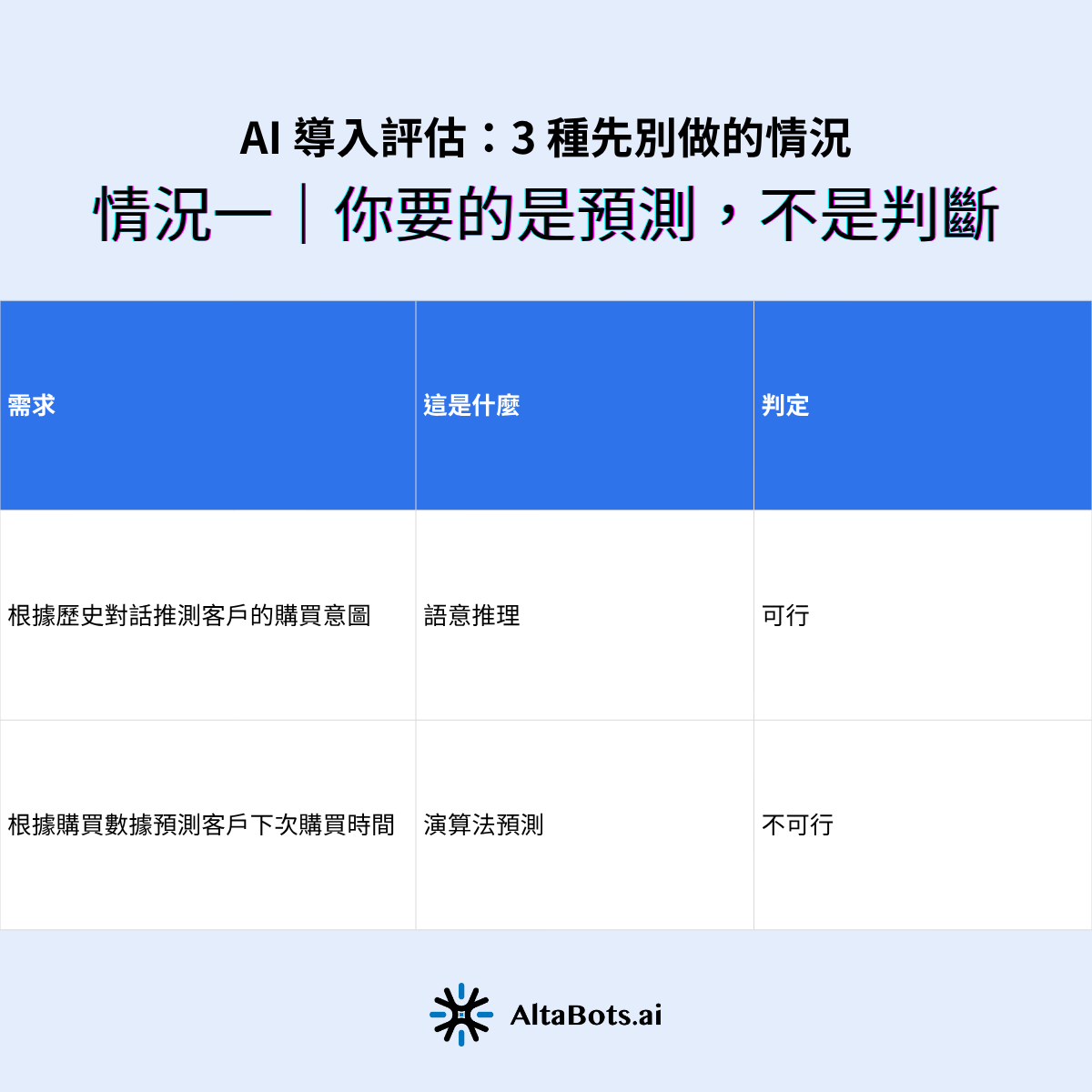
Same customer, same data. The difference is whether the output is "an interpretation" or "a value". An interpretation can be wrong, and when it is, you can tell: you read it, feel the judgment is a bit odd, and go back to check. A wrong value cannot be seen. It is simply treated as fact and used to schedule production, place purchase orders and adjust staffing. This is why the line must be drawn before purchase, not after go-live.
A version we actually met
A contact at a manufacturer asked in a meeting whether we could build a raw material usage forecast for him. Our answer was that we did not recommend it.
This was not about insufficient data or bad timing. The act of forecasting itself should not be handed to an AI Agent. But in the same meeting we offered something else: based on past historical data, organize the patterns and anomalies in usage so he can make his own judgment. The difference is that we do not generate the forecast number. We help him see what was already in the data.
The outcome of that meeting turned out to be more interesting, and we save it for the end of the article.
By the way: specialized recognition tasks are also outside an AI Agent's territory
Besides forecasting, there is another kind of need that should not go to an AI Agent: recognition tasks that are only accurate when a dedicated model is trained, such as production line defect detection, medical image interpretation and circuit board recognition. What this shares with forecasting is not that "the output is a value" but that "a general-purpose LLM never saw what you want it to handle during training". The test is different, but the conclusion is the same.
AltaBots.ai is an Agent layer on top of general-purpose LLMs and does not do model training or fine-tuning. This sentence is a boundary, not a flaw. For which manufacturing scenarios an AI Agent can truly handle, see the scenario review in 2026 Smart Manufacturing AI Agent Adoption Guide.
Case 2 | what you want AI to read does not exist yet
Before organizing the data, confirm the data is there
The second case is a mismatch at the data layer: what the AI Agent needs to process does not yet exist in any system, or exists in a form that cannot be read. This is different from "the data is not organized yet". It is not a timeline issue but a feasibility issue.
Test: does the data exist, and in what form?
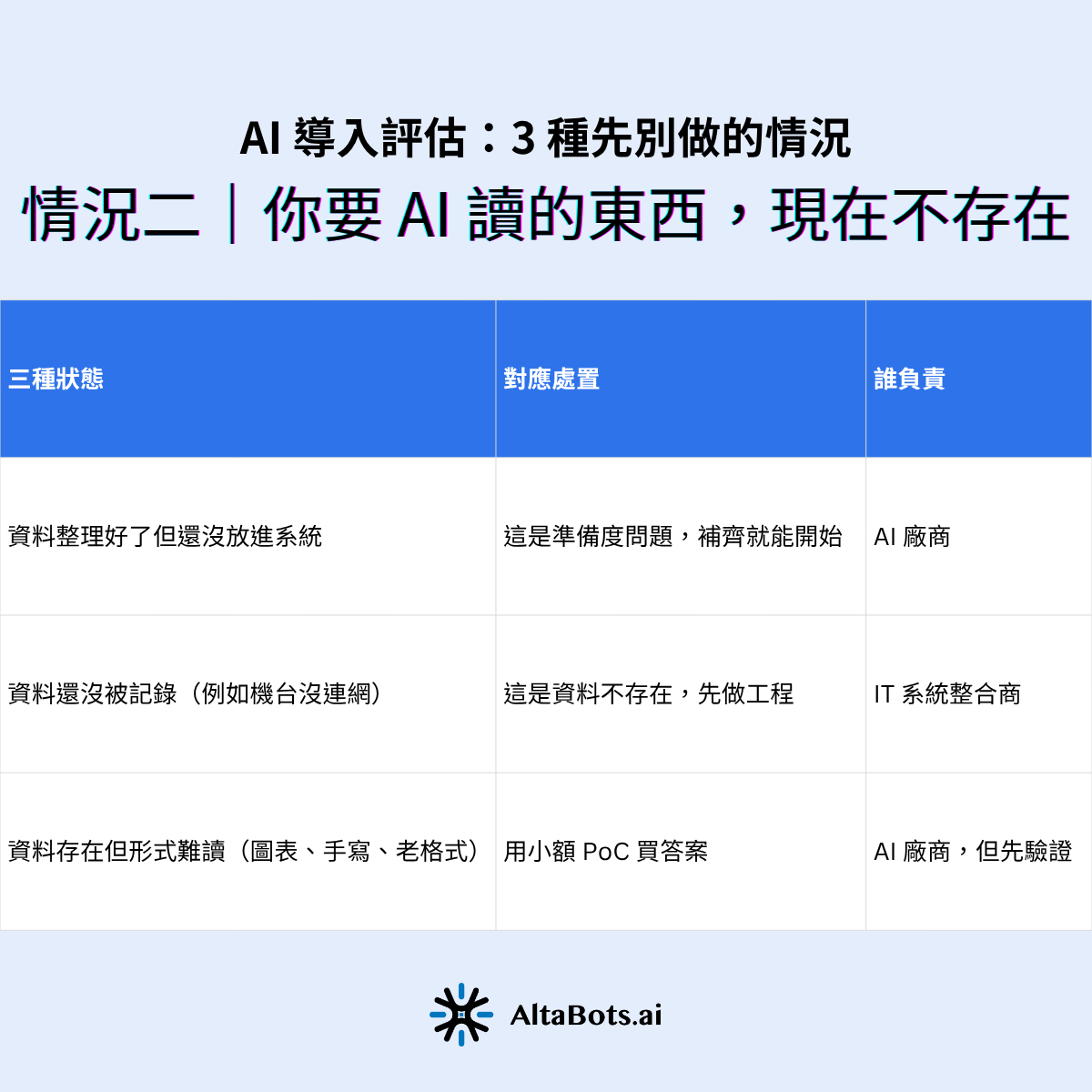
Most readiness checklists ask "is the data organized?", which implies that as long as you invest time in organizing it, you can begin. But before starting there is a more basic question: where is this data now? If it does not exist anywhere it can be read, or exists in a form that cannot be read in, no amount of organizing will produce results.
A version we actually met
Data that does not exist: A manufacturer wanted energy monitoring and hoped AI could interpret abnormal machine energy use. In the assessment we found that only the MES was networked at the plant, and the machines themselves were not yet connected. The real-time current, voltage and load data to feed the AI was never recorded at all. The reasonable path is to first complete machine connectivity, run for three to six months to accumulate data, and then come back to AI interpretation, rather than signing an AI project first and waiting for data to arrive.
If senior management asks, "Can't we sign the AI project first and fill in the data as we go?", a practical answer is: machine connectivity and AI interpretation are two independent phases, each with its own acceptance, and tying them into one contract lets each hold the other back. Going separately is actually faster.
Data that exists but is hard to read: Another manufacturer's contact wanted an internal knowledge base to answer email questions from sales and R&D. The need itself falls into a feasible type, but they had built one with open-source tools before and got stuck on recognition accuracy for images and complex tables. The reasonable path is a small PoC first, feeding in the most typical chart cases to test them.
Way out: three things a small PoC should verify
A PoC does not verify "whether it can produce a result", since an LLM always gives an answer. What to verify is whether the recognition rate on your ten most complex documents passes the threshold, whether the system can flag a wrong answer when it gives one (instead of confidently answering wrongly), and whether speed becomes unacceptable when the data volume grows tenfold.
Put the acceptance criteria into the PoC contract, and do not move to formal adoption if the answers are not right. For the contact, this means an internal proposal with real evidence, not persuading the boss with a vendor's slide deck. Looking back at Gartner's 40% figure, a large part of "runaway costs" and "unclear business value" comes from this red line not being applied before purchase.
Case 3 | the rules are fixed, and no step needs judgment
Mixed processes need AI; pure rules do not
The third case is a mismatch in the nature of the need: if a process is fixed rules from start to finish and no step needs semantic judgment, traditional automation tools are enough. Adding AI only makes something that was stable and cheap expensive and unstable. Of the three red lines, this is the one hit most often in practice, because the word AI can be attached to anything now, and many needs are packaged as AI projects when at heart they fall within what Zapier or n8n do.
Test: does this step require understanding content before deciding?
Walk through the process from start to finish and ask this question at every step.
"You know by matching" looks like this: sales enters an order into Excel, and when Excel is updated, accounting is notified; a customer fills in a website form and a thank-you email is sent automatically; on the 5th of every month the previous month's report is sent to the manager automatically. The rules can be written out: if A happens, do B. Zapier can do these.
"You only know by understanding the content" looks like this: a customer raises something on LINE, so should it go to sales or customer service? Does this email mention product A or product B? The same matter is written differently in the meeting minutes and in the quotation, so which one is right? The rules cannot be fully written, because the content is different every time. This is where AI is needed to judge.
Once you walk through a process, if even one step falls under "needs to understand content", it is within the AI Agent's territory. If not a single step does, Zapier or n8n is cheaper.

A version we actually met
A construction contractor's site log Agent is a typical mixed process. The whole requirement contains two kinds of steps:
Steps that run by rules: each day, check which sites have not yet submitted a log, fill in the day's weather automatically, match progress percentages to work items, and save the log to a database. Ordinary automation tools can run these.
Steps that need understanding of content: messages that field engineers post in a LINE group are usually colloquial, for example "Site 3 rain stopped work for two hours this afternoon". The AI has to recognize from that sentence which site it is, what time period, which type of work item, and how long the rain stopped work, and fill the matching fields. When a field is missing it also has to ask proactively to complete it. The rules for this part cannot be fully written.
If you look only at the first kind, you would think the project does not need AI; if you look only at the second kind, you would think the whole project needs AI. Only the two kinds together make the complete solution. This is also what "some steps do not need AI" means: it does not mean "the whole project cannot be done".
Way out: dividing the work among three kinds of tools
Zapier and n8n are not the same category of tool as AltaBots.ai, and they are not competitors. They handle automation that "runs by rules", while AltaBots.ai handles judgment that "needs understanding of content". Within the same process, the two kinds of tools can be linked through APIs so that each segment uses the most suitable tool. When we advise a client that a process only needs Zapier, we are not handing the business away. We are correcting the purchasing decision to the right tool category and leaving the part that truly needs AI to the tool that should use AI. For the contact, the long-term meaning is that in the third month, when the boss asks "why didn't we just use Zapier for this?", they will have an answer.
After the three red lines, what remains enters formal assessment
Case 1 is a mismatch in the nature of the need, Case 2 is a data layer that does not hold up, and Case 3 is the wrong tool category. If none of the three is hit, the need is worth taking further: data readiness, integration difficulty, timeline and budget, and whether to run a PoC first. The matters readiness checklists ask about are not unimportant; they should simply come after the red lines. For a need that passes the red lines, insufficient readiness is a timing issue; for a need that does not pass them, perfect readiness does not help.
For readers who want to continue to the readiness gate, see 5 Key Risks to Know Before Adopting an AI Agent. That article deals with "already decided to do it, how to avoid trouble", which connects with this one on "whether to do it". If you are comparing several vendors at the same time and feel they all say about the same thing, 5 Delivery Checkpoints for Choosing an AI Agent Consultant has criteria from the delivery side.
What happened to the client we told "this can't be done"
Saying it cannot be done led to something that can
In Case 1 we mentioned a manufacturer who wanted a raw material usage forecast, and after our assessment we told him directly that we did not recommend it. But the story does not end there. We then asked him: what is the original problem you want to solve?
The need he brought to the meeting was written as "a raw material usage forecasting model", but when asked about the original problem, he used a different set of words: do not run out of stock, do not overstock, keep costs from drifting. These three things relate to forecasting but are not the same problem: inventory management has operations research methods, and cost anomalies have a data analysis path, and neither needs an LLM. AI cannot produce a forecast number, but it can do something else: lay out the past five years of usage data, mark when each abnormal swing occurred and which items it corresponded to, and let purchasing see the pattern and make its own judgment. The version that finally went live used data organization and visualization, not an AI Agent. This part is not technically hard. What is hard is being willing to stop in the meeting and ask clearly "what do you actually want", instead of rushing to serve up a solution. The fork where most purchases go wrong is whether this one question gets asked.
There is a view in the market that consultants only hold meetings and results take a long time to show. This reflects the real experience of many buyers, and we do not deny it. If you have this concern, there is a simple check: before signing, did the company first tell you what should not be done? AltaBots.ai is an Agent layer on top of general-purpose LLMs and is strong at workflow orchestration, the combined design of Workflow nodes and LLM nodes. It does not do model training or fine-tuning, does not build forecasting algorithms, and does not take over Zapier's job. This is a boundary we are willing to draw for clients before purchase, and it is the reason the three red lines exist.
Conclusion | this article is itself a demo of this
If you happen to have a need to assess, run it through these three red lines. If you hit any one, this article has already saved you three months and a purchase. If you hit none, that is the need that truly deserves assessment. Data-DI consultants can help you take that need through the rest of the assessment: data readiness, cross-department alignment, PoC scope and go-live timeline.
We call this a feasibility screening. Its purpose is to give both sides a preliminary shared understanding of the project, and we deliver a marked feasibility verdict that you can take straight into an internal proposal. For needs that pass the red lines, we list the smallest feasible starting point: in most cases you can see a first usable version in 3 to 8 weeks, not delivery three months later.
In the contact form, briefly describe your need and attach the result of the three-question self-check (which one you hit, or none of the three). We will reply first with a preliminary judgment, then schedule a free assessment.
Contact us with your self-check results
References

[1] Gartner. "Gartner Predicts Over 40% of Agentic AI Projects Will Be Canceled by End of 2027." Newsroom, 2025-06-25.
https://www.gartner.com/en/newsroom/press-releases/2025-06-25-gartner-predicts-over-40-percent-of-agentic-ai-projects-will-be-canceled-by-end-of-2027
[2] MIT Project NANDA. "The GenAI Divide: State of AI in Business 2025." 2025-07.
https://mlq.ai/media/quarterly_decks/v0.1_State_of_AI_in_Business_2025_Report.pdf
FAQ
FAQs about this article
How is an AI Agent platform different from data analytics and machine learning?

An AI Agent platform is good at workflow orchestration: it lets an LLM step in at the right moment, connect to other systems and hand results back to the process. Data analytics and machine learning are good at finding patterns in numbers, making predictions and classifying. They are different tool categories matched to different vendors, and it is hard for one vendor to go deep on both.
If some steps in the process do not need AI, is it still an AI project?
Yes, and it is very common. In most projects only a small part needs judgment, and the rest running by rules is a normal combination. Giving pure rules to AI is a waste, and pushing what needs judgment into Zapier cannot extract the fields. The value of an AI Agent platform is exactly that it lets the two kinds of nodes connect in one process.
What is the difference between an AI Agent and RPA? When should I use which?
RPA (robotic process automation) belongs to the same category as Zapier and n8n: repetitive actions whose rules can be fully written, triggered by conditions. An AI Agent handles judgments whose rules cannot be fully written: reading a piece of text, recognizing meaning and deciding the next step from the content. Both can coexist in one process: steps that run by rules go to RPA or an automation tool, steps that need judgment go to the AI Agent, and they are linked through APIs. Case 3 has the full way of judging this.
We are a small or mid-sized business. Do we need this kind of assessment too?
Yes, and even more so. A large company that goes wrong once still has the budget to start over, but for a small or mid-sized business, a wrong direction in its first AI purchase usually means there is no second one. Checking the three red lines needs no technical background; five minutes can rule out the needs that should not be done and keep the limited budget for the one that will produce results.
If I hit none of the three cases, what should I look at next?
The readiness gate: data readiness, department alignment, timeline and budget, whether to run a PoC first, and how to evaluate vendors. We have two other articles on these topics; search for "5 Key Risks to Know Before Adopting an AI Agent" and "5 Delivery Checkpoints for Choosing an AI Agent Consultant".
More articles


訂閱我們的電子報
每月 8 日定期發送最新趨勢與實用資訊!



