

2026 AI customer service trends: accuracy to resolution | Alta.DI
In 2026, Taiwan's AI customer service evaluation has moved from accuracy to autonomous resolution. This article compiles the latest Gartner and Zendesk data and three trends, with a selection checklist. Book a free 30-minute health check to talk it through.


The main thread of Taiwan's AI customer service trends in 2026 is that the focus of evaluation has moved from "are the answers accurate" (accuracy) to "did the job get finished" (autonomous resolution rate), while the line between humans and AI and AI transparency have become hard criteria in selection.
If you evaluated AI customer service in 2024 or 2025, the core question then was probably "will it get things wrong?" In 2026 that question has not gone away, but it is no longer enough. Most platforms on the market can now answer common questions correctly. What really separates them is whether the AI can finish tasks like checking an order, changing a booking or opening a ticket on its own, and, when it cannot, how smooth the handoff to a person is.
This article is for business decision-makers and customer service managers who are re-evaluating AI customer service. It starts with the key differences between 2026 and last year, then sets out three trends with the matching international data, and ends with a capability checklist you can take straight to vendors.
1. How is AI customer service in 2026 different from last year?
In one sentence: in 2025, AI customer service competed on "answering," and in 2026 it competes on "resolving." That is a paradigm shift from generative AI (producing correct answers) to agentic AI (completing tasks autonomously).
This is not vendor talk but a clear prediction from a research firm. Gartner states that by 2029, agentic AI will autonomously resolve 80% of common customer service issues without human intervention, bringing about a 30% reduction in operating costs [1]. In other words, over the next three years the competition in customer service will not be about whether AI sounds human, but about whether it has the permissions and ability to handle a matter from start to finish.
Taiwan's market maturity has kept pace with this turn. According to the AI Foundation (AIF) 2026 Taiwan Industry AI Adoption Survey, the AI adoption index of Taiwan companies rose from 36.77 the previous year to 46.32, companies at the Ready AI and Scaling AI stages together reached 47.8%, and only 26.8% of companies still know nothing about AI [2]. This suggests your peers have probably adopted AI already or are doing so. In 2026 the question is no longer "whether to use AI customer service" but "what standard to choose by, and how to divide the work once chosen."
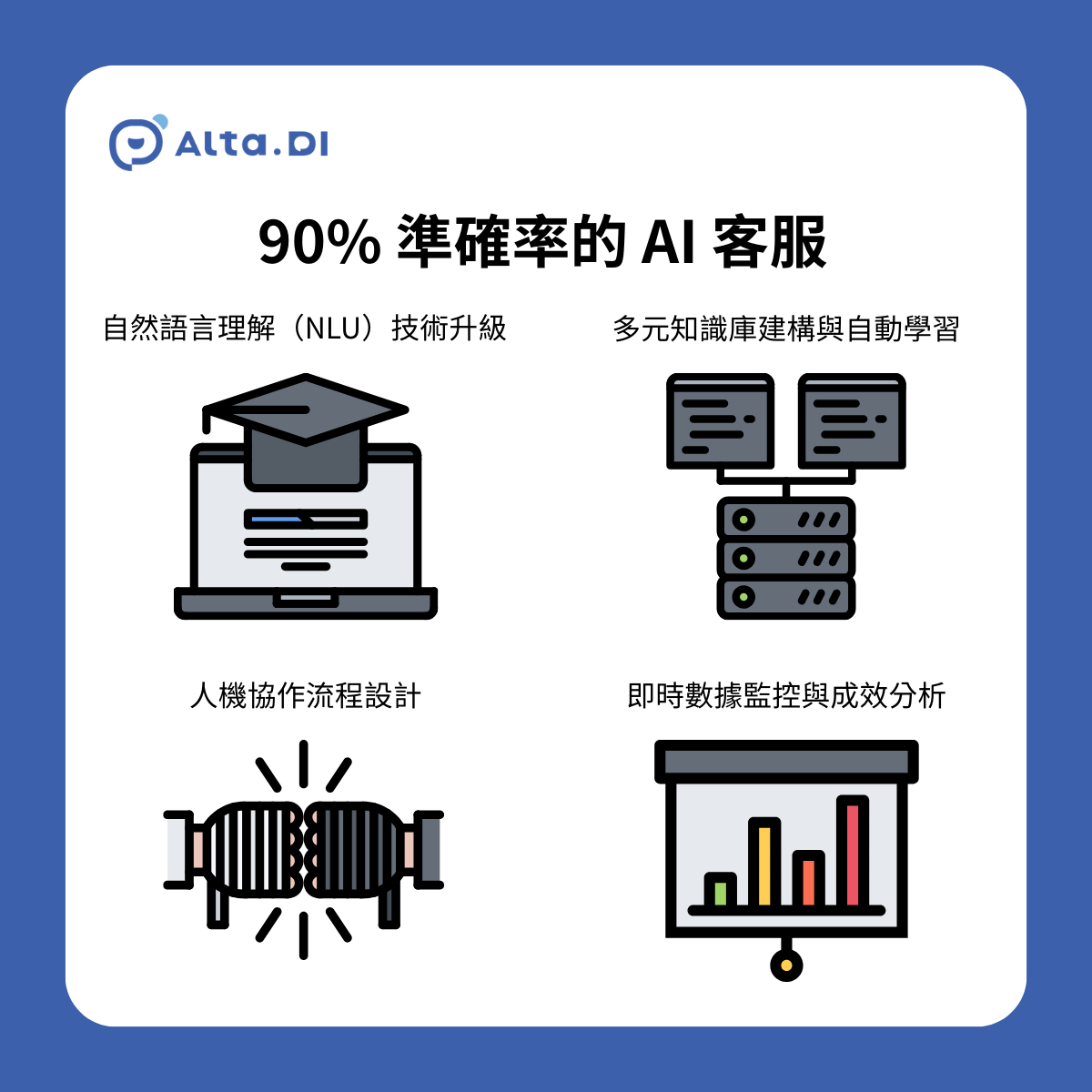
2. Beyond 90% accuracy, which metrics matter?
Accuracy still matters, but in 2026 its role is an "entry ticket" rather than the "finish line." Accurate answers only mean the AI does not make things worse; they do not mean the customer's problem is solved. An AI that answers correctly but makes customers check their orders in the back office every time, and an AI that brings up the order status, tracking number and estimated delivery date in one go, may have the same accuracy, yet the experience and cost are two different worlds.
So for 2026 we suggest expanding the evaluation dashboard from a single accuracy figure to a set of metrics:
Of these, "does it make things up when wrong" deserves a particular explanation. Generative AI has an inherent chance of inventing an answer when retrieval finds no data, and in customer service every sentence is a brand commitment. Quoting the wrong shipping fee or the wrong warranty terms costs far more than not answering. So when evaluating answer quality in 2026, the question is not "will it be wrong" (it will), but "how does the system catch it when it is wrong": is there a mechanism that switches to a designated script when no answer is found, and a rule that automatically hands uncertain questions to a person?
For how to set baseline values for FRT and SLA and what a reasonable range is for each channel, we have a full comparison in "What is an SLA? Understanding 2026 customer service FRT benchmarks and attainment rates" that can be used with this table.
3. What are the three trends most worth watching in the second half of 2026?
Trend 1: AI moves from "answering questions" to "getting things done"
What agentic AI means in practice is that AI customer service starts taking over multi-step tasks: looking up order data on e-commerce platforms, guiding the return and exchange process, and creating and routing tickets automatically, instead of replying "please contact a service representative." Gartner's 2029 forecast of an 80% autonomous resolution rate rests on exactly this kind of task capability becoming widespread [1]. The implication for companies is direct: when evaluating a platform, do not test only Q&A; test whether "a task can be completed." For example, have the AI actually run a return inquiry and see which step it breaks at.
Trend 2: the line between humans and AI is redrawn, and "unattended customer service" cools off
The counter-signal most worth noting in 2026 is the market's correction on "fully replacing people." In February 2026 Gartner predicted that by 2027, half of the companies that cut customer service staff because of AI will rehire them, under different job titles [3]; the firm also observed that companies that have actually reduced customer service headcount because of AI are still a minority. This does not mean AI is useless. It means the question of "which tasks go to AI and which step must keep a person" matters more than expected. In practice we suggest drawing the line by "reversible vs irreversible": reversible actions such as inquiries and status notifications can be handed to AI with confidence, while irreversible decisions such as refunds and compensation keep a person in charge. For the full method of drawing the line, see "Can after-sales customer service be handed to AI?".
Trend 3: transparency and memory become customers' trust threshold
Zendesk's CX Trends 2026 surveyed more than ten thousand consumers and customer service decision-makers worldwide and drew three key signals: 63% of customers say their demand for transparency is higher than last year; 74% of customers are frustrated by having to repeat themselves when they switch to a different agent; and 83% of customer service decision-makers believe AI with memory and context is the key to personalized service [4][5]. In plain terms: in 2026 customers want the AI to be correct, want to know on what basis it answered, and do not want to introduce themselves again. The same survey revealed another threshold, which is that service entry points are becoming multimodal: among high-maturity companies, 93% of AI customer service can already handle at least one non-text medium (images, voice, video), compared with only 54% among low-maturity companies [4].
When a customer sends a photo of a damaged product, whether the AI can understand it is becoming a dividing line in the experience. For selection, this means "how an answer was produced" must be traceable and auditable, and conversations and customer data across channels must really be connected, not one separate set per channel.

4. Facing these three trends, which platform capabilities should a company check?
Translating the trends into procurement language gives three capability checklists. Below, the approach of Alta.DI, a channel-agnostic AI customer service platform, serves as an example for comparison, and you can ask any platform you evaluate the same set of questions.
First: can tasks be completed?
A customer asks "Where is my order?" Does your AI customer service reply "please provide your order number and contact a service representative," or bring up the tracking number and estimated delivery date directly? The difference lies in whether the platform has a layered automation architecture.
Alta.DI's approach is a three-layer routing of FAQ bot, Flow Bot and AI Bot: standard questions go to the FAQ, multi-step processes (parcel lookups, member services, return and exchange guidance) go to the Flow Bot, and open-ended questions go to the AI Bot combined with a RAG knowledge base, which then connects to order and product data from e-commerce channels such as Shopify and Shopline, so that "checking an order" really returns results. For which situations each of the three bots suits, see "FAQ / Flow / AI Bot selection guide".
Second: is the human handoff smooth?
A customer asks a return question on LINE in the evening. Partway through the guidance the AI finds it needs a person's judgment. Can the agent who picks it up the next morning see the earlier conversation, or does the customer have to repeat everything?
Alta.DI brings messaging channels such as LINE, Facebook Messenger, Instagram, website LiveChat and WhatsApp together in a single workbench, and context follows the conversation on transfer, so the customer does not have to start over. This addresses exactly the point that frustrates 74% of customers in the Zendesk survey [5]. For the complete steps of full-channel integration, see "How to do omnichannel integration? A 5-step AI customer service OMO guide".
Third: can answers be verified?
If your boss asks, "AI customer service has been live for three months. Is it actually working?", can you answer? Behind this are two things: "what happens when the AI cannot find an answer?" and "how do I track its performance?"
The first looks at the guard mechanism: Alta.DI can set a default reply script, so that when the AI retrieves no knowledge it responds with the designated script and does not invent an answer. The second looks at whether daily operations form a cycle: the customer service manager first uploads product manuals and return and exchange rules to the knowledge base, sets reply rules and handoff conditions for each channel in Agent Settings, then tests in Playground with real questions, running one round each of brand inquiries, purchases and after-sales, and confirms answer quality before launch. After launch, each week they open "Analytics" for conversation statistics, FRT and resolution rate by time period; go to "Enhanced Training" to review which replies need correcting one by one; and when a systematic evaluation is needed, use Evaluation to run a round on the agent's output quality. Everything from building the knowledge base to tracking results is done in one back end, so when the boss asks there are numbers to answer with.
5. Where should a company start now?
After reading the trends, you may be standing at a choice point: wait and see for half a year, or use the second half of the year to get your customer service in shape? From a rollout consultant's perspective, our suggestion is not to rush to sign with a platform, but it is worth doing three low-cost things first.
First, take stock of existing customer service conversations: find the 10 most repeated question types (for example by classifying by keyword or topic), and mark which are "reversible and automatable." This list directly decides the scope of the AI's first tasks. Second, measure the current baseline: record today's FRT, transfer rate and off-hours missed volume, so that later you can verify whether the AI actually solved problems. Third, test vendors with real scenarios: take your own return process or order inquiry as the test, ask them to walk through the whole thing live, and watch for breakpoints and handoff quality.
Every company gets stuck in a different place: some in scattered channels, some in knowledge base quality, some in no agreement on the division of work between humans and AI. If you want to clarify where to begin, Data-DI offers a free 30-minute AI customer service health check, in which a consultant reviews your current customer service process, tool setup and the entry points most likely to show results first, and gives recommendations for your actual situation. You do not need to prepare data first; tell us your industry and the channels you use today.
References

[1] Gartner. (2025.03). Gartner Predicts Agentic AI Will Autonomously Resolve 80 Percent of Common Customer Service Issues Without Human Intervention by 2029. Gartner Newsroom.
https://www.gartner.com/en/newsroom/press-releases/2025-03-05-gartner-predicts-agentic-ai-will-autonomously-resolve-80-percent-of-common-customer-service-issues-without-human-intervention-by-20290
[2] AI Foundation (AIF). (2026.04). 2026 Taiwan Industry AI Adoption Survey (in Chinese). AIF official website.
https://aif.tw/event/ai-research/
[3] Gartner. (2026.02). Gartner Predicts Half of Companies That Cut Customer Service Staff Due to AI Will Rehire by 2027. Gartner Newsroom.
https://www.gartner.com/en/newsroom/press-releases/2026-02-03-gartner-predicts-half-of-companies-that-cut-customer-service-staff-due-to-ai-will-rehire-by-2027
[4] Zendesk. (2025.11). Contextual Intelligence Becomes the New Standard for Exceptional Customer Experience in 2026. Zendesk Newsroom.
https://www.zendesk.com/newsroom/press-releases/contextual-intelligence-becomes-the-new-standard-for-exceptional-customer-experience-in-2026/#georedirect
[5] Zendesk. (2026.04). Zendesk CX Trends 2026. Zendesk CX Trends official website.
https://cxtrends.zendesk.com/
FAQ
FAQs about this article
What is the most important AI customer service trend in 2026?

The focus of evaluation has shifted from accuracy to autonomous resolution rate, meaning whether the AI can complete the task in full. At the same time, the line between humans and AI and AI transparency have replaced single-figure accuracy as the core selection criteria for companies in 2026.
How does autonomous resolution rate differ from accuracy?
Accuracy measures whether the AI answers correctly; autonomous resolution rate measures the share of problems the AI finishes without handing to a person. A correct answer that does not solve the problem still loses customers, so in 2026 the two need to be read together.
Will AI replace human customer service agents?
Not entirely. Gartner predicts that by 2027, half of the companies that cut customer service staff because of AI will rehire. A reasonable approach is to give reversible inquiry work to AI and keep people in charge of irreversible decisions such as refunds.
Which metrics should I watch when evaluating an AI customer service platform in 2026?
We suggest five: answer accuracy and guard mechanisms, autonomous resolution rate, first response time and SLA attainment rate, whether full context is kept when transferring to a person, and whether the answer generation process can be traced and audited.
Where should I start when adopting AI customer service?
First take stock of the 10 most repeated customer service question types, measure your current response-time baseline, then test vendors with your own real processes. Confirm the scope of the first automatable tasks before deciding on a platform.
More articles


訂閱我們的電子報
每月 8 日定期發送最新趨勢與實用資訊!



