

Cross-border AI customer service: accurate beats fast | Alta.DI
In cross-border e-commerce, AI customer service succeeds by giving correct answers, not fast ones. This article breaks down three design layers: factual accuracy, contextual accuracy and when to hand off to a person. It covers EU AI Act and Taiwan AI Basic Act transparency requirements, with a real conversation example.


Summary
The most common myth when cross-border e-commerce adopts AI customer service is treating "fast replies" as doing well. When customers are spread across countries and channels such as Facebook, WhatsApp and Email, what decides whether they stay is "answering correctly": factually correct, able to pick up the context, and knowing when to hand off to a person. This article breaks down the three layers of correct answers in cross-border AI customer service, and the trust design behind them.
Introduction
Getting cross-border AI customer service right depends not on how fast it replies but on whether it answers correctly: the answer must be factually correct, fit the customer's situation at that moment, and know which questions to hand back to a person.
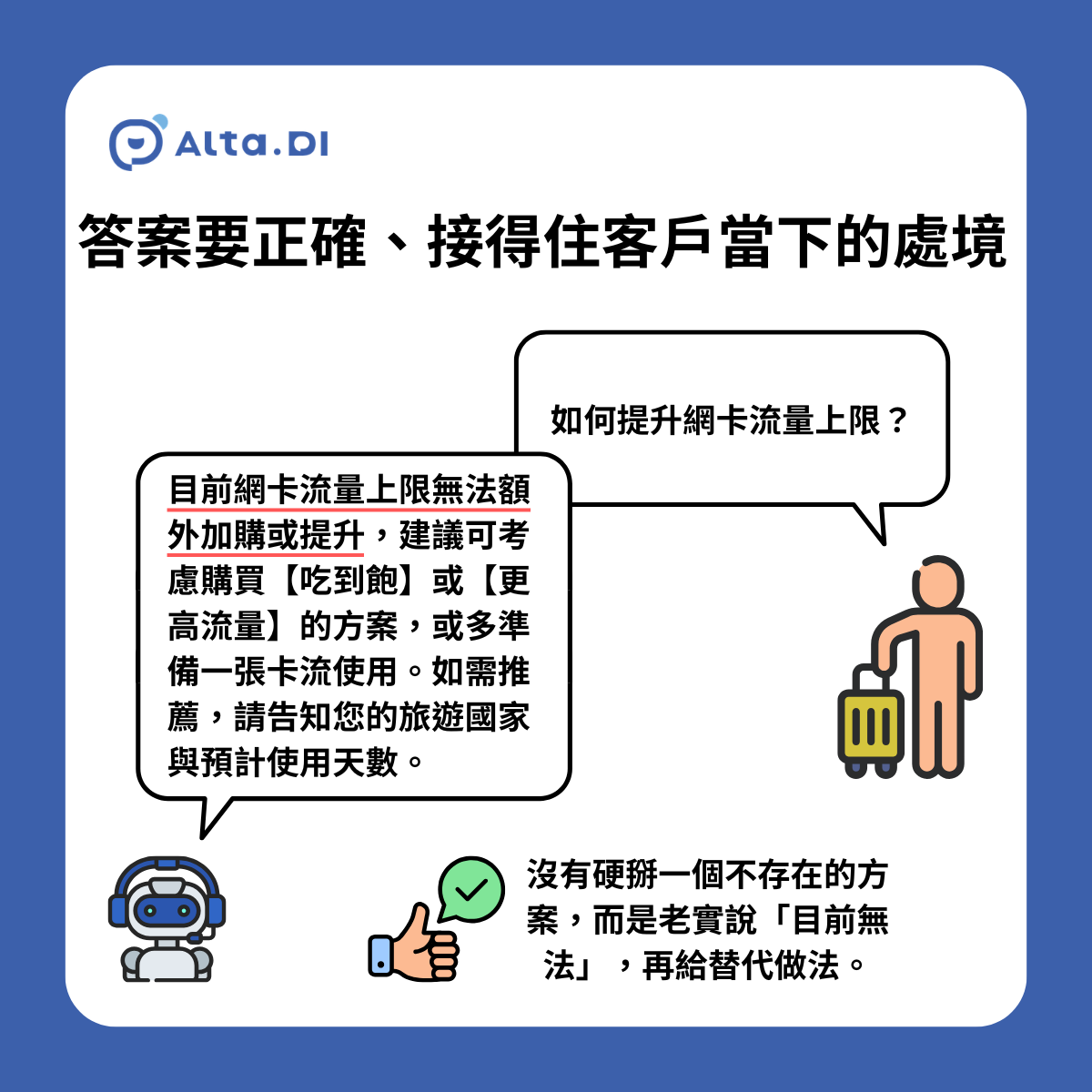
A real customer service conversation makes this easiest to explain. A traveler abroad sent a Facebook message to the service assistant of a cross-border eSIM brand: "My family member's eSIM hit its data cap. Why can they still get online?" The question looks simple, but it is where many AI customer service systems answer wrong or gloss over the point. The assistant replied that after the cap is reached the speed is usually throttled but the connection is not cut, so they can still get online, only more slowly. When the traveler then asked whether they could buy more to raise the cap, it did not invent a plan that does not exist. It honestly said "not available for now," and then gave an alternative. (Source: Alta.DI customer service conversation example)
What matters is that every sentence it gave was right, and that is exactly what this wave of AI customer service in 2025 lacks most. Over the past year companies rushed to automate customer service, and quite a few deployments produced more going in circles and repeated explanations. The problem usually is not the AI but a trade-off: putting response speed ahead of solving the problem. For cross-border sellers the cost is higher, because your customers speak different languages, live in different time zones and reach you through different apps, and a single wrong answer often means a lost order across the sea.
This article answers: what does "answering correctly" mean for cross-border AI customer service? It breaks into three layers, factual accuracy, contextual accuracy, and knowing when to let go. It also covers how, when selling into different markets, to make customers who are doubtful about AI willing to hand their questions to it.
Break one myth first: your cross-border customers are not split by age but by "whether they trust AI"
Key point of this section: segment by trust in AI, not by age
Whether a customer is willing to use AI customer service depends mainly not on age but on how much they trust AI. Within the same age group, some are happy to let AI handle things and some only want a person.
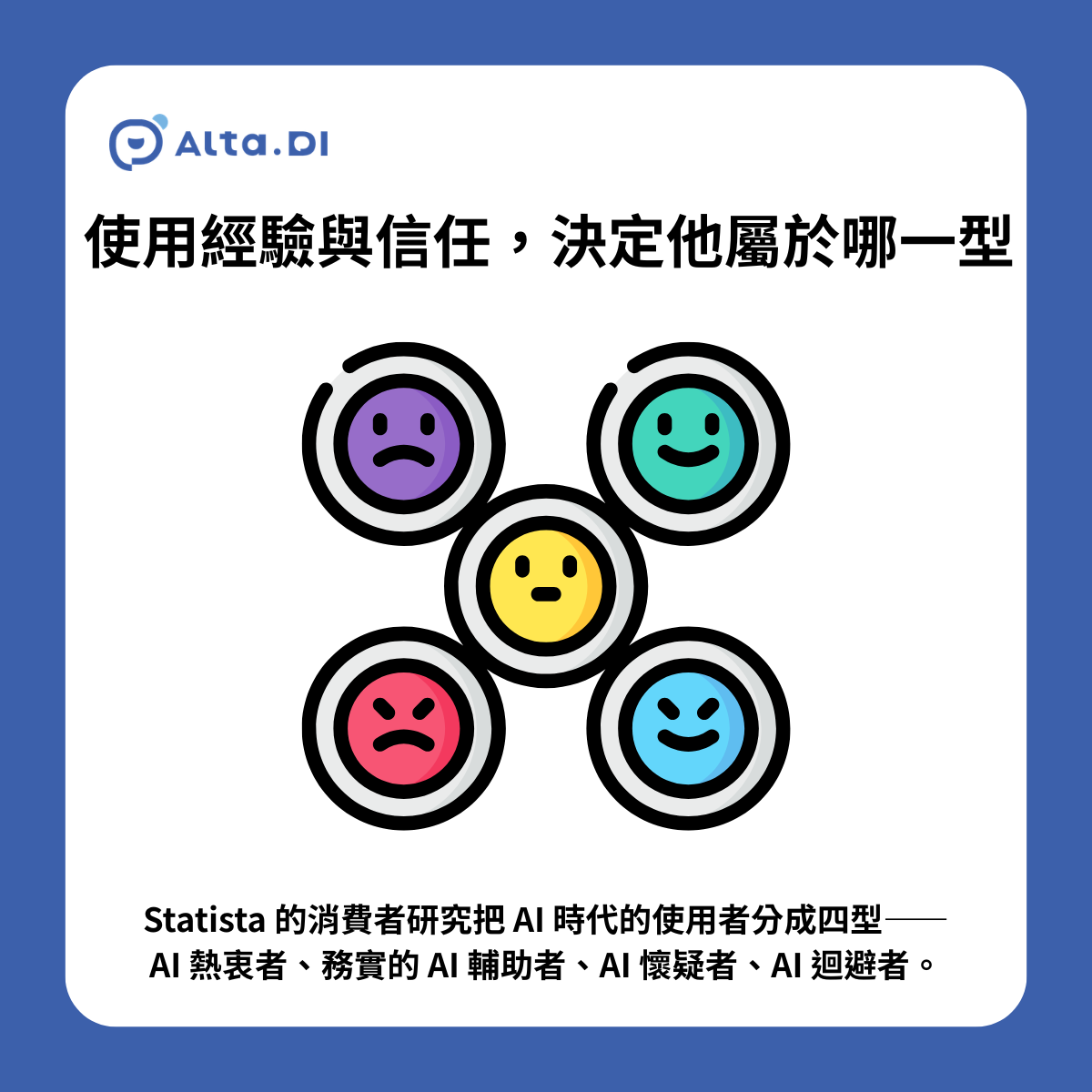
When many brands segment cross-border customers, the first move is to split by age: young customers to AI, older customers kept for people. In 2026 that assumption no longer holds. Statista's consumer research divides users in the AI era into four types: AI enthusiasts, pragmatic AI-assisted users, AI skeptics and AI avoiders. What decides the type is experience and trust, not birth year [1]. A sixty-year-old business owner may use AI every day to look things up, while a customer in their twenties may insist on a human reply. We wrote last year about Three Misconceptions About Gen Z and AI Customer Service, and the point is the same: do not treat a demographic label as the answer.
So rather than agonizing over "how old is this customer, and should they get AI," the better question is: whether or not they trust AI, was this reply correct? A person skeptical of AI will relax after a few correct, fitting answers in a row. Conversely, even the biggest AI fan will turn away after being tripped up by one wrong answer. Answering correctly is the only password that works across the whole spectrum of trust.

Why do customers get more dissatisfied as AI customer service gets more automated?
Key point of this section: more complaints are not the AI's fault; chasing speed has outweighed chasing resolution
Dissatisfaction with AI customer service mostly does not come from using AI, but from a system designed to end conversations as quickly as possible rather than solve the problem. Replies come fast but nothing is resolved, so customers have to ask again and again.
Look at the facts first. Over the past year companies automated heavily, and the results are real: Shopify research shows AI can now handle about 30 to 40 percent of standard customer service before a person steps in, for questions such as shipping status, return rules and payment confirmation [2]. But customer frustration is building too. Glance's 2026 survey found that about three quarters of consumers feel frustrated with AI customer service, citing more going in circles, more dead ends and more repeated explanations. In the same survey, nearly nine in ten people said their loyalty to a brand would fall if it removed human support altogether [3].
The problem lies in a wrong orientation that is easily rewarded: treating response speed as the main metric. When a team watches average response time and conversation closure rate, the AI gets tuned to end conversations by the shortest path: dropping an FAQ link, giving a canned answer, quickly marking the case resolved. The numbers look great on the surface, but the customer's problem is not solved, so they rephrase and ask again, and the same issue gets "quickly handled" three times. Customers say it clearly themselves: in Glance's survey, 68% said the most important thing in a service interaction is that "the problem is fully resolved," not a fast reply [3]. And Adobe's 2026 survey found that 37% of consumers who expected to reach a person but found themselves talking to an AI would end the interaction with the brand outright [4].
Switch to "resolution rate first" and the design changes: the AI must first judge whether it can answer correctly, and if it cannot, hand off to a person cleanly and accurately, rather than forcing out an ambiguous answer to get rid of the customer. The metrics to watch also change: first-contact resolution rate, and whether the case is truly resolved after handoff, rather than how fast a conversation gets closed.
For cross-border sellers, this difference is magnified. Your customers are in other time zones and speak other languages, and they will not patiently ask the same question three times. They are more likely to close the shopping cart and go find a competitor who answers clearly. So the real question is not "is the AI fast enough," but "did it actually resolve things this time."
What "answering correctly" really means: factually correct x contextually correct
Key point of this section: answering correctly = saying what is true + fitting your situation
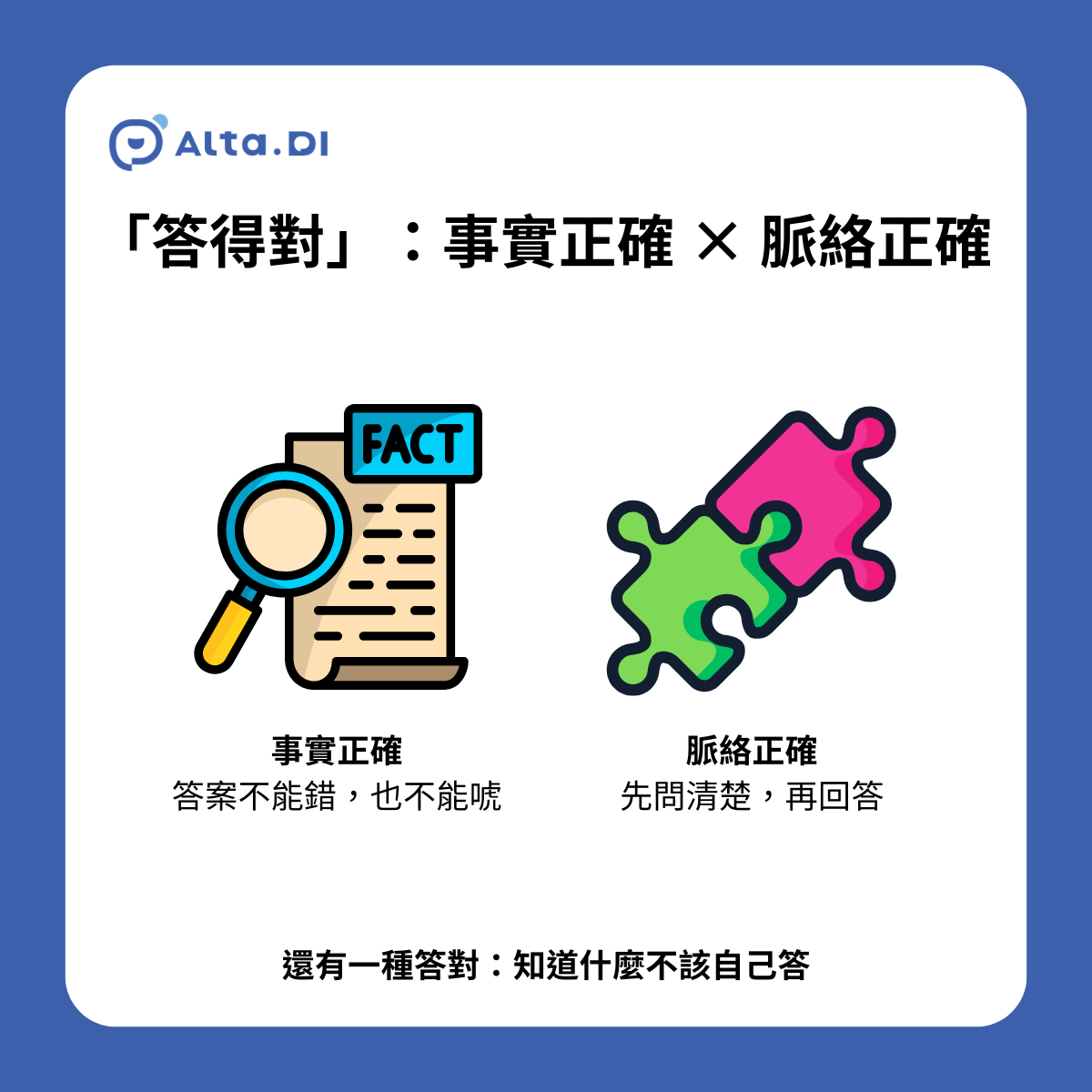
"Answering correctly" has two conditions, and neither can be missing. One is factual correctness: the answer itself is not wrong and was not made up by the AI. The other is contextual correctness: the answer fits the customer's situation and needs at that moment. Without either one, no reply counts, however fast.
Factually correct: the answer cannot be wrong, and cannot be bluffed
This means the answer cannot be wrong and cannot be invented by the AI. Back to the eSIM brand's conversation: when the customer asked "why can I still get online after hitting the cap," the assistant gave the correct explanation (throttled, not cut off) rather than glossing over it. More importantly, when the traveler asked "can I buy more to raise the cap," it did not invent a plan to keep the conversation going. It honestly admitted "not available for now," then gave an alternative. This condition covers not only "answering correctly what it knows" but also "admitting when it does not know."
This matters especially in cross-border service. The usage rules of e-tickets, customs thresholds and return windows often differ by country, and a wrong answer on one policy often brings not a complaint an apology can settle but a return order. What makes an AI do this reliably is RAG: letting it answer only from the official knowledge you upload, and say plainly that there is nothing when it cannot find anything, rather than improvising from impression.
Contextually correct: ask first, then answer
The second condition is that the answer fits the customer's situation "at this moment." The same question, "which eSIM is better," has completely different answers depending on which country, how many days and how many people. Before giving a recommendation, the eSIM brand's assistant first asked back, "Which country are you traveling to, and for how many days?" It asked first and answered after, rather than handing over a generic list. This step is the dividing line between "precise" and "vague."
Cross-border service has another layer of context that is easily missed: customers do not neatly finish what they have to say in one place. They may ask halfway on Facebook, follow up the next day on WhatsApp, and add one more line by Email. If the AI treats them as a stranger at every channel switch and makes them start over, the context breaks. In Zendesk's 2026 survey, 74% of consumers said repeating the same thing to different service agents frustrates them [5]. The approach that truly holds the thread is to let the customer's identity, conversation history and order status follow them across channels: when they change platforms, the AI does not change its memory.
Another kind of correct answer: knowing what not to answer yourself
Sometimes "answering correctly" means "knowing you should not answer." For low-risk, reversible questions such as checking an order, recommending a plan or explaining a policy, handing them to the AI is fast and reliable. But for refunds, return disputes and highly emotional complaints, situations that are hard to undo once handled wrongly, the right move is to hand off to a person cleanly rather than have the AI take it on reluctantly. Telling where that line is, and passing the right question to the right person at the right moment, is itself part of answering correctly.
Making doubtful customers willing to accept it: say things in the open
The last piece is for customers who have doubts about AI. Under every AI reply from the brand above, there is a "source" marker, and customers can click through to see what the answer is based on. That small step earns trust: Zendesk's 2026 survey shows that 95% of consumers want to know why an AI made a given judgment, and demand for transparency is more than 60% higher than a year earlier [5]. When the source of the answer, and the fact that "you are talking to an AI," are stated openly, people who were doubtful become more willing to hand over their questions.
For cross-border sellers, disclosure has also moved from "considerate" to "compliance." Article 50 of the EU Artificial Intelligence Act takes effect on August 2, 2026. It requires AI systems that interact directly with people, including customer service chatbots, to let users know they are talking to an AI, and its scope extends beyond the EU to any business serving EU customers [6]. In Taiwan, the Artificial Intelligence Basic Act took effect in January 2026 and lists "transparency and explainability" as one of its seven principles. It does not currently impose immediate obligations on private companies the way the EU does, but the direction is clear [7]. Building transparency in early is the way to save trouble later.
Factual accuracy and contextual accuracy are the two core elements of answering correctly. Add knowing when to let go and laying the basis of the answer in the open, and you have a complete AI customer service that customers can trust. Next, let us look at how Alta.DI turns these into features you can configure and operate.
How Alta.DI turns "answering correctly" into configurable features
Key point of this section: the knowledge base blocks errors, follow-up questions fill in context, all channels share memory, and data diagnostics keep fixing it
Getting an AI to answer correctly reliably cannot depend on luck. The platform has to turn each condition into a feature you can configure and operate. The Alta.DI AI customer engagement platform is designed on this logic.
First, factual accuracy. Alta.DI lets you upload your own official knowledge in formats such as PDF, Excel, CSV and URLs, and build a dedicated AI knowledge base; when the AI answers, it uses a RAG architecture and answers only from this content, saying plainly that there is nothing when the database has no answer. This is exactly what let the eSIM brand honestly say "the cap cannot be topped up for now": answer when there is data, do not invent when unsure.
Next, context. Alta.DI has a built-in follow-up question mechanism, so you can set the AI to ask for key information before it recommends or decides, such as travel country and number of days, avoiding a generic list that does not fit the case. For the customer's situation across channels, the customer center takes over: it gathers each customer's basic data, conversation history, order trail and behavior tags on one customer information card, with conversations stored permanently and summarized automatically by AI. So whether a customer comes in from Facebook, WhatsApp, Instagram or Email, you are facing the same person with a memory, and do not have to ask again each time. For cross-border brands whose customers are spread across countries and platforms, this matters especially.
As for "knowing what not to answer yourself," Alta.DI divides the work across three layers: Flow bot, AI bot and human agents. Standard processes and common questions go to bots (about 90% can be shared, per official figures), while keywords such as refunds and disputes trigger an automatic handoff to a person, keeping human effort for situations that truly need judgment.
Finally, making correct answers "last." Customers will always ask new questions the knowledge base does not yet cover, so correct answers cannot be a one-time thing. Alta.DI's data analytics platform automatically classifies and tags conversations and finds the knowledge blind spots where the AI answered poorly, so you can go back and add them to the knowledge base. Answering correctly then becomes a self-correcting cycle rather than something fixed at launch.
For these features to work, the key is "setting them up right." Alta.DI does not end when it hands you the tool; it uses a five-week consultant-led rollout: from listening to your needs, through building the knowledge base and workflows and checking results, to system launch and follow-up improvement, the team works alongside cross-border brands to tune the AI until it answers correctly. If you need more complex, cross-system automated workflows, you can extend with AltaBots.ai, the enterprise AI Agent platform.
Conclusion: ask "is it correct?" First, then "is it fast?"
Whether cross-border service should use AI has long stopped being the question. What truly sets companies apart is whether this AI answers correctly. Get factual accuracy, contextual accuracy, knowing when to hand a question back to a person, and showing the basis of answers to customers all in place, and even customers skeptical of AI will gradually hand over their trust. If you cannot, replying faster only pushes people away faster.
If you are competing for orders in cross-border markets, you might start by checking one small thing: pick a few of the questions most often asked and most often answered wrongly, and see whether your current service, human or AI, answers them correctly every time. This step is often the starting point for turning cross-border customer service from a cost center into a driver of repeat purchases. To see how this works in practice, refer to How a Cross-Border E-Commerce Team Went from Burnout to Automated Customer Service.
If you want to tune your own AI customer service to answer correctly, you are welcome to book an Alta.DI product trial, or simply talk with a consultant about your cross-border scenario.
References

[1] Statista (2026). Consumer Trends 2026: Decoding AI Consumers.
https://www.statista.com/business/ai-consumers-whitepaper-report
[2] eDesk (2025). 100+ eCommerce Customer Service Statistics(citing Shopify research).
https://www.edesk.com/blog/ecommerce-customer-service-statistics/
[3] Glance (2025). 2026 CX Trends Report.
https://www.glance.cx/blog/75-of-consumers-left-frustrated-by-ai-customer-service
[4] Adobe (2026). 2026 AI and Digital Trends Report.
https://business.adobe.com/resources/digital-trends-report.html
[5] Zendesk (2026). CX Trends 2026.
https://cxtrends.zendesk.com/
[6] EU Artificial Intelligence Act, Article 50: Transparency Obligations.
https://artificialintelligenceact.eu/article/50/
[7] Ministry of Digital Affairs (2025). Press release on the Legislative Yuan's third-reading passage of the Artificial Intelligence Basic Act (in Chinese).
https://moda.gov.tw/press/press-releases/18316
FAQ
FAQs about this article
How does cross-border e-commerce AI customer service differ from ordinary AI customer service?

Cross-border AI customer service has three more things to handle: customers spread across time zones and countries, different channels such as Facebook, WhatsApp and Email, and different rules and languages in each country. That means it must not only reply fast but also remember the same customer across channels and give factually correct answers for each market, which is harder than customer service for a single market.
Can AI customer service give wrong answers or make things up (hallucinate)? How do you prevent it?
Yes. If the AI is left to generate answers freely, it can invent content that sounds plausible but is wrong. The way to prevent this is a RAG architecture, which has the AI answer only from the official knowledge base you upload and say plainly that it has nothing, or hand off to a person, when it cannot find an answer, rather than piecing one together. The more complete the knowledge base is kept, the lower the chance of wrong answers.
If customers abroad ask questions through Facebook, WhatsApp and Email, can AI customer service keep up?
Yes, provided the platform supports all-channel integration and context carries over across channels. When a customer's identity, conversation history and order data sit in one place, the AI faces the same person with a record whichever channel they come in from, and they do not have to explain from the start each time. This matters especially for cross-border brands whose customers are spread over several platforms.
Can multilingual AI customer service be done? Will the answers lose their tone?
AI customer service built around a large language model can reply to customers in multiple languages. Whether answers lose their tone depends not on translation but on the source of facts and tone settings: as long as answers come from the same official knowledge base and the tone is adjusted for the brand and market, customers in different languages get the same accurate information. Where needed, you can still set handoff to a person for specific languages or situations.
Which questions should the AI answer, and which should go to a person?
Low-risk, reversible questions suit the AI, such as checking orders, explaining policies and recommending plans. Situations involving refunds, disputes or heightened emotions should go to a person. The rule of thumb is simple: if a wrong answer is hard to undo, hand it to a person. A good platform can use keyword or intent detection to hand off automatically at the right moment.
More articles


訂閱我們的電子報
每月 8 日定期發送最新趨勢與實用資訊!



