

AI customer service for tutoring centers, 24/7 | Alta.DI
Late-night inquiries go unanswered and admin staff are tied up by repeated questions? Alta.DI AI customer service brings LINE and Messenger together, RAG keeps course and tuition answers free of errors, and the entry plan costs under NT$10,000, going live in as little as 1-2 weeks. Book a free consultation.


AI customer service for the education industry is an intelligent customer service system that combines natural language processing with knowledge base retrieval (RAG). Designed for tutoring centers (buxiban), language centers and training institutions, it replies automatically 24 hours a day, recommends courses by the student's level, and automates the process from the first inquiry to completed enrollment.
When parents and students are used to "instant replies" and a tutoring center still leaves them with an "outside business hours" canned message until the next day, what slips away in between is often the enrollment lead. A falling birth rate has shrunk the student pool, yet competition among tutoring centers has grown fiercer. This article uses the latest international data to show how AI Agents, RAG and omnichannel integration help a tutoring center run a 24-hour enrollment reception system.
How is traditional tutoring center customer service different from AI customer service?
Traditional tutoring center customer service works on "student asks, a person answers," limited by working hours and staff quality. AI customer service catches every inquiry around the clock first, keeping administrative staff for the interactions that need judgment. The difference is not being a little faster, but whether anyone picks up.
The cost of tutoring center customer service is hidden in "the calls that were not picked up." When a parent sees an ad and sends a message at 11 p.m. and gets a reply only at noon the next day, their interest has mostly cooled by then. AI customer service changes the responsibility for answering from "someone is there" to "always there," a gap that traditional shift scheduling cannot fill.

Why should tutoring centers adopt AI customer service now?
The competitive structure of tutoring in 2026 is already different from three years ago. According to the Ministry of Education's buxiban information management system, the number of registered short-term tutoring centers across Taiwan is still above ten thousand. Students are fewer but competitors are not, and whoever catches the inquiry first and recommends more accurately locks in this year's students first. The three figures below show how tight that window is.
91% of customer service leaders are asked to adopt AI this year
A Gartner survey of 321 customer service leaders in February 2026 shows that 91% are under pressure from senior executives to implement AI solutions within 2026 [1]. The same survey also notes that executive expectations have moved from "cutting costs" to "directly improving customer satisfaction." For tutoring centers the meaning is direct: your competitors are deploying AI customer service, faster than you may think.
By 2029, agentic AI will autonomously resolve 80% of routine customer service
Gartner predicts that by 2029, agentic AI can autonomously resolve up to 80% of common customer service issues without human intervention [3]. A tutoring center does not have to wait until 2029 to benefit. Routine questions that take up most of administrative staff's time, such as timetable lookups, tuition explanations and leave requests, are exactly what AI can take over most readily now.
This generation of students expects "instant replies" by default
Today's students grew up in digital environments, and their expectation of "instant" is far higher than their expectation of "a human touch." Zendesk's 2026 CX survey notes that 88% of consumers think replies should be faster than a year ago, and that share is rising year by year [6]. To them, waiting for a callback the next day is a bad experience, and a bad experience shows up directly in enrollment numbers. Institutions that reply the next day often lose the people who were most willing at that moment.
The 3 most common customer service gaps at tutoring centers
The trend is clear, but many tutoring centers and language centers are still stuck in the same places. We run into the three gaps below almost every time we work with education institutions.
Late-night inquiries go unanswered
Students are most active between 10 p.m. and 1 a.m., exactly the gap after administrative staff go home. From our observation of education institutions we have worked with, late-night inquiries make up about 25-35% of the day's total, with a missed rate above ninety percent. Zendesk's 2026 CX survey also shows that 74% of consumers now expect customer service to be available around the clock [6], so no one answering late at night goes against most people's default expectation.
More troublesome than a missed inquiry is the cooling of interest. A student sees an ad late at night, becomes interested and sends an inquiry, and when the reply arrives the next day, interest has faded, so conversion is often cut to half or less. The ad budget behind each of these inquiries may flow to a competitor who responds instantly while it waits.
Administrative staff tied up by repeated questions
Eighty percent of the questions that well-paid administrative staff answer each day are "How much is tuition?", "Are there classes this week?" and "How do I request leave?" This is a misallocation of people: the work that really needs a person, such as receiving new students, following up potential students and handling complex consultations, cannot get onto the schedule. Gartner also predicts that by 2028, more than half of customer service organizations will substantially increase their AI investment, in order to move people out of repetitive work and into high-value interactions that cannot be automated [2].
Enrollment can only passively wait for students to come in
Without a proactive enrollment mechanism, many institutions can only wait for students to sign up on their own. Gartner observes that organizations are moving from "passive answering" to "proactively predicting needs," offering relevant information or recommendations before the student asks. For a tutoring center, being half a beat late is more than a service problem. It builds into a long-term disadvantage in enrollment.

How does Alta.DI close these 3 gaps?
Alta.DI is a channel-agnostic AI customer interaction platform, built around all channels and all data, linking the full customer journey from the first inquiry to completed enrollment so education institutions move from "passively waiting for inquiries" to "actively taking in enrollment." Three modules address the three gaps above.
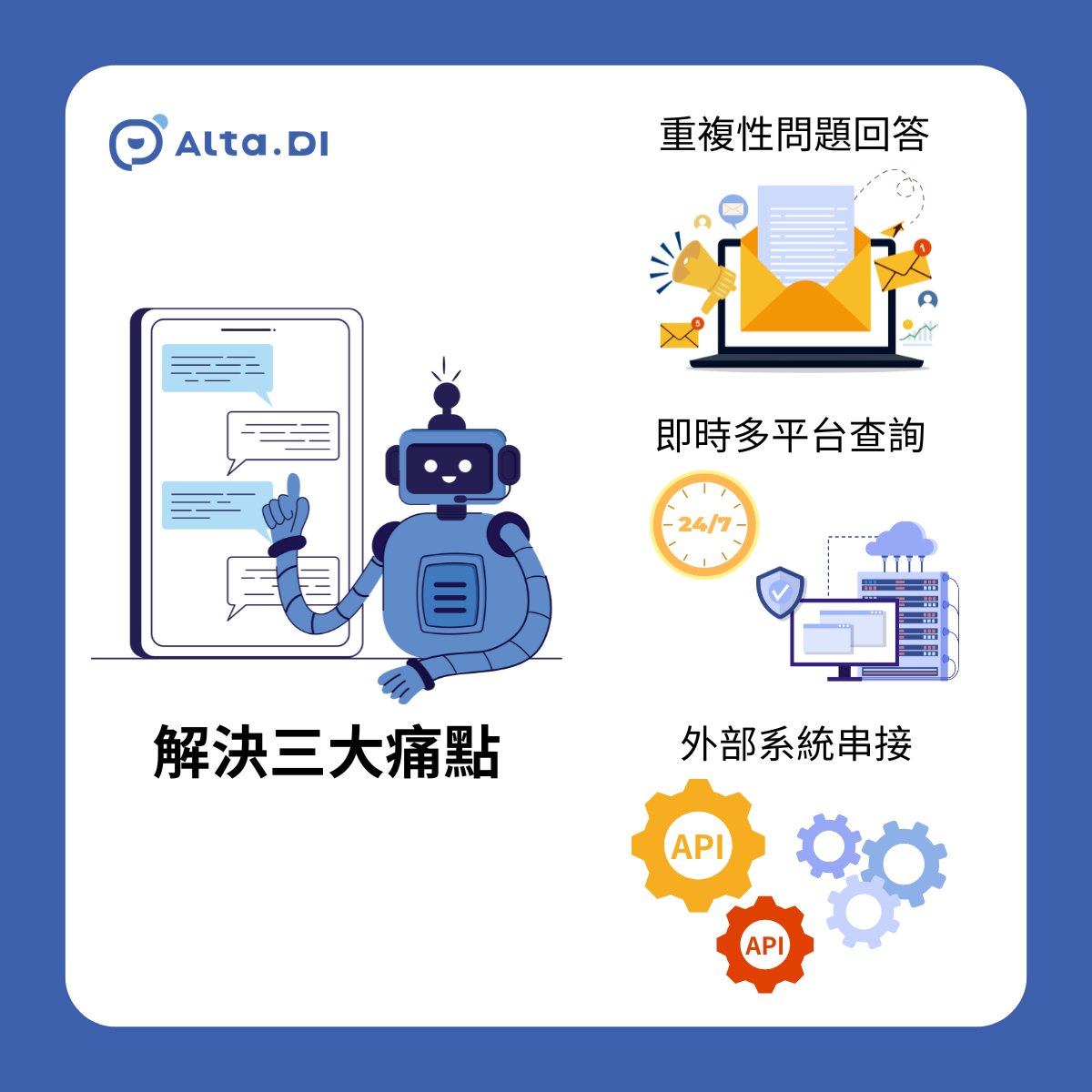
Module 1: AI Agent × human-AI collaboration, freeing administrative capacity
Alta.DI's AI Agent is positioned as backup for the administrative team and does not replace people. The system can independently handle about 80% of routine inquiries, including timetables, tuition and leave rules. Based on actual implementation data, administrative staff gain 4-5 hours a day and can focus on work that needs human judgment. This also echoes Gartner's observation for 2026: organizations ahead of the curve are shifting staff toward higher-value knowledge management and content review, and more than half of customer service leaders are training their teams in this direction [5].
For complex further-education planning or complaints, the AI assesses the conversation context and hands over to a human with a full conversation summary attached, so the advisor can get to the point without asking for the background again. Administrative staff take over "hot questions" that come with context, not cold cases that start from zero. The foundation of this automatic handling is the RAG knowledge base in Module 3 below, which keeps every AI answer grounded. To see how AI Agents are put into daily use in different industries, see our 2026 AI Agent enterprise automation cases.
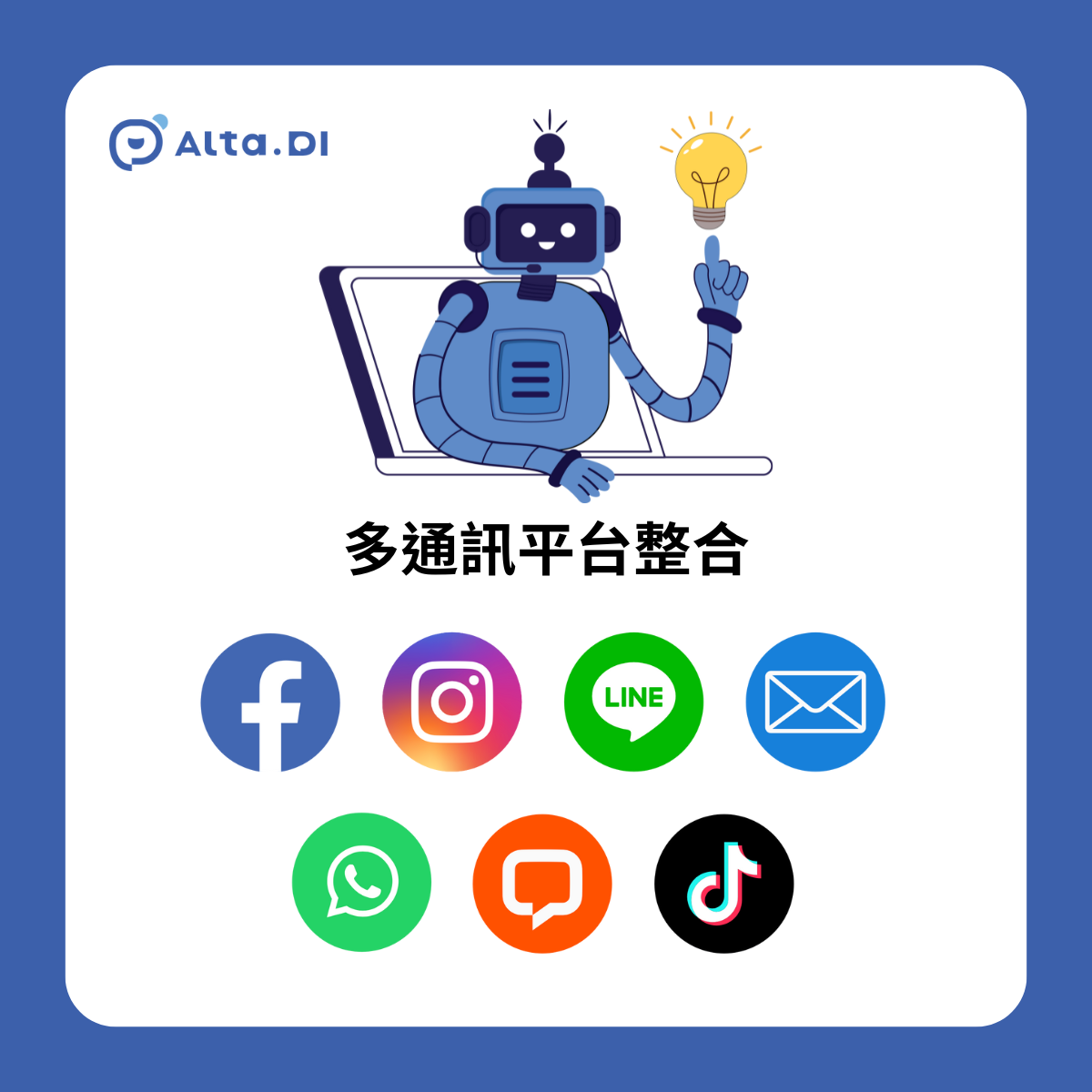
Module 2: omnichannel integration, one back office for all conversations
A student asks on LINE, a parent confirms on Facebook, and finally they enroll on the website. With traditional methods this path means switching between several back offices, which easily loses messages and breaks data. Alta.DI brings LINE, Messenger, Instagram and the website Live Chat into one management interface (WhatsApp is supported from the advanced plan upward), and whichever channel a customer comes from, the system recognizes the same user. A question a parent asked on LINE will not have to be repeated on Messenger.
This is also the biggest difference between Alta.DI and competitors tied to a single channel. Wherever your customers are spread across platforms, the service follows, and the data is kept in one place instead of locked inside a channel. For a follow-up approach, see the 5-step guide to omnichannel integration (OMO).
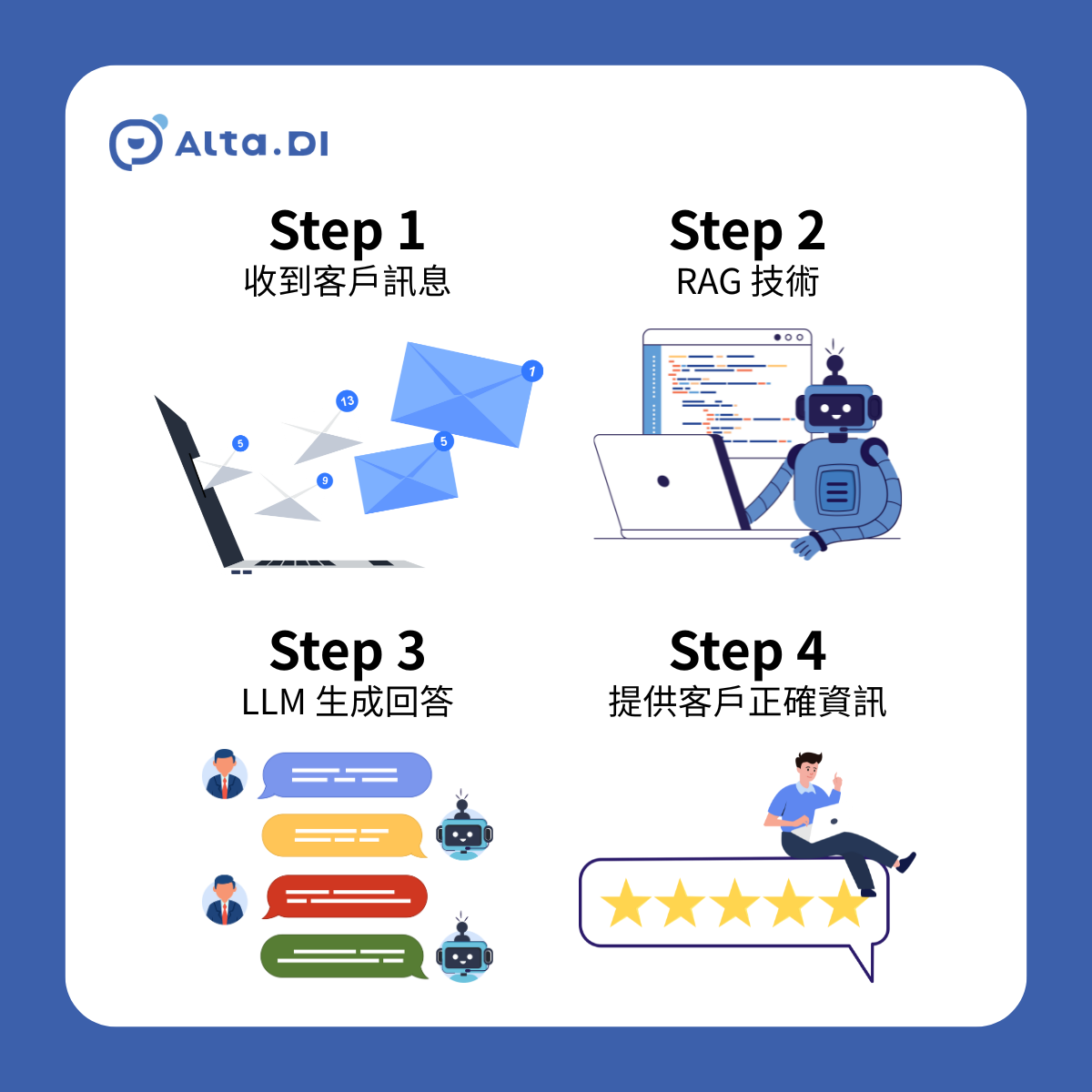
Module 3: RAG knowledge base, keeping the AI from answering course information wrongly
The most serious AI risk in the education industry is giving the wrong course information. A wrong tuition figure or a mixed-up start date can lose the trust of a whole family in one mistake. The cost is backed by data: in Zendesk's 2026 survey, 85% of CX leaders believe customers will leave a brand because their issue was not resolved, even losing them at first contact [6].
Alta.DI's RAG (Retrieval-Augmented Generation) technology makes the AI "retrieve" from the database you uploaded before answering, instead of generating on its own. When the database has no matching information, the system honestly replies "This question needs to be answered by a staff member" and hands over automatically, instead of making something up. Setup is No Code: upload course data in PDF, Excel or CSV format to complete training, and when courses change you re-upload to sync, so maintenance cost is low. To understand how it works, see examples of RAG and knowledge base applications.
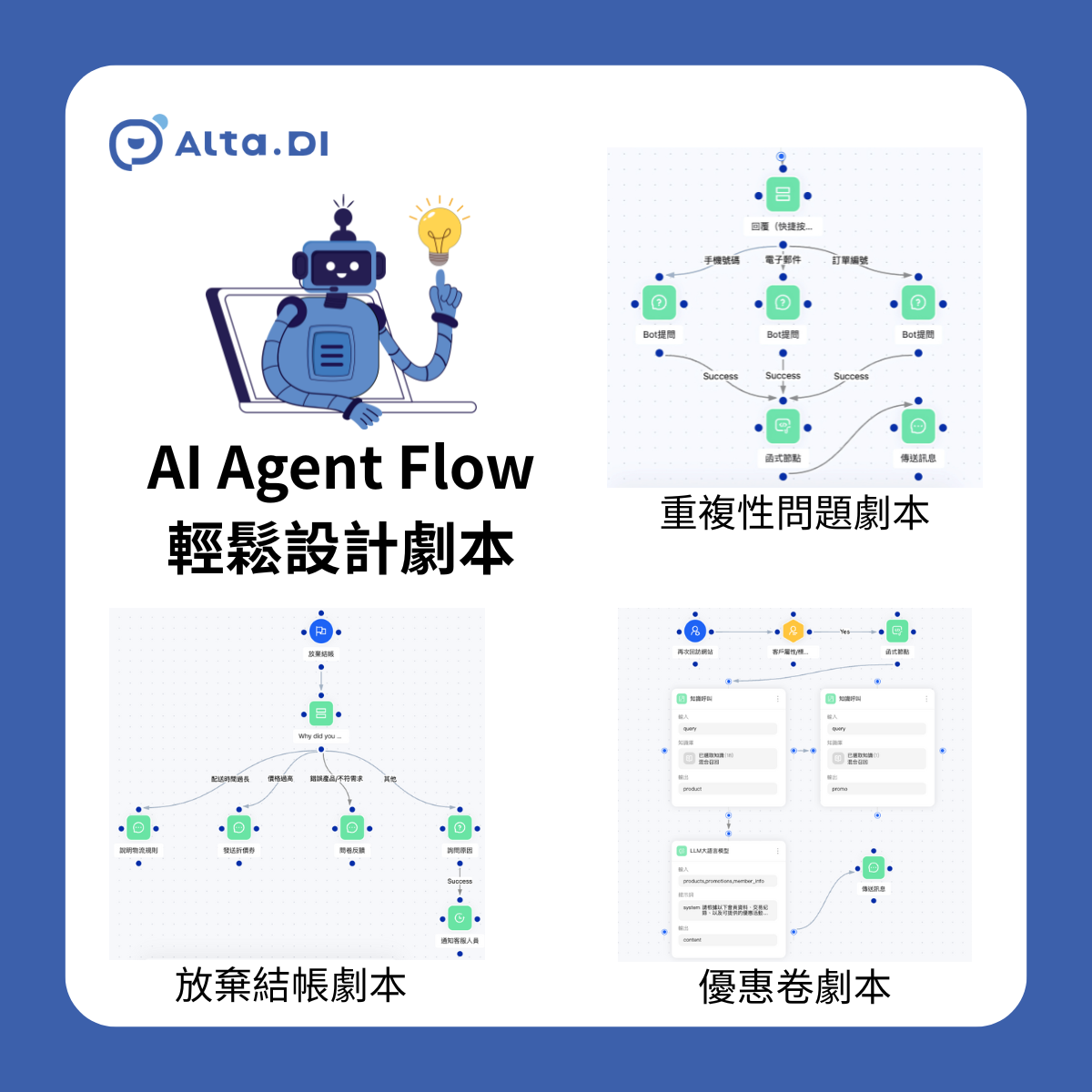
Three real scenarios: from waiting for students to come in to AI actively taking orders
Adopting Alta.DI is more than switching customer service tools. It changes the enrollment logic from "passive waiting" to "actively catching every opportunity." The three scenarios below are the conversion points we see most often when working with education institutions.
Scenario 1: automatic late-night replies that also retain the lead
A student scrolls past an ad at midnight and messages to ask about courses, but nobody replies, and by the next day interest has cooled and the ad budget is wasted. Alta.DI's approach is for the AI to respond right away to initial questions, such as class times and tuition range, and proactively guide: "Want to know more about the course details? Leave your LINE or phone number, and an advisor will contact you first thing tomorrow." Each ad dollar brings back a valid lead instead of a message left on read.
Scenario 2: recommend courses by level, shortening decision time
With many course types (TOEIC, TOEFL, IELTS, business English), it is hard for administrative staff to judge each student's needs in a short time, and they easily recommend the wrong course or reply too slowly, so the student turns to a competitor. Alta.DI uses conversational guidance to analyze the student's level and goals and then gives a plan directly, for example: "At your current TOEIC mock exam score of 500, we suggest the 'TOEIC 700 Sprint Class,' held Tuesday and Thursday evenings, with the next term starting in July." This does the initial screening for the student.
Scenario 3: administrative automation, letting the front desk focus on high-value work
Eighty percent of phone calls are existing students requesting leave or asking about make-up class times, which ties up administrative staff and leaves no capacity to receive new students or follow up on potential customers. With Alta.DI, a student types "I want to request leave" on LINE, and the AI checks against the rules and completes the task. When information is missing, the system asks back for the necessary details, fully automated. Connecting to a tutoring center's existing student management system is a custom integration, which Alta.DI consultants can assess and help connect after reviewing the existing system, so that the human front desk can put its time back into receiving new students, handling complaints and driving class renewals.
What education institutions see after adopting Alta.DI
Below are the results from Alta.DI's actual implementations at education and training institutions:
- Response speed: average response time reduced from 30 minutes to under 5 seconds
- Customer satisfaction (CSAT): up from 75% to 95%
- Repetitive staff hours: about 80% saved, so administrative staff can focus on high-value work
These results line up with the direction Gartner observes: the core value of AI customer service has moved from "reducing cost" to "directly improving customer satisfaction" [1]. Gartner also predicted in early 2026 that, as AI compute costs rise, organizations ahead of the curve will use AI to raise customer lifetime value and course renewals, putting plain cost-cutting in second place [4].
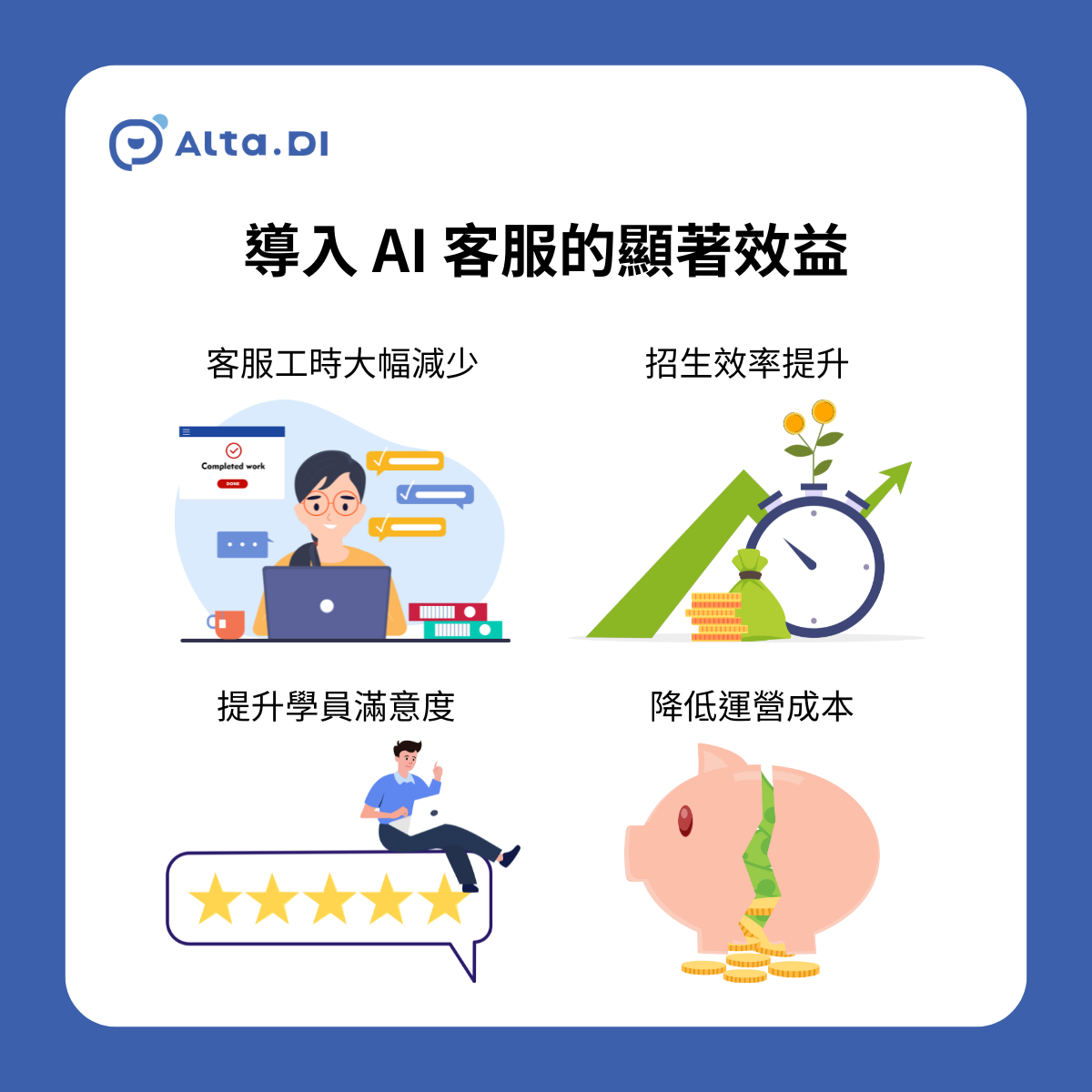
The enrollment battlefield has moved onto the screen
Competition among tutoring centers in 2026 is often decided not in the classroom but in the 30 seconds when a student scrolls on their phone late at night. The 91% in Gartner's February 2026 survey shows that competitors are deploying AI, and every inquiry missed at night is a potential student flowing to them [1].
Alta.DI lets education institutions complete AI customer service deployment on one platform: 24-hour automatic replies, course recommendations by level and administrative process automation. And because it is not tied to a single channel, your enrollment data stays in your own hands instead of being scattered across platforms. The earlier you start, the sooner the benefits of automation accumulate, so do not wait for peak season to go live in a hurry.
To see Alta.DI's full features first, start with a full breakdown of Alta.DI AI features . When you are ready, book a free Alta.DI consultation, and we will plan a 24-hour automated enrollment solution for your institution.
References

[1] Gartner. (2026). Gartner Survey Finds 91% of Customer Service Leaders Under Pressure to Implement AI in 2026. Gartner Newsroom.
https://www.gartner.com/en/newsroom/press-releases/2026-02-18-gartner-survey-finds-ninety-one-percent-of-customer-service-leaders-under-pressure-to-implement-ai-in-2026
[2] Gartner. (2026). Gartner Predicts Over 50% of Customer Service Organizations Will Double Their Technology Spend By 2028. Gartner Newsroom.
https://www.gartner.com/en/newsroom/press-releases/2026-03-31-gartner-predicts-over-50-percent-of-customer-service-organizations-will-double-their-technology-spend-by-2028
[3] Gartner. (2025). Gartner Predicts Agentic AI Will Autonomously Resolve 80% of Common Customer Service Issues Without Human Intervention by 2029.
Gartner Newsroom. https://www.gartner.com/en/newsroom/press-releases/2025-03-05-gartner-predicts-agentic-ai-will-autonomously-resolve-80-percent-of-common-customer-service-issues-without-human-intervention-by-20290
[4] Gartner. (2026). Gartner Predicts GenAI Cost Per Resolution for Customer Service Will Exceed Offshore Human Agent Costs by 2030. Gartner Newsroom.
https://www.gartner.com/en/newsroom/press-releases/2026-01-26-gartner-predicts-genai-cost-per-resolution-for-customer-service-will-exceed-offshore-human-agent-costs-by-2030
[5] Gartner. (2025). Customer Service and Support Leaders Must Prioritize Blending Human Strengths with AI Intelligence in 2026. Gartner Newsroom.
https://www.gartner.com/en/newsroom/press-releases/2025-12-17-customer-service-and-support-leaders-must-prioritize-blending-human-strengths-with-ai-intelligence-in-2026
[6] Zendesk. (2026). Zendesk Customer Experience (CX) Trends Report 2026. Zendesk.
https://cxtrends.zendesk.com/
FAQ
FAQs about this article
About how long does it take a tutoring center to go live with AI customer service?

The basic version of AI customer service can go live in as little as 1-2 weeks, and a full plan that includes assessing connection to existing systems takes about 4-6 weeks. We suggest starting 2 months before the enrollment peak season to leave time for testing and tuning, and not waiting until peak season to adopt in a hurry.
Could AI customer service give students the wrong tuition or the wrong start time?
With RAG (Retrieval-Augmented Generation), every AI answer is based on the database you upload and is not made up on its own. For questions the database does not cover, it tells the student a staff member needs to answer and hands over automatically, and updating the knowledge base regularly keeps it accurate.
Is AI customer service cost-effective for small and mid-sized tutoring centers?
Alta.DI uses modular plans, and the entry plan's monthly fee is under NT$10,000. Compared with the monthly salary of hiring one more administrative staff member, the late-night coverage alone is something people cannot reach, and the return on ad spend is usually noticeable in the first year.
What is RAG? Why do tutoring centers need it in particular?
RAG makes the AI retrieve the correct information from your database before generating a reply, which prevents the AI from inventing courses or quoting the wrong tuition. Course information at tutoring centers must be free of errors, and one mistake can lose the trust of a whole family.
How is Alta.DI different from just using ChatGPT?
ChatGPT is a general-purpose AI that cannot serve students on LINE and does not guarantee correct course information. Alta.DI integrates all channels, is not tied to any channel, and has built-in RAG against hallucination and conversation data analytics.
More articles


訂閱我們的電子報
每月 8 日定期發送最新趨勢與實用資訊!



