

How to choose AI customer service for travel businesses | Alta.DI
Can't keep up with guest messages across LINE, Instagram and booking forms? Alta.DI brings every channel into one back office, with RAG-based answers and live translation in 50 languages, turning inquiries into bookings. Book a free consultation.


In travel, orders are often lost at the first reply. A traveler asks about an itinerary on LINE late at night, or messages a room rate on Instagram, and by the time someone answers the next morning, they have already booked elsewhere.
AI customer service for travel is a system that brings LINE, Instagram and website booking messages into a single back office and replies instantly by using RAG to check the business's own itinerary and room-rate data. It suits travel agencies, hotels and booking operators, and airlines that need to take inquiries around the clock.
According to a joint McKinsey and Skift Research report [1], about 90% of travel executives are already adopting generative AI, but most are still at the experimental stage and have not let AI handle every front-line inquiry. Taiwan tourism continues to recover: the Tourism Administration of the Ministry of Transportation and Communications estimates international visitors will grow 9% in 2026, reaching 9.3 to 9.4 million [3]. Meanwhile, traveler inquiries arrive from LINE, Instagram DMs and website booking forms at the same time. One agent cannot watch three windows, and every missed message is a missed booking.
Alta.DI is a channel-agnostic AI customer service platform: all channels, all data, wherever your customers are. It uses RAG (Retrieval-Augmented Generation) to check the business's own database before replying to travelers, cutting average response time from 30 minutes to under 5 seconds. The same system can also step in the moment a traveler asks about price, carrying a simple Q&A into a quote and a sale.
Why is 2026 the right time for travel businesses to adopt AI customer service?
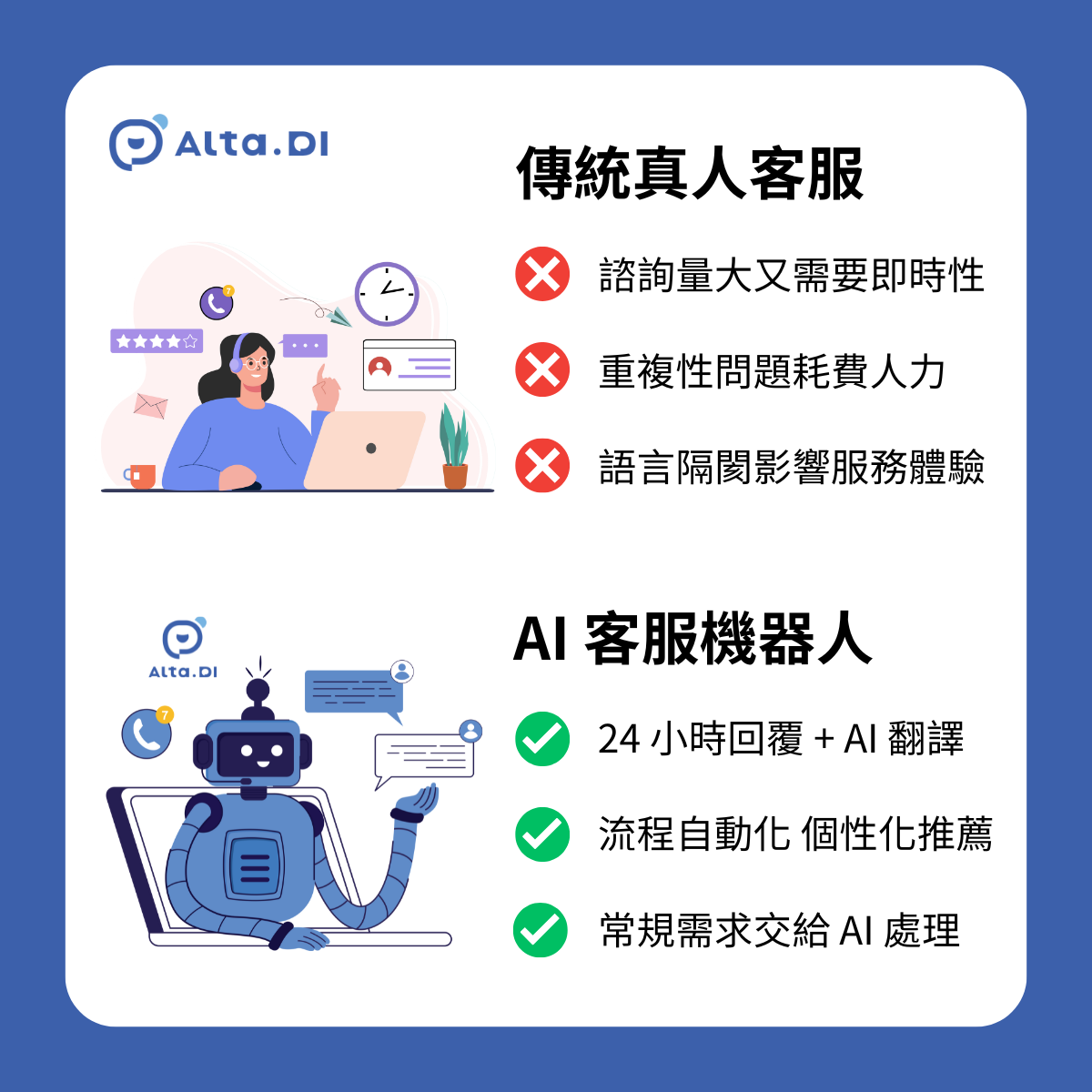
2026 is a turning point for adopting AI customer service in travel, because travelers now treat instant replies at any hour as the baseline, and answering a step late means handing the booking to a competitor.
According to Zendesk's CX Trends 2026 report [2], 74% of consumers see 24/7 service as a basic expectation, and 88% of customers want faster responses than they got a year ago. For a Taiwanese traveler still researching a Japan trip in the middle of the night, "we'll reply when we're back at work tomorrow" pushes the booking to a competitor who is still awake.
The same McKinsey and Skift survey [1] found that nearly 60% of travel executives confirm AI has raised employee productivity, and other operators have seen gains in personalization and decision speed. These benefits concentrate among businesses that put AI on the customer service front line. Running AI only in the back office for analytics is invisible to guests, and the results are limited.
If you still rely on staff shifts for customer service, you pay in labor cost, and time zones and busy lines can make you miss entire batches of international inquiries. To build intelligent customer service step by step, see our Complete Guide to Building an AI Customer Service Knowledge Base.
Will AI customer service quote the wrong room rate? How RAG removes hallucinations
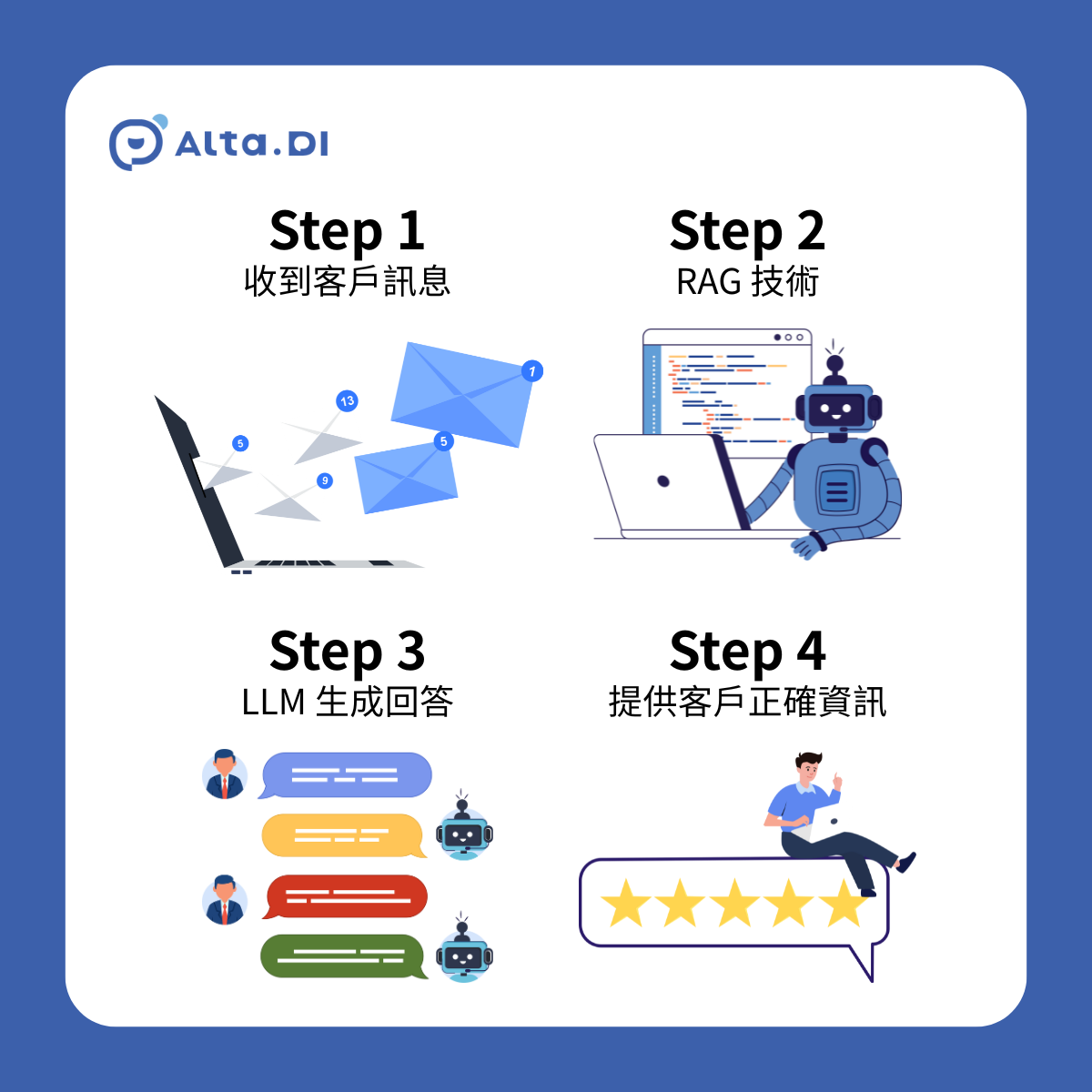
RAG (Retrieval-Augmented Generation) is a technique that has the AI look up the business's own data before it writes an answer. It answers only when it finds something and hands over to a person when it does not, which stops hallucinations such as wrong room rates or nonexistent flights at the source.
Many travel businesses hesitate over AI customer service because they fear it will say something false with a straight face: the wrong visa rule, an outdated ticket change policy, and one complaint or even compensation claim follows. Alta.DI's approach is to let the AI look for answers only in the business's own knowledge base. It works in three steps:
- Build the knowledge base: upload internal PDF, Excel or CSV files (itineraries, price lists, visa rules), and the system organizes them into a searchable semantic index.
- Retrieve first, then answer: when a traveler asks a question, the AI matches it against the knowledge base and pulls the most relevant passages before generating a reply. It speaks only when it has a source.
- Boundary guard: when the knowledge base has no clear answer, the AI replies with the wording the business has set or hands over to a person, and does not make anything up.
This also lets Alta.DI learn the details of the travel industry, such as differences in ticket change and refund rules or visa validity for different routes. These are the easiest things to get wrong, and exactly where general-purpose AI makes the most mistakes. To see how RAG works on the customer service front line, see RAG and Knowledge Base Use Cases.

Can't keep up with LINE, IG and booking messages? One back office for every channel
Omnichannel integration brings LINE, Facebook, Instagram, website chat and booking messages into one back office, so travel agencies, hotels and airlines no longer switch between windows or miss inquiries that cross platforms.
Does your customer service team spend the day switching between the LINE Official Account, Facebook Messenger, Instagram DMs and email? Messages scattered across tools are easy to miss, customer records do not add up, and every conversation feels like meeting the customer for the first time.
Alta.DI is not tied to any channel: all channels, all data. Wherever a traveler asks, the conversation is gathered in the same back office, and when an agent steps in they see the full context without scrolling back to find the last question. Airlines commonly work this way, keeping the app, online chat and social channels in sync so they can respond instantly wherever the customer comes from.
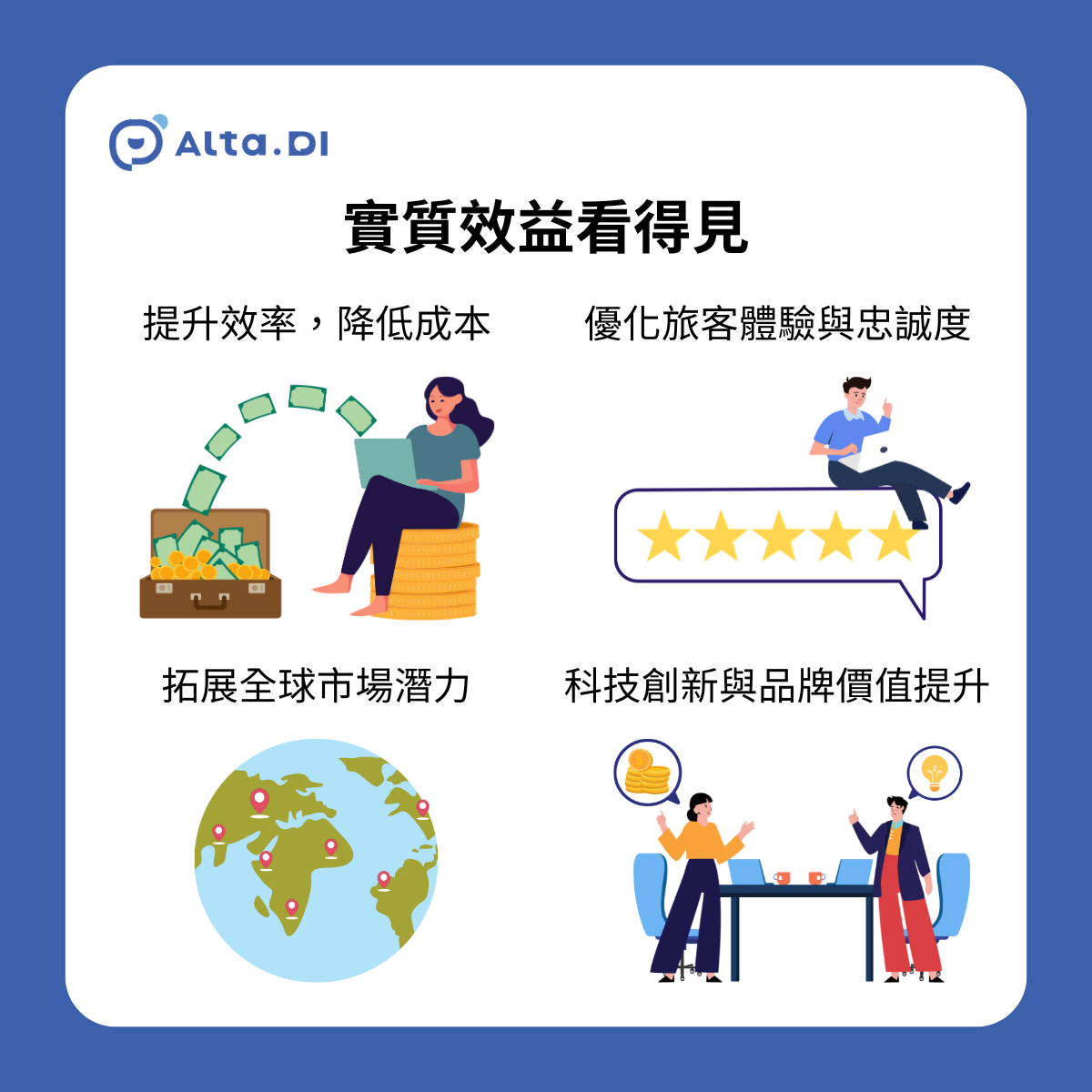
After one travel customer adopted Alta.DI, response time dropped from an average of more than 30 minutes to under 5 seconds, customer satisfaction rose from 75% to 95%, and the AI intercepted and handled 80% of routine inquiries such as order lookups and common questions. Agents no longer answer the same questions all day and can keep their time for high-value interactions that need judgment. For the full omnichannel rollout steps, see the 5-Step Guide to Omnichannel Integration (OMO).

Receiving travelers from japan, Korea, Europe and the US? How live AI translation works
Alta.DI has built-in live two-way translation in more than 50 languages. A traveler asks in their own language, the system converts it to Chinese for the agent, and the agent's Chinese reply is translated back into the traveler's language, so a local team can serve international travelers without multilingual staff.
Since Taiwan reopened its borders, inbound travel has kept recovering, and the Tourism Administration notes that visitors now come from a wider range of countries instead of depending on one, which raises the need to serve more languages [3]. But when travelers from Japan, Korea, Europe or the US arrive, language becomes the gate before a sale. A traveler asks in Japanese, the agent answers in Chinese, and a few rounds later a promising inquiry has worn out.
It works as live two-way translation: a traveler asks in Japanese, the system shows the agent the Chinese version, and when the agent replies in Chinese, the system translates it back to Japanese immediately. To the traveler, it feels like talking to someone who speaks their language. You do not need to pay high salaries for a multilingual team to carry a traveler from an itinerary inquiry to a confirmed booking without a break. To see Alta.DI's full AI customer service capabilities, visit the Alta.DI product page.
From service to sales: how does AI turn inquiries into bookings?
Beyond answering questions, AI customer service can read purchase intent from a traveler's very first inquiry and carry high-intent conversations into a quote and a sale, so inquiries do not end when the question is answered.
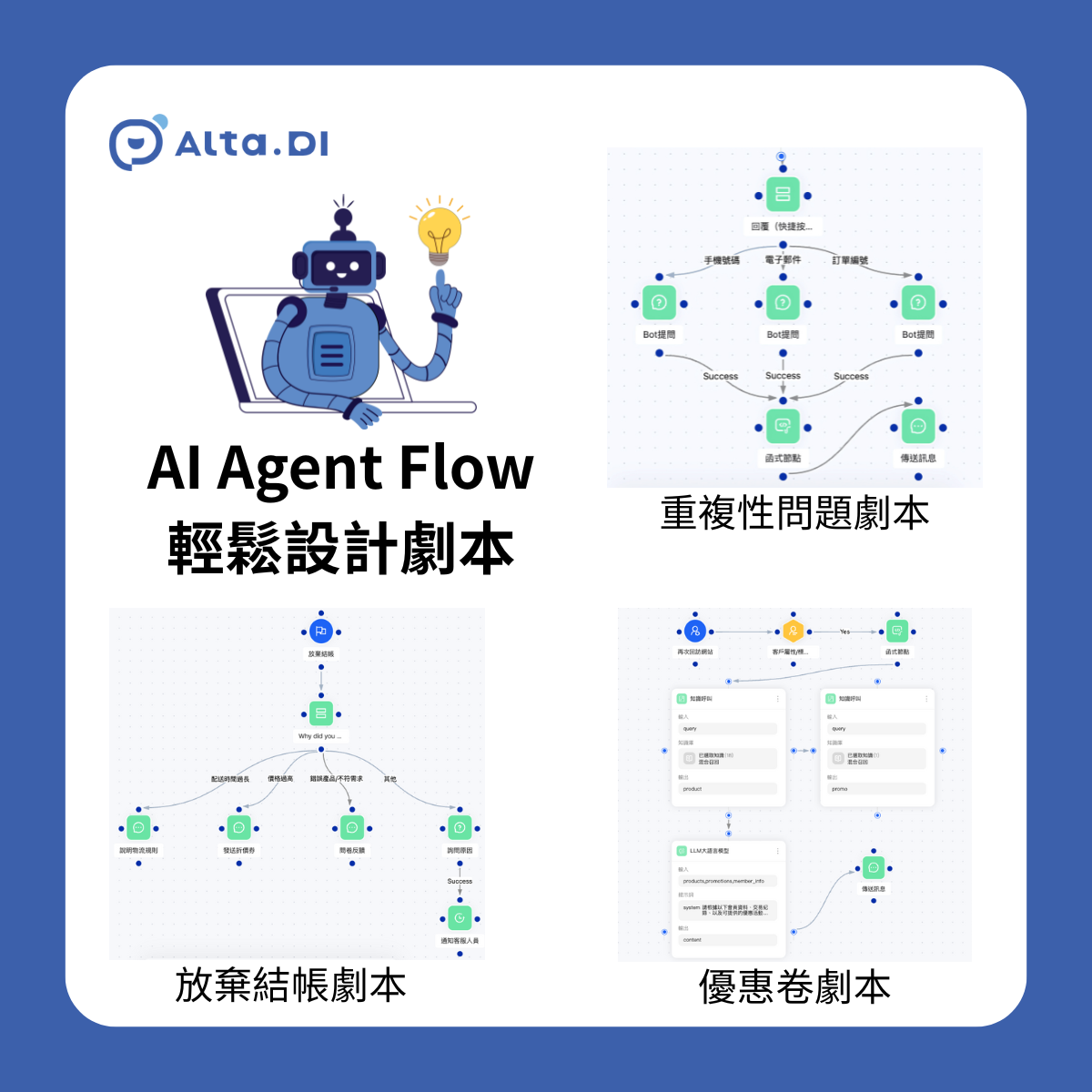
Traditional customer service is passive: one question, one answer. AI customer service that helps close sales reads the buying signal the moment a traveler speaks and guides the conversation to the next step. For the travel journey from price inquiry to booking, Alta.DI uses three stages of human-AI collaboration:
- AI recommendation (attract): when a traveler asks about "skiing in Japan" or "family-friendly itineraries", the AI Agent pulls from the product database to suggest itineraries with images, highlights and an approximate budget, and takes up the interest first.
- Intent recognition and handoff (retain): when a traveler asks "how much is this?" or "I'd like a quote", the system reads the high purchase intent and prepares to hand over to a sales agent.
- Human quote (close): the AI passes the conversation to a sales agent with a summary. Which itineraries the traveler viewed and what they care about are clear at a glance, so the agent does not have to ask from scratch and can quote directly on the plan the traveler is interested in.
According to the same McKinsey and Skift report [1], more than 90% of travelers trust the itinerary information AI provides, but only 2% are willing to let AI complete a booking fully automatically. This suggests AI suits the broad recommendations at the front, while a person should take over for the final step. AI covers breadth, people cover closing, and the sales team frees time from repetitive inquiries to accompany travelers who are ready to book through the last mile.
Summary: start with the channel where you miss the most messages
In 2026, travel businesses compete on experience and efficiency, and travelers, bookings and competitors will not wait. Alta.DI puts omnichannel integration, precise RAG-based answers, live translation and human-AI order handling into one system. Start by connecting the channel where you miss the most messages, and you can see the effect of automation before peak season.
To find out which AI customer service setup fits your travel business, book a free consultation, and Alta.DI will help you review your customer service plan before peak season.

References

[1] McKinsey & Company and Skift Research. (2025). Remapping Travel with Agentic AI. McKinsey.com.
https://www.mckinsey.com/industries/travel/our-insights/remapping-travel-with-agentic-ai
[2] Zendesk. (2025). CX Trends 2026: Contextual Intelligence Becomes the New Standard. Zendesk.com.
https://cxtrends.zendesk.com/
[3] Tourism Administration, Ministry of Transportation and Communications (statement by Director-General Chen Yu-hsiu at the Ministry's Lunar New Year press conference). (2026). International visitors expected to grow 9% in 2026, reaching 9.3 to 9.4 million (in Chinese). Commercial Times.
https://www.ctee.com.tw/news/20260210700982-430104
FAQ
FAQs about this article
Which kind of AI customer service suits hotels and booking operators?

Hotels and booking operators suit an omnichannel AI customer service that integrates LINE, Instagram and website booking messages. Alta.DI uses RAG to check room types, rates and booking rules before answering, and hands over to a person when there is no source, so wrong prices are avoided. It can go live in as little as a few working days.
How can an airline or travel agency cover app, online chat and social channels at once?
Omnichannel integration brings messages from the app, online chat, Facebook, Instagram and LINE into one back office. Wherever the traveler comes from, you reply on the same screen, with no missed messages, no window switching and the full conversation context preserved.
Can RAG really stop AI from answering incorrectly?
Yes. RAG forces the AI to answer only from the knowledge base the business uploaded. When it finds no source, it replies with the configured wording or hands over to a person. This prevents hallucinations such as wrong room rates or nonexistent flights, and is much safer than a general-purpose AI guessing at answers.
Can Alta.DI serve international travelers in Japanese or other languages?
Yes. Alta.DI has built-in live two-way translation in more than 50 languages. When a traveler asks in Japanese or Korean, the message is converted to Chinese for the agent to read, and the agent's reply is translated back into the traveler's language, so a local team can serve international travelers without multilingual staff.
How long does it take to go live with Alta.DI?
Once the knowledge base is built, basic deployment can be completed in as little as a few working days. For omnichannel integration or a customized sales flow, we suggest reserving 2 to 4 weeks for testing and adjustment so that response quality meets peak-season needs.
More articles


訂閱我們的電子報
每月 8 日定期發送最新趨勢與實用資訊!



