

Choosing AI customer service for aesthetic clinics | Alta.DI
For aesthetic clinics, the first question about AI customer service is not how fast it replies but whether it will cross medical advertising rules. A selection traffic light covers 4 compliance questions to ask vendors, plus a 90-day case. Book a free consultation.


The first question an aesthetic medicine clinic should ask when choosing AI customer service is not "how fast does it reply?" but "will it make a treatment-efficacy promise on its own and cross a red line in medical advertising law?" Most discussion of AI customer service for aesthetic clinics focuses on driving sales, raising repurchase, and 24-hour guided selling. But for a clinic governed by medical advertising rules, the cost of choosing the wrong framework is not a lower conversion rate. It is legal risk.
In 2026, with AI customer service already standard, the question is no longer "whether to adopt." Salesforce's 7th edition State of Service report (a survey of 6,500 service professionals) indicates that AI is expected to handle 50% of customer service cases in 2027, up sharply from 30% in 2025, and that 79% of service leaders see investing in AI customer service as necessary to stay competitive [1]. For an aesthetic clinic, the real decision has moved earlier: how to pick the right one.
At a chain aesthetic medicine group advised by Alta.DI, after adopting compliance-designed AI customer service, the night-time reply rate rose from 0% to 100% and the inquiry-to-appointment rate rose by 28%. But the precondition for that result was locking down the point that "the AI does not say things it shouldn't." This article uses a "selection traffic light" to walk through the 4 key questions an aesthetic clinic should ask vendors, and uses this 90-day real-world case to show how compliance and results can go together.

Why should an aesthetic clinic look at "compliance" before "speed" when choosing AI customer service?
Key point: Medical advertising law covers more than ads. An AI that says the wrong thing counts too.
The first threshold for an aesthetic clinic choosing AI customer service is compliance. Medical advertising law clearly limits what a medical institution may say, and an AI without a control mechanism can easily generate treatment-efficacy promises in conversation and cross the line. This is entirely different from the usual e-commerce logic of treating conversation as an entry point for guided selling.
Under Article 84 of the Medical Care Act, only medical institutions may publish or broadcast medical advertising. Article 85 limits what may be advertised to a positive list (institution name, address, physician names and qualifications, clinical departments and hours, and so on). Article 86 prohibits improper promotion such as exaggerating treatment effects. Article 87 further states that content that "implies or alludes to" medical services and is enough to attract patients counts as medical advertising even if it is not stated outright [2]. In other words, if an AI customer service agent replies "this treatment is guaranteed to work" or "you'll look ten years younger right after," the law treats it no differently from writing that sentence on your signboard, and violators can be fined NT$50,000 to NT$250,000 [2].
The Ministry of Health and Welfare further lists terms such as "complete cure," "once and for all," "never recurs," and "rejuvenation," along with promotional tactics such as limited-time offers, buy-one-get-one, and free treatments, as improper promotion. The latter may also violate Article 61 of the Medical Care Act on improper solicitation [2]. This is exactly what makes treating AI customer service as a "marketing tool" most dangerous. General marketing pursues lines that drive conversion, such as "consult now," "limited-time offer," and "fix dullness with this." The same line in an aesthetic clinic's conversation can cross both the exaggerated-efficacy line and the improper-solicitation line at once. The essence of medical marketing is long-term patient relationships, not short-term closing. Choosing AI customer service with an e-commerce guided-selling framework hands legal risk to a bot that improvises.
A traffic light for choosing aesthetic clinic AI customer service: 4 questions to ask vendors
Key point: Choose by "can compliance be held" instead of "how many features"
When an aesthetic clinic chooses AI customer service, rather than comparing the number of features, it is better to screen vendors with 4 compliance- and service-oriented questions: can the AI be locked to controlled data only, do sensitive situations automatically go to a human, is the LINE integration deep enough, and is the setup partner a data consultant or a configuration technician. The more clearly a vendor answers these 4 questions, the better it understands aesthetic medicine.

Controlled knowledge boundary: can the AI say only what you give it?
Key point: If the knowledge base doesn't have it, the AI should not guess
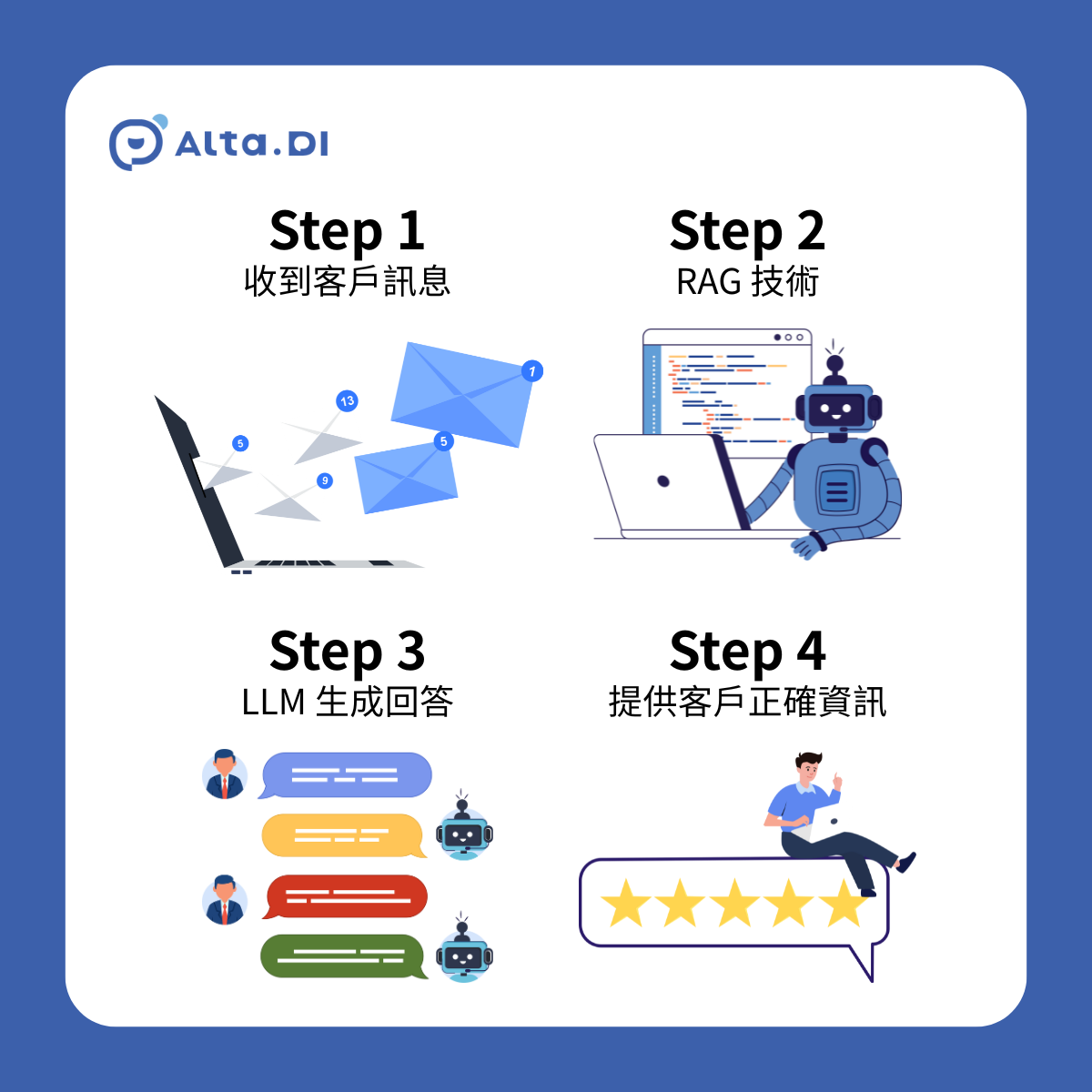
A controlled knowledge boundary means every answer the AI gives is strictly based on controlled data the clinic has uploaded, and it does not generate content the knowledge base lacks. This is the basic mechanism, using RAG (retrieval-augmented generation), that stops AI hallucination and avoids treatment-efficacy promises.
In practice, the clinic uploads its standard operating procedures, post-treatment care leaflets, treatment package inserts, and price lists to the knowledge base. When a customer asks "How long after Phoenix radiofrequency treatment can I wear makeup?", the AI retrieves the care documents you uploaded and gives a standard, consistent answer instead of inventing medical advice. The treatment names and efficacy mentioned in medical advertising should in any case be limited to the scope of the approved Chinese-language package insert of the product [2]. To understand how this mechanism works in practice, see our RAG and Knowledge Base Applications and Guide to Building an AI Customer Service Knowledge Base.
Human handoff in sensitive situations: are medical judgments handed to a person automatically?
Key point: For allergies, inflammation, or poor results, the AI should not reply by itself
Human handoff in sensitive situations means the system can recognize keywords that call for medical judgment (such as allergy, inflammation, abnormal post-treatment reactions, or results below expectations) and hand the conversation to a human agent smoothly, with the full conversation record attached so the customer doesn't have to repeat themselves.
This design has three key parts. First, smart handoff: when the system recognizes sensitive words or judges that a situation is beyond the AI's scope, it transfers to a human automatically. Second, full context handover: when a human takes over, they can see the entire conversation between the AI and the customer, so service is not interrupted. Third, compliant division of work: the AI handles information delivery and humans handle medical judgment. With this boundary clearly drawn, the clinic also has a clear design rationale to explain when regulators conduct inspections.
Depth of local LINE integration: are you covering the main battlefield of Taiwan's aesthetic medicine?
Key point: Aesthetic clinic customers are on LINE, and integration can't just mean it connects
Depth of local LINE integration means more than "it connects." It means whether the AI can take action directly on LINE: booking appointments, checking remaining treatment sessions, and reporting member information, rather than just replying passively.
Inquiries from Taiwan's aesthetic clinic customers are heavily concentrated on LINE, followed by Instagram and the website. An ideal platform lets you manage all messages from LINE, Messenger, Instagram, and the website in one back end, and through integration lets the AI guide customers to complete appointments and look up treatment sessions in the CRM. There are two sides to the selection point here: one is that the LINE integration should be deep (it is the main battlefield of aesthetic medicine in Taiwan), and the other is not being locked into a single channel, so service can happen in whichever channel your customers are in. Alta.DI's LINE integration is tuned especially for Taiwan usage while keeping all channels on equal footing. For more, see the Alta.DI product overview.

Setup partnership: do you get a data consultant or someone who just configures and launches?
Key point: Aesthetic clinics need a strategic partner, not someone who sets up the system and leaves
The difference in setup partnership is this: some vendors send implementation staff who build the knowledge base, configure the system, and go live, while others send data consultants who start from your data and operating strategy and work alongside you on how to use it. For aesthetic medicine, which is both heavily regulated and highly competitive, only the latter can handle the dual need for compliance and results.
This is also the biggest difference between Alta.DI and most tool-based vendors. Data-DI's foundation is data consulting and strategy consulting, not just system delivery. More importantly, Alta.DI started in 2019 by serving securities firms and has built compliance know-how in highly regulated industries such as financial securities. Aesthetic medicine and financial securities are both high-compliance verticals where "one wrong sentence creates legal risk," so this experience carries over directly. Why this kind of system needs consultants rather than tools alone is fully explained in Why AI Customer Service Adoption Needs Consultant Support .
A chain aesthetic medicine Group's first 90 days: how do compliance and results go together?
Key point: Lock down compliance first, and efficiency is real efficiency
After adopting compliance-designed AI customer service, a chain aesthetic medicine group cut first reply time from 30 minutes to 5 seconds within 90 days, raised the night-time reply rate from 0% to 100%, and raised the inquiry-to-appointment rate by 28%, with about 80% of routine Q&A handled by AI. These numbers hold only because the AI answers within controlled boundaries.

From our advising experience, this change does not happen in one step. At day 30, the reduction in first reply time is most obvious. At day 60, the inquiry-to-appointment rate begins to show a measurable increase. At day 90, the overall customer service labor cost structure shows clear improvement. This timeline matters: it shows that AI customer service is not a tool that works the moment you plug it in, but a system investment that needs upfront knowledge base building and process adjustment.
It is worth stressing that efficiency gains are not the end goal. By handing about 80% of routine Q&A to AI, consultants' hours can be reallocated to VIP customer care and explaining complex treatments. The Salesforce 7th edition report points the same way: companies that adopt AI customer service expect, on average, about a 20% drop in service costs and case handling time, and most service staff also report better career development and new skills [1]. Freeing people from repetitive answering and putting them where they create real differentiation is the core of results beyond compliance.
How much does AI customer service cost for an aesthetic clinic? How do you estimate ROI?
Key point: The monthly fee is not the point. The payback logic is.
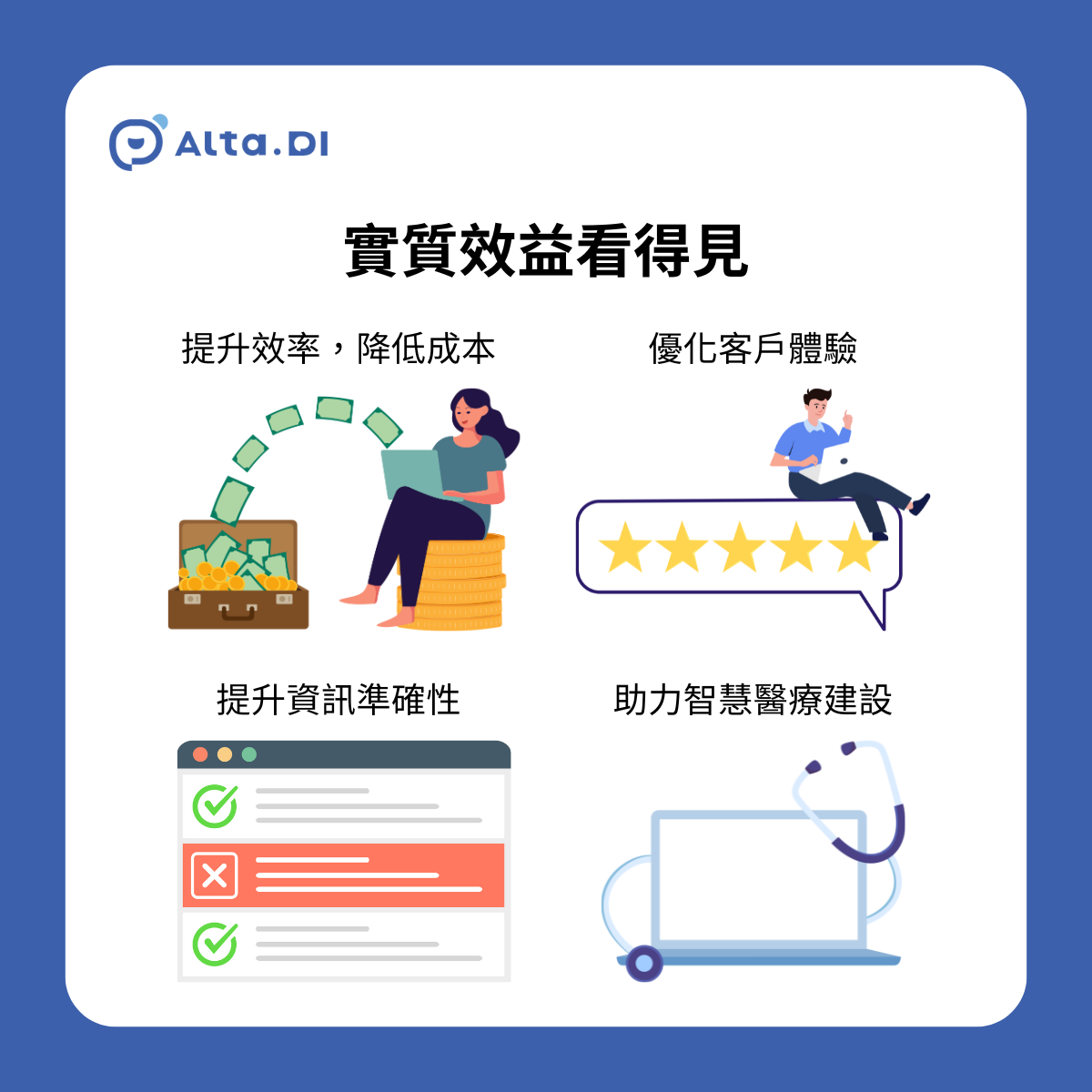
The Alta.DI Growth Plan costs NT$9,980 per month (annual contract) and suits aesthetic clinics with more than 100 inquiries a week, or clear message traffic after working hours. On this cost basis, most clinics can recover their adoption cost within 3 to 6 months.
The fee is only the starting point. The real question is what this money buys back, which can be broken down along two dimensions. On the cost side, after adoption about 80% of routine Q&A is handled by AI, and customer service staff shift their focus from "answering machine" to VIP care and explaining complex treatments. For a clinic with 2 full-time customer service staff at NT$40,000 monthly salary each, annual labor cost is about NT$960,000. If its size allows reducing routine customer service staffing by 1 person, the annual saving is about NT$480,000, against an annual contract fee of NT$119,760 (9,980 × 12), a considerable return. On the revenue side, a night-time reply rate going from 0% to 100% means the high-intent inquiries that used to be lost entirely now have a chance to enter the appointment funnel. Combined with the 28% rise in inquiry-to-appointment rate, if a clinic receives 400 inquiries a month with an average ticket of NT$8,000, a conservative estimate is 10 to 15 more closed sales per month.
The above is an illustrative calculation, not cited data. Actual benefits vary with clinic size, average treatment ticket, and how complete the setup is. For a more precise estimate for your clinic, we suggest discussing your actual inquiry volume and average ticket directly with a consultant.

4 preparations before going live: get compliance and experience right the first time
Key point: The foundation for compliance and experience has to be laid before launch
The key to a successful AI customer service adoption at an aesthetic clinic is not choosing the most expensive system but laying four foundations in the right order: a compliant knowledge base, a persona with compliant wording, handoff logic for sensitive situations, and a single-channel test. Missing any one of them leads to AI giving wrong answers or a broken customer experience after launch.
- Build a compliant knowledge base: Organize common Q&A, post-treatment care leaflets, treatment package inserts, and price ranges, and upload them together. The completeness of the knowledge base directly decides the accuracy of the AI's replies and whether it strays into statements outside the package insert.
- Set a persona and compliant "cannot answer" wording: Make sure the tone fits the clinic's image, and set the standard response and handoff wording for when efficacy or medical-judgment questions come up.
- Define the human handoff list: Put complaints, inquiries about medical complications, and abnormal treatment feedback on the must-transfer trigger list. The finer the logic, the more controllable the regulatory risk.
- Test on a single channel before expanding: Start by testing on one channel (for example the website or LINE), gather feedback, and then extend to other channels, so you don't launch every channel at once and then fail to handle unexpected situations in real time.

Conclusion: in the era when AI customer service is standard, aesthetic clinics compete on "choosing the right framework"
Key point: Don't choose aesthetic clinic customer service with an e-commerce guided-selling framework
In 2026, with AI customer service already standard, the gap between aesthetic clinics is not whether they adopted it but whether they chose the right framework: treating conversation as "professional consultation that cannot go wrong," not as "a guided-selling entry point to push sales." When Salesforce estimates that AI will handle half of customer service cases in 2027 [1], adopting late means falling behind, but choosing the wrong framework could mean stepping on a mine. Your consultants shouldn't spend their time repeating treatment prices, and your prospective customers shouldn't turn to a competitor because no one answers late at night. But all of that depends first on confirming that the AI will not say what it shouldn't say for you.
Every aesthetic clinic has different compliance and customer service sticking points: some are stuck on how to build the knowledge base without crossing the line, some on handoff logic for sensitive situations, some on the depth of LINE integration. If you want to work out which step your clinic should start with, Alta.DI offers a free consultation (30 minutes) in which a consultant reviews your current customer service process, compliance risk points, and quick wins that can be improved. You don't need to prepare data first. Just tell us your current situation and the tools you use. To get started, book a free Alta.DI consultation.
References

[1] Salesforce. (2025). State of Service Report, 7th Edition. Salesforce.
https://www.salesforce.com/blog/state-of-service/
[2] Department of Medical Affairs, Ministry of Health and Welfare. Medical Advertising Management Page (Medical Care Act, Articles 84 to 87). Ministry of Health and Welfare. (in Chinese)
https://dep.mohw.gov.tw/DOMA/cp-2708-38120-106.html
FAQ
FAQs about this article
How do you choose AI customer service for an aesthetic clinic without violating medical advertising law?

The key is to choose a platform that can lock the knowledge boundary: the AI answers only from the controlled data you upload, does not guess when the knowledge base has no answer, and hands sensitive situations to a human automatically. Under Article 86 of the Medical Care Act, exaggerating treatment effects is a violation, and a controlled design lowers the risk of crossing the line at the source.
Could AI customer service make a treatment-efficacy promise on its own and get the clinic fined?
It could if there is no control mechanism. An AI using RAG answers only from controlled data and does not guess when the knowledge base has nothing. Combined with automatic handoff to humans on sensitive words, so that professionals handle medical judgment, the risk of violating medical advertising law drops substantially.
Roughly how much does AI customer service cost for an aesthetic clinic, and how long until it pays back?
The Alta.DI Growth Plan costs about NT$9,980 per month (annual contract) and suits clinics with 100 or more inquiries a week or traffic at night. Most clinics can recover the cost within 3 to 6 months through reallocated staff time and additional appointment volume.
Does AI customer service for an aesthetic clinic have to integrate with LINE?
We recommend it. LINE is the core channel for communication between Taiwan's aesthetic clinics and their customers, but integration depth matters more than whether it exists: being able to book appointments and check remaining treatment sessions directly in LINE is where the experience differs. Ideally the back end also manages the website and social channels together.
Is it also suitable for a small single-location clinic?
Yes. There are two thresholds: whether weekly message volume exceeds 100, and whether there is clear traffic after working hours. If either is met, the return can usually be recovered within 3 to 6 months. We suggest testing on a single channel first and expanding after confirming the results.
More articles


訂閱我們的電子報
每月 8 日定期發送最新趨勢與實用資訊!



